Imposter Syndrome After Buying a Dental Practice

Co-Founder, Minty Dental
In Summary
- Imposter syndrome — the persistent feeling of being a fraud despite objective evidence of competence — is especially common among high-achieving healthcare professionals, including dentists
- A 2025 narrative review published in Cureus found imposter syndrome is widespread in dentistry, driven by perfectionism culture, high-stakes clinical decisions, and limited business training
- Dental school delivers thousands of hours of clinical training but almost no formal preparation for managing staff, reading a P&L, or making hiring decisions — the gap is structural, not personal
- New owners typically experience two identity shifts at once: from employee to employer, and from clinician to business owner — each carries its own psychological weight
- The feeling tends to peak in the first 30–90 days and, left unaddressed, can quietly damage staff relationships, leadership presence, and financial outcomes
Feeling Like a Fraud After Closing Is Almost Universal — and Almost Never Talked About
Imposter syndrome is the persistent internal experience of feeling like a fraud — a nagging sense that your success isn't fully deserved, that you're not as capable as others believe, and that it's only a matter of time before someone figures that out. It doesn't discriminate by skill level. In fact, research consistently shows it hits hardest among high achievers who hold themselves to exacting standards.
For new dental practice owners, that description fits almost perfectly.
The closing documents are signed. The keys are yours. And somewhere between the congratulations and the first Monday morning as the person everyone looks to for answers, a quiet voice shows up: What have I done? Do I actually know how to run this?
That voice is more common than the profession tends to admit. According to a 2025 narrative review published in Cureus, imposter syndrome is widespread in dentistry — driven by a combination of perfectionism culture, high-stakes clinical decisions, and a training environment that prepares dentists to treat patients but rarely prepares them to lead organizations. The ADA has also recognized imposter syndrome as a significant challenge for new dentists, with wellness experts noting that self-doubt can persist well into established careers.
The structural reason this hits so hard at ownership is worth naming directly. Dental school delivers thousands of hours of clinical training — and almost none on managing a team, interpreting a profit-and-loss statement, or navigating a difficult conversation with a long-tenured employee. That gap isn't a reflection of your preparation or your judgment. It's a design feature of dental education, not a personal failing. Thinking through whether you're clinically ready for ownership is a reasonable exercise — but clinical readiness and business readiness are two entirely different questions, and most new owners are only ever tested on the first one before closing.
What makes the ownership transition particularly disorienting is that two identity shifts happen simultaneously. The first is moving from employee to employer — suddenly, the people who showed up to work today are depending on you for their livelihoods. The second is moving from clinician to business owner — your performance is now measured not just by patient outcomes, but by collections, overhead ratios, and whether payroll clears on Friday.
Most new owners feel the weight of both at once, and the gap between what I know how to do and what I'm now responsible for tends to be widest in the first 30 to 90 days. That's not a warning sign. That's the transition working exactly as it does for almost everyone who's made it.
Why 'Suddenly Being the Boss' Feels So Disorienting — Even When You Were Ready
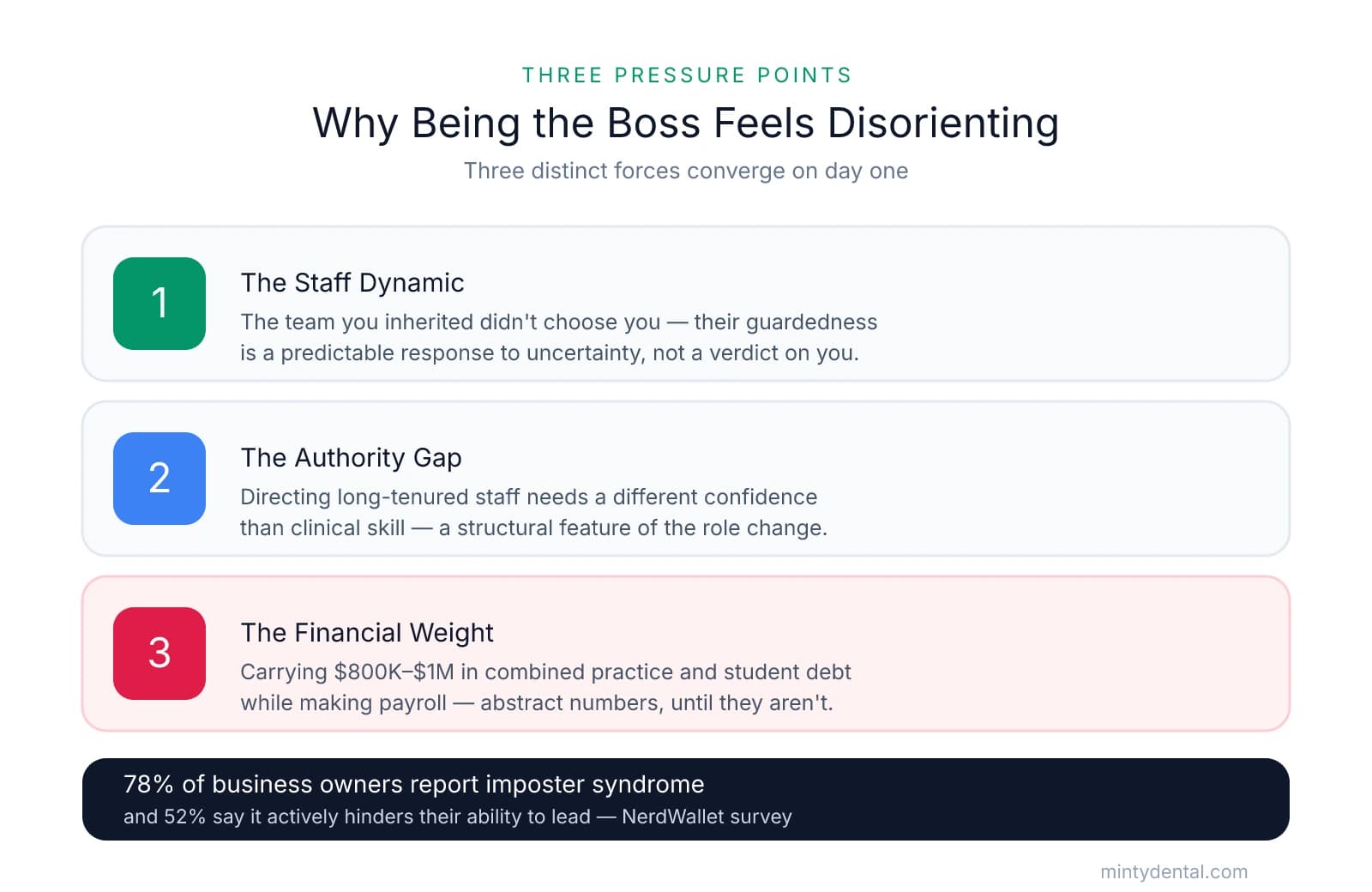
That disorientation isn't random. It comes from three distinct pressure points that converge on day one — and understanding each one separately makes them easier to navigate.
The staff dynamic
The team you inherited didn't choose you. They chose to work for the previous owner — someone they knew, trusted, and had built routines around. When a practice sells, staff often carry their own anxieties about what changes, what stays, and whether their jobs are safe. Their initial guardedness isn't a verdict on you. It's a predictable response to uncertainty.
What this looks like when navigated well: new owners who acknowledge the transition openly — who say, in effect, I know this is an adjustment for everyone — tend to build trust faster than those who arrive with a change agenda. Staff skepticism usually softens within the first few months when they see consistency and feel heard. If you're already fielding pressure around benefits or compensation expectations, the dynamics behind that are worth understanding before responding — the staff expectations that often surface after a sale follow a recognizable pattern.
The authority gap
Giving direction to a 20-year office manager, or a hygienist who's been at the practice since before you graduated dental school, requires a different kind of confidence than clinical skill. This is where many new owners quietly struggle — not because they lack judgment, but because the situation itself is genuinely awkward.
Research from the Center for Creative Leadership identifies the shift from individual contributor to manager as one of the most difficult transitions in a professional career — and dental ownership compresses that entire transition into a single day. The discomfort of authority isn't immaturity. It's a structural feature of the role change.
A behavioral pattern worth watching for here is over-accommodation: avoiding hard conversations, deferring to staff on decisions that are yours to make, or optimizing for being liked rather than trusted. That instinct is understandable, but it tends to erode authority over time rather than build it.
The financial weight
Nothing in clinical training prepares you for the psychological reality of carrying $800K–$1M or more in combined practice and student loan debt while also making payroll. The numbers are abstract until they aren't — and for many new owners, the anxiety that comes with that responsibility runs quietly underneath everything else. If that financial weight is affecting how you're showing up as a leader, it's worth naming directly rather than letting it operate in the background; how new owners cope with practice debt anxiety is a conversation more owners are having than it might seem.
According to a NerdWallet survey, 78% of business owners reported experiencing imposter syndrome, and 52% said it was actively hindering their ability to lead. The feeling is common — but its downstream effects on decision-making are real, which is why recognizing these three pressure points for what they are matters.
A Framework for Moving Through It: What New Owners Actually Do in the First 90 Days
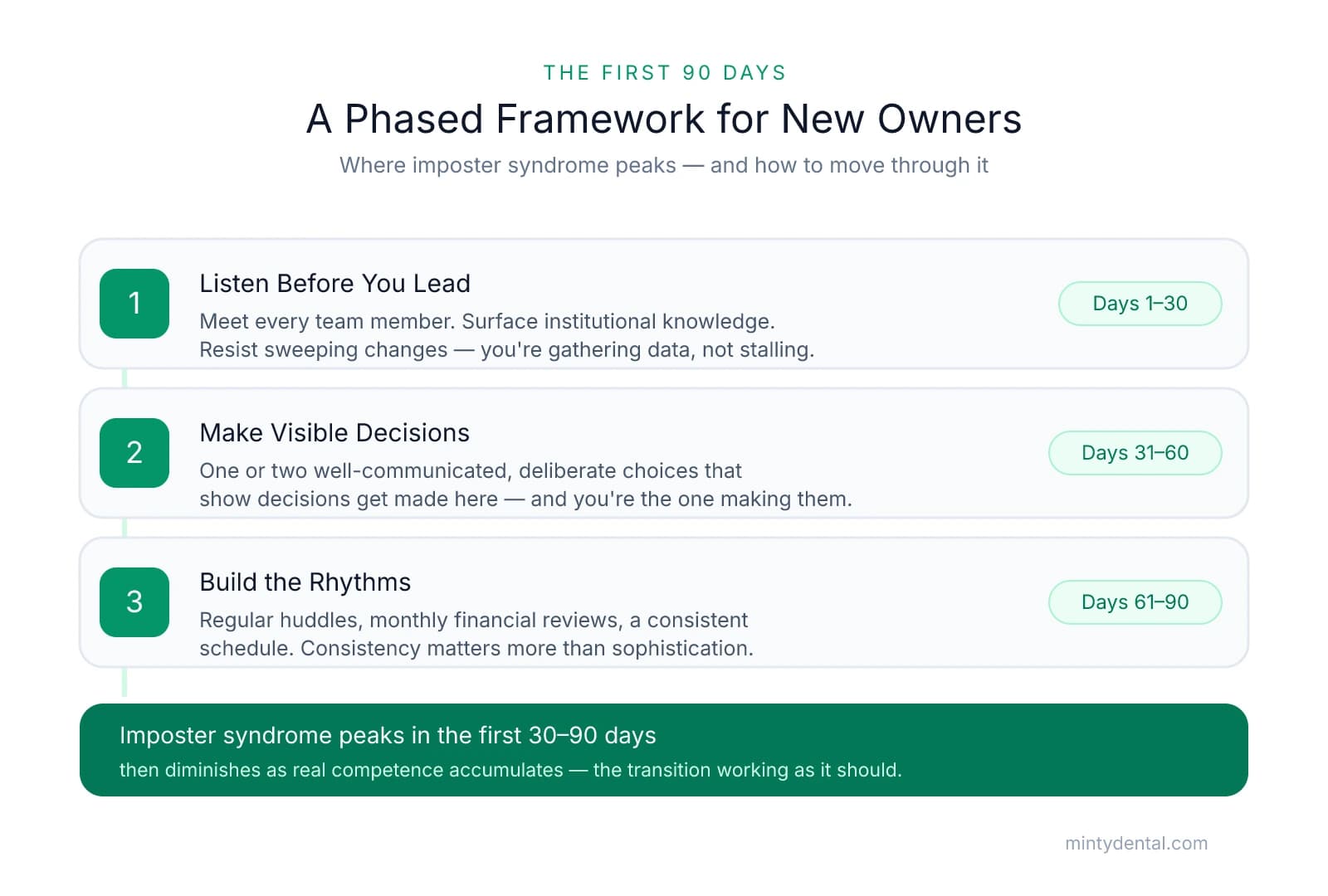
Knowing why the transition feels disorienting is useful. Having something concrete to do with that knowledge is better. What follows is a phased framework that addresses both the operational and psychological dimensions of the first 90 days, drawn from patterns that tend to show up across successful transitions.
1. Days 1–30: Listen before you lead
The instinct to prove yourself through action is strong in the first month — and worth resisting. The most valuable thing you can do in this phase is hold individual meetings with every team member: not to announce your vision, but to understand theirs. What do they love about how the practice runs? What's frustrated them? What did the previous owner do well that they'd hate to lose?
These conversations accomplish two things simultaneously. They surface institutional knowledge you can't get from a chart audit or a P&L — the kind that lives in a long-tenured hygienist's head. And they signal something staff respond to faster than almost any policy change: that you're paying attention to them specifically.
Resist the urge to make sweeping changes in this window. Observe the practice's rhythms. Learn the scheduling patterns, the billing quirks, the unwritten rules. You're gathering data, not stalling.
2. Days 31–60: Make one or two deliberate, visible decisions
By the second month, the team is watching to see whether you're actually leading or just maintaining. This is the moment to make one or two well-communicated decisions that reflect your direction — not aggressive changes, but clear signals.
Maybe it's a new morning huddle format. Maybe it's a policy you've clarified in writing. Maybe it's a staffing or compensation decision you've been weighing — if you're navigating whether to adjust pay after the acquisition, this is typically the right window to act, with clear reasoning attached.
The goal isn't to shake things up. It's to demonstrate that decisions get made here — and that you're the one making them.
3. Days 61–90: Build the rhythms that signal you're running the practice
Operational cadence is what shifts a practice's center of gravity from "the old owner's way" to "how we do things now." By day 61, you should be establishing regular team huddles, monthly financial reviews, and a consistent schedule the team can orient around.
These rhythms don't need to be elaborate. Consistency matters more than sophistication. A practice where the owner reviews the numbers monthly and runs a standing team meeting is one where staff start to feel stability — and where you start to feel it too.
On the psychological side
The operational framework only works if the internal work runs alongside it. Two things tend to matter most here.
First, build a peer network of other new owners who are in the same phase. The ADA New Dentist Committee and most state dental associations offer structured peer groups specifically for this transition — and talking to someone who closed six months before you is often more useful than any consultant.
Second, practice separating I don't know this yet from I'm not capable of learning it. Imposter syndrome conflates temporary knowledge gaps with permanent inadequacy — and that conflation is what makes it damaging. According to research published in PMC, imposter syndrome tends to diminish as real competence accumulates. The goal isn't to feel confident before you act. It's to act in ways that build the competence that eventually makes confidence feel earned.
The two behavioral traps to watch for — over-accommodation (deferring to staff on decisions that are yours) and over-correction (making aggressive changes to assert authority) — are both driven by the same underlying anxiety. The framework above is designed to give that anxiety somewhere useful to go.
When the Feeling Doesn't Fade: Distinguishing Normal Adjustment from a Real Problem
The framework above works when the underlying feeling is normal adjustment. But not every case of persistent self-doubt is imposter syndrome in the clinical sense, and it's worth being precise about the difference.
The typical arc: imposter syndrome tends to peak in the first 30–90 days and diminish as real competence accumulates. You learn the billing rhythms. You navigate your first difficult staff conversation. You close a month where the numbers made sense. Each of those experiences deposits something into your confidence that no amount of reassurance can replicate. The research literature on imposter syndrome consistently supports this pattern — the feeling fades as evidence of actual capability builds.
If the feeling is intensifying at month six or twelve rather than softening, that's worth examining more carefully — not with alarm, but with curiosity. In many cases, persistent anxiety at that stage isn't psychological noise. It's a signal pointing at something operational: a cash flow pattern that hasn't stabilized, a staff dynamic that's quietly draining the culture, a clinical capacity ceiling you haven't figured out how to break through. The anxiety may be accurate. The question is whether you're reading it as information or just experiencing it as distress.
Imposter syndrome vs. a genuine skill gap: these are meaningfully different, and conflating them leads to the wrong response. Imposter syndrome is feeling undeserving despite real competence — the evidence of your capability is there, but you discount it. A genuine skill gap is something else entirely: you actually need to learn how to read a P&L, have a performance conversation with a long-tenured employee, or understand why your overhead ratio is running high. That's not a psychological problem. It's a solvable one. Naming it as a skill gap — rather than evidence that you shouldn't own a practice — changes what you do next.
One grounding anchor worth returning to when the doubt runs loud: the financial trajectory of ownership is real and well-documented. According to ADA survey data cited by White Coat Investor, owner dentists average roughly $260,000 annually compared to $184,000 for employed dentists. That gap reflects something genuine about what ownership builds over time — and it's worth holding onto when the first year feels harder than expected.
When you need support beyond peer conversation, a few resources are worth knowing: ADA Wellness offers mental health resources specifically for dentists, most state dental associations run peer support programs, and dental-specific coaches who work with new owners in the first year can help when the operational and psychological threads are hard to separate.
The goal of ownership was never to feel certain. It was to build the systems, relationships, and judgment that make good decisions more likely — even when you're not sure. Most of the dentists who've made this transition successfully didn't feel ready when they started. They just kept acting anyway.
Sources & References
The data and claims in this article are drawn from the following sources. We prioritize government data, peer-reviewed research, and established industry publications to ensure accuracy.
- Imposter Syndrome in Dentistry: Prevalence, Contributing ...— pmc.ncbi.nlm.nih.govGovernment
- Q&A: Building confidence in the face of imposter syndrome— adanews.ada.orgIndustry
- Research from the Center for Creative Leadership— ccl.org
- Impostor Syndrome among entrepreneurs: Actionable solutions— smallbusinessresearchandenterprise.comIndustry
- ADA New Dentist Committee— ada.org
- Prevalence, Predictors, and Treatment of Impostor Syndrome - PMC - NIH— pmc.ncbi.nlm.nih.govGovernment
- Dentist Salaries in 2025: Comparing DSO vs. ...— www.whitecoatinvestor.com
- ADA Wellness— ada.org
Ready to Own Your Dental Practice?
Imposter syndrome is common when transitioning from associate to owner, but you don't have to navigate it alone. Minty's acquisition guidance walks you through every step of buying a practice, building your confidence from day one.