How Payer Mix Affects How Much You Can Borrow to Buy a Practice

Co-Founder, Minty Dental

In Summary
- Lenders calculate your borrowing capacity based on net collections — gross billing minus contractual adjustments and write-offs — not the headline number a broker quotes
- Payer mix is the primary driver of that gap: a practice billing $1.2M with heavy Medicaid exposure may net only $720K after adjustments, while an equivalent fee-for-service practice may net $1.05M or more
- Lenders typically require a debt service coverage ratio (DSCR) of at least 1.25x — meaning the practice's net income must exceed annual debt payments by 25% — and payer mix directly sets the ceiling on how much debt the practice can support
- Dental-specialized lenders normalize for insurance reimbursement cycles and contractual write-offs; generalist lenders often don't, which can produce DSCR calculations that are meaningfully off
- Understanding payer mix before you make an offer gives you both a more accurate loan ceiling and a concrete negotiating lever on price
Payer Mix Is What Lenders Actually Lend Against
Payer mix is the percentage breakdown of a dental practice's revenue by source — typically fee-for-service (FFS) or cash-pay patients, PPO-contracted insurance, and government programs like Medicaid or CHIP. It sounds like an operational detail. In underwriting, it's one of the most consequential numbers in your file.
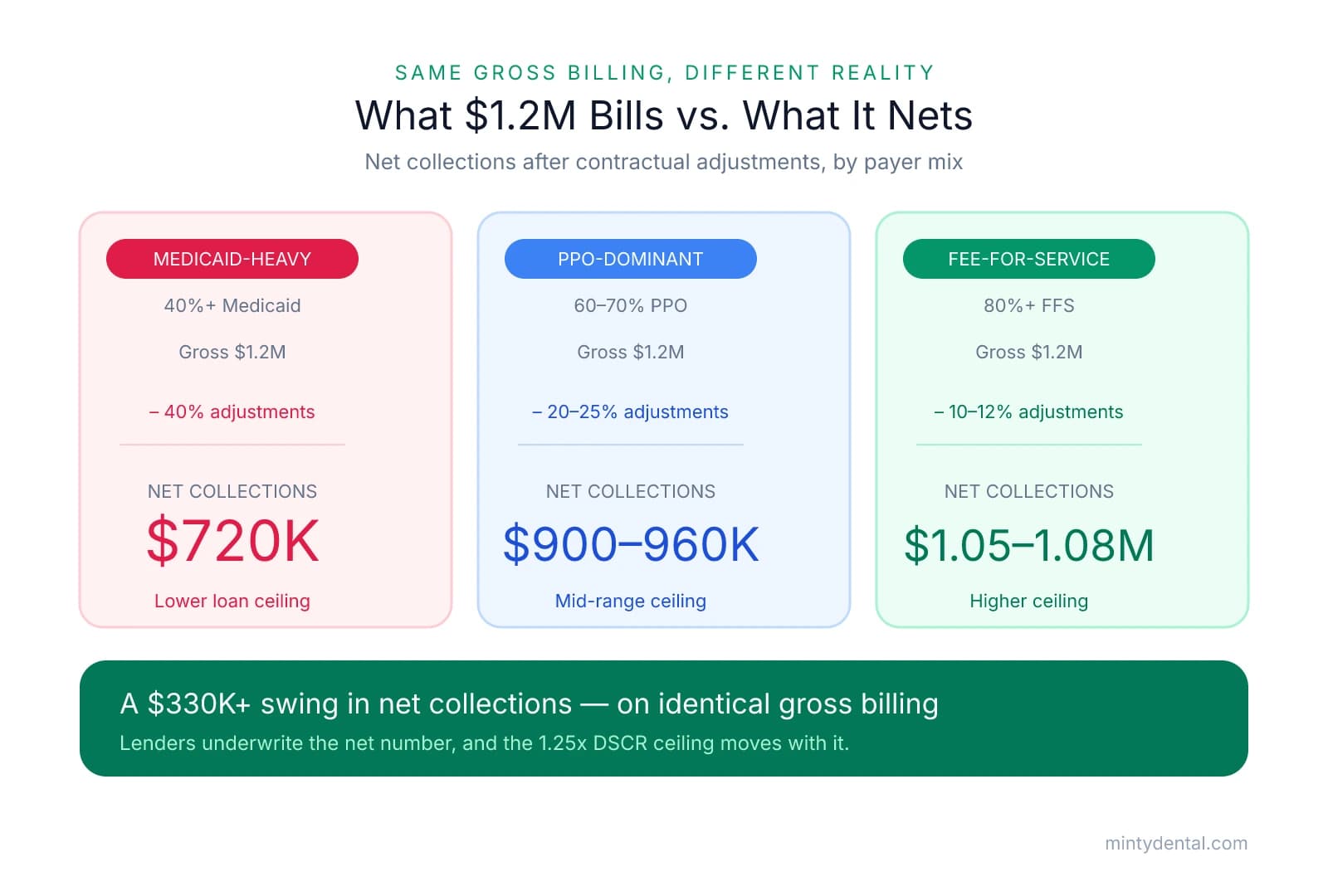
One thing many buyers don't realize until they're deep in underwriting is that the lender's income number and the broker's collections number are rarely the same. A practice listed at "$1.2M in collections" is quoting gross billing — what was charged. What a lender underwrites is net collections: what was actually received after contractual adjustments, write-offs, and insurance discounts are stripped out. Payer mix is the primary driver of that gap, and the gap can be enormous.
Consider how differently the same gross billing translates depending on who's paying:
| Practice Type | Gross Billing | Contractual Adjustments | Net Collections | Supportable Loan (1.25x DSCR)* |
|---|---|---|---|---|
| Medicaid-heavy (40%+ Medicaid) | $1,200,000 | ~40% | ~$720,000 | Lower ceiling |
| PPO-dominant (60–70% PPO) | $1,200,000 | ~20–25% | ~$900,000–$960,000 | Mid-range |
| Fee-for-service (80%+ FFS) | $1,200,000 | ~10–12% | ~$1,050,000–$1,080,000 | Higher ceiling |
*Supportable loan amount depends on overhead, doctor compensation, and debt service — the DSCR calculation applies to net operating income after expenses, not net collections alone.
The DSCR framework is where payer mix becomes a hard number. Most dental practice lenders — including those underwriting SBA 7(a) acquisitions — require a minimum 1.25x debt service coverage ratio, meaning the practice's net operating income must cover annual loan payments by at least 25%. That threshold is calculated on net collections after overhead and a market-rate doctor salary for the buyer, not on gross billing. A Medicaid-heavy practice netting $720K after adjustments has a meaningfully lower income base to run that calculation against than an FFS practice netting $1.05M — which translates directly into a lower maximum loan amount, even if both practices carry the same asking price.
Dental-specialized lenders understand that insurance reimbursement typically runs on 30–45 day AR cycles and that contractual adjustments vary significantly by payer contract — they normalize for this in underwriting. Generalist lenders often don't, which can produce DSCR calculations that overstate or understate the practice's true debt capacity. If you're evaluating a practice with a complex payer mix, the lender you choose matters almost as much as the practice itself — a point worth exploring when reviewing what banks actually look for in a dental acquisition file.
The practical implication: before you focus on what a practice is asking, it's worth understanding what it can actually support.
How Payer Mix Shapes the Purchase Price — and the Financing Gap
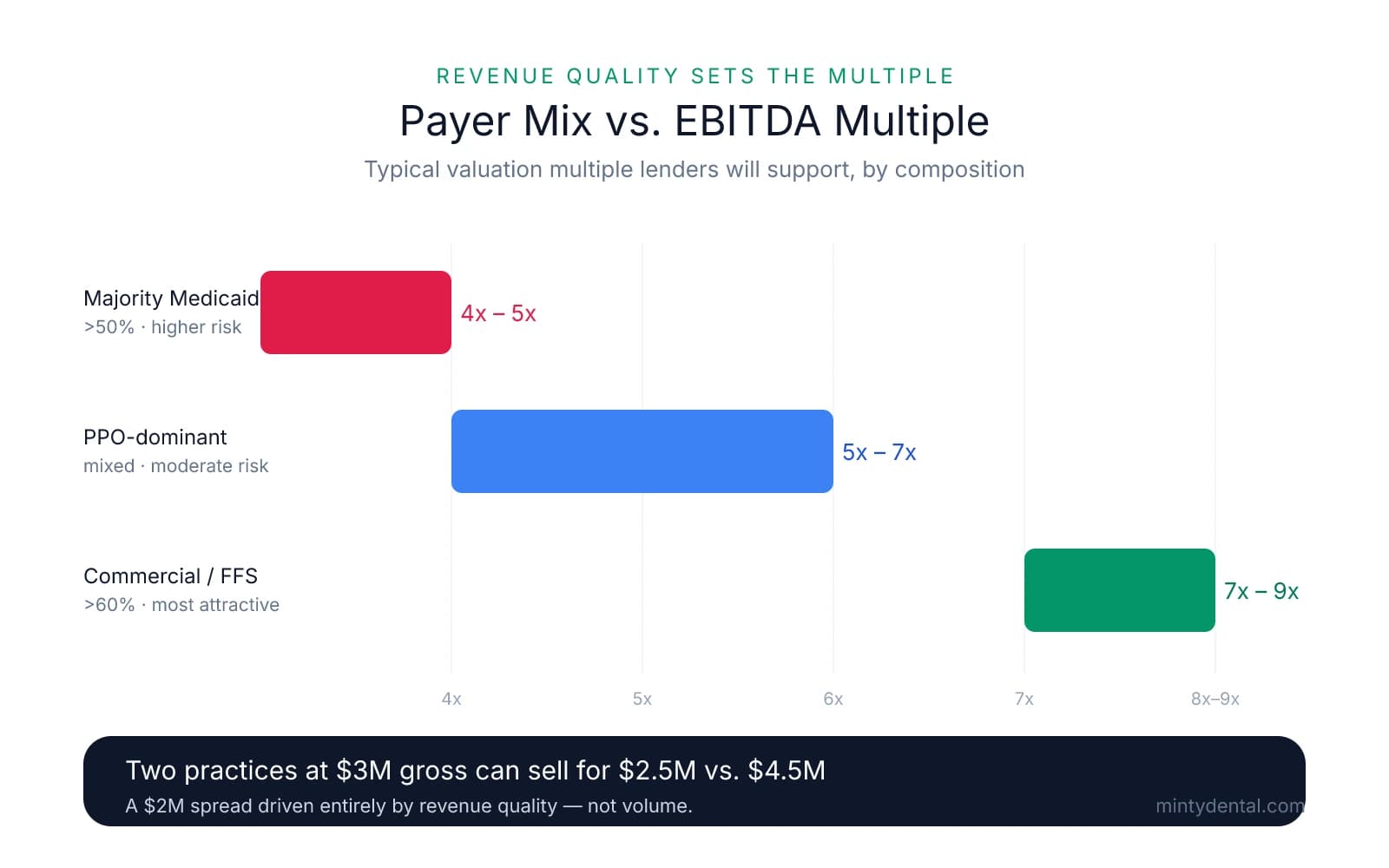
Payer mix doesn't just affect what a practice nets — it also affects what the practice is worth. That creates a two-sided problem for buyers: the same revenue quality issue that compresses net income also compresses the valuation multiple a lender will support, meaning payer mix works against you on both sides of the DSCR equation simultaneously.
Why Revenue Quality Changes the Multiple
Acquirers and lenders don't treat all revenue as equal. Commercial and fee-for-service revenue is predictable, high-margin, and not subject to state budget cycles. Medicaid revenue is lower-margin, administratively intensive, and carries meaningful policy risk — reimbursement rates can shift with little notice depending on state-level funding decisions. That risk differential gets priced directly into the EBITDA multiple a buyer can justify paying.
| Payer Mix Composition | Typical EBITDA Multiple | Lender Risk View |
|---|---|---|
| >60% Commercial / FFS | 7x – 9x | Most attractive; stable, high-margin revenue |
| PPO-dominant (mixed commercial) | 5x – 7x | Moderate; depends on write-off percentages |
| Majority Medicaid (>50%) | 4x – 5x or lower | Higher risk; compressed margins, reimbursement exposure |
Per current healthcare M&A benchmarks, two practices generating identical $3M in gross revenue can sell for $2.5M versus $4.5M based on payer mix alone — a $2M spread driven entirely by revenue quality, not volume.
A Lower Price Isn't Automatically a Better Deal
This is where many buyers get tripped up. A Medicaid-heavy practice priced at $2.5M looks more accessible than a comparable FFS practice at $4.5M. But the lower price doesn't resolve the financing challenge if net income is also lower. The DSCR calculation doesn't care about the purchase price in isolation — it cares about whether the practice's net cash flow supports the debt at whatever price is being asked.
If a Medicaid-heavy practice nets $400K after overhead and a market-rate doctor salary, and the acquisition debt at $2.5M requires $280K in annual debt service, the DSCR sits around 1.43x — workable. But if overhead is higher due to administrative burden and net income is closer to $300K, that same loan structure produces a 1.07x DSCR, which most dental lenders won't approve. The lower price didn't create a bargain; it just shifted where the constraint shows up.
The PPO Write-Off Data Point Buyers Should Request
For PPO-heavy practices, the headline participation rate tells only part of the story. A practice with 70% PPO participation and average write-offs of 28–32% has meaningfully different revenue quality than one with 70% PPO at 14–16% write-offs — even though both report the same payer mix percentage. According to PPO Negotiation Solutions, write-off percentages, contracted fee schedules, and credentialing status are among the most consequential — and most overlooked — factors in evaluating a practice's true cash flow.
Requesting a fee schedule analysis and plan-by-plan write-off breakdown during due diligence gives you the data to pressure-test the asking price. If the valuation was built on gross collections without accounting for above-average write-offs, you may have a concrete basis for renegotiation — and if the bank appraisal comes in lower than the asking price, payer mix analysis is often what explains the gap.
A Framework for Evaluating Payer Mix Before You Make an Offer
The goal isn't to avoid practices with government payer exposure or heavy PPO participation — it's to make sure the price reflects the revenue quality you're actually buying. The following process gives you a structured way to do that before you commit to a number.
Step 1: Request a payer mix report broken down by revenue source
Ask for the breakdown by net collections — not patient count, not gross billing. What percentage of actual collected revenue comes from fee-for-service, each PPO plan, Medicaid, and other government programs? This is the number that flows into your DSCR calculation, and it's often materially different from what the broker's summary implies.
Step 2: Calculate the effective collection rate by payer
For each payer category, divide net collections by gross billed fees. A practice billing $1.2M and collecting $840K has a 70% effective collection rate — but if that rate is 85% on commercial patients and 52% on Medicaid, the blended figure is masking a meaningful quality gap.
Step 3: Pull the AR aging report by payer
Medicaid AR aging beyond 90 days is a red flag that won't appear on the income statement. Slow-paying or uncollectable receivables inflate the apparent revenue picture while quietly compressing actual cash flow. Request the aging report segmented by payer and look specifically at what's sitting beyond 60 and 90 days.
Step 4: Review PPO fee schedules and write-off percentages
A practice with 70% PPO participation at 30% average write-offs has a fundamentally different revenue profile than one at 70% PPO with 15% write-offs. According to PPO Negotiation Solutions, contracted fee schedules and credentialing status are among the most consequential — and most overlooked — factors in evaluating real cash flow. If the valuation was built on gross collections without accounting for above-average write-offs, you have a concrete basis for renegotiating the price.
Step 5: Account for the credentialing gap
PPO contracts don't automatically transfer to you at closing. The insurance credentialing gap means your effective payer mix on day one may look different from the seller's — some patients may be out-of-network with you until credentialing is complete, which can take 60–120 days or longer. Model your year-one DSCR with this in mind, not the seller's established payer mix.
Step 6: Model DSCR at net collections — not gross
For any practice with 35%+ Medicaid concentration, run the DSCR calculation using net collections after adjustments. If the practice nets $680K after contractual write-offs and the asking price requires $420K in annual debt service, the math may still work — but confirm it before making an offer, not after.
Practices with compressed payer mix aren't automatically bad acquisitions. What makes them problematic is when the asking price was built on gross collections without accounting for the revenue quality underneath. The framework above gives you the data to evaluate that gap — and, where it exists, to negotiate a price that actually reflects what you're buying.
Putting Payer Mix to Work in Your Financing Conversation
Buyers who understand payer mix walk into both the negotiation and the lender conversation with a clearer picture of what the practice is actually worth to finance. That clarity is an advantage — and it's one most buyers leave on the table.
Using Payer Mix as a Negotiating Lever
If the analysis from the previous steps reveals that net collections are materially lower than gross collections suggest — say, 30% below asking due to Medicaid write-offs or above-average PPO adjustments — that's a data-backed basis for a lower offer, not just a gut feeling about the price.
The practical move: build your offer around net collections, not gross. If a practice bills $1.2M but nets $780K after contractual adjustments, the valuation multiple should be applied to the $780K figure. When a seller or broker pushes back, the payer mix report and effective collection rate by payer are your evidence — not an opinion, a calculation.
This works in the other direction too. A practice with a strong FFS mix or low-write-off PPO contracts may actually support a higher loan than its gross collections imply — meaning payer mix analysis can confirm that a price is fair, not just flag when it isn't. The influence of payer mix on dental practice financials is well established in the literature, reinforcing why this analysis belongs at the center of any acquisition offer.
Preparing for the Lender Conversation
Before approaching a lender, run the DSCR calculation yourself using net collections. Subtract a market-rate doctor salary, subtract overhead, and divide the remaining net operating income by the proposed annual debt service. If the result is below 1.25x, the deal likely needs repricing or restructuring before a lender will approve it.
Then walk in with a clean payer mix summary: net collections by payer category, write-off percentages by plan, and an AR aging report segmented by payer. Presenting this proactively signals that you've done the work — and removes the ambiguity that slows underwriting down.
Dental-specialized lenders vs. generalist lenders: This distinction matters more than most buyers expect. Dental-specialized lenders understand that PPO contractual adjustments are standard, that Medicaid reimbursement runs on different cycles, and that insurance normalization is part of the income calculation — not a red flag. Generalist lenders often treat write-offs as losses and may produce a DSCR calculation that meaningfully misstates your actual borrowing capacity. If you're evaluating a practice with a complex payer mix, the lender choice is part of the deal structure. It's worth understanding how SBA and conventional loan structures differ before deciding which path fits your situation.
The number you bring to that conversation — your own DSCR estimate built on net collections — is what separates a borrower who gets a fast, accurate approval from one who gets a conditional letter full of follow-up questions.
Sources & References
The data and claims in this article are drawn from the following sources. We prioritize government data, peer-reviewed research, and established industry publications to ensure accuracy.
- SBA Dental Practice Acquisition Loans: July 2026 Rates— baystreetlending.comIndustry
- Payor Mix and Medical Practice Valuation: Why Not All Revenue is ...— sovdoc.comIndustry
- What Buyers Must Review Before Acquiring a Practice— pponegotiationsolutions.comIndustry
- Influence of Payor Mix on Hospital Dental Practice— pubmed.ncbi.nlm.nih.govGovernment
Ready to maximize your practice acquisition potential?
Understanding your payer mix is crucial for securing favorable financing terms. Minty's acquisition experts guide you through every step of buying a practice, helping you navigate lending requirements and find the right opportunity for your financial situation.