Buying an Endo or Perio Practice: What's Different

Co-Founder, Minty Dental
In Summary
- Endodontic and periodontic practices generate revenue almost entirely through GP referrals — not a recurring patient base — which makes the acquisition risk profile fundamentally different from a general practice purchase
- Endodontic practices have no hygiene department and no recall system; every patient is a one-time referral, meaning the practice's value lives in relationships, not in a patient list
- Perio practices operate a hybrid model — surgical procedures plus periodontal maintenance — but still depend on GP referrals for new case flow
- Endodontists are consistently the second-highest earning dental specialists, per ADA Health Policy Institute data, and perform roughly 25 root canals per week compared to about 2 for general dentists
- Buyers evaluating specialty practices need to treat referral relationship continuity as the central due diligence question — not patient retention in the traditional sense
Specialty Practices Run on a Different Business Model Than General Dentistry
Specialty dental practice: A dental practice that limits its scope to a defined clinical discipline — such as endodontics or periodontics — and receives patients almost exclusively through referrals from general practitioner dentists, rather than building an independent recurring patient base.
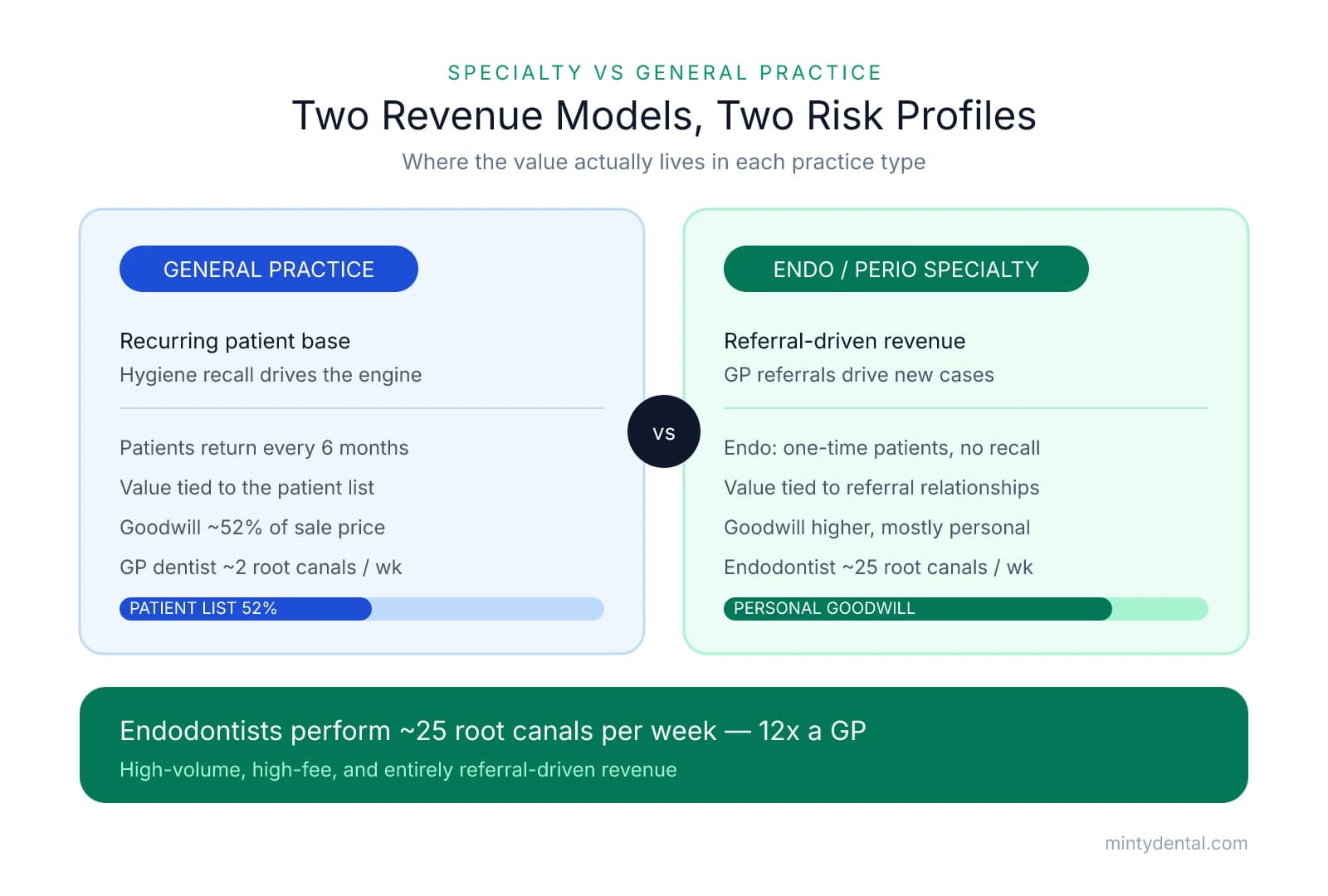
That distinction isn't just clinical. It's the structural difference that reshapes how these practices are valued, how risk is distributed in a sale, and what due diligence actually needs to cover.
In a general practice, revenue has a built-in engine: hygiene recall. Patients return every six months, the schedule fills predictably, and the practice's value is meaningfully tied to that recurring patient base. When you buy a GP practice, you're acquiring a book of relationships — patients who have a reason to come back regardless of who owns the practice.
Endodontic practices don't work that way. There is no hygiene department, no recall system, and no returning patient base to speak of. Every patient who walks through the door was sent by a GP — and once the root canal is done, that patient goes back to their referring dentist. The endodontist never sees them again. According to the American Association of Endodontists, endodontists complete an average of 25 root canal treatments per week, compared to roughly 2 for general dentists — high-volume, high-fee, and entirely referral-driven.
That volume translates to strong income. The ADA Health Policy Institute has consistently found endodontists to be the second-highest earning dental specialists — a reflection of both procedure fees and throughput. But that earning power is inseparable from the referral network sustaining it. Remove the referring GPs, and the revenue stops.
Periodontic practices have a more layered model. Surgical procedures — osseous surgery, implant placement, extractions — generate significant per-case revenue, but the practice also carries a periodontal maintenance patient base that returns on a 3–4 month recall cycle. That recurring component gives perio practices some structural similarity to general dentistry. Even so, new surgical case flow depends almost entirely on GP referrals. The maintenance base provides stability; the referral network drives growth.
What this means for buyers is that the referral-dependent revenue structure reframes where value actually lives in these practices. In a GP acquisition, goodwill is partly tied to the patient list. In a specialty acquisition, goodwill is concentrated in the seller's professional relationships — with referring dentists who chose to send cases to this practice specifically because of who owns it. That's a different kind of asset, and it requires a different kind of evaluation.
How Valuation Works Differently — and What the Numbers Actually Mean
The headline numbers on a specialty practice can look deceptively familiar. A practice collecting $1.2M in endo revenue and a general practice at the same collections level appear comparable on paper — similar asking prices, similar financing conversations. But the risk profiles are fundamentally different, and the valuation mechanics reflect that once you look past the top-line multiple.
Collections Multiples by Specialty
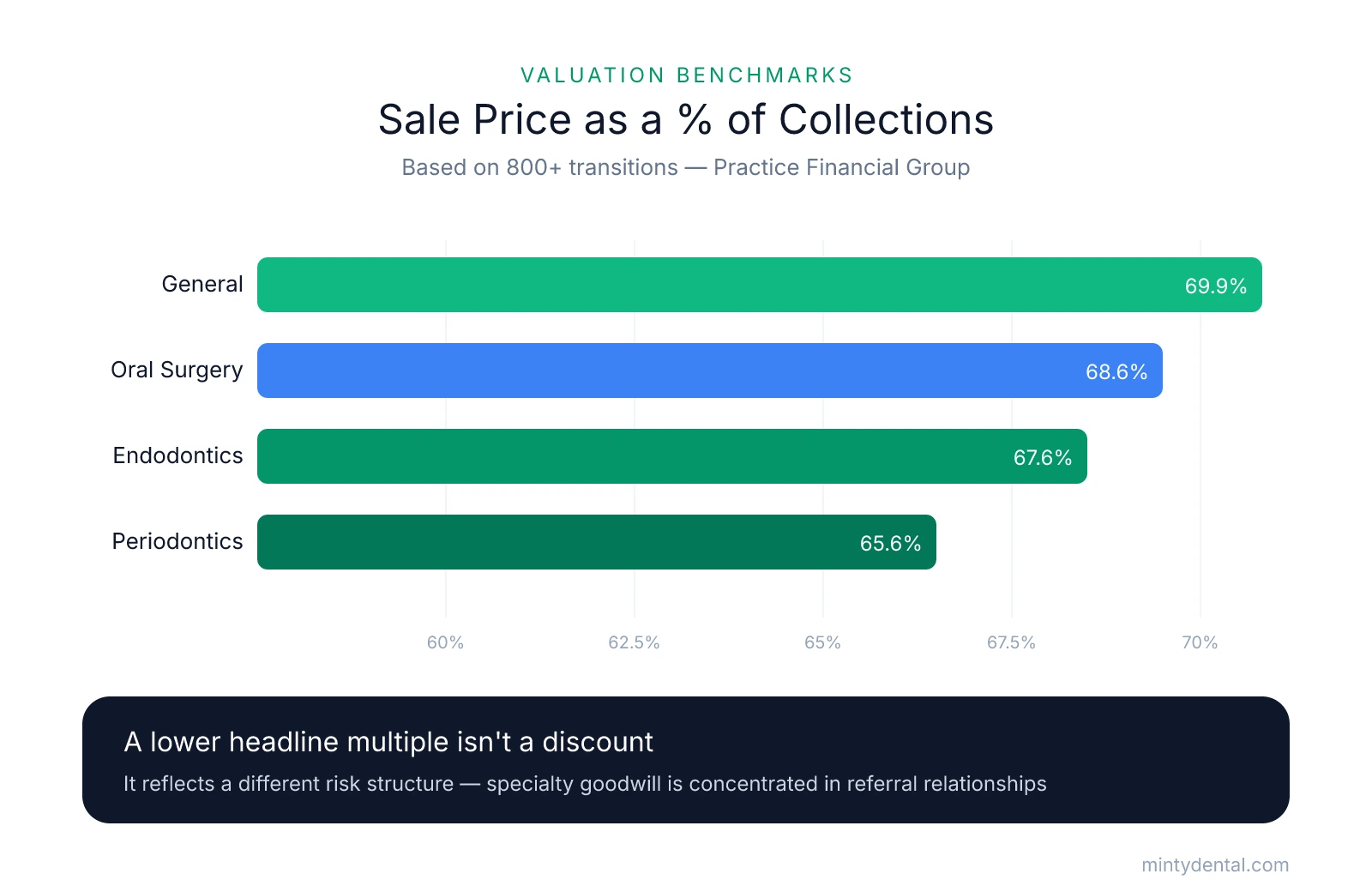
According to Practice Financial Group, which analyzed over 800 transitions, the average sale price as a percentage of collections breaks down as follows:
| Practice Type | % of Collections | Goodwill as % of Sale Price |
|---|---|---|
| General Dentistry | ~69.9% | ~52% |
| Oral Surgery | ~68.6% | ~74% |
| Endodontics | ~67.6% | Higher than GP |
| Periodontics | ~65.6% | Higher than GP |
Endo and perio sit slightly below general dentistry on this metric — but that lower headline multiple doesn't mean these practices are cheaper or less valuable. It reflects a different risk structure, not a discount.
Where EBITDA Multiples Tell a Different Story
The collections percentage is only one lens. Specialty practices — particularly perio and oral surgery — often command 3–5x EBITDA due to higher procedure fees per visit and leaner overhead ratios. An endodontist performing 25 root canals per week at premium fees generates strong margins relative to a general practice carrying hygiene staff, recall systems, and broader overhead. When profitability is the denominator, specialty practices can look more attractive — not less.
The Goodwill Composition Problem
This is where the real due diligence question lives. In a general practice, goodwill averages around 52% of the purchase price and is largely tied to the patient base — people who have a reason to return regardless of who owns the practice. In specialty practices, goodwill represents a higher share of the purchase price, but it's almost entirely personal goodwill: the seller's relationships with referring GPs who chose to send cases to this practice because of this clinician.
That distinction has direct tax implications worth understanding — how goodwill is allocated between personal and enterprise goodwill affects both your purchase price structure and your post-close tax position.
The practical risk: a practice collecting $1.2M in endo revenue may have 30 referring dentists driving that volume. If 3–5 of those GPs account for 60–70% of referrals, the practice's value is highly concentrated in relationships that may not survive the seller's departure. That's a concentration risk that no collections multiple captures.
The Narrow Buyer Pool
One additional factor shapes how these deals get structured: most states require the buyer to hold the relevant specialty credential. That narrows the buyer pool significantly — which can extend time on market, affect seller leverage, and limit financing competition. Lenders familiar with specialty transitions understand this dynamic, but buyers should expect deal structures that account for it, including longer seller transition periods and earnout provisions tied to referral retention.
The Due Diligence Checklist That's Specific to Endo and Perio Deals
Understanding the valuation mechanics is one thing — knowing what to actually verify before signing is another. Standard general practice due diligence checklists cover financials, staffing, equipment, and lease terms. Those still apply here. But specialty acquisitions have a second layer of investigation that most general practice checklists don't address, and skipping it is where deals go wrong.
Here are the six areas that deserve dedicated attention in any endo or perio transaction:
1. Referral source mapping Request a referral log covering the past three years — case volume by referring GP, broken down by year. What you're looking for is concentration. As DMCounsel's periodontal practice guide notes, referral dependency is one of the defining risk factors in specialty transitions. If 3–5 referring GPs account for more than 60% of case volume, that concentration is arguably the single biggest risk factor in the deal — more significant than the asking price itself.
2. Referral relationship audit Volume data tells you who's sending cases. It doesn't tell you why. The follow-up question is whether those relationships are personal or professional. Personal relationships — dental school classmates, longtime friends, golf partners — are harder to transfer to a new owner. Professional relationships built on clinical reputation and consistent outcomes tend to be more durable across ownership changes. The AAE's guidance on endodontic practice transitions specifically flags how referring GPs react to a new provider as a key variable — worth exploring directly with the seller before close.
3. Independent equipment appraisal Specialty practices carry expensive, specialized equipment that depreciates quickly and may need replacement sooner than the seller's depreciation schedule suggests. CBCT systems, surgical microscopes, piezoelectric units, and implant systems all fall into this category. An independent appraisal — not just the seller's asset list — lets you price replacement timelines into your offer rather than discover them post-close.
4. Perio-specific: procedure revenue breakdown Ask for a revenue breakdown by procedure type: implant placement, osseous surgery, scaling and root planing, and periodontal maintenance. These have meaningfully different risk profiles. Maintenance revenue is relatively stable and transferable. Implant placement revenue depends heavily on the seller's relationships with restorative GPs — if those GPs were sending implant cases specifically because of the seller's relationship with them, that revenue may not follow a new owner.
5. Endo-specific: case complexity mix Review what percentage of cases are primary root canal treatments versus retreatments, calcified canals, or surgical endo. Retreatments are more time-consuming and technically demanding. A buyer whose clinical range doesn't extend to complex cases will see an immediate production gap — and may also inherit retreatment liability on prior work. Know what the practice actually produces before assuming you can replicate it.
6. Scope-of-practice alignment Some perio practices generate meaningful revenue from procedures — bone grafting, sinus lifts, full-arch implant cases — that require specific training beyond general periodontal credentials. A buyer who can't perform those procedures loses that revenue on day one. Audit the procedure mix against your own clinical capabilities before the offer stage, not after.
Structuring the Deal to Protect the Referral Network
Everything covered so far — the referral-dependent revenue model, the goodwill concentration risk, the due diligence checklist — converges on a single practical question: how do you structure the deal so that the referral network actually transfers?
The answer lives in four contract provisions that many buyers treat as boilerplate but shouldn't.
Seller transition period. Specialty practices need a longer, more structured seller presence than general practices. A 6–12 month transition is reasonable to negotiate — but the length matters less than what the seller is actually obligated to do during it. The seller's primary job isn't to see patients alongside you. It's to personally introduce you to every GP who referred cases in the past two years. That's a different obligation, and it needs to be written that way. A well-structured seller employment agreement should define referral-introduction milestones explicitly — not just hours per week in the office.
Earnout structure. Because referral-dependent revenue is harder to predict post-closing, earnouts appear more frequently in specialty deals than in general practice transactions. As Oral Health Group notes, earnouts allow buyers and sellers to bridge a valuation gap when they disagree on future performance — which is exactly the situation in a specialty acquisition where referral continuity is uncertain. From the buyer's side, an earnout can be a useful tool, but the metric matters enormously. Tying the earnout to collections alone rewards the seller even if revenue holds temporarily before declining. Tying it to referral retention rate — the percentage of active referring GPs still sending cases 12 months post-close — aligns the seller's incentive with the actual risk you're carrying.
Non-compete scope. The non-compete in a specialty acquisition needs to cover more than clinical practice. A seller who opens a competing practice five miles away and calls their former referring GPs has effectively taken the practice's referral network with them. The clause should explicitly prohibit referral solicitation — not just treating patients — within the defined geographic and time boundaries.
Referral introduction list. Negotiate a specific, named list of referring GPs the seller will personally introduce you to, with a defined timeline. ADS Transitions identifies the referral network as the defining value driver in specialty practice sales — which means a vague "seller will assist with introductions" clause is insufficient. Named contacts, defined timeline, documented completion. This single provision is often more protective than the transition period length itself. The closest general practice analogue is a patient retention guarantee — but in specialty deals, it's referring GPs, not patients, whose retention you're protecting.
Your own relationship-building plan. No contract survives indefinitely, and the transition period will end. The buyers who protect their referral base long-term are the ones who treat the transition as a starting point, not a solution. Attending local dental society meetings, hosting CE events for referring GPs, and building a clinical reputation through consistent outcomes are the protections that no earnout clause can substitute. The seller opens the door. Keeping it open is your job.
Sources & References
The data and claims in this article are drawn from the following sources. We prioritize government data, peer-reviewed research, and established industry publications to ensure accuracy.
- What's the difference between a dentist and an endodontist?— www.aae.orgIndustry
- Buying or Selling a Dental Practice, Start with an Accurate ...— ada.orgIndustry
- How Much is Your Dental Practice Worth?— practicefinancialgroup.comIndustry
- How Much Is My Dental Practice Worth? 2026 Valuation ...— jaffelawpllc.comIndustry
- Purchasing a Periodontal Practice in 2025: A Step-By- ...— www.dmcounsel.comIndustry
- Practical Advice on Transitions in Endodontic Practice— www.aae.orgIndustry
- Earnouts in dental practice acquisitions: What you need to ...— www.oralhealthgroup.comIndustry
- Selling a Specialty Dental Practice: What You Need to Know— www.adstransitions.comIndustry
Ready to acquire your specialty practice?
Buying an endo or perio practice requires specialized knowledge and strategic guidance. Minty's acquisition experts walk you through every step—from identifying the right specialty practice to closing the deal—with no upfront fees.