Dental Practice Valuation: EBITDA vs Collections Multiple

Co-Founder, Minty Dental

In Summary
- Collections multiples (60-80% of gross revenue) assume average profitability and dominate general practice deals under $1.5M
- EBITDA multiples (3-5x adjusted earnings) reward operational efficiency and are standard for specialty practices, multi-location groups, or DSO acquisitions
- The same $1M practice can be valued at $700K using a 70% collections multiple or $850K using a 5x EBITDA multiple—sellers present whichever number is higher
- Collections-based valuation treats all revenue equally; EBITDA-based valuation accounts for how much the practice actually keeps after expenses
- Understanding which method applies protects you from overpaying for a practice with weak margins disguised by strong collections
Collections Multiples Measure Revenue, EBITDA Multiples Measure Profitability—and That Difference Determines Which One Matters
Collections multiples measure how much a practice bills. EBITDA multiples measure how much it keeps. A practice can generate impressive revenue while operating at razor-thin margins—and the valuation method determines whether you're paying for gross activity or actual profitability.
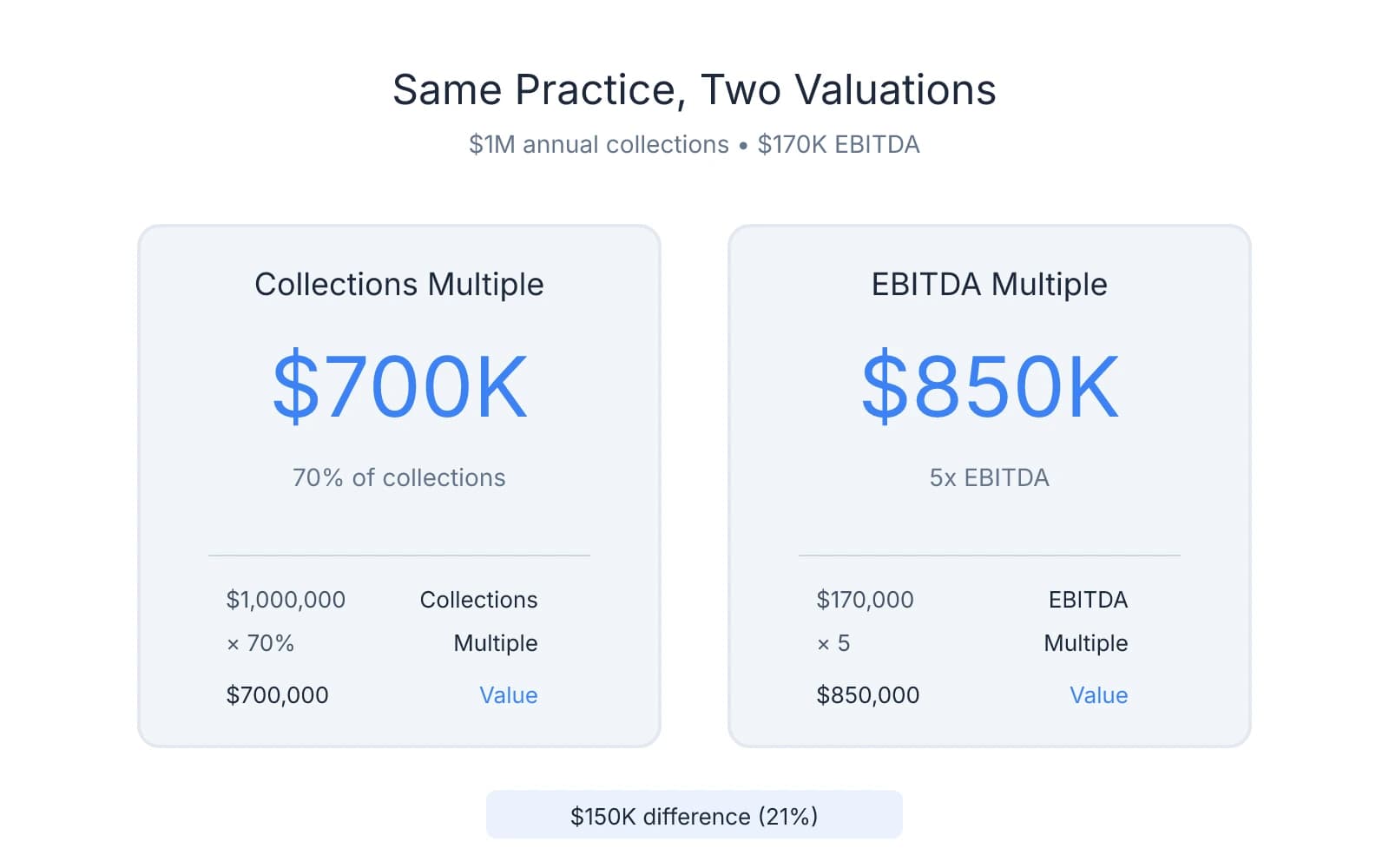
Collections-based valuation applies a percentage to annual gross revenue. For general practices, that percentage typically falls between 60-80% of trailing twelve-month collections. A practice collecting $1M annually might be valued at $700K using a 70% multiple. The method assumes industry-standard profitability—around 35-40% overhead after owner compensation. It's straightforward, widely understood, and dominant in deals under $1.5M.
EBITDA-based valuation applies a multiple to adjusted earnings—typically 3-5x for dental practices. EBITDA (Earnings Before Interest, Taxes, Depreciation, and Amortization) represents cash-generating capacity after operating expenses but before financing costs. The same $1M practice with $170K in adjusted EBITDA would be valued at $850K using a 5x multiple. This method rewards operational efficiency. A practice running at 30% overhead commands a higher multiple than one at 45%, even with identical collections.
Sellers present whichever method produces the higher number. If the practice runs lean and profitable, expect EBITDA-based valuation. If margins are weak but collections are strong, expect a collections multiple. When a seller insists on collections-based pricing but refuses to share detailed P&L statements, that often signals profitability doesn't support the asking price.
The method that applies depends on practice size, specialty focus, and buyer type. General practices under $1.5M typically trade on collections multiples. Specialty practices—particularly oral surgery, perio, or ortho—lean toward EBITDA because profit margins vary widely based on case mix. Multi-location groups and DSO acquisitions almost always use EBITDA multiples because operational efficiency becomes the primary value driver at scale.
If the seller hasn't specified which method they're using, that's your first question. The answer tells you whether you're being asked to pay for revenue or profitability. For a framework on running preliminary valuations before engaging an appraiser, estimating practice value without an appraiser walks through the calculations step by step.
How to Calculate Each Method Correctly—and Where Sellers Inflate the Numbers
Running the calculations yourself before accepting a seller's valuation gives you leverage during negotiation and reveals whether the asking price reflects reality or optimism. Both methods follow defined formulas, but each has manipulation points where sellers can inflate the outcome by 15-30%.
Collections Multiple: Start With Cash Received, Not Production
Collections-based valuation begins with verified gross collections—actual cash received over the trailing twelve months, not what was produced or billed. Pull practice management software reports for total payments received, then adjust for one-time events that won't recur: insurance settlements from prior disputes, PPO credentialing bonuses, or bulk Medicaid catch-up payments. These inflate the baseline without reflecting sustainable revenue.
Once you have normalized collections, apply a multiple between 60-80% based on practice characteristics. A $1.2M solo general practice in a stable suburban market with balanced PPO/FFS mix typically sits around 70%. Practices closer to 60% carry risk factors: heavy Medicaid participation, aging patient base with limited new patient flow, or location in a saturated market. Practices approaching 80% show strong fundamentals: consistent new patient acquisition, high fee-for-service percentage, or specialty services commanding premium reimbursement.
The most common inflation tactic is including accounts receivable in the collections figure. A seller might present $1.1M in "collections" when $950K was actually received and $150K remains outstanding. That $150K gets valued at 70%—adding $105K to the asking price for revenue you'll spend months collecting, if you collect it at all. Always verify collections against deposit records, not production reports.
EBITDA Calculation: Add Back the Right Expenses, Normalize Owner Compensation
EBITDA-based valuation starts with net income from the practice tax return, then adds back five categories: Interest, Taxes, Depreciation, Amortization, and Owner Compensation. For a practice showing $80K in net income, $12K in interest expense, $28K in taxes, $15K in depreciation, $5K in amortization, and $180K in owner W2 salary, your starting EBITDA is $320K.
The critical adjustment: subtract a normalized owner salary to reflect what you'd pay a replacement dentist to produce the same clinical output. For a general dentist producing $800K-$1.2M annually, that normalized salary typically falls between $200K-$250K depending on regional compensation benchmarks. If the seller paid themselves $180K, you add back $180K and subtract $225K, reducing EBITDA to $275K. Apply a 4x multiple and the practice values at $1.1M.
Sellers inflate EBITDA through aggressive add-backs. Legitimate add-backs include one-time expenses that won't recur: legal fees from a prior lawsuit, equipment repairs from a flood, or retirement party costs. Aggressive sellers add back continuing education, marketing spend, professional dues, and lab costs—expenses you'll absolutely incur. Request three years of P&L statements and compare add-back categories year over year. If "non-recurring" expenses appear in all three years, they're recurring.
The other manipulation point is understating normalized owner compensation. A seller producing $1.5M annually might argue for a $175K replacement salary because "associates in this area work for less." That's true for associates producing $600K. An associate producing $1.5M commands $275K-$300K in most markets. Understating this figure by $100K inflates EBITDA by the same amount—adding $400K-$500K to the valuation at a 4-5x multiple.
The Multiple Itself Varies With Risk and Growth
Collections multiples range 60-80% based on revenue quality and risk factors. EBITDA multiples range 3-5x based on growth trajectory, operational efficiency, and market position. A practice with declining patient counts, aging equipment, and 50% overhead might command a 3x EBITDA multiple. A practice with 10% year-over-year growth, modern systems, and 30% overhead could justify 5x. The multiple is where subjective judgment enters—and where buyers often accept a seller's assumption without questioning it.
If a seller presents only one valuation method, calculate the other yourself. The gap between them reveals whether profitability supports the revenue story. A practice valued at $750K using a 75% collections multiple but only $600K using a 4x EBITDA multiple is telling you margins are weak. That's not necessarily a deal-breaker, but it changes your negotiation position. For detailed work on how the purchase price gets allocated across asset categories for tax purposes, the purchase price allocation calculator walks through the breakdown step by step.
When Collections Multiples Make Sense—and When They Hide Profitability Problems
Collections multiples work well for single-location general practices with stable revenue, industry-standard overhead between 60-65%, and predictable patient mix. In these cases, gross collections serve as a reliable proxy for profitability because the practice operates within normal efficiency parameters. A $1M practice running at 62% overhead generates roughly $380K in owner earnings before compensation—close enough to industry averages that applying a 70% collections multiple ($700K valuation) approximates what an EBITDA calculation would produce.
This simplicity is why collections-based pricing dominates community dental transactions. Most SBA lenders and regional banks underwrite deals using debt service coverage ratios calculated directly from gross revenue. A lender can look at $1M in collections, assume 35% flows to the owner after expenses, and determine whether $350K in annual cash flow supports a $700K loan at current rates. The underwriting process takes days instead of weeks.
But collections multiples break down when overhead deviates significantly from the 60-65% baseline. Consider a practice collecting $1M annually but running at 75% overhead. Using a 70% collections multiple, the valuation lands at $700K. Run the EBITDA calculation and the picture shifts: $1M in revenue minus $750K in expenses leaves $250K. Subtract a $225K normalized owner salary and you're left with $25K in adjusted EBITDA. At a 4x multiple, that practice is worth $100K—not $700K. The $600K gap represents what you're overpaying for inefficiency when you accept a collections-based price without checking profitability.
The reverse scenario is equally important. A practice collecting $1M with overhead at 50% generates $500K before owner compensation. Subtract $225K for normalized salary and you have $275K in EBITDA. At a 5x multiple—justified by exceptional operational efficiency—the practice values at $1.375M. The same practice valued at 70% of collections would be priced at $700K, leaving $675K on the table.
When a seller insists on collections-based valuation despite overhead consistently above 70%, pull three years of P&L statements and calculate EBITDA yourself. If the seller refuses to provide detailed financials but maintains the collections multiple is "standard for practices this size," that's a signal the numbers don't support the asking price. Practices with healthy margins welcome EBITDA analysis because it demonstrates value. Practices with weak profitability hide behind gross revenue.
The decision framework is straightforward: if overhead sits between 60-65% and the practice operates as a stable general dentistry model, collections multiples are appropriate. If overhead exceeds 70%, run the EBITDA calculation before accepting any valuation—the gap between methods tells you how much you're being asked to pay for operational problems you'll inherit. If overhead falls below 55%, push for EBITDA-based pricing because you're buying a practice that outperforms its peers. For detailed analysis of what high overhead means for acquisition decisions, whether 70% overhead is too high to buy walks through the specific risks and post-closing implications.
When EBITDA Multiples Are Non-Negotiable—and How to Structure Your Offer Accordingly
EBITDA-based valuation becomes the only defensible method in five situations: specialty practices, multi-location groups, practices with significant associate production, deals involving DSO interest or future rollup potential, and any practice where overhead deviates more than 10 percentage points from industry norms. In these cases, collections multiples either fail to capture the practice's actual value or systematically misprice the asset.
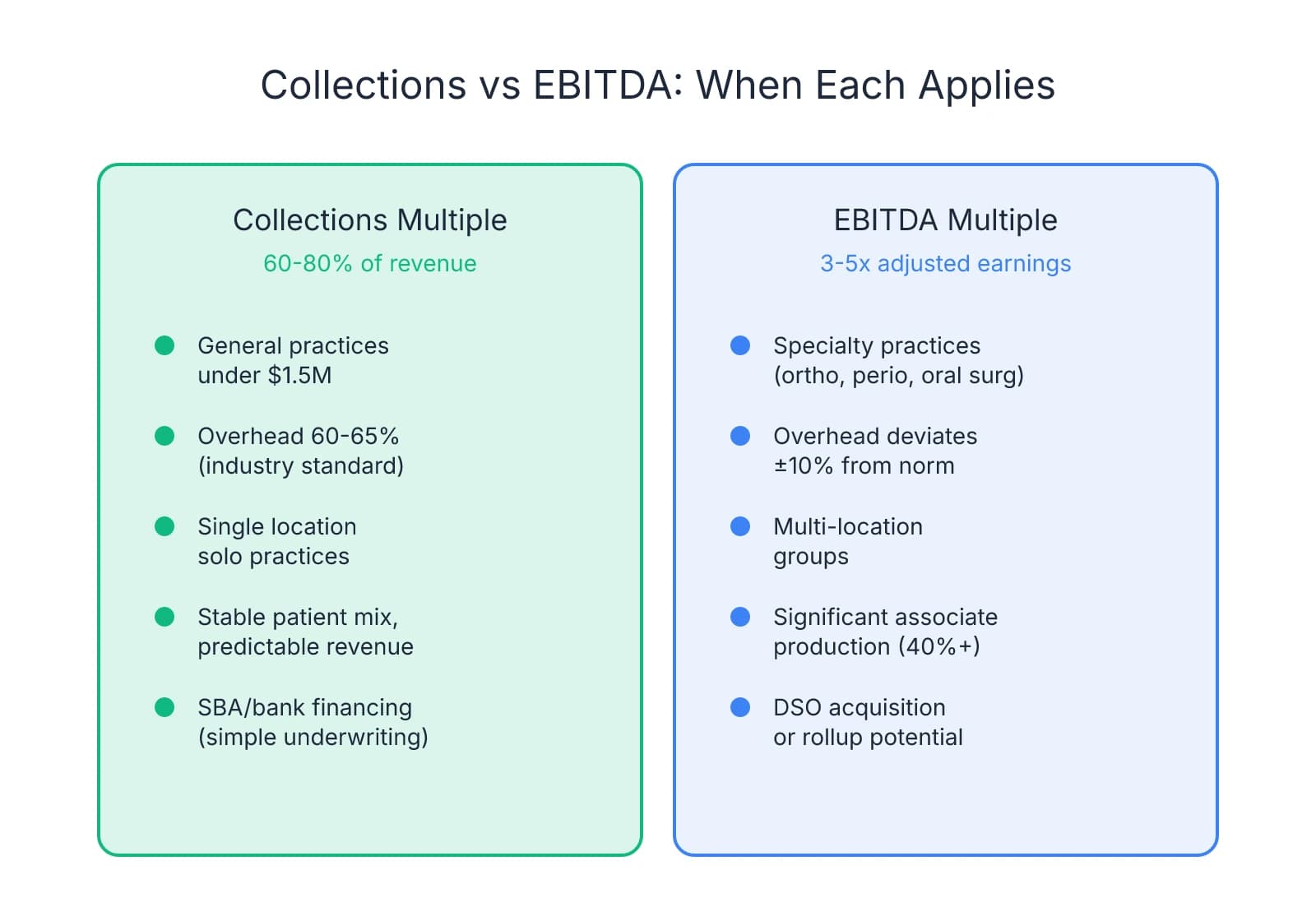
Specialty practices—orthodontics, periodontics, oral surgery, endodontics—operate with fundamentally different cost structures than general dentistry. An ortho practice collecting $1.5M might run at 40% overhead due to lower lab costs and higher treatment values per patient. A perio practice at the same revenue level might sit at 55% because of equipment intensity and assistant requirements. Collections multiples treat both identically. EBITDA multiples account for the operational reality: the ortho practice generates $900K before owner compensation while the perio practice generates $675K. That $225K difference compounds across a 4-5x multiple into a $900K-$1.125M valuation gap that collections-based pricing completely misses.
Multi-location groups and practices with multiple associates producing 40%+ of total revenue require EBITDA analysis because profitability depends on operational leverage, not just gross collections. A three-location group collecting $3M annually might generate $1.2M in EBITDA if managed efficiently—justifying a $4.8M-$6M valuation at 4-5x. The same $3M in collections across three poorly integrated locations with redundant overhead might produce only $600K in EBITDA, worth $2.4M-$3M. Collections multiples would value both at $2.1M-$2.4M using a 70-80% range, systematically underpricing the efficient operator and overpricing the inefficient one.
DSO interest or future rollup potential makes EBITDA the only relevant metric because institutional buyers acquire cash flow, not revenue. A practice positioned for DSO acquisition needs verified EBITDA documentation to support the transaction. If you're buying with the intention of selling to a group within 3-5 years, structuring your initial acquisition on collections multiples and then trying to justify EBITDA-based pricing on exit creates a valuation mismatch that costs you equity.
Structuring an EBITDA-Based Offer: Verification First, Multiple Second
Building an offer around EBITDA starts with verified adjusted earnings—not the seller's representation of what EBITDA "should be" after add-backs. Request three years of business tax returns (Form 1120-S or 1065) and corresponding P&L statements. Calculate EBITDA yourself: net income plus interest, taxes, depreciation, amortization, and owner compensation, minus a normalized replacement salary for the owner's clinical production. Cross-reference the seller's add-back schedule against actual expenses. If they're adding back $40K in "non-recurring marketing costs" but the same line item appears in all three years, it's recurring—leave it in the expense base.
Once you have verified EBITDA, apply a multiple based on practice-specific risk and growth factors. Stable practices with flat or modest growth, industry-standard patient retention, and no significant capital needs typically trade at 3-4x. Practices showing consistent 8-12% annual growth, strong new patient acquisition, modern equipment, and high treatment acceptance rates can justify 4-5x. Specialty practices with referral networks and limited competition often command the higher end of the range.
Where sellers push aggressive add-backs—personal vehicle expenses, family member salaries for minimal work, or "owner perks" like country club dues—structure the offer with earnout provisions tied to actual performance. If the seller claims $200K in EBITDA but $40K comes from questionable add-backs, offer a base price using $160K in verified EBITDA at 4x ($640K) plus an earnout: if the practice generates $200K in EBITDA under your ownership in year one, the seller receives an additional $160K (4x the disputed $40K). This shifts risk appropriately—if the earnings are real, the seller gets paid for them. If they're not, you haven't overpaid for fiction. For detailed mechanics on how earnout structures protect buyers while keeping deals competitive, how earnout agreements work for buyers covers the specific terms and triggers.
Red Flags That End the Conversation
Two situations warrant walking away. The first is when a seller claims high EBITDA but refuses to provide documentation supporting their add-back schedule. "My accountant says we can add back $60K in expenses" without corresponding receipts, invoices, or detailed P&L breakdowns means the number is aspirational, not factual. EBITDA-based valuation requires verification.
The second is when a general practice demands an EBITDA multiple above 5x without corresponding growth metrics, market position, or operational efficiency to justify the premium. A 5x+ multiple is defensible for high-growth specialty practices, practices with proprietary patient acquisition systems, or locations with significant barriers to competitive entry. A stable general practice collecting $1M annually in a competitive suburban market asking for 5.5x EBITDA is mispriced.
If you've verified EBITDA, applied an appropriate multiple, and the seller's asking price still sits 20%+ above your calculated value, the deal is mispriced. That's not a negotiation problem—it's a valuation problem. Present your analysis, explain the comparable transactions supporting your multiple, and give the seller the opportunity to adjust their expectations. If they won't, move to the next opportunity. For guidance on how to reframe price discussions when due diligence reveals gaps between asking price and verified value, how to renegotiate after due diligence walks through the specific conversation structure and supporting documentation.
Sources & References
The data and claims in this article are drawn from the following sources. We prioritize government data, peer-reviewed research, and established industry publications to ensure accuracy.
Frequently Asked Questions
Ready to value your dental practice?
Understanding valuation methods is the first step toward selling. Minty Plus provides expert guidance through the entire acquisition process, helping you maximize your practice's true worth.