Is 70% Overhead Too High to Buy a Dental Practice?

Co-Founder, Minty Dental

In Summary
- Industry benchmarks place healthy dental practice overhead at 60-65% of collections, meaning 70% overhead leaves only 30 cents of every dollar for debt service and owner compensation
- The critical question isn't the percentage itself but whether the absolute cash flow covers your loan payments plus a livable salary—a practice collecting $1.2M at 70% overhead leaves $360K, while $500K collections at the same percentage leaves just $150K
- High overhead stems from either structural factors like expensive leases and PPO-heavy patient bases, or operational inefficiencies like overstaffing and poor vendor contracts—only the operational drivers are fixable post-acquisition
- A 70% overhead practice can work financially if collections are high enough and you can optimize expenses over time, but requires careful cash flow modeling before you commit
70% Overhead Means Thin Margins, But Context Determines Whether It's a Deal-Breaker
When you see a practice listing with 70% overhead, your first instinct might be to move on. That number sits well above the 60-65% benchmark most healthy practices maintain, and it signals financial strain. But overhead percentages alone don't determine whether a practice is buyable—what matters is whether the remaining margin generates enough absolute cash flow to cover your debt service and pay you a livable salary.
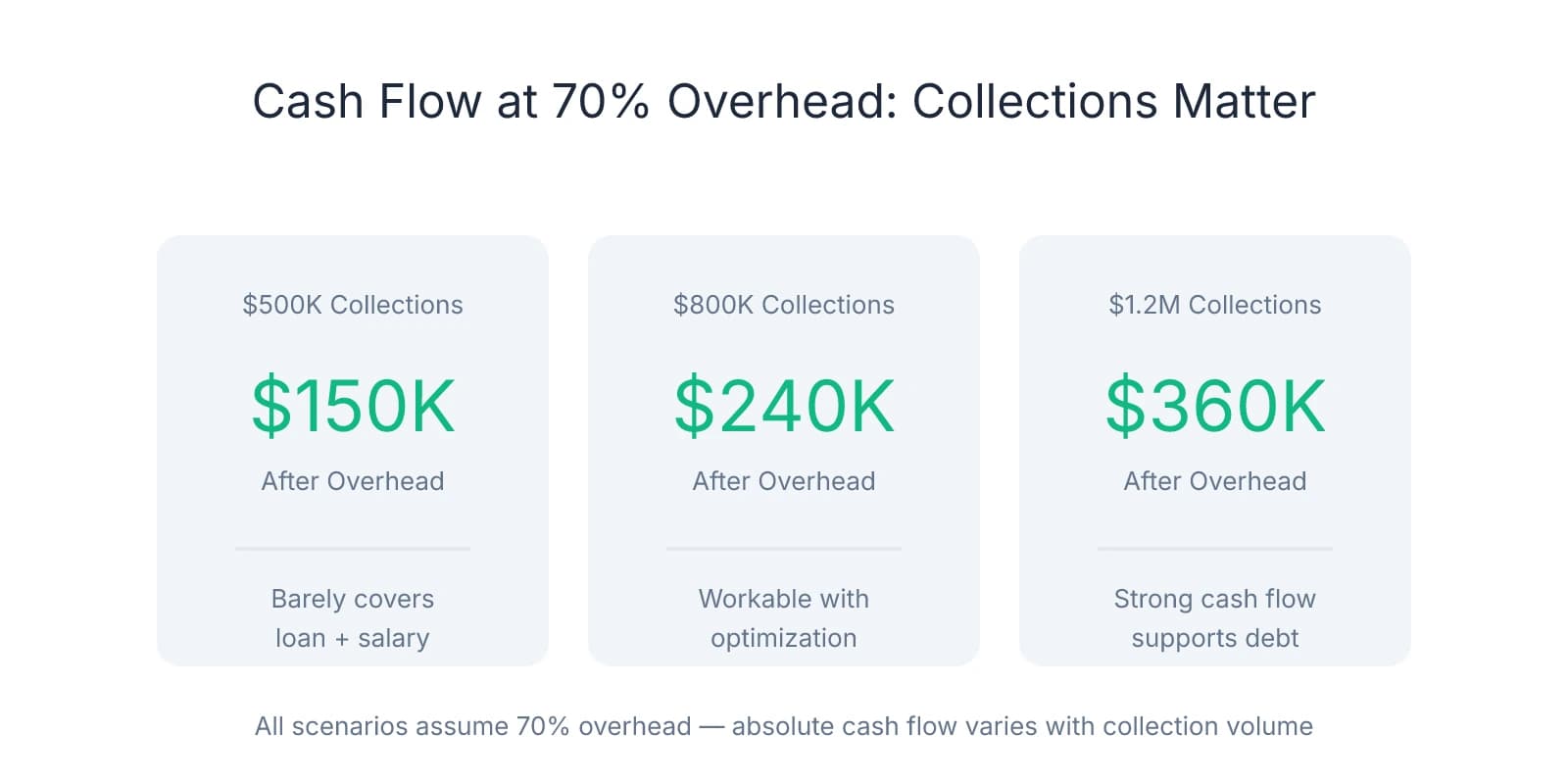
Start with the math. At 70% overhead, you're left with 30 cents of every collected dollar. A practice collecting $800,000 annually leaves you $240,000 before debt service. If your acquisition loan requires $120,000 in annual payments and you can live on $120,000 while you optimize expenses, the deal could work. But if you need $180,000 personally, or if debt service runs higher, you're underwater from day one—no matter how efficiently you operate.
A practice collecting $1.2 million at 70% overhead still leaves $360,000, which may support acquisition debt and a competitive salary. The same 70% overhead on $500,000 in collections leaves just $150,000—barely enough to service a typical practice loan, let alone pay yourself. This is why calculating your break-even point before you sign anything matters more than fixating on the overhead ratio.
Where overhead comes from determines whether you can fix it. Structural drivers—an expensive lease in a high-cost market, a patient base dominated by low-reimbursement PPO plans, or a location requiring premium staffing costs—are baked into the practice. Operational inefficiencies, on the other hand, respond to new management: overstaffing, poor purchasing contracts, outdated scheduling systems, and redundant technology subscriptions can all be addressed once you take over.
One pattern worth paying attention to: practices with high overhead often have one or two dominant cost categories driving the number up. Pull the profit-and-loss statement and look for line items that exceed industry norms. Dental supply costs should sit around 5-8% of collections—if you're seeing 12%, that's a vendor contract problem, not a structural flaw. Staff costs typically run 20-25% of collections; if they're pushing 35%, you're likely looking at overstaffing or inefficient scheduling, both of which you can address.
The decision to walk away or move forward hinges on whether the practice generates enough cash flow to service debt and pay you, and whether the high overhead is fixable or permanent. Run the numbers on absolute cash flow first, then assess whether the overhead drivers are within your control to change.
Where to Look When Overhead Runs High: The Expense Categories That Drive the Number
When overhead hits 70%, the first step is diagnosing where the money is going. Request a category-level P&L breakdown during due diligence—not just a single overhead percentage, but line-item expenses grouped by function. Most practices break down into four major cost buckets: staffing, facility, supplies and lab fees, and administrative expenses.
Staffing costs typically represent 25-30% of collections and include salaries, payroll taxes, and benefits. Anything above 30% warrants scrutiny. Pull the practice's scheduling data and compare staff hours to patient volume—many practices carry legacy employees whose hours no longer match production needs. If the practice runs two hygienists but schedules only 12-15 hygiene appointments per day, you're overstaffed. Wage benchmarks vary by market, but if you're paying $45/hour for a dental assistant in a region where $35/hour is standard, that gap compounds across every paycheck. Retaining staff through ownership transitions requires balancing continuity with operational efficiency—you can maintain team stability while right-sizing schedules to match patient flow.
Facility costs—rent, utilities, property taxes, and maintenance—should stay under 8% of collections in most markets. When you see 10-12%, dig into the lease terms. If the seller owns the building and charges the practice above-market rent, that's an add-back you can negotiate away. If the lease reflects a premium location in a high-cost urban core, that's structural—you inherit it, and it doesn't compress post-acquisition. One pattern that surfaces in high-overhead practices: sellers who signed long-term leases during peak market conditions and never renegotiated when rates softened. Pull comparable lease rates for similar square footage in the area to assess whether you have leverage to renegotiate or walk.
Supply and lab costs running above 8% and 10% respectively often point to poor vendor contracts or lack of buying group membership. Many solo practices order supplies ad hoc from multiple vendors, paying retail prices on everything from gloves to composite. Joining a group purchasing organization can cut supply costs by 15-20% without changing clinical quality. Lab fees above 10% may indicate the practice sends out work that could be done in-house with a CEREC or similar technology, or that the seller uses a premium lab when a mid-tier option would deliver comparable results. Request vendor invoices for the past 12 months and compare unit pricing to what buying groups offer.
Administrative expenses—software subscriptions, insurance premiums, marketing, and billing services—above 10% often reflect redundant systems or outdated processes. Many practices carry multiple software subscriptions that overlap in function: separate platforms for scheduling, billing, patient communication, and imaging when an integrated practice management system would consolidate costs. Insurance premiums vary by coverage, but if malpractice or general liability runs significantly above market, shop carriers during your first year. Marketing costs above 3-4% of collections may indicate the seller is paying for ineffective channels—print ads, direct mail campaigns that generate few new patients—rather than digital strategies with measurable ROI.
Before you calculate true overhead, request a recast P&L that removes add-backs—expenses the seller incurs that won't carry over to new ownership. Common add-backs include owner discretionary spending (continuing education trips, personal vehicle costs run through the business), excess rent if the seller owns the building, and above-market compensation for family members on payroll. A practice showing 72% overhead on the raw P&L may recast to 65% once you strip out $50,000 in owner discretionary expenses and $20,000 in excess rent. Questions to ask before buying should include a detailed walk-through of every add-back the seller claims.
The goal isn't to hit an arbitrary overhead target—it's to identify which expenses are compressible and which are fixed, then model whether the remaining cash flow supports your acquisition. A practice with 70% overhead driven by overstaffing and poor vendor contracts gives you room to optimize. The same percentage driven by a locked-in expensive lease and a PPO-heavy patient base leaves you with structural costs you can't escape. Overhead should be evaluated through both spending and collections lenses—cutting costs reactively without addressing revenue leakage won't fix the underlying problem.
The Overhead-to-Cash Flow Calculation: How to Determine If the Numbers Work for You
With the expense breakdown in hand, the next step is determining whether the practice generates enough cash after expenses and debt service to meet your income needs. Walk through the calculation step by step, using actual numbers from the practice you're evaluating.
Start with annual collections—the total revenue the practice actually collected, not what it produced. If the practice collected $900,000 last year, that's your starting point. Multiply collections by the overhead percentage to find total operating expenses: $900,000 × 0.70 = $630,000. Subtract overhead from collections to arrive at gross profit: $900,000 - $630,000 = $270,000. This is the pool of money available to service your acquisition debt and pay yourself.
Next, calculate your annual debt service—the total you'll pay toward your practice loan each year. Most buyers finance 80-90% of the purchase price through an SBA 7(a) loan. If you're buying the practice for $700,000 and putting 10% down, you're borrowing $630,000. SBA loan terms typically run 10 years at current rates around 7-8%. A $630,000 loan at 7.5% over 10 years requires roughly $89,000 in annual payments. Subtract that from your gross profit: $270,000 - $89,000 = $181,000 remaining for owner compensation before taxes.
Whether $181,000 works depends entirely on your personal financial situation. If you're single with minimal debt and can live comfortably on $120,000, you have $61,000 in cushion for tax obligations and reinvestment. If you're supporting a family, carrying $200,000 in student loans, and need $150,000 to cover living expenses, you're left with $31,000 before taxes—tight, but potentially workable if you can optimize overhead quickly.
Loan structure significantly affects your first-year cash flow. That same $630,000 loan stretched over 15 years instead of 10 drops annual payments to roughly $70,000—freeing up an extra $19,000 per year. The tradeoff is paying more interest over the life of the loan, but many buyers prioritize lower payments in the early years when cash flow is tightest. Understanding how working capital fits into your loan structure matters here—some lenders bundle working capital into the loan, others require it as separate cash reserves.
Now layer in the direction of collections. A practice collecting $900,000 at 70% overhead with flat or declining revenue over the past three years signals a shrinking patient base. High overhead paired with declining collections is a red flag: you inherit both the cost structure and the revenue problem, and fixing overhead won't matter if you can't stabilize production. Pull three years of collections data and calculate year-over-year growth.
Contrast that with a practice collecting $900,000 at 70% overhead but showing 5-8% annual growth. High overhead with strong, stable collections often means the seller hasn't optimized expenses—overstaffing, expensive lease, poor vendor contracts—but the patient base is healthy and production is solid. That's an optimization opportunity, not a structural flaw.
Finally, factor in working capital needs for your first 6-12 months. Even if the math shows $181,000 available for owner compensation, you won't see that cash evenly distributed. Payroll hits every two weeks. Rent is due monthly. Supply orders can't wait. If you're running tight on cash flow—say, $15,000 per month after debt service—you need reserves to cover gaps during the transition when collections may dip or expenses spike. Most buyers need $30,000-$50,000 in working capital to bridge the first few months while patient flow stabilizes.
Run the numbers with your actual income needs, loan terms, and working capital requirements before you decide whether 70% overhead is a problem you can solve or a constraint you can't escape.
What You Can Fix After Closing—and What You Can't
The distinction between fixable and structural overhead determines whether a 70% practice becomes profitable under your ownership or stays expensive indefinitely. Some cost drivers respond to operational discipline—renegotiating contracts, optimizing schedules, eliminating waste. Others are baked into the practice's location, lease terms, or patient demographics.
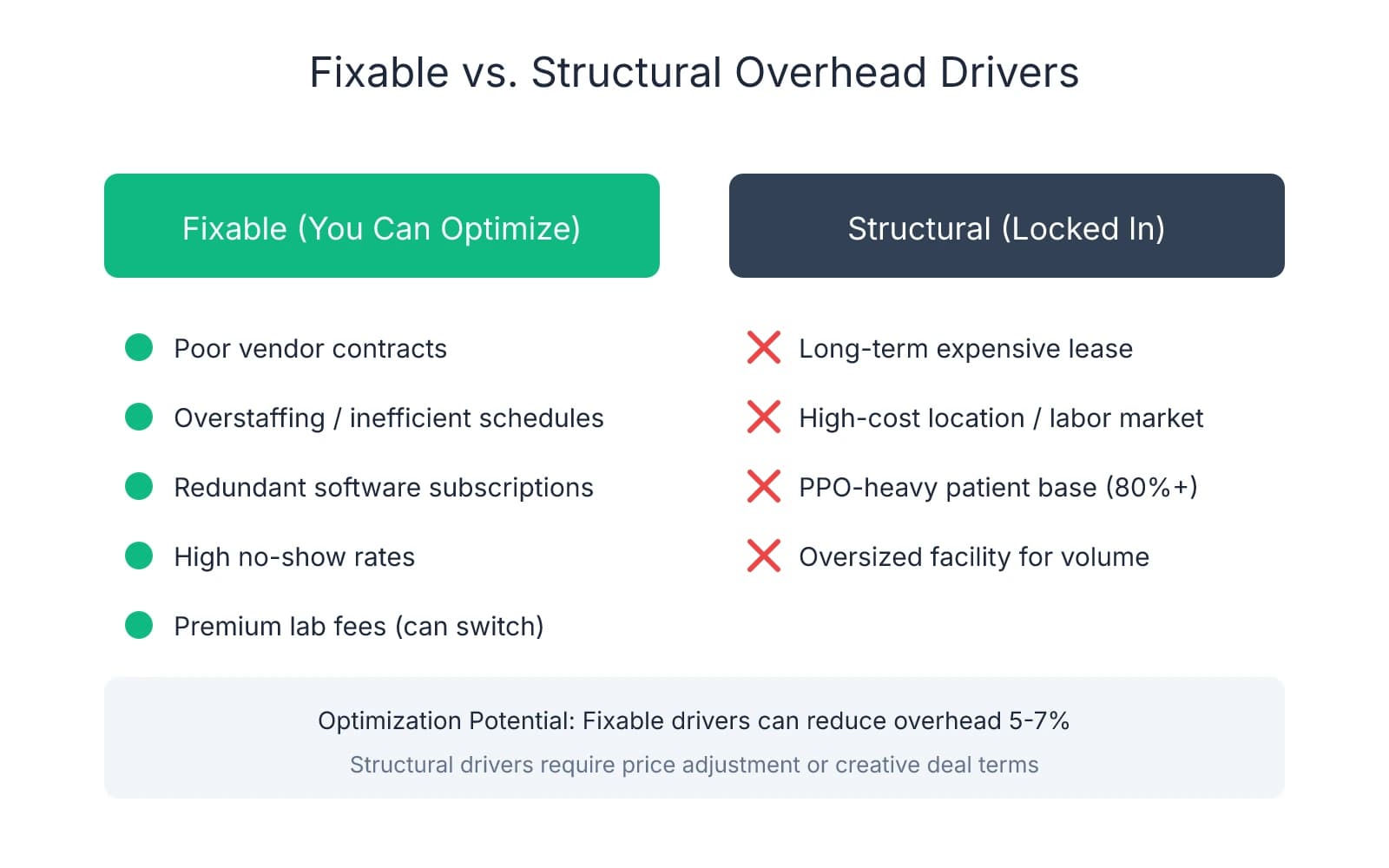
Start with what you can control. Vendor contracts for supplies and lab work rarely get renegotiated by sellers who've used the same vendors for a decade. Joining a group purchasing organization like Dental Gator or Benco Dental can cut supply costs by 15-20% without changing clinical quality—on a practice spending $70,000 annually on supplies, that's $10,500-$14,000 back in your pocket. Lab fees respond to similar pressure: if you're sending crown and bridge work to a premium lab charging $300 per unit when a mid-tier lab delivers comparable results at $220, switching vendors saves $80 per crown. Over 100 units per year, that's $8,000.
Staffing inefficiencies surface quickly once you track hours against production. Pull scheduling data for the past six months and compare staff hours to patient volume. If you're running two full-time hygienists but scheduling only 12-15 hygiene appointments per day, you're overstaffed—one hygienist plus a part-time backup would cover the load. Reducing one full-time hygienist from 40 hours to 24 hours per week saves roughly $25,000 annually in wages and benefits. Staff retention during ownership changes requires thoughtful communication and fair treatment, but it doesn't mean inheriting inefficient schedules—realigning hours to match patient flow is standard practice management.
Redundant software subscriptions pile up when practices add tools without retiring old ones. Review every software line item on the P&L and ask whether the tool delivers measurable value. If you're paying $400/month for a patient communication platform that sends automated reminders but your no-show rate hasn't improved, that's $4,800 annually you can reallocate. Practices with outdated technology stacks often pay for legacy systems they no longer use but never canceled.
Scheduling inefficiencies that create gaps, no-shows, and underutilized chair time directly inflate overhead as a percentage of collections. If your schedule runs with 20% no-show rates and you're not filling those slots with same-day patients, you're losing production while fixed costs—rent, staff wages, utilities—stay constant. Implementing a short-call list, tightening recare protocols, and using automated reminders can reduce no-shows to 8-10%, which adds $50,000-$80,000 in annual collections to a $900,000 practice without increasing expenses. That improvement alone drops overhead from 70% to 66-67%.
Operational discipline alone—tracking metrics monthly, negotiating contracts annually, optimizing staffing to match patient flow—can reduce overhead by 5-7 percentage points over 12-18 months. On a practice collecting $1 million annually, bringing overhead from 70% to 64% adds $60,000 to your bottom line.
Now consider what you can't fix quickly. Above-market leases with years remaining on the term don't renegotiate until renewal. If the practice is locked into $8,000/month rent for three more years when comparable space leases for $5,500, you're carrying $30,000 annually in excess facility costs—and there's no immediate fix. When landlords won't cooperate, your options narrow to waiting out the term or relocating, both of which take time and capital.
High-cost locations with premium labor markets don't compress. If you're buying a practice in a metro area where hygienists command $55/hour and assistants earn $25/hour, those wages reflect local market rates—not seller inefficiency. You can optimize scheduling to reduce total hours worked, but you can't pay below-market wages and expect to retain staff.
PPO-heavy patient bases with low reimbursement rates take years to shift. If 80% of the practice's revenue comes from PPO plans reimbursing at 60-70% of UCR fees, you inherit that payor mix and the margin compression it creates. Dropping insurance contracts is possible, but it requires building a fee-for-service patient base first—most buyers can't afford to cut PPO revenue immediately without replacing it.
Oversized facilities relative to patient volume create fixed costs you can't escape. If the practice occupies 3,500 square feet with six operatories but schedules only three chairs consistently, you're paying rent, utilities, and maintenance on unused space. Downsizing requires relocating, which means new build-out costs, patient communication, and potential volume loss during the transition.
Before you commit, calculate the optimized overhead scenario: if you can realistically bring expenses from 70% to 65% within 18 months through vendor negotiations, staffing adjustments, and scheduling improvements, does the improved cash flow justify the acquisition? On a practice collecting $1 million, reducing overhead to 65% adds $50,000 annually—enough to cover higher debt service or increase owner compensation.
If high overhead is structural—locked-in expensive lease, high-cost location, PPO-dominated patient base—and cash flow is already tight, the practice may require a price adjustment or creative deal structure to reduce your risk. Earnout agreements that tie part of the purchase price to future performance, or seller notes that defer payments until you've optimized operations, shift risk away from you and give you breathing room to fix what's fixable. Negotiating beyond price becomes critical when the numbers are tight and the overhead drivers are mixed.
The decision framework is straightforward: if the fixable expenses can bring overhead into the 60-65% range and the practice generates sufficient cash flow during the optimization period, it may be worth buying. If the high overhead is structural, the cash flow is already tight, and you're inheriting cost drivers you can't change, the risk is high—and the price should reflect that reality.
Sources & References
The data and claims in this article are drawn from the following sources. We prioritize government data, peer-reviewed research, and established industry publications to ensure accuracy.
- Four Surprising Reasons Why a Dental Practice's Overhead May Be ...— www.pkfod.comIndustry
- Average Dental Practice Overhead: Benchmarks and Insights - Overjet— overjet.comIndustry
- 6 Steps to Reduce Dental Practice Overhead — Without Sacrificing ...— tttdental.com.hk
- If Overhead Is High, Where Should I Look Before Cutting Costs ...— www.youtube.com
- SBA loan terms typically run 10 years at current rates around 7-8%— sba.gov
- Ask the Expert: Practical strategies to reduce dental practice expenses— adanews.ada.orgIndustry
Frequently Asked Questions
Find Your Ideal Practice Overhead Fit
Whether you're concerned about overhead costs or seeking guidance on evaluating practice financials, Minty Plus provides expert acquisition support to help you navigate the numbers and find a practice that aligns with your goals.