How Much Should I Spend on Marketing First Year Owning a Practice?

Co-Founder, Minty Dental

In Summary
- Industry benchmarks of 4-7% assume steady operations, but first-year buyers face a unique challenge: protecting an inherited patient base during ownership transition, not just maintaining steady growth
- Your actual spend depends on what you bought: a full schedule with strong retention needs 3-4% focused on patient communication, while open capacity or seller departure risk requires 6-8% for new patient acquisition
- The first 90 days post-closing carry the highest patient attrition risk—underfunding marketing during this window can erode the asset value you just financed
- Retention-mode marketing (patient newsletters, transition announcements, reputation management) costs less than growth-mode campaigns (paid search, direct mail, new patient offers) but protects immediate revenue
Your Marketing Budget Depends on What You Inherited, Not Industry Averages
Most guidance on dental practice marketing budgets starts with industry benchmarks of 4-7% of collections. That range works for established practices in steady-state operations. But as a first-year buyer, you're not managing steady state. You're managing transition risk.
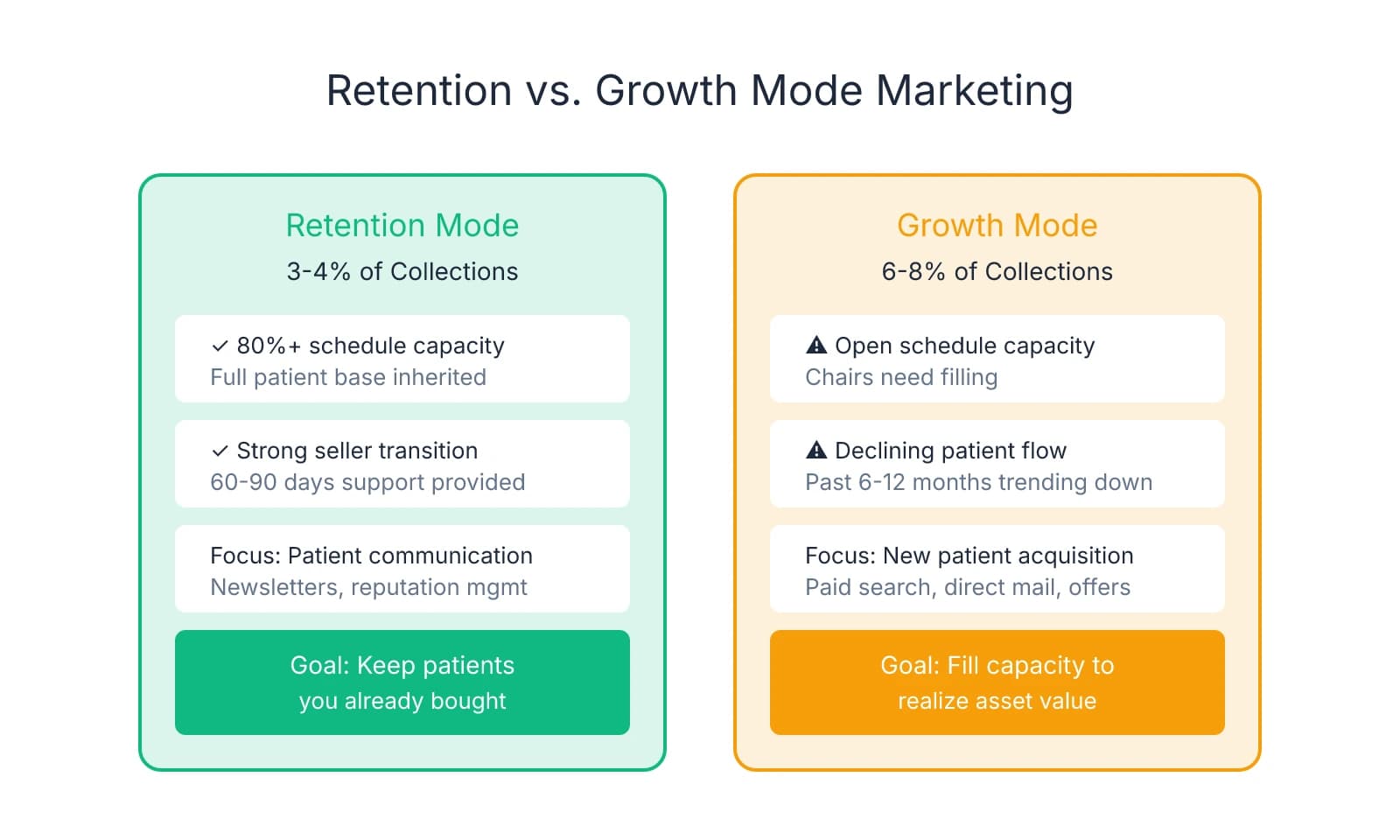
The patients you just financed didn't choose you. They chose the seller. Some will stay because the care is good and the location is convenient. Others will leave because they had a personal relationship with the previous owner. Your marketing budget needs to reflect which scenario you're navigating.
Start by assessing what you inherited. If the practice runs at 80%+ schedule capacity, the seller provided 60-90 days of structured transition support, and patient flow has been stable over the past 12 months, you're in retention mode. Your job isn't to fill the schedule—it's to keep the patients you bought. That means your marketing spend focuses on communication: transition announcements, patient newsletters, reputation management, and visibility in the channels where your existing base already engages. A retention-focused budget often runs 3-4% of collections.
If the practice has open capacity, declining patient flow over the past 6-12 months, or the seller left abruptly with minimal transition support, you're in growth mode. The asset you bought has revenue potential, but you need to fill chairs to realize it. That requires new patient acquisition: paid search, direct mail, new patient offers, and potentially partnerships with referring providers. Growth-mode marketing typically requires 6-8% of collections or more, depending on market competitiveness and how much capacity you need to fill.
The first 90 days post-closing are the highest-risk period for patient attrition. This is when patients decide whether to stay or start looking elsewhere. Many buyers underestimate how many patients leave during ownership transitions, and going dark on marketing during this window accelerates the problem. Even if your long-term budget sits at 5%, front-loading spend in the first quarter protects the asset you just financed. A patient who leaves in month two represents lost revenue for the entire loan term.
One pattern worth noting: buyers who assume the seller's reputation will carry them often underfund marketing in year one, then scramble in year two when revenue hasn't met projections. The opposite mistake—spending aggressively without knowing whether you need retention or acquisition—burns cash without protecting the base. The right budget starts with an honest assessment of what you bought and what the transition actually looks like.
Calculate What Your Cash Flow Can Actually Support
Before you commit to any marketing percentage, run the actual cash flow math. Start with projected monthly collections—use the trailing twelve-month average from the seller's financials, not the best month or the number the broker highlighted. From that figure, subtract debt service first. If you financed $800K at 7% over ten years, you're paying roughly $9,300/month, or about $112K annually. That's 14% of collections if the practice does $800K/year, closer to 9% if it does $1.2M. Debt service typically runs 8-12% of the purchase price annually.
Next, subtract payroll. For most general practices, total payroll—including hygienists, assistants, front desk, and your own compensation—runs 30-35% of collections. Then subtract supplies and lab fees (typically 12-15% of collections) and fixed overhead: rent, utilities, insurance, software subscriptions. A practice collecting $80K/month with $6K in loan payments, $26K in payroll, $11K in supplies and lab, and $7K in fixed costs has about $30K in gross margin before owner compensation. If you're taking $12K/month as owner draw, that leaves $18K in discretionary budget.
Marketing at 5% of $80K collections would be $4K/month—roughly 22% of your available margin after owner compensation. That's the real constraint. Marketing doesn't just compete with other expenses—it competes with equipment upgrades, technology investments, emergency reserves, and your ability to weather a slow month without missing payroll.
Many first-year owners cut marketing when cash flow tightens, but this creates a delayed revenue problem. Most marketing channels have a 60-90 day lag between spend and patient conversion. If you pause campaigns in month three because collections dipped, you'll see the impact in months five and six when the pipeline dries up.
Model this during due diligence, not after closing. Pull the seller's P&L, plug in your projected debt service and owner compensation, and calculate what's left for discretionary spending. If the math shows you'll have $2K/month for marketing but the practice needs growth-mode investment, that's a signal to renegotiate the purchase price, increase your down payment to lower debt service, or plan for a lower owner draw in year one.
One framework that helps: calculate your breakeven patient count. If your average patient generates $400/year in production and your monthly operating expenses (including debt service and owner draw) total $70K, you need 175 active patients producing consistently just to cover costs. If your inherited base is 800 patients but only 400 are active, you know exactly how much growth you need—and whether your cash flow can fund the marketing required to get there.
Where to Allocate Your First-Year Marketing Budget
Once you know what you can spend, the next decision is where to deploy it. The right allocation depends on whether you're protecting an inherited patient base or filling open capacity—and it starts with funding the essentials that keep the practice visible and operational.
Baseline digital presence typically absorbs 30-40% of your budget. This includes Google Business Profile optimization, website hosting and maintenance, and a patient communication platform for recalls and appointment reminders. If your Google Business Profile isn't claimed, updated with accurate hours, and actively collecting reviews, you're invisible in local search. If your website hasn't been updated since 2018 or doesn't load properly on mobile, patients assume the practice is outdated or closed.
For a practice with a $4,000 monthly marketing budget, this baseline might look like $400/month for website hosting and updates, $600/month for a patient communication platform with automated recalls and two-way texting, and $500/month for reputation management and local SEO work. That's $1,500 total. It's not glamorous, but it's the infrastructure that keeps existing patients engaged and makes you discoverable when someone searches "dentist near me."
Retention and reactivation should take another 30-40% of your budget in year one. Acquiring a new patient costs 5-7 times more than retaining an existing one, and existing patients refer at higher rates. A reactivation campaign targeting patients who haven't scheduled in 12-18 months—via email, text, or a limited-time hygiene offer—often converts at 15-20%. That's significantly higher than cold acquisition.
Internal referral programs cost almost nothing to run but require structure. One approach: offer existing patients a $50 credit for every new patient they refer who completes treatment. If 5% of your active base refers one patient per year, that's 20 new patients for $1,000 in credits—far cheaper than paid ads. Patient experience improvements that drive word-of-mouth—like a welcome email series explaining your clinical approach, or a post-appointment follow-up text—don't show up as line items in your marketing budget, but they directly affect retention and referral rates.
In a $4,000/month budget, allocate $1,500 here: $800 for email and SMS campaigns to inactive patients, $400 for referral program credits, and $300 for patient experience tools like post-visit surveys or birthday messages.
Local visibility takes 20-30% of the budget. This includes ongoing local SEO work—ensuring your practice appears in the top three results for "dentist in [city]" searches—and managing your presence across directories like Healthgrades, Zocdoc, and Yelp. It also covers community engagement: sponsoring a local youth sports team, participating in health fairs, or partnering with nearby pediatricians and orthodontists for referrals.
For a $4,000 budget, this might be $800/month: $500 for local SEO and directory management, $300 for community sponsorships or events. The ROI here is slower but compounds—patients who find you through local search or a referral from their pediatrician tend to stay longer and refer more than patients who clicked a Facebook ad.
New patient acquisition through paid channels should be 0-20% of your budget in year one—and only if you have open capacity. Google Ads and Facebook ads work, but cost per new patient often runs $300-800 depending on your market. If your schedule is already 75% full and your average new patient generates $1,200 in lifetime value, paid ads can make sense. But if you're still stabilizing the base and don't have chair time to absorb new patients, you're paying for leads you can't convert.
In a $4,000 budget with open capacity, you might allocate $1,000/month to paid search targeting high-intent keywords like "emergency dentist near me" or "dentist accepting new patients [zip code]." Track cost per lead and cost per completed appointment religiously. If you're spending $600 to acquire a patient who shows up once and doesn't return, the channel isn't working.
One allocation model that works for a $4,000/month budget: $1,500 to digital presence and patient communication, $1,500 to retention and reactivation, $1,000 to local SEO and reputation management, and $0-500 to paid acquisition depending on capacity. This protects the base, keeps you visible locally, and avoids burning cash on expensive ads before you've maximized the revenue from patients you already have.
What to Defer Until Year Two (and What Never to Cut)
When cash flow tightens in year one—and it will—the instinct is to cut marketing entirely. But not all marketing spend is equal. Some expenses protect the asset you financed. Others drive growth you can defer.
Never cut patient recall and communication systems. Automated appointment reminders reduce no-shows. Recall campaigns bring patients back for hygiene visits. Two-way texting lets patients reschedule without calling during business hours. If you shut these down to save $600/month, you're not cutting marketing—you're cutting patient retention. A practice that loses 10% of its active base because patients forgot to schedule has lost far more revenue than the cost of the platform. Retaining existing patients costs 5-7 times less than acquiring new ones.
Never cut Google Business Profile management or website uptime. If your practice doesn't appear in local search results, you're invisible to patients looking for care. If your website is down or hasn't been updated in two years, patients assume the practice is closed or neglected. Budget $400-600/month for hosting, security updates, and local SEO monitoring. That's not optional.
Never cut reputation management. Reviews drive patient decisions. A practice that stops responding to feedback or monitoring its online presence during the first year risks accumulating negative reviews without rebuttal. One unaddressed complaint on Google can cost you dozens of potential patients who never call.
Safe to defer: paid advertising campaigns. Google Ads, Facebook ads, and direct mail drive new patient acquisition, but they're expensive and they require capacity. If your schedule is already 70% full or your cash flow can't support $800/month in ad spend, pause these channels. You're not losing existing patients by going dark on paid search—you're just not accelerating growth. The risk is that you defer too long and find yourself with open capacity in month nine, at which point you're restarting campaigns from scratch and waiting 60-90 days for the pipeline to fill.
Safe to defer: social media management and content marketing. Posting three times per week on Instagram and publishing blog articles might build long-term brand equity, but they don't protect immediate revenue. If you're paying $1,200/month for a social media manager and your schedule is stable, that budget can move to retention or be banked as reserve. Restart it in year two when cash flow stabilizes.
Safe to defer: expensive branding projects. New logos, office redesigns, and printed collateral can wait. Patients care more about whether you answered the phone and got them in quickly than whether your business cards match your website. If a branding agency is pitching a $15K rebrand in your first six months, defer it.
If cash flow forces cuts, eliminate new patient acquisition spend first and protect retention spend last. Losing existing patients is far more expensive than delaying growth. A patient who leaves in month four represents lost revenue for the life of your loan. A new patient you didn't acquire in month four just means your growth timeline extends by a quarter.
Track leading indicators monthly to know whether your spend is working. Revenue lags marketing by 60-90 days, so don't judge ROI based on immediate collections. Instead, track new patient call volume, appointment conversion rate, reactivation response rate, and online review volume. If new patient calls dropped from 40/month to 20/month after you paused paid ads, you know the channel was working. If reactivation emails are converting at 18% and generating six appointments per campaign, you know that spend is protecting revenue.
Marketing spend in months 1-3 drives revenue in months 3-5. If you cut marketing in February because January collections were soft, you'll see the impact in April and May when the pipeline runs dry. Many first-year owners panic and cut spend based on a single slow month, then face a deeper revenue gap two months later. The way out is to protect baseline marketing even when cash flow feels tight.
By month 6-9, evaluate whether to increase spend based on schedule capacity. If your schedule is consistently full and you're turning away patients or booking three weeks out, additional marketing spend is wasted. If your schedule still has gaps and patient flow hasn't recovered to pre-sale levels, you're likely underspending. The right budget isn't static—it adjusts based on whether the practice is hitting capacity or still has room to grow.
One decision framework that helps: if cutting a line item would make it harder for existing patients to stay engaged or find you, don't cut it. If cutting it just means fewer new patients in the pipeline, it's safe to defer. The practice you bought has value because it has patients. Protect that base first. Growth can wait until year two.
Sources & References
The data and claims in this article are drawn from the following sources. We prioritize government data, peer-reviewed research, and established industry publications to ensure accuracy.
- How Much Should You Invest in Marketing Your Dental Practice?— www.dentistrytoday.comIndustry
- How to Retain Patients When Buying or Joining a Practice— ada.orgIndustry
- Most marketing channels have a 60-90 day lag between spend and patient conversion— dentaleconomics.com
- Google Business Profile optimization— support.google.com
- Examining the ROI of Patient Retention vs. New Patient Acquisition— www.dentalintel.com
- The Most Effective Dental Marketing Strategies for Maximum ROI in ...— nexusdentalsystems.comIndustry
Frequently Asked Questions
Ready to launch your new practice?
Navigating marketing budgets is just one piece of owning a dental practice. Minty Plus provides comprehensive guidance through your first year of ownership, helping you make smart investments in growth and profitability from day one.