How to tell your boss you're leaving to start your own practice

Co-Founder, Minty Dental

In Summary
- Your employment contract—not professional courtesy—dictates when you can legally leave, with most requiring 60-90 days written notice and containing provisions that affect final pay, bonus clawback, non-compete activation, and malpractice tail coverage
- Resign in person with a brief written letter stating your last day; frame your departure around ownership goals rather than dissatisfaction, and avoid disclosing deal specifics that could trigger non-compete challenges
- Patient non-solicitation clauses prohibit you from encouraging transfers even when patients ask where you're going—document every interaction and avoid providing practice details until your employment officially ends
- Time your resignation around financing approval or purchase agreement execution rather than LOI signing; resigning too early leaves you exposed if the deal collapses
Your Employment Contract Controls When—and How—You Can Leave
Before you rehearse what you'll say to your boss, pull out your employment agreement. That document—not your relationship with the practice owner—has already determined much of what happens when you resign. The notice period, non-compete radius, patient non-solicitation clause, and termination provisions all dictate the conversation you're about to have.
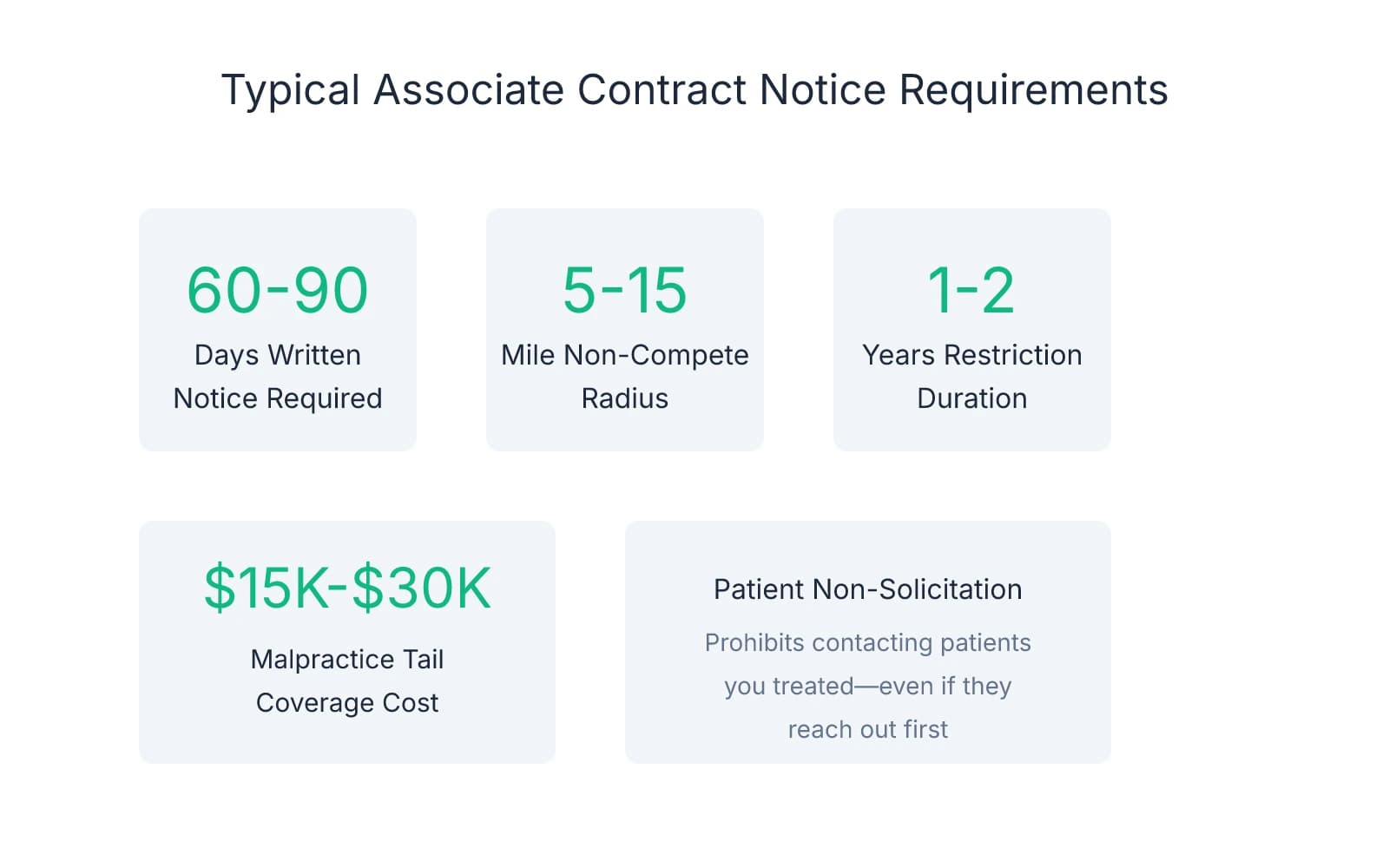
Most dental associate contracts require 60-90 days written notice before resignation. This isn't courtesy—it's a contractual obligation. Miss it, and you may forfeit final compensation, trigger bonus clawback provisions, or activate restrictive covenants that weren't otherwise enforceable. Some agreements tie notice requirements to specific compensation structures: if you're on a production-based model with quarterly reconciliation, leaving without proper notice can mean walking away from collections you've already earned.
Start by identifying the termination section of your contract. Look for language defining "voluntary termination," "resignation," or "termination without cause." Many contracts specify that notice must be in writing and delivered to a specific person or address. Some require notice during business hours or via certified mail. These procedural requirements matter—if the contract says 90 days and you give 60, you're in breach regardless of how reasonable your timeline feels.
Next, review what happens to your compensation after you resign. Does your base salary continue through the notice period? Are you still eligible for production bonuses on work completed before departure? Some contracts include clawback provisions allowing the practice to recoup signing bonuses, relocation stipends, or continuing education reimbursements if you leave within a certain timeframe. One pattern that catches many buyers off guard: contracts tying final pay to completion of all outstanding treatment plans, which can delay your last paycheck by months.
The non-compete clause deserves close attention. In most states, non-competes are enforceable if reasonable in scope, duration, and geographic radius. A typical dental non-compete restricts you from practicing within 5-15 miles of the current practice for 1-2 years after departure. But enforceability varies widely—some jurisdictions limit or void non-competes entirely, while others enforce them aggressively. If you're buying a practice within the restricted radius, you need to know whether that clause will hold up before you sign an LOI.
Patient non-solicitation clauses operate separately from non-competes and are often more enforceable. These provisions prohibit you from contacting patients you treated at the practice, even if they reach out first. The risk is subtle: if patients follow you organically, the seller may claim you violated the non-solicitation clause and pursue damages. Many buyers underestimate how this affects the transition—especially in smaller communities where patient loyalty runs deep.
Malpractice tail coverage is another termination trigger rarely discussed until too late. Most associate agreements specify that the practice's malpractice policy covers you only while employed. Once you leave, you need tail coverage to protect against claims arising from treatment you provided during employment. Some contracts require the practice to pay for tail coverage; others make it your responsibility. Tail policies can cost $15,000-$30,000 depending on your claims history and coverage limits. If your contract is silent on who pays, assume it's you.
The timing of your resignation relative to the acquisition timeline determines whether you're protected if the deal collapses. Many buyers assume they should resign once they sign the letter of intent, but that's often too early. The LOI is non-binding—financing can fall through, due diligence can uncover deal-breaking issues, and sellers can walk away. A safer approach is timing your resignation around financing approval or purchase agreement execution, which gives you more certainty the deal will close.
Before you make any decisions, consult a healthcare employment attorney who practices in your state. Contract enforceability varies by jurisdiction, and what's standard in one state may be unenforceable in another. An attorney can review your termination provisions, assess the non-compete's validity, and help you structure a resignation timeline that minimizes risk. This review should happen before you sign an LOI—not after you've committed to a deal and realized your contract won't let you leave on the timeline you need.
The Conversation Itself: What to Say and What to Leave Out
With your contractual obligations mapped and your timeline aligned with the deal's closing schedule, the actual resignation meeting requires deliberate framing. This conversation sets the tone for how you'll be remembered in the community you're about to serve as an owner.
Request an in-person meeting with your supervising dentist. Email and text resignations feel dismissive, and in a profession built on relationships, the medium matters. Schedule the meeting early in the week, ideally when the practice isn't in the middle of patient care. Bring a brief, professional resignation letter stating your last working day and referencing your contract's notice period. The letter doesn't need to explain your reasons—it's a formal record, not a narrative. One sentence works: "I am writing to formally resign from my position as Associate Dentist, effective [date], in accordance with the 90-day notice requirement outlined in my employment agreement."
Frame your departure around professional growth and ownership goals, not dissatisfaction with the current practice. The distinction matters because you may need this relationship as a referral source, professional reference, or collaborative partner on complex cases. Instead of listing grievances, focus on what you're moving toward: "I've decided to pursue practice ownership, and I've found an opportunity that aligns with that goal." This framing keeps the conversation forward-looking and removes any implication that the resignation reflects poorly on your current employer.
Avoid disclosing deal specifics, practice location, or timeline details that could complicate your non-compete or create competitive tension. Many buyers assume transparency builds goodwill, but in practice, it often backfires. If the practice you're buying is within your non-compete radius, revealing the location gives your current employer information they can use to challenge the deal. When asked where you're going, a neutral response works: "I'm still finalizing the details, but I'll make sure patients are transitioned appropriately."
Prepare responses to predictable questions about patient transitions, your new location, and whether you're "taking" anyone with you. Most employers will ask these questions to assess risk. On patient transitions, emphasize continuity of care: "I'll work with you to ensure every patient has a clear plan, and I'll complete any treatment in progress before my last day." On location, stay vague unless your contract requires disclosure: "I'm exploring a few options, but nothing I can share yet." On staff, be direct: "I'm not recruiting anyone—this is my decision, not theirs."
The dental community is smaller than most buyers expect, and word travels quickly through study clubs, CE courses, and informal networks. What you say in this meeting will likely reach other dentists, specialists you refer to, and patients who ask where you went. Maintaining professionalism protects your reputation as you transition into ownership.
One pattern worth noting: many buyers feel compelled to over-explain their decision, as if justifying the resignation will soften the impact. It doesn't. The more you explain, the more you invite questions, pushback, or attempts to negotiate a counteroffer. A clear, respectful statement of intent—delivered in person, supported by a written letter, and focused on your professional goals—gives your employer the information they need without creating friction.
Managing Patient Relationships Without Violating Your Agreement
The most legally sensitive part of your departure isn't the resignation conversation—it's what happens in the weeks after, when patients ask where you're going. Many buyers assume patient loyalty is a compliment they can accept freely, but most associate contracts include non-solicitation clauses that turn those conversations into legal exposure.
Patient non-solicitation provisions typically prohibit you from encouraging, inviting, or directing patients to transfer to your new practice. What they can't do—in most jurisdictions—is prevent patients from independently choosing to find you. The distinction matters because it defines what you can and can't say when a patient asks, "Where are you going?" A direct answer with your new practice name and location can be interpreted as solicitation, even if the patient initiated the question. A safer response acknowledges their loyalty without providing actionable information: "I really appreciate that you're asking. Dr. [Name] will make sure you're taken care of, and the practice will help you with any transition you need."
Where many buyers misstep is in the follow-up. A patient who asks once may ask again, or mention they'd like to stay with you, or request your contact information. Each interaction creates a record—and if your former employer later claims you solicited patients, those records become evidence. One protection many buyers overlook is documenting every patient interaction during the notice period. Keep a log of who asked where you're going, what you said, and whether they requested transfer information. If a dispute arises, contemporaneous notes showing you declined to provide practice details carry more weight than your memory six months later.
The risk escalates when patients ask front desk staff, hygienists, or other team members about your departure. You can't control what they say, but you can clarify expectations with the practice owner during your resignation meeting. Ask how the practice plans to communicate your departure to patients and whether there's a standard script for staff to use. This ensures everyone understands the legal boundaries so patients don't receive conflicting or legally problematic information from different sources.
Treatment continuity is both an ethical obligation and a contractual one. Most associate agreements require you to complete ongoing treatment plans or transition them to another provider before your last day. Abandoning a patient mid-treatment—even if you're leaving the practice—can trigger state dental board complaints and malpractice exposure. If you've started a crown prep, placed an implant, or begun ortho treatment, you're responsible for ensuring that work is completed or properly handed off.
One scenario that catches buyers off guard: patients who refuse to see another dentist and demand you finish their treatment after you've left. Your obligation here is to continuity of care, not to the patient's preference. If you've provided appropriate notice and the practice has made another qualified dentist available, you've met your duty. Returning to your former practice to complete treatment after your employment ends can violate your non-compete and signal to your former employer that you're still treating "their" patients—which strengthens any claim that you solicited them.
Patients belong to the practice, not to the treating dentist, which means the owner must ensure continuity of care regardless of who leaves. If patients are dissatisfied with the transition, their recourse is with the practice—not with you personally, assuming you've fulfilled your contractual obligations. This distinction protects you from liability claims that arise after your departure, as long as you've documented your handoff and completed or transitioned all active treatment.
Where buyers often get burned is in underestimating how patient loyalty affects their former employer's perception of solicitation. If 30 patients transfer to your new practice within six months of your departure, your former employer may assume you actively recruited them—even if you didn't. The burden of proof in a non-solicitation dispute often falls on you, which is why documenting your compliance during the notice period matters.
One final consideration: if you're buying a practice in the same community, patient questions about your departure will continue long after you've left. Patients will ask mutual acquaintances, check social media, or simply search your name and find your new practice. You can't prevent organic discovery, but you can avoid actions that look like solicitation—posting your new practice location on social media before your notice period ends, sending farewell emails with your new contact information, or telling patients "I can't say where I'm going, but you can find me if you look." The safest path is silence until your employment officially ends and your non-solicitation period expires.
Protecting Your Transition When the Deal Timeline Shifts
Deal timelines in dental practice acquisitions shift more often than they hold. Financing can take 60-90 days or longer depending on lender workload and documentation requirements, due diligence can uncover issues that need resolution before closing, and sellers can request extensions for personal or financial reasons. If you've already given notice and the closing date moves, you're managing a gap between when you're contractually obligated to leave and when you can legally start at your new practice.
One option is negotiating an extension to your notice period. If your contract requires 90 days and closing is delayed by three weeks, ask your current employer whether you can extend your departure date. Frame this as continuity of care: "The closing timeline has shifted slightly, and I'd like to ensure we don't leave any treatment plans incomplete. Would it be possible to extend my last day to [new date]?" Most practice owners prefer a known departure date over an abrupt exit.
If extending your notice period isn't viable—or if the delay stretches beyond a few weeks—explore whether you can negotiate a short-term consulting or per diem arrangement. This keeps you employed, maintains your income, and avoids the gap that triggers questions from patients and staff. The structure matters: a consulting agreement should specify your availability, compensation, and scope of work so it doesn't inadvertently extend your non-compete or create new restrictive covenants.
The harder scenario is when the deal collapses entirely after you've resigned. This happens more often than buyers expect—financing falls through, due diligence reveals undisclosed liabilities, or the seller decides not to sell. If you've already given notice and your last day is approaching, you're facing unemployment with no new practice to transition into. One protection is waiting until financing is conditionally approved and the purchase agreement is signed before submitting notice. This doesn't eliminate risk entirely—deals can still fall apart after the purchase agreement—but it reduces the likelihood that you'll be caught without a position.
If you do find yourself in this position, assess your options immediately. Can you withdraw your resignation if the deal hasn't closed yet? Some employers will allow this if you're still within the notice period and they haven't hired a replacement. If withdrawal isn't possible, start looking for bridge employment—locum tenens work, temporary associate positions, or per diem opportunities that keep you practicing while you regroup.
The financial exposure is significant. If you're between practices for even a few months, you're covering student loan payments, living expenses, and potentially COBRA health insurance without income. One pattern worth paying attention to: buyers who resign before financing is approved often do so because they're worried about losing the deal if they don't show commitment. But sellers and brokers understand that buyers need financing certainty before they can leave their current position—pushing you to resign early is a red flag, not a standard expectation.
Where buyers protect themselves most effectively is by building contingency language into the LOI or purchase agreement. A financing contingency allows you to walk away if your lender denies the loan or changes the terms materially. A due diligence contingency gives you an exit if you discover issues that weren't disclosed upfront. These provisions don't prevent deal delays, but they give you legal grounds to terminate the agreement without penalty if the timeline becomes unworkable.
The timing decision ultimately comes down to risk tolerance. Resigning before financing approval and the purchase agreement is signed exposes you to the possibility of being unemployed if the deal collapses. Waiting until after those milestones reduces that risk but may compress your notice period and create tension with your current employer. Most buyers find a middle path: they wait until financing is conditionally approved and the LOI is signed, then give notice with a departure date that aligns with the projected closing. This approach balances legal protection with professional courtesy, and it gives you room to adjust if the timeline shifts by a few weeks rather than falling apart entirely.
Sources & References
The data and claims in this article are drawn from the following sources. We prioritize government data, peer-reviewed research, and established industry publications to ensure accuracy.
- [PDF] What you Need to Know Before Signing That Contract— ada.orgIndustry
- Resigning Without Notice Risks for Dental Associates— reviewdentalcontracts.comIndustry
- Operation Resignation: 6 Steps To Ensure A Graceful Departure— www.healthecareers.comIndustry
- Patients First: Guidance for Retreatment When an Associate Leaves ...— tdicinsurance.com
Frequently Asked Questions
Ready to transition from associate to owner?
Whether you're planning your exit strategy or already negotiating practice ownership, understanding your contract is just the first step. Minty Plus provides hands-on guidance through the entire acquisition process, from initial conversations with your employer to closing on your new practice.