Should You Buy a Second Dental Practice or Grow Your First Location?

Co-Founder, Minty Dental

In Summary
- Most single-location practices run 15-25% below capacity—unused chair time and scheduling gaps that represent immediate revenue without new real estate or major capital.
- Incremental revenue in an existing practice delivers dramatically better margins because fixed costs (rent, equipment, core staff) are already covered—practices at 40%+ margins can often add 20-30% more revenue without proportional expense increases.
- Same-location growth strategies include optimizing scheduling, adding evening/Saturday hours, expanding into higher-margin procedures, and improving case acceptance through better patient communication.
- Opening a second location nearly doubles fixed overhead while you can still only produce in one place at a time—the first location often subsidizes the second for years before expansion breaks even.
- Successful multi-location ownership requires systems that function without constant oversight, not just clinical skill and ambition.
The Case for Growing Your First Location Is Stronger Than Most Buyers Realize
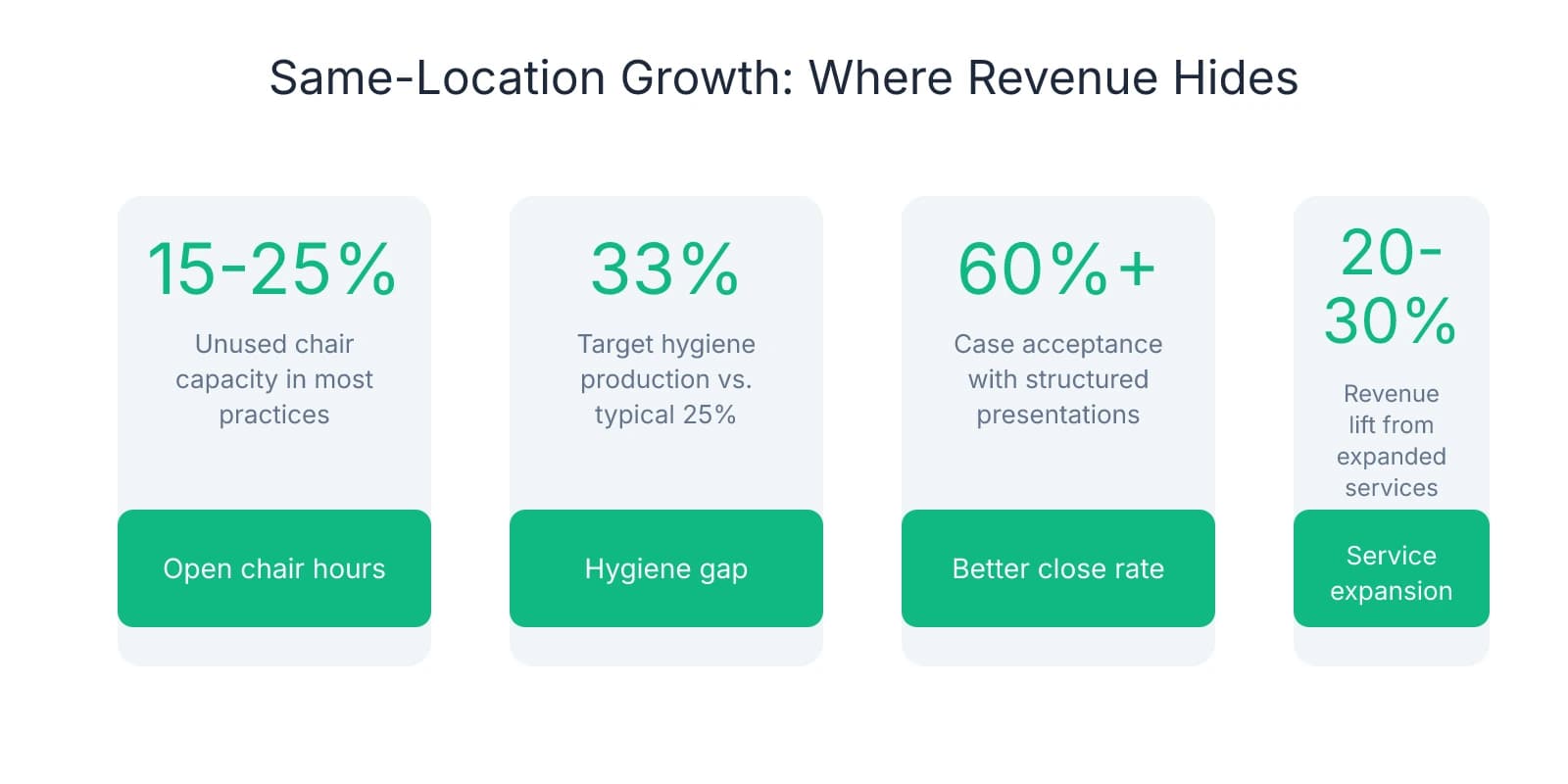
Pull your schedule from last month and count the open chair hours. Most single-location practices find 15-25% unused capacity—hygiene appointments that could have been booked, production hours blocked for administrative work, days that ended at 3pm when patients would have come at 5pm. That unused time represents revenue that doesn't require a lease negotiation, buildout, or second set of equipment.
The financial case is straightforward. Dental practices typically carry 60-65% fixed overhead—rent, core staff, equipment leases, insurance. Those costs don't change whether you produce $50,000 or $75,000 monthly. Incremental revenue drops almost entirely to your bottom line. A practice at 40% margins can often add $200,000 annually without hiring another full-time employee, and most flows straight through as take-home income.
Compare that to opening a second location, where you start from zero. New buildout costs, lease obligations, staff recruitment, patient acquisition—all while you can still only produce in one operatory at a time. The first location often subsidizes the second for years before expansion breaks even.
Where most practices leave money on the table is execution, not capacity. Scheduling templates that create artificial gaps. Hygiene departments at 25% of total production when benchmarks sit closer to 33%. Case acceptance rates in the 40-50% range when structured presentations and financing could push that into the 60s. Evening and Saturday hours that would fill immediately but remain unopened because "we've always closed at 5pm."
One pattern worth noting: practices that expand service mix—adding implants, clear aligners, or cosmetic procedures—often see revenue jumps of 20-30% without adding clinical hours. The procedures command higher fees, and patients who trust you for general care will often accept treatment they'd otherwise seek elsewhere.
If your practice generates $800,000 annually at 42% margins, you're taking home roughly $336,000. Growing same-location revenue to $1 million—through better scheduling, expanded services, and improved case acceptance—could add $150,000+ to your take-home with minimal overhead. Opening a second location might eventually match that, but it takes three to five years of negative cash flow and operational complexity to get there.
The question isn't whether your market can support a second location—it's whether your first location is performing at a level that justifies looking elsewhere.
When a Second Location Actually Makes Sense: The Readiness Checklist
Expansion isn't something you pursue when you're bored or when a good location becomes available. It's something you earn through systems, stability, and financial performance that proves your first practice can sustain itself without constant oversight.
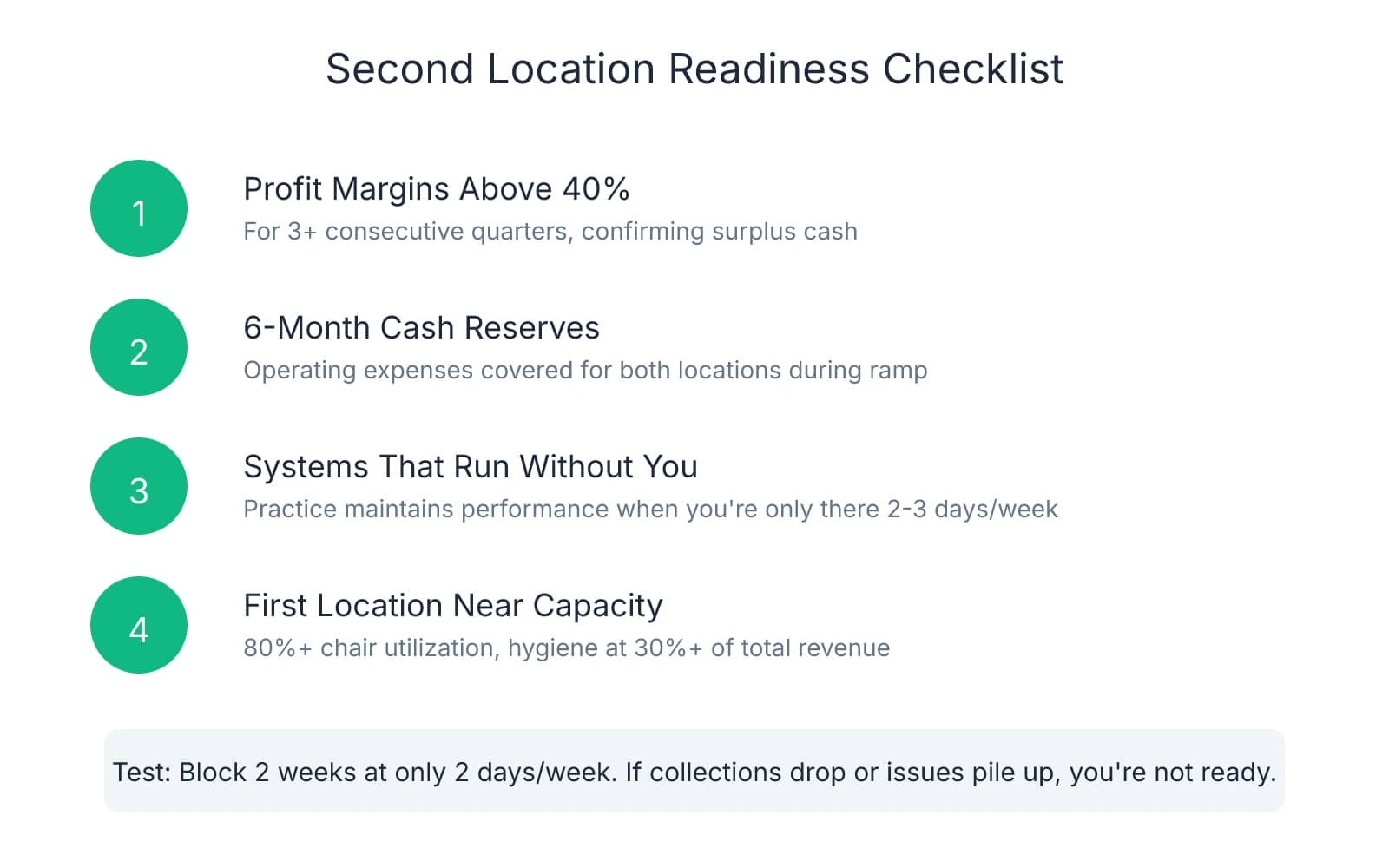
The financial prerequisites are specific. Profit margins should sit above 40% for at least three consecutive quarters, confirming surplus cash beyond personal income needs. Accounts receivable should stay under 30 days. Hygiene production near 33% of total revenue indicates balanced scheduling and effective recall systems. Cash reserves covering three to six months of operating expenses—for both locations—protect against the ramp period when the new practice burns cash while building its patient base.
One metric many buyers overlook is owner time in daily operations. If you're still working full clinical schedules, managing staff conflicts, handling supply orders, and troubleshooting patient complaints, your practice isn't ready. Successful multi-location owners typically spend less than half their time on operational tasks—the practice operates profitably when they're only there part-time. That requires documented systems, capable managers, and either a strong associate or an associate-ready team.
The leadership shift is more fundamental than most buyers expect. Managing one practice is about clinical excellence and being present when problems arise. Managing two is about financial oversight across locations, delegation to people you can't directly observe, and building systems that function without your daily presence. You're no longer the lead clinician who also handles admin work—you're running a small enterprise where your value comes from strategy, hiring, and accountability structures.
Where expansion plans often fail is underestimating the split-presence problem. When you divide time between two locations, both typically suffer short-term. The original practice experiences declining collections as patients notice reduced availability, staff morale drops, and small operational issues compound. Meanwhile, the new location struggles to ramp because you're not there enough to establish culture, train the team, or build patient trust. Both locations need resilience to handle this transition—the first must already operate smoothly during partial absence, and the second needs strong systems and leadership to function while you're splitting focus.
A useful test: block out two weeks where you're only in your current practice two days weekly. If collections drop, staff performance declines, or you return to a backlog of decisions only you can make, your practice isn't ready. If it runs smoothly and profitability holds, you've built the foundation required.
Buy vs. Start: What Changes When You're Adding a Second Location
The acquisition calculus shifts completely when adding a second location. As a first-time buyer, you can afford the 6-12 month ramp of a startup because you're working full-time in that one location. As a multi-location owner, that same ramp becomes a financial drain you're funding from elsewhere while your attention splits between two offices.
Buying an existing practice as your second location solves the divided-attention problem through immediate cash flow. You acquire a patient base generating revenue from day one, trained staff who already know the systems, and operational momentum that doesn't require constant presence. The purchase price runs higher—expect $400,000-$700,000 depending on collections and location—but you're buying time and focus. Most acquired second locations reach profitability within 90-180 days once you stabilize the transition, compared to 12-18 months for a startup.
The startup path looks cheaper on paper but rarely proves cheaper in practice. Buildout and equipment costs typically run $350,000-$500,000, with first-year marketing adding another $30,000-$75,000. Then comes working capital—cash to cover payroll, rent, supplies, and loan payments during months before revenue covers expenses. Most startups don't break even in the first six months, meaning you're subsidizing operations from your first location's cash flow while trying to maintain its performance.
One challenge that surfaces repeatedly in second-location startups is the associate problem. You can't be in two places at once, which means the new location needs a dentist who operates with ownership-level accountability. Most associates, while skilled clinicians, don't approach a new practice with the same intensity as the founder. Where I've seen second locations underperform most consistently is when the owner assumed an associate would run the startup with founder-level hustle. That rarely happens.
Geographic and demographic fit matters more for a second location than your first. The new practice should serve a different patient base without pulling from your existing one—close enough that you can maintain regular presence without excessive drive time, but far enough that patients aren't choosing between your two offices. A 15-25 minute drive typically works well. Demographics should complement rather than replicate your first location—if your original practice serves young families in a suburban area, a second location targeting retirees or professionals in a nearby town creates portfolio diversification rather than internal competition.
Financing also shifts when acquiring a second location. Lenders view multi-location borrowers differently, often requiring lower loan-to-value ratios and higher cash reserves. Many buyers need 20-30% down rather than the 10-15% typical for a first acquisition, and lenders scrutinize the first practice's financial performance closely.
One pattern worth noting: buyers who acquire an existing practice as their second location tend to reach stable multi-location profitability 12-18 months faster than those who start from scratch. The acquired practice generates cash flow that offsets the learning curve of managing two offices, and existing systems give you a template to refine rather than building everything from zero.
Making the Decision: A Framework for Choosing Your Path
Start with four diagnostic questions. Can your first practice maintain current performance when you're only there 2-3 days weekly? If collections drop or operational issues pile up during your absence, you don't have the systems required—you have a practice that depends on constant presence. Are profit margins consistently above 40% for three consecutive quarters? Anything below means you're still optimizing the business model, and expansion will only amplify existing inefficiencies. Do you have cash reserves covering six months of operating expenses at both locations? The ramp period burns cash faster than most buyers expect. Is your first practice operating at or near capacity? If you're running below 80% chair utilization or hygiene is producing below 30% of total revenue, you have revenue sitting in your existing four walls.
Where most buyers get the timeline wrong is treating expansion as an opportunity to seize rather than a milestone to earn. Successful multi-location owners typically spent 2-3 years building systems and optimizing their first practice before expanding—not because they were cautious, but because that's how long it takes to document workflows, develop managers who can run operations without daily oversight, and stress-test profitability during reduced owner presence.
The lifestyle and stress factors deserve weight equal to financial analysis. Multi-location ownership requires tolerance for complexity, delegation to people you can't directly observe, and being mentally "on" across multiple teams simultaneously. Some buyers discover they prefer the deep expertise and control from mastering one practice over the operational juggling required to manage two. The question isn't whether you're capable of multi-location ownership; it's whether that model aligns with how you want to spend your professional energy.
If same-location growth is the right path, the highest-ROI investments cluster around filling existing capacity and improving conversion rates. Invest in targeted marketing to fill open chair time you're already paying for. Optimize scheduling templates to reduce gaps and extend hours into evenings or Saturdays when demand exists. Expand service offerings that leverage existing infrastructure: clear aligners, implants, or cosmetic procedures can increase revenue per patient without additional operatories. Improve case acceptance through structured treatment presentations, third-party financing, and team training. These moves typically deliver 15-25% revenue growth within 12-18 months, with most flowing directly to profit.
If multi-location expansion is the right path, preparation needs to happen before you start searching. Document all systems and standard operating procedures so new team members can follow established processes without constant guidance. Develop leadership within your first practice that can run daily operations without your presence. Build 6-12 months of cash reserves to cover the ramp period. Only then should you begin searching for acquisition opportunities that complement your existing practice—different patient demographics, 15-25 minute drive time, and financial performance suggesting stable operations rather than a turnaround project.
The decision isn't permanent or binary. Many buyers who initially pursue same-location growth eventually expand once their first practice demonstrates the required systems and profitability. Others who assumed multi-location ownership was the goal discover they prefer running one excellent practice. Both paths lead to higher income and professional satisfaction—but only when the choice aligns with your current operational readiness, financial position, and tolerance for complexity. If you're not sure which path fits, the questions worth asking before making any major practice decision apply here: What problem am I solving? What changes if I'm wrong? And what preparation work can I do now that makes either path more likely to succeed?
Sources & References
The data and claims in this article are drawn from the following sources. We prioritize government data, peer-reviewed research, and established industry publications to ensure accuracy.
- The Second Location Trap: What Dentists Should Know Before ...— practicecfo.comIndustry
- How to Scale a Multi-Location Dental Practice - Duckett Ladd— duckettladd.comIndustry
- Am I ready to open a second dental practice location?— pages.ada.orgIndustry
Frequently Asked Questions
Ready to expand your dental empire?
Whether you're scaling your current location or acquiring a second practice, Minty connects you with vetted opportunities and provides expert guidance through every step of your growth journey.