Dental Practice Revenue Drops in Summer: What Buyers Should Know

Co-Founder, Minty Dental

In Summary
- July, August, January, and September consistently fall below average revenue across thousands of dental practices nationwide, with summer months typically trailing peak performance by 10-15%
- These dips stem from family vacations, school breaks, and patients deferring non-urgent care—not practice quality or operational problems
- March, April, and June emerge as peak revenue months year after year, creating a predictable pattern buyers can use to normalize financial performance
- Buyers who don't account for seasonality risk misreading a practice's true earning potential or walking away from solid opportunities based on incomplete data
- Understanding which months underperform—and by how much—gives buyers leverage to ask better questions during due diligence and avoid overpaying based on artificially high periods
Summer Revenue Dips Are Predictable—and Buyers Who Understand Them Have an Advantage
Seasonal revenue fluctuation in dental practices: the predictable pattern where certain months consistently generate below-average collections due to patient behavior, school schedules, and vacation timing—independent of practice quality or clinical performance.
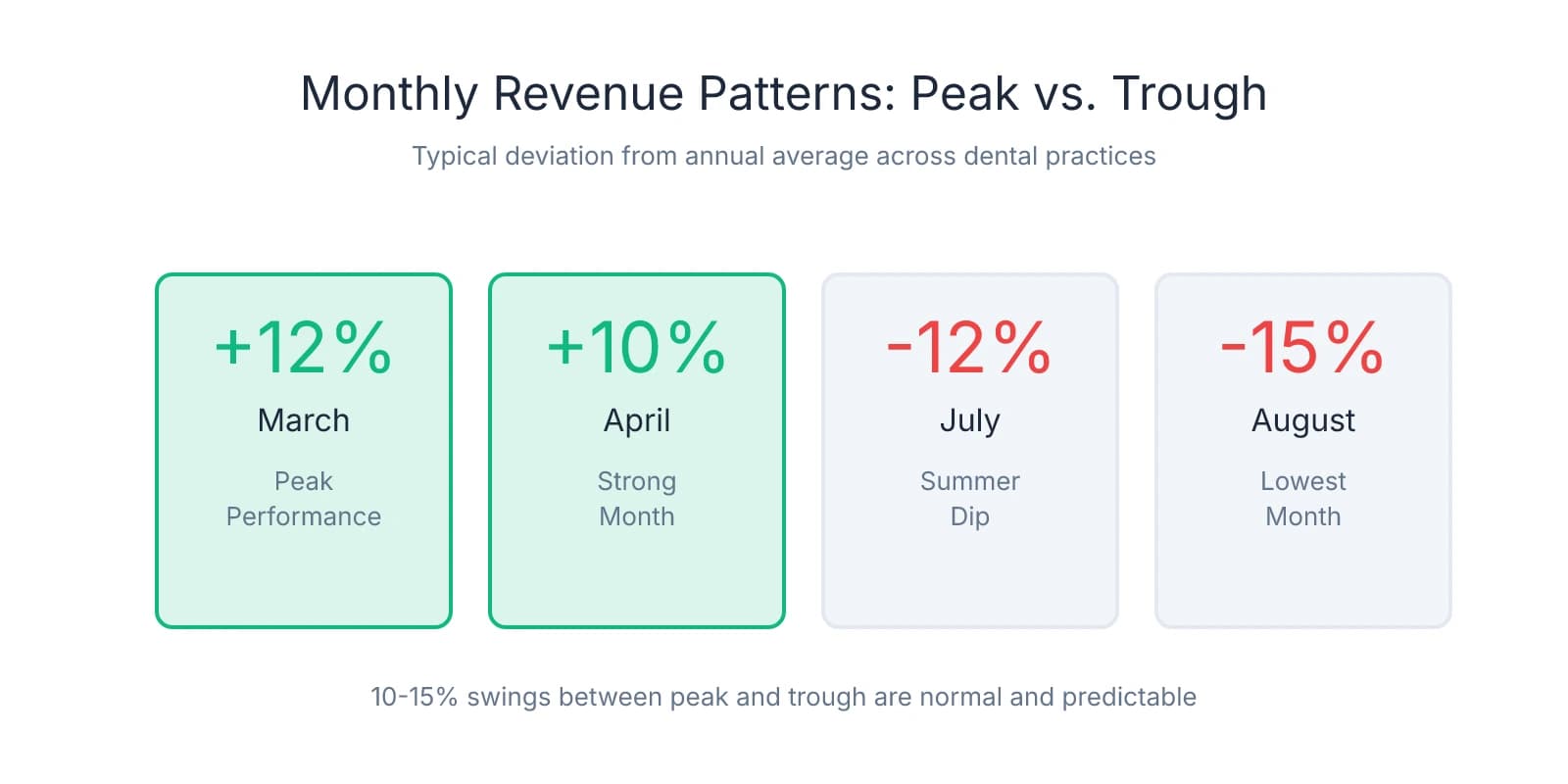
When you pull three years of P&L statements during due diligence, one pattern appears across nearly every general practice: summer revenue drops. July and August trail the annual average by double digits. January often underperforms. September lags behind spring and early summer.
National data from thousands of practices shows March, April, and June consistently exceed annual averages across key metrics—practice gross production, patients seen, total restorations completed. Summer months fall short on all three. The gap isn't small: practices routinely see 10-15% swings between peak and trough months, driven entirely by when patients choose to schedule care.
The reasons are structural. Families take vacations in July and August. Parents prioritize dental visits before school starts, not during summer break. Patients with insurance benefits that reset in January often defer non-urgent treatment until later in the year. Peak appointment volume hits June through August, but those appointments skew toward cleanings and exams—not the higher-revenue restorative work that drives collections.
Where buyers get burned is treating every revenue dip as a practice-specific problem. A seller shows you financials with a weak August, and you assume patient attrition or operational drift. You negotiate the price down or walk away entirely. Meanwhile, the practice next door shows the same August dip for the same reason: it's summer.
The advantage goes to buyers who can separate predictable seasonality from genuine structural issues. When you see July revenue at 85% of the March number, your first question shouldn't be "What's wrong with this practice?" It should be "Does this pattern hold across all three years, and does it match the national baseline?" If the answer is yes, you're looking at normal seasonality. If July suddenly dropped 30% in year three while prior years held steady, that's worth exploring in how to distinguish real profitability concerns from temporary fluctuations.
Most buyers focus on annualized revenue and trailing twelve-month averages, which works for valuation. But if you're evaluating cash flow timing, staffing needs, or working capital requirements, you need the monthly breakdown. A practice that does $80K in March and $65K in August requires different financial planning than one with flat $72K months year-round—even if both average $850K annually.
One step that protects you: ask the seller for month-by-month revenue data across three years, then calculate each month's percentage of the annual average. If July, August, and January consistently sit 10-15% below that average, and March through June consistently exceed it, you're seeing seasonality. If the pattern is erratic—strong Julys one year, weak the next, with no consistent explanation—dig deeper into patient retention, referral sources, and whether the revenue trend signals a larger problem.
Understanding seasonality doesn't just prevent false alarms. It gives you a framework for evaluating every revenue claim the seller makes, every projection the broker provides, and every assumption your lender builds into cash flow analysis.
How to Separate Seasonal Patterns from Structural Revenue Problems
With that baseline understanding of normal seasonal patterns, the next step is distinguishing them from genuine revenue problems. Start by requesting granular data: at least three years of monthly production and collections reports. Not quarterly summaries. Not trailing twelve-month averages. Monthly breakdowns that show exactly what the practice collected in July 2022, July 2023, and July 2024.
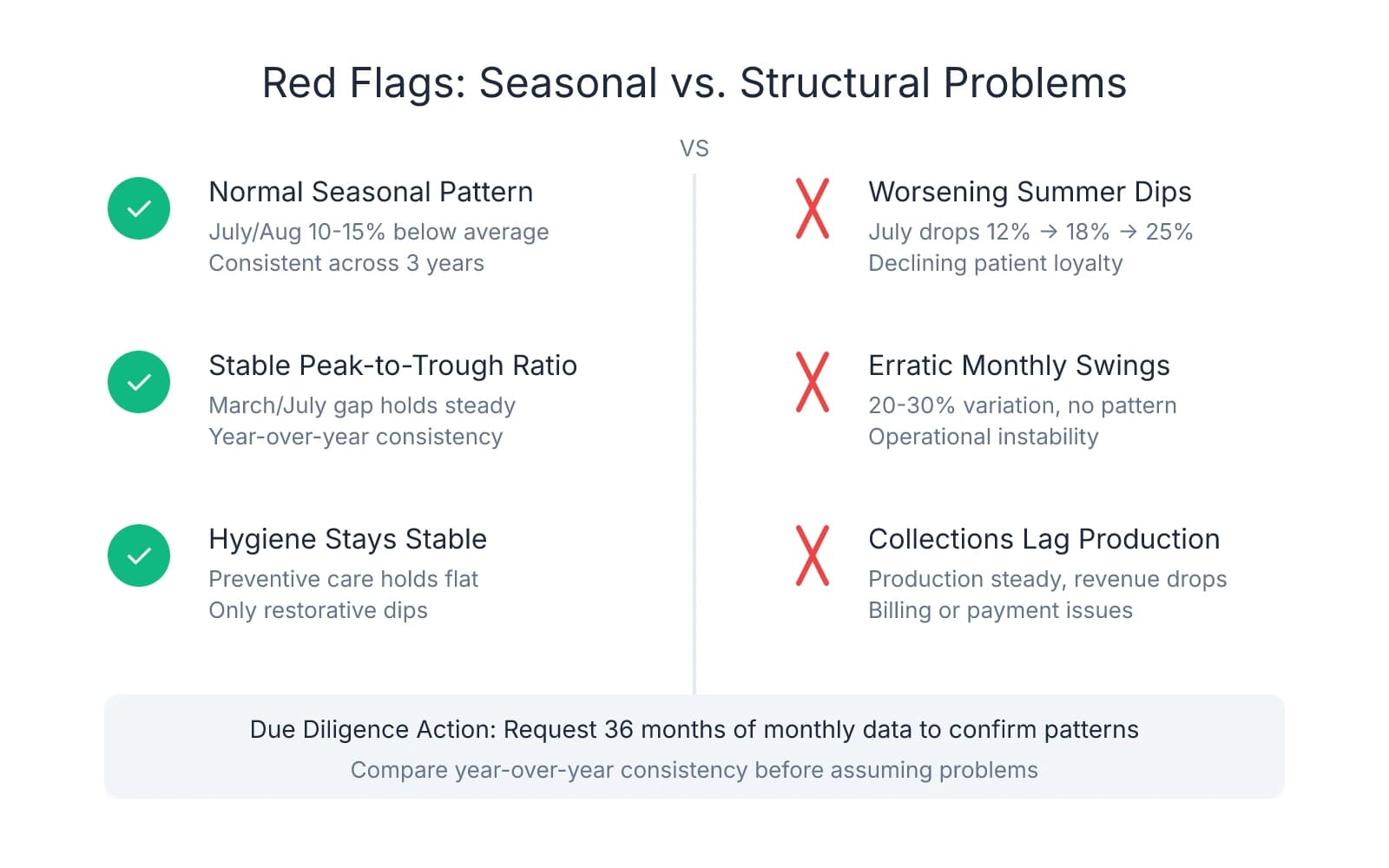
Three years gives you enough history to spot repeating patterns. If July consistently underperforms March by 12-15% across all three years, that's seasonal. If July 2022 and 2023 matched March, but July 2024 dropped 30%, you're looking at something else—patient attrition, a key hygienist departure, a competitor opening nearby, or a shift in referral patterns that hasn't stabilized yet.
Once you have the monthly data, calculate each month's percentage deviation from the annual average. Take total collections for the year, divide by twelve to get the monthly average, then compare each month against that baseline. Summer months running 10-15% below average align with national patterns. A 25% drop suggests the practice is losing patients faster than seasonality explains.
Consistency matters more than absolute numbers. A practice that does $65K in August and $80K in March isn't necessarily healthier than one doing $50K in August and $62K in March—what matters is whether the ratio holds steady year over year. If the gap between peak and trough months is widening, that's a structural issue. If it's stable across three years, it's seasonal.
Where many buyers miss the nuance: comparing the practice's seasonal pattern to local factors, not just national benchmarks. A practice in a tourist-heavy area may see stronger summer revenue as visiting families seek emergency care or cleanings while traveling. A practice near a university may see September and January dips that exceed the national average as students leave for breaks. Rural practices often show different patterns than urban ones, driven by agricultural cycles, local employment seasonality, or patient demographics that don't mirror suburban family practices.
One question worth asking the seller directly: "Walk me through why July 2024 was 18% below your annual average—what's driving that?" If the answer is "families on vacation, same as every year," and the data supports it, you're fine. If the answer is vague, defensive, or inconsistent with prior years, probe deeper. Ask about patient retention rates, hygiene recare compliance, and whether any key staff members left during that period.
Red flags that signal structural problems rather than seasonality:
- Progressively worsening summer dips year-over-year: July 2022 at 12% below average, July 2023 at 18% below, July 2024 at 25% below—this suggests declining patient loyalty or a weakening referral base
- Revenue drops that don't align with known seasonal patterns: If August is weak but June and July are strong, or if January underperforms but February and March do too, the issue isn't seasonality
- Erratic monthly performance with no consistent rhythm: Revenue that swings 20-30% month-to-month with no repeating pattern suggests operational instability, inconsistent staffing, or a patient base that isn't anchored to routine recall schedules
- Collections significantly lagging production during slow months: If production holds steady but collections drop, the practice may have billing issues, insurance processing delays, or patients deferring payment—problems that compound during low-volume periods
When evaluating whether a practice's revenue pattern is normal, compare it against both national benchmarks and the specific context of the location. A 15% summer dip in a suburban family practice is expected. The same dip in a practice serving retirees in a year-round temperate climate is unusual. If the seller's explanation for seasonal variation doesn't match the patient demographics or local economy, that's worth investigating before you move forward with valuation discussions based on annualized revenue.
The goal isn't to eliminate seasonality from your analysis—it's to confirm that what you're seeing is seasonality and not a practice in decline.
What Summer Revenue Patterns Reveal About Cash Flow and Operations
Once you've confirmed the revenue pattern is seasonal rather than structural, the next consideration is how those patterns affect your cash flow and operations. Seasonal revenue patterns don't just affect your P&L—they dictate cash flow timing in ways that catch first-time buyers off guard. A practice that collects $80K in June and $65K in July creates a mismatch: July's revenue may not cover August's payroll, loan payment, and vendor invoices without reserves already in place.
One protection many buyers overlook is building working capital into the acquisition loan specifically to cover seasonal gaps. Lenders typically recommend 2-3 months of operating expenses as working capital, but that calculation should reflect your worst-case months—not your average ones. If August historically runs 15% below average and your monthly overhead sits at $55K, your working capital buffer needs to account for a $47K revenue month, not the $65K annual average.
Practices with strong hygiene programs and active recall systems: operations that maintain consistent preventive care scheduling through automated reminders, proactive reactivation outreach, and structured hygiene intervals—resulting in smaller seasonal revenue swings because routine cleanings and exams are less discretionary than restorative treatment.
Where some practices mitigate summer dips more effectively than others comes down to hygiene infrastructure. Preventive care—cleanings, exams, fluoride treatments—is less discretionary than restorative work. Families may defer a crown until September, but they're more likely to keep a hygiene appointment if the recall system is persistent. Practices that run tight hygiene schedules with minimal gaps tend to see 8-10% summer dips instead of 15-18%, simply because the hygiene column holds steadier than restorative production.
During due diligence, one metric worth calculating is the practice's hygiene-to-doctor production ratio across peak and trough months. If hygiene production drops proportionally with doctor production during summer, the practice likely doesn't have a robust recall system—patients are deferring all care, not just elective procedures. If hygiene production stays relatively flat while doctor production dips, that's a healthier sign: the practice has built-in stability through preventive care. For more on how hygiene production ratios signal operational health, see what low hygiene production means when evaluating a practice.
One step that protects cash flow in year one: model your monthly expenses and loan payments against the seller's actual seasonal revenue pattern, not the annual average. Take the trailing twelve months of collections data, map it month-by-month, then overlay your projected fixed costs—loan payment, payroll, rent, lab fees, supplies. Identify which months run negative or break even, and confirm your working capital covers those gaps.
Where buyers often get burned is assuming they can "work harder" through slow months to offset seasonal patterns. You can't schedule patients who are on vacation. You can't convert treatment plans when families are prioritizing back-to-school expenses over dental work. What you can do is structure your financing to account for predictable low-revenue periods, tighten your recall and reactivation systems before summer hits, and avoid discretionary spending during months when cash flow is already constrained.
For practices considering whether to add working capital to their acquisition loan, the calculation should be straightforward: take your three lowest-revenue months from the seller's financials, subtract your projected monthly operating expenses and debt service, and multiply the shortfall by 1.5 to build in a buffer. That's your minimum working capital target. More on structuring working capital into your loan can be found in how working capital fits into dental practice financing.
Building Seasonal Revenue Analysis Into Your Due Diligence Checklist
With cash flow implications clear, the final step is integrating seasonal analysis into your due diligence process. Monthly revenue trend analysis belongs in your due diligence checklist alongside profit and loss statements, tax returns, and patient count reports—not as an afterthought, but as a core component of financial verification. Request three years of monthly collections data broken out by production source: doctor, hygiene, and lab. This breakdown reveals whether seasonal dips affect all revenue streams equally or concentrate in specific areas.
One question that reveals more than most buyers realize: "How do you manage cash flow during slow months?" The seller's answer tells you whether they've planned for seasonality or struggled with it. A seller who describes maintaining a working capital reserve, timing major equipment purchases around peak revenue months, or adjusting hygiene hours in July has managed the practice with financial discipline. A seller who mentions deferring vendor payments, using personal funds to cover payroll, or expressing surprise at the question hasn't—and you're inheriting that operational gap.
If summer dips exceed industry norms by more than a few percentage points—say, 20-25% below annual average instead of the typical 10-15%—use that data as leverage. According to Duckett Ladd, accounts receivable ratios and revenue patterns that deviate from healthy benchmarks signal collection problems or operational issues that justify price adjustments. A practice with steeper-than-normal seasonal variation may require seller financing to ease first-year cash flow, or a purchase price reduction that reflects the added working capital you'll need to stabilize operations. For more on using due diligence findings to adjust terms, see how to renegotiate price after discovering financial concerns.
Working with a dental-focused CPA to model your first 18 months of cash flow using the practice's actual seasonal pattern—not generic projections—is one of the highest-return investments you'll make during due diligence. A CPA who understands dental practice finances can map your loan payments, payroll, overhead, and owner draw against the seller's real monthly collections, then identify which months will run negative and how much working capital you need to bridge those gaps.
Understanding seasonality before closing means you can time decisions around the practice's natural rhythm rather than fighting against it. If you know August revenue drops 15% below average, you don't schedule a major equipment purchase or hire a new hygienist that month—you wait until September or October when cash flow rebounds. If you're planning a marketing push to attract new patients, you launch it in March or April, not July when families are already committed to summer plans. If you're considering when to bring on your first associate, you model that decision against seasonal cash flow, not just annualized revenue.
The checklist for incorporating seasonal analysis into due diligence:
- Request 36 months of monthly collections data, broken out by doctor production, hygiene production, and lab fees
- Calculate each month's percentage deviation from the annual average and compare against national benchmarks for general practices
- Ask the seller how they've historically managed cash flow during low-revenue months—document their answer
- Work with a dental CPA to model your first 18 months of cash flow using the practice's actual monthly revenue pattern, not averages
- Identify which months will require working capital reserves and confirm your financing includes adequate liquidity
- If seasonal dips exceed industry norms, evaluate whether that justifies price adjustments, seller financing, or contingencies that protect you during the transition
Seasonal revenue analysis isn't about finding reasons to walk away—it's about entering ownership with realistic expectations and a financial plan that accounts for how the practice actually performs month-to-month. For guidance on what the first few months of ownership look like when you've planned for seasonality, see what to expect in the first 90 days after closing.
Sources & References
The data and claims in this article are drawn from the following sources. We prioritize government data, peer-reviewed research, and established industry publications to ensure accuracy.
- How seasonality affects revenue in the dental practice— dentalproductsreport.comIndustry
- Seasonality in Dentistry: What Are the Busiest Months for Dentists?— www.tempstars.comIndustry
- [PDF] Economic Outlook and Emerging Issues in Dentistry - ADA.org— ada.orgIndustry
- 5 ways to manage seasonality trends in the dental practice— www.dentalproductsreport.comIndustry
- Financial Due Diligence for Dental Practices: What to Look For in 2026— duckettladd.comIndustry
Frequently Asked Questions
Find Your Ideal Practice Despite Seasonal Trends
Summer slowdowns are common in dental practices, but they shouldn't derail your acquisition strategy. Minty's marketplace connects you with practices across the country, while our expert guidance helps you evaluate revenue patterns and make informed decisions.