A 50/50 Partnership Practice Doubles Risk Unless You Structure It Right

Co-Founder, Minty Dental

In Summary
- 50/50 partnerships fail at higher rates than unequal ownership structures because equal voting rights without tie-breaking mechanisms create decision paralysis on major business decisions like expansion, equipment purchases, and associate hiring.
- The three structural pillars that determine partnership success are a written agreement with deadlock provisions, a compensation model that rewards individual production rather than just equity split, and a pre-negotiated buyout formula that both parties agree to before conflict arises.
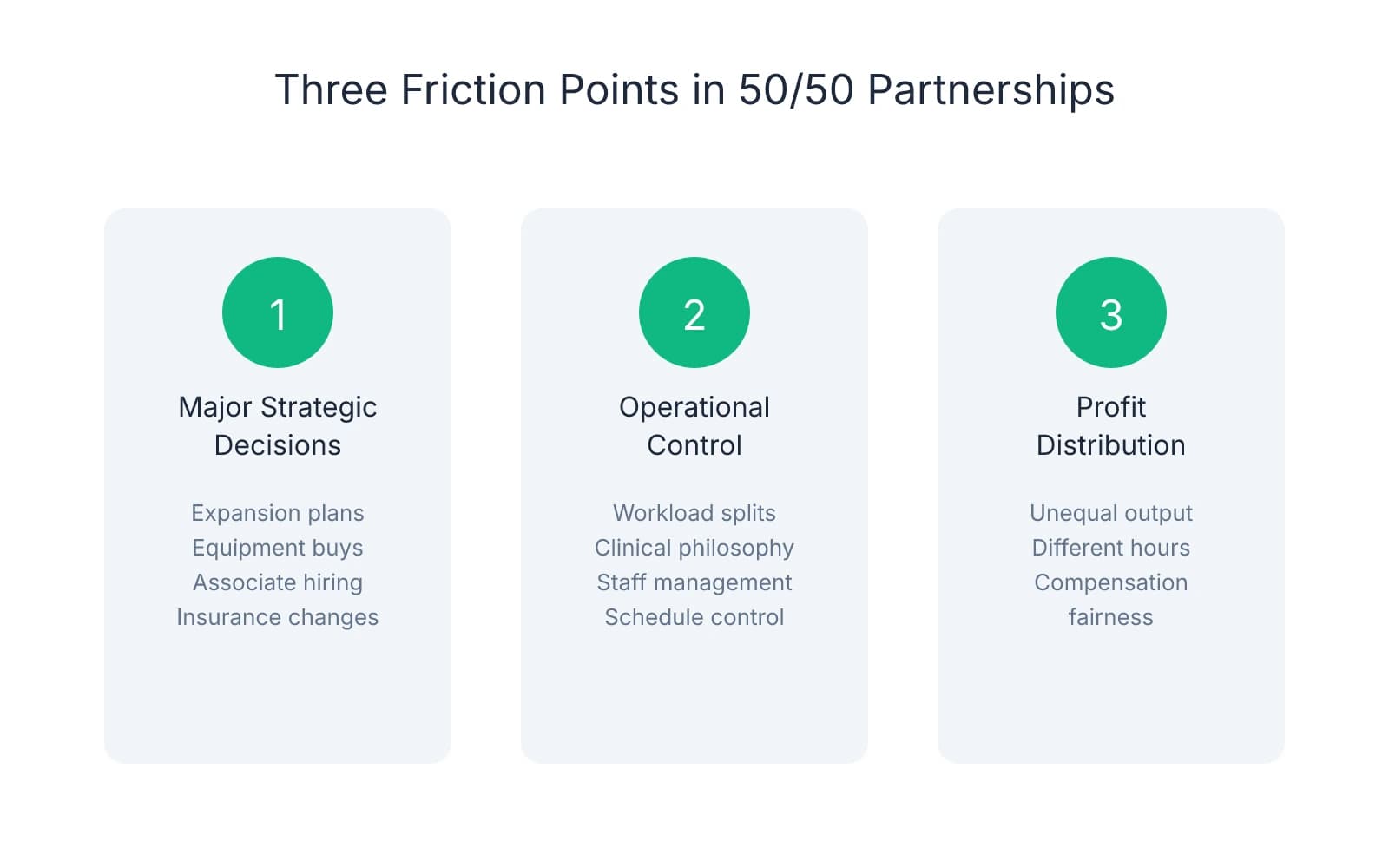
- Most partnership friction surfaces in three areas: major strategic decisions requiring unanimous approval, day-to-day operational control when workload or clinical philosophy differs, and profit distribution when one partner consistently outproduces the other.
- Before committing to shared ownership, answer four questions: who has final authority on which decisions, how will clinical and administrative workload be divided, what happens if financial contributions become unequal, and are both partners aligned on a 5-10 year exit timeline.
Equal Ownership Creates Equal Vulnerability Without the Right Framework
Splitting a practice acquisition 50/50 makes intuitive sense—you halve the down payment, share the debt burden, and distribute the operational risk. For many first-time buyers, partnership feels like the only realistic path to ownership when student loans already exceed $400,000. But equal equity doesn't mean equal risk—in most cases, it doubles it.
The pattern plays out predictably: two associates with complementary skills decide to buy together. They split the purchase price, divide the patient schedule, and assume the partnership will run itself. Within 18 months, they're deadlocked over whether to add a third operatory, which insurance plans to drop, or how to handle an underperforming hygienist. Without a mechanism to resolve the impasse, both partners are stuck—unable to move forward, unable to exit cleanly.
Where 50/50 partnerships fail isn't in the equity split itself. It's in the absence of structure around three friction points: major business decisions, day-to-day operational control, and profit distribution when production levels diverge. A practice that generates $1.2 million annually can support two full-time dentists, but only if both partners agree on how to allocate new patients, whether to invest in CEREC, and what happens when one partner wants to cut back to four days while the other wants to expand into pediatrics.
Questions worth answering before signing include whether the practice has enough patient volume for two full-time producers, whether the physical space allows simultaneous scheduling, and whether both partners are willing to take on administrative responsibilities beyond clinical work. If one partner expects to focus purely on patient care while the other manages payroll and staff issues, that imbalance needs to be reflected in compensation—not just equity.
What separates partnerships that work from those that dissolve is rarely the relationship itself. It's whether the agreement includes deadlock provisions that force resolution, whether compensation rewards individual contribution rather than just ownership percentage, and whether both parties negotiated a buyout formula before conflict made negotiation impossible.
The questions to resolve before committing: Who has final authority on hiring, equipment purchases over a certain threshold, and lease renewals? How will clinical workload and administrative duties be divided, and what happens if one partner consistently works fewer hours? If one partner contributes more capital upfront, does that affect profit distribution? And critically—are both partners aligned on a 5-10 year timeline, or is one planning to exit in three years while the other expects to practice for another 20?
Equal ownership works when the framework around it is anything but equal. The partnership agreement, the compensation model, and the exit strategy determine whether shared ownership becomes a strategic advantage or a structural liability.
How Financing Works When Two Buyers Split the Purchase
Lenders evaluate partnership acquisitions differently than solo buyer deals—not because the practice itself carries more risk, but because two financial profiles introduce more variables that can derail approval. Both partners' credit scores matter. Both debt-to-income ratios get scrutinized. And if one partner's student loan balance sits at $500,000 while the other carries $200,000, that gap affects how much working capital the bank will require.
Most dental lenders structure partnership loans so that both borrowers meet minimum thresholds independently—typically a credit score above 680, a debt-to-income ratio under 45%, and enough post-graduation production history to demonstrate clinical competency. One partner with a 720 credit score and three years of associate experience won't offset another partner's 640 score and two years out of residency. The deal gets structured to the weaker profile, or it doesn't get approved.
The financing decision that shapes everything downstream is whether to pursue separate loans or joint debt. With separate loans, each partner borrows their 50% share independently—two distinct notes, two sets of terms, two personal guarantees. This structure offers the cleanest exit pathway: if one partner wants out in year three, the remaining partner isn't automatically responsible for refinancing the other's debt.
Joint debt—where both partners co-sign a single loan—simplifies the initial transaction but complicates future exits. Both partners carry full personal liability for the entire loan amount, not just their half. If one partner defaults, the lender pursues both. And if one partner wants to buy the other out, the remaining partner typically needs to refinance the full balance in their name alone.
The trade-off comes down to approval speed versus exit flexibility. Joint debt often closes faster because the lender underwrites one loan instead of two, and the combined income of both partners can support a larger loan amount. But that efficiency creates entanglement. Separate loans take longer to structure and may result in slightly different interest rates if one partner's credit profile is stronger, but they preserve independence.
Working capital becomes more complex when two buyers share overhead. Most lenders include working capital in the loan package—typically three to six months of operating expenses. With two partners, the question is whether to pool that capital in a shared operating account or maintain separate reserves. A framework many partnerships use: pool working capital for shared expenses like rent and staff payroll, but maintain separate accounts for individual production-related costs like lab fees and continuing education.
One protection worth building into the loan structure: an assumption clause that allows a remaining partner to take over the exiting partner's debt without triggering a full refinance. Not all lenders offer this, but when it's available, it prevents a scenario where one partner's exit forces a fire sale because the remaining partner can't qualify for a new loan on short notice.
The financing structure you choose should anticipate the partnership dissolving, even if both parties expect it to last decades. Separate loans with assumption clauses offer the most flexibility. Joint debt with a clear buyout formula comes next. Joint debt with no exit provisions is where partnerships get trapped.
The Partnership Agreement Clauses That Prevent Deadlock and Protect Your Investment
With the financing structure in place, the next layer of protection comes from the partnership agreement itself—the operating system that determines whether your practice functions or fractures when partners disagree. Most 50/50 partnerships operate without friction until the first major decision surfaces: whether to hire an associate, drop a PPO, or invest $80,000 in a CBCT system. Without a mechanism to resolve that impasse, both partners are stuck.
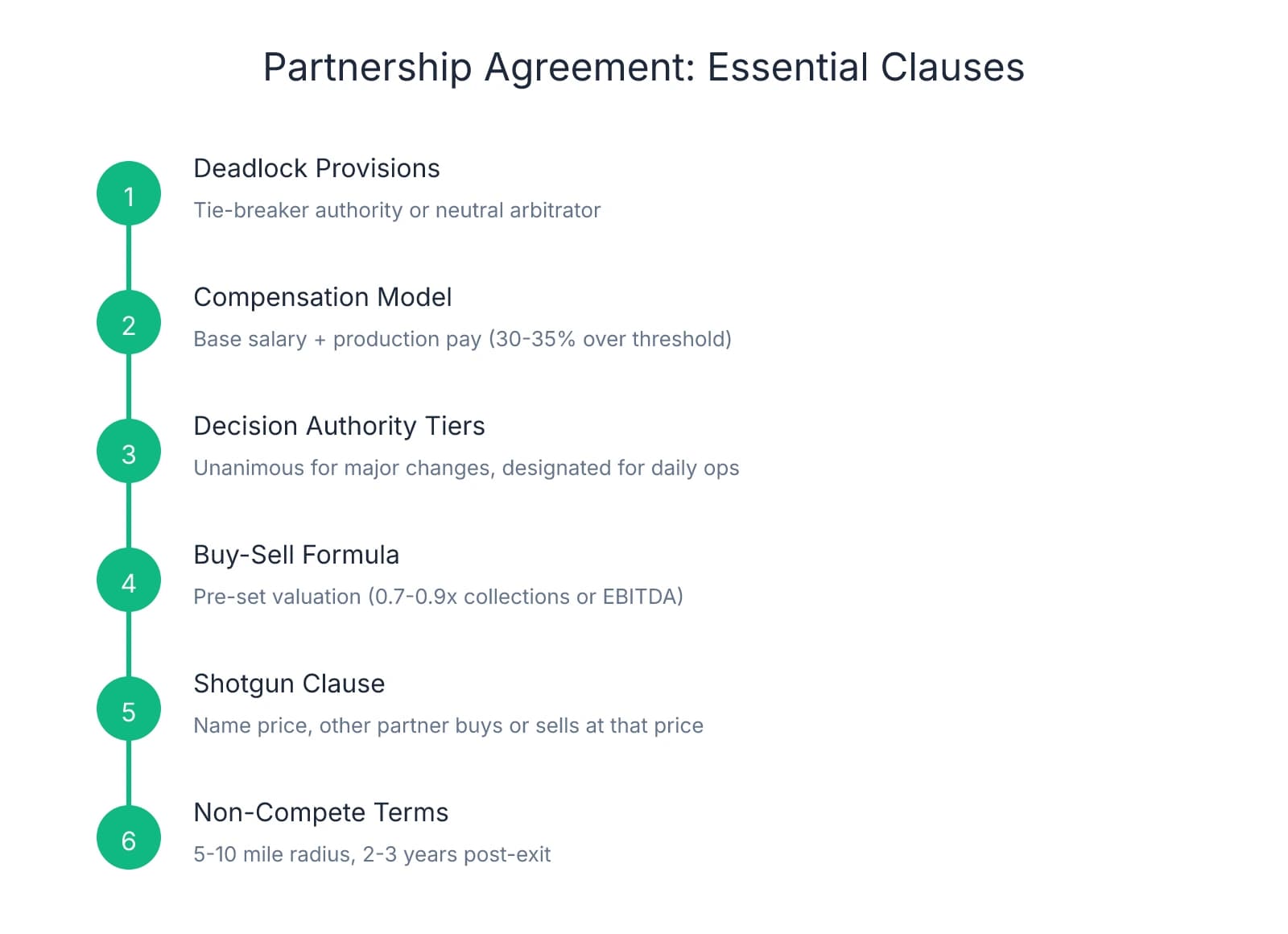
Deadlock provisions exist to break ties without litigation. One structure: a neutral third-party tie-breaker—typically a dental practice consultant or accountant both parties trust—who reviews the disputed decision and casts the deciding vote. A faster alternative: rotating decision authority, where one partner holds tie-breaking power for clinical decisions while the other controls business operations.
The shotgun clause—also called a buy-sell provision—offers a more definitive resolution. One partner names a price for the entire practice. The other partner then chooses: buy at that price, or sell at that price. This forces both parties to propose a fair valuation, since the partner making the offer doesn't know which side of the transaction they'll end up on. Where shotgun clauses fail is when one partner has significantly more liquidity than the other. A protection worth adding: a financing contingency that gives the responding partner 60-90 days to secure a loan before the offer expires.
Mediation and arbitration requirements create a structured escalation path before disputes reach litigation. Many agreements specify that partners must attempt mediation within 30 days of a deadlock. If mediation fails, binding arbitration follows—a private process where an arbitrator hears both sides and issues a decision both parties must accept.
Compensation structure determines whether equal ownership feels fair when production levels diverge. A hybrid model balances equity with individual contribution: each partner draws a base salary covering overhead and administrative time, then receives production-based pay for clinical work beyond a threshold—often 30-35% of personal collections after lab fees. Profit distribution happens quarterly or annually, split according to equity. One pattern that creates friction: paying both partners equally regardless of production, then discovering one partner consistently works four days while the other works five.
Decision-making authority should be tiered based on financial impact and strategic significance. Unanimous consent typically applies to decisions that alter the practice's structure: selling the practice, adding a second location, taking on debt above $50,000-$100,000, or entering a long-term DSO contract. Simple majority or designated managing partner authority covers day-to-day operations—hiring staff, negotiating vendor contracts, approving marketing spend under $10,000, or adjusting patient scheduling protocols.
Buy-sell provisions create the exit pathway both partners need before conflict makes negotiation impossible. The valuation formula should be defined upfront: a multiple of trailing twelve-month collections (often 0.7-0.9x for general practices), an EBITDA-based calculation, or independent appraisal. Payment terms matter as much as valuation—most buyouts structure as a down payment (20-30% of purchase price) with the balance paid over 3-5 years at a defined interest rate.
Non-compete obligations protect the remaining partner from immediate competition, typically restricting the exiting partner from practicing within a 5-10 mile radius for 2-3 years. Right of first refusal provisions ensure that if one partner wants to sell their equity to an outside buyer, the remaining partner gets the option to match that offer before the sale proceeds.
The clauses that matter most are the ones that activate during conflict, not during smooth operations. A partnership agreement that defines deadlock resolution, compensation structure, decision authority, and exit terms before disagreement surfaces keeps both partners protected.
Due Diligence and Day-One Decisions When You're Buying as a Team
Once the agreement framework is set, the practical work of evaluating and operating the practice begins. Dividing due diligence between two partners requires more than splitting tasks—it requires both buyers to see the complete picture while leveraging different expertise. One approach: assign financial review to the partner with stronger business acumen (P&L analysis, tax return verification, accounts receivable aging) while the other leads clinical assessment (treatment plans in progress, referral patterns, equipment condition).
The risk in task division is that one partner defers entirely to the other's judgment in their assigned area, then discovers post-closing that a problem was missed. A protection many partnerships use: each partner reviews the other's findings before closing, with both signing off on the full due diligence report. What often gets overlooked during this phase is verifying that patient records, referral relationships, and staff knowledge transfer equally to both new owners.
Pre-closing agreements prevent the operational confusion that surfaces the week after closing. Decide before you sign: who manages clinical scheduling, who oversees financial reporting and payroll, who handles staff supervision, and who leads marketing. Many partnerships default to "we'll figure it out together," which works until the first scheduling conflict arises and neither partner knows who has authority to resolve it. A clearer structure: assign a managing partner for administrative decisions with a defined term (12-24 months), then rotate the role.
Patient and staff communication about the ownership change should be coordinated, not improvised. Draft a joint letter to active patients introducing both doctors and reassuring continuity of care. Schedule a staff meeting before closing where both partners present together, answer questions about job security, and clarify reporting structure.
First-year operating protocols create the transparency and accountability that prevent small disagreements from becoming structural problems. Weekly partner meetings—30 minutes, standing agenda—cover patient flow, staff issues, and upcoming decisions that need joint approval. Monthly financial reviews should include shared access to practice management software, side-by-side comparison of each partner's production and collections, and a reconciled P&L that both partners verify before profit distribution.
Early warning signs the partnership isn't working often surface in patterns, not single incidents. Persistent disagreements over minor decisions signal misaligned expectations about autonomy and control. One partner consistently working more hours or generating significantly higher production without corresponding compensation adjustment creates resentment. Communication breakdowns—decisions made without consulting the other partner, information withheld—indicate trust erosion.
When to revisit the partnership structure: if production levels diverge by more than 20% for two consecutive quarters, if one partner reduces clinical hours without mutual agreement, or if either partner expresses interest in exiting within the next 12-24 months. The conversation should happen before resentment calcifies into conflict. Many partnerships benefit from a scheduled six-month and twelve-month review where both partners assess whether the agreement is working and whether compensation structure needs adjustment.
The transition period and first year of shared ownership test whether the partnership structure you built on paper functions under operational pressure. Divide due diligence to leverage expertise, but ensure both partners validate the full picture. Agree on operational authority before closing, not after conflict forces the conversation. Build transparency into financial reporting and decision-making from day one. And recognize early when the partnership isn't working—before both partners are locked into a structure neither wants but neither can exit cleanly.
Sources & References
The data and claims in this article are drawn from the following sources. We prioritize government data, peer-reviewed research, and established industry publications to ensure accuracy.
- What Dentists Need to Know About Deadlock Provisions in ...— www.dmcounsel.com
- Questions to Consider When Creating a 50/50 Partnership— dentalcpas.comIndustry
- Demystifying the Practice Loan Process | American Dental Association— ada.orgIndustry
- Navigating Dental Practice Buy-ins: A Guide for ... - Commerce Bank— www.commercebank.com
Frequently Asked Questions
Ready to buy a dental practice with a partner?
Partnership structures require careful planning and expert guidance to protect your investment. Minty Plus provides hands-on support through acquisition and beyond, ensuring your partnership is set up for success from day one.