Non-Compete Clauses in Dental Practice Sales: What Buyers Should Know

Co-Founder, Minty Dental

In Summary
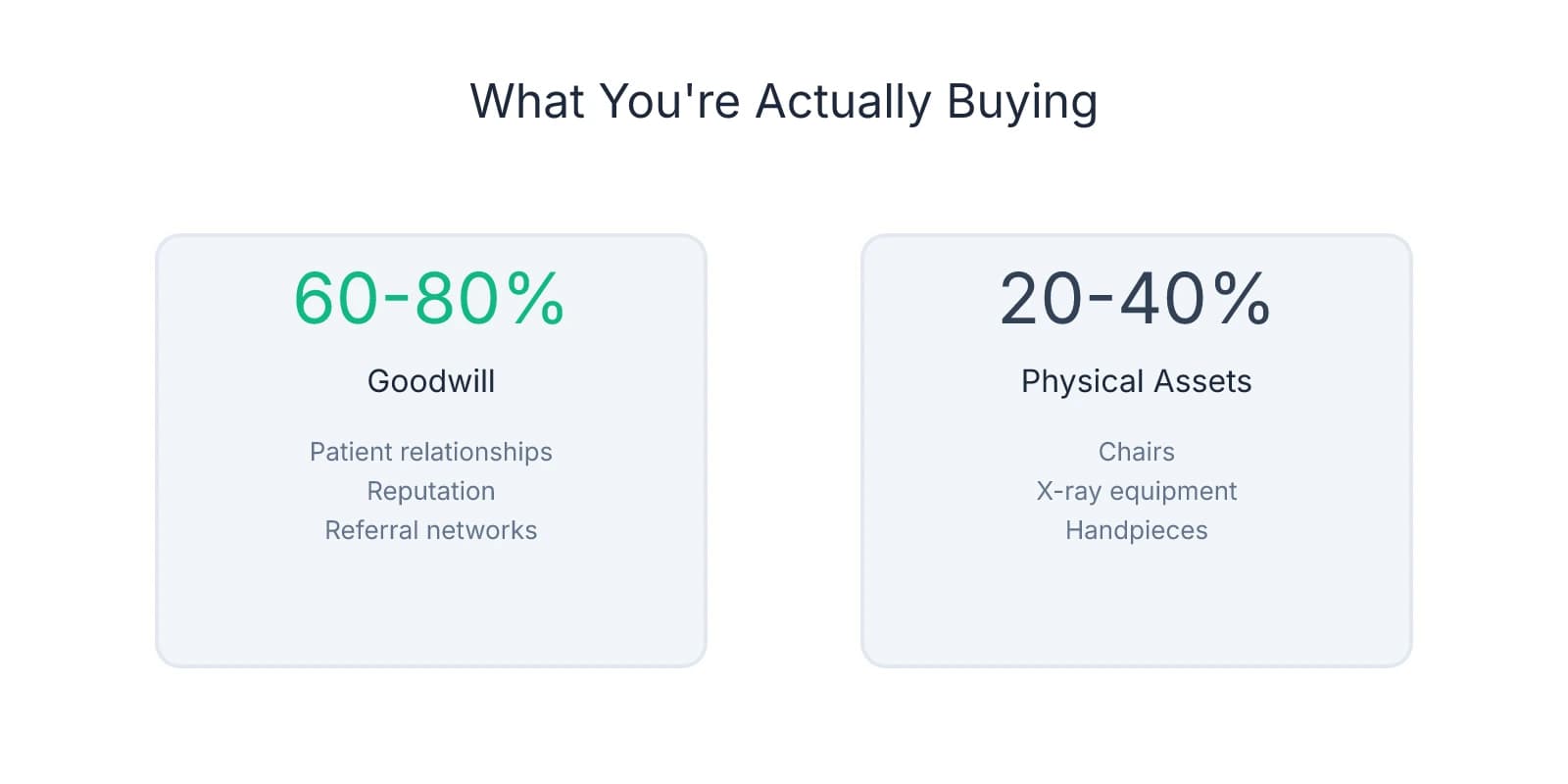
- Goodwill—patient relationships, reputation, and referral networks—typically represents 60-80% of what you're paying for when you buy a dental practice
- Without a non-compete clause, the seller can legally open a competing practice nearby and reclaim the patients you just purchased, undermining your entire investment
- The myth that non-competes "aren't enforceable" comes from tech industry cases and overly broad employment agreements—practice sale non-competes are different and usually hold up in court when properly drafted
- Enforceability hinges on three factors: reasonable geographic scope, reasonable duration, and protection of a legitimate business interest like goodwill
- Non-compete language belongs in the purchase agreement itself, not just in an employment contract if the seller stays on temporarily
Non-Competes Protect the Asset You're Actually Buying
When you buy a dental practice, the physical assets—chairs, X-ray equipment, handpieces—make up a fraction of the purchase price. The real investment sits in goodwill: the patient relationships the seller built over years, the reputation they earned in the community, and the referral network they cultivated. In most transactions, goodwill accounts for 60-80% of the total price. You're not buying equipment. You're buying trust that already exists between patients and the practice.
Without a non-compete clause, that trust walks out the door with the seller. They can legally open a new practice three blocks away, notify their former patients, and reclaim the relationships you just paid for. The investment you made in goodwill evaporates, and you're left with a patient base that may not stick around.
A non-compete clause prevents this by restricting the seller from practicing within a defined geographic area for a set period. The clause isn't about controlling the seller—it's about preserving the asset you're acquiring.
Many buyers hesitate here because they've heard that non-competes "aren't enforceable." That belief usually stems from tech industry cases and overly broad employment agreements—situations where companies tried to restrict workers from earning a living in their field. Practice sale non-competes are different. Courts recognize that when a seller receives substantial payment for goodwill, restricting them from immediately reclaiming that goodwill is reasonable. In most cases, these agreements are enforceable when drafted correctly.
Enforceability depends on three factors. First, the geographic scope must be reasonable—typically tied to the practice's actual patient draw area, not an arbitrary radius. Second, the duration must be reasonable—usually two to five years, enough time for you to solidify patient relationships without indefinitely blocking the seller from their profession. Third, the restriction must protect a legitimate business interest, which goodwill clearly qualifies as.
One pattern worth paying attention to: where the non-compete language actually sits. If the seller is staying on temporarily as an associate, buyers sometimes assume the employment agreement's non-compete is sufficient. It's not. Employment-based non-competes often carry different enforceability standards and may not survive if the employment relationship ends early. The non-compete protecting your goodwill investment belongs in the purchase agreement itself, tied directly to the sale transaction.
This is where experienced legal counsel matters. A generic template or a clause borrowed from another deal may not account for your state's specific requirements or the practice's unique patient geography. When negotiating the purchase agreement beyond price, the non-compete clause deserves the same scrutiny as the financial terms. It's the mechanism that ensures the goodwill you're paying for actually transfers to you.
What Makes a Non-Compete Enforceable in Your State
State law determines whether your non-compete will hold up in court. Four states—California, North Dakota, Oklahoma, and Minnesota—ban non-competes entirely, with limited exceptions for business sales. If you're buying a practice in one of these states, the seller can open a competing practice the day after closing, and you have no legal recourse through a non-compete. Other states impose income thresholds or industry-specific restrictions. Texas enacted legislation in 2025 limiting dentist non-competes to a five-mile radius and one-year duration, with mandatory buyout provisions capped at the seller's annual salary.
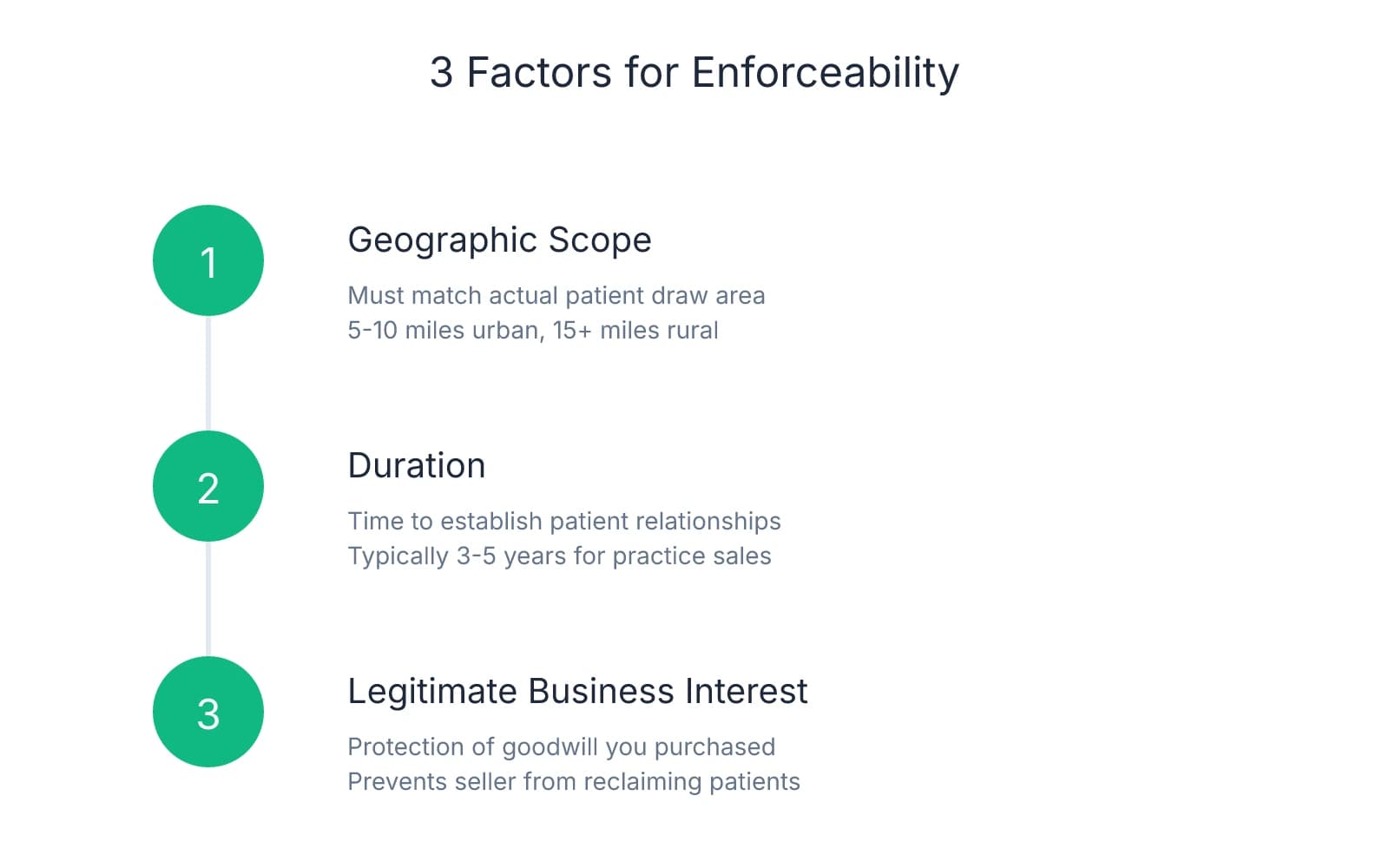
Courts in states that allow non-competes evaluate three factors: geographic scope, duration, and legitimate business interest. Each must be reasonable, and "reasonable" is defined by the specific circumstances of your practice and market.
Geographic scope must match the practice's actual patient draw area. A ten-mile radius works in a dense urban market where patients rarely travel more than fifteen minutes. In a rural area where patients drive thirty miles for care, a fifteen-mile restriction may be justified. One approach many buyers use is pulling a patient address report during due diligence and mapping where 80-90% of active patients live. That radius becomes the basis for the non-compete boundary.
Duration typically runs three to five years for practice sales. This gives you enough time to establish relationships with existing patients and transition recall schedules without the seller immediately competing. Courts treat practice sale non-competes more favorably than employment non-competes because the seller received substantial consideration—the purchase price—and voluntarily sold the goodwill. That distinction matters. A five-year restriction in a practice sale is defensible; the same term in an associate employment agreement might not be.
Legitimate business interest is the easiest factor to satisfy in a practice sale. You paid for goodwill, and the non-compete protects that investment. Where buyers run into trouble is when the restriction goes beyond protecting goodwill and starts limiting the seller's ability to earn a living in unrelated contexts. A clause that prevents the seller from practicing dentistry, soliciting patients, or working within the restricted area is enforceable. A clause that prevents them from teaching at a dental school, consulting on cases outside the area, or covering emergencies for another practice may not be.
Typical enforceable terms for dental practice sales include a five-to-ten-mile radius in urban markets, potentially fifteen miles or more in rural areas, a three-to-five-year duration, and restrictions on practicing dentistry and directly soliciting patients. Some agreements carve out exceptions—allowing the seller to teach, consult, or provide limited emergency coverage—without undermining the core protection.
Overly broad restrictions create risk. A fifty-mile radius, a ten-year duration, or vague language that could be interpreted to block any dental-related work gives a court reason to strike down the entire clause or modify it to something "reasonable." In some states, if a court finds a non-compete unreasonable, it can blue-pencil the terms—rewrite them to be enforceable. In others, an overly broad clause is void entirely, leaving you with no protection at all.
If your state recently passed legislation affecting non-competes, assume older templates are outdated. Your attorney should confirm the agreement complies with current law before you sign. One question worth asking during due diligence conversations: has the seller's attorney reviewed the non-compete language against recent state law changes?
How to Structure Terms That Protect Without Overreaching
With the legal framework clear, the next decision is how to structure the specific terms. Geographic scope should reflect where patients actually come from, not an arbitrary number pulled from a template. Pull the practice management system's patient address report and map the zip codes or calculate drive times for the top 80-90% of active patients. If most patients live within a seven-mile radius, that's your starting point for the restriction. Some buyers use drive-time analysis instead of mileage—restricting the seller from practicing within a fifteen-minute drive during normal traffic. This approach accounts for geography better than a fixed radius, especially in areas where highways create uneven patient draw patterns.
Duration should align with the time needed to establish patient relationships and transition goodwill. Three to five years is standard for practice sales. Shorter periods—one or two years—may not adequately protect the investment, particularly if the seller has deep community ties. Longer periods—seven or ten years—start to look punitive rather than protective. A five-year restriction tied to a structured transition plan is defensible. A ten-year restriction with no rationale beyond "maximum protection" gives a court reason to reduce it or void it entirely.
Define restricted activities clearly. The non-compete should prohibit the seller from practicing dentistry within the restricted area, directly or indirectly soliciting patients from the practice, recruiting staff members, and interfering with referral relationships. Vague language like "engaging in competitive activities" creates ambiguity. Specific language—"providing dental services to patients of record as of the closing date" or "soliciting referrals from orthodontists, oral surgeons, or other specialists who referred patients to the practice during the twelve months prior to closing"—removes interpretation gaps.
Include separate non-solicitation clauses for patients, staff, and referral sources. These are often enforceable even in states that restrict non-competes, because they don't prevent the seller from practicing—they just prevent them from poaching relationships that were part of the sale. A patient non-solicitation clause prohibits the seller from directly contacting patients of record or encouraging them to transfer care. A staff non-solicitation clause prevents the seller from recruiting hygienists, front desk staff, or associates. A referral source non-solicitation clause protects relationships with specialists and other providers who referred patients to the practice.
Negotiate carve-outs carefully. Many sellers want the flexibility to teach at a dental school, provide emergency coverage for colleagues, or consult on cases outside the restricted area. These activities don't directly compete with your practice, and allowing them can make the overall restriction more defensible by showing it's narrowly tailored. The key is limiting the scope so the seller can't use the carve-out to effectively practice full-time. A reasonable carve-out might allow the seller to provide emergency coverage for up to ten days per year, teach at an accredited dental school without treating patients, or consult on cases referred by dentists outside the restricted area.
If your state requires a buyout provision, structure it so the seller must pay fair market value to exit the restriction early. Some states now mandate that non-competes include a buyout option, allowing the restricted party to pay a fee and terminate the restriction. Texas caps the buyout at the seller's annual salary, but other states leave the amount negotiable. A buyout tied to a percentage of the purchase price or the estimated value of the goodwill at risk creates a real deterrent. One protection many buyers overlook is requiring the seller to provide advance notice—sixty or ninety days—before exercising the buyout, giving you time to respond if they plan to open a competing practice.
Ensure the non-compete appears in the asset purchase agreement, not just the employment agreement. If the seller stays on as an associate during the transition, buyers sometimes assume the employment agreement's non-compete is sufficient. It's not. The non-compete protecting your goodwill investment should be a standalone provision in the purchase agreement, tied directly to the sale transaction and the consideration you paid. This structure also avoids enforceability issues that arise when employment non-competes are challenged under state-specific employment law restrictions.
When structured well, a non-compete protects both sides and keeps expectations aligned from day one. The seller knows exactly what they can and can't do, and you know the goodwill you paid for won't walk out the door. The restriction should fit the practice, not the template.
Enforcement, Remedies, and What Happens When Sellers Breach
Even a well-drafted non-compete only works if you're prepared to enforce it. When a seller violates the non-compete, you have three primary remedies: injunctive relief, monetary damages, and liquidated damages if the agreement specifies them.
Injunctive relief is the most powerful tool because it stops the harm immediately. This is a court order prohibiting the seller from practicing in the restricted area or soliciting patients. Courts grant injunctions when you can demonstrate irreparable harm—patient loss that can't be adequately compensated with money. If the seller opens a practice two miles away and starts contacting former patients, the damage to your goodwill is ongoing and difficult to quantify precisely. In a 2023 Manitoba case, a court temporarily enforced non-compete and non-solicit restrictions against a selling dentist who allegedly breached the agreement, demonstrating how courts will act quickly to protect buyers when violations occur.
Monetary damages compensate you for financial losses caused by the breach. This includes lost revenue from patients who left, diminished practice value, and costs incurred responding to the violation. Where buyers often struggle is proving causation—that the revenue loss resulted from the seller's competition rather than other factors like staff turnover or market changes. The stronger your documentation, the easier it is to establish the financial impact.
Liquidated damages clauses simplify enforcement by pre-defining the penalty for specific violations. A well-drafted clause might specify $5,000 per patient solicited, $10,000 per month the seller practices within the restricted area, or a lump sum equal to a percentage of the purchase price. Courts generally uphold liquidated damages if the amount is a reasonable estimate of potential harm, not a penalty designed to punish.
Document violations carefully from the moment you suspect a breach. Track patients who leave after the seller opens a competing practice—pull reports from your practice management system showing transfer requests, missed recall appointments, or patients who call asking about the seller's new location. Save evidence of solicitation: letters the seller sent to former patients, social media posts advertising their new practice, or staff reports of phone calls encouraging patients to switch. Calculate the financial impact by comparing revenue in the months following the breach to the same period in prior years, adjusting for seasonal patterns.
Act quickly when a breach occurs. Delays weaken your position and allow the seller to establish patient relationships that become harder to unwind. Many buyers send a cease-and-desist letter immediately upon discovering the violation, putting the seller on notice and creating a record of your response. This often brings the seller to the negotiating table before litigation becomes necessary.
Structure the agreement to make enforcement easier. Include an attorney fee provision that shifts legal costs to the breaching party—this removes the financial barrier to pursuing a claim and creates a strong deterrent. Add a provision requiring the seller to pay your costs of monitoring compliance. Define what constitutes a violation in specific terms: "practicing dentistry within the restricted area includes providing dental services at any location, whether as an owner, associate, independent contractor, or volunteer."
Prevention is cheaper than litigation. Maintain strong patient communication during the transition period—send letters introducing yourself, call patients personally after their first appointment, and ensure recall systems are functioning smoothly. Monitor the seller's activities through periodic Google searches, checks of state licensing databases, and conversations with referral sources. Build relationships with specialists and other providers in your referral network so they understand you've purchased the practice and are continuing the same standard of care.
Where buyers often get burned is assuming the non-compete will enforce itself. It won't. Enforcement requires vigilance, documentation, and a willingness to act when violations occur. The agreement is only as strong as your commitment to defending it. When problems arise during the transition, addressing them early prevents small issues from becoming existential threats to the goodwill you purchased.
Sources & References
The data and claims in this article are drawn from the following sources. We prioritize government data, peer-reviewed research, and established industry publications to ensure accuracy.
- What is a Restrictive Covenant Agreement in a Dental Acquisition?— aaronbrunerlaw.comIndustry
- The Myth of the “Non-compete” Agreement - Dental Buyer Advocates— www.dentalbuyeradvocates.comIndustry
- State Noncompete Law Tracker - Economic Innovation Group— eig.orgIndustry
- Lone Star Limitations – Texas Further Narrows the Use of Non ...— www.tradesecretslaw.comIndustry
- Understanding Restrictive Covenants When Selling Your Dental ...— ameriprac.comIndustry
- Non-Compete / Non-Solicit Temporarily Enforced Against Dentist ...— dentistlawyers.ca
Frequently Asked Questions
Protect Your Practice Investment Today
Non-compete clauses are just one piece of safeguarding your dental practice acquisition. Minty Plus provides comprehensive guidance on structuring deals that protect your investment and ensure long-term success, with expert support throughout the entire process.