Common Mistakes When Evaluating a Dental Practice to Buy

Co-Founder, Minty Dental

In Summary
- 95% of sellers prefer independent buyers when they understand full deal structures—DSO offers typically pay only 50-70% cash at closing versus 100% for private buyers
- DSOs evaluate the same fundamentals you do (margins, demographics, efficiency) but optimize for regional portfolio fit, creating opportunities in strong practices that don't match their footprint
- Asset purchase structure and allocation negotiations determine your tax liability and write-off speed—often more impactful than headline price
- Post-closing revenue drops stem from staff turnover and operational inefficiencies (revenue per employee, A/R aging) that due diligence should uncover before you commit
Why You're Not Actually Competing Against DSOs
Most associates assume they're outgunned before making an offer. The narrative is everywhere: DSOs have unlimited capital and can pay whatever it takes. You hear stories of corporate buyers offering 100% of collections.
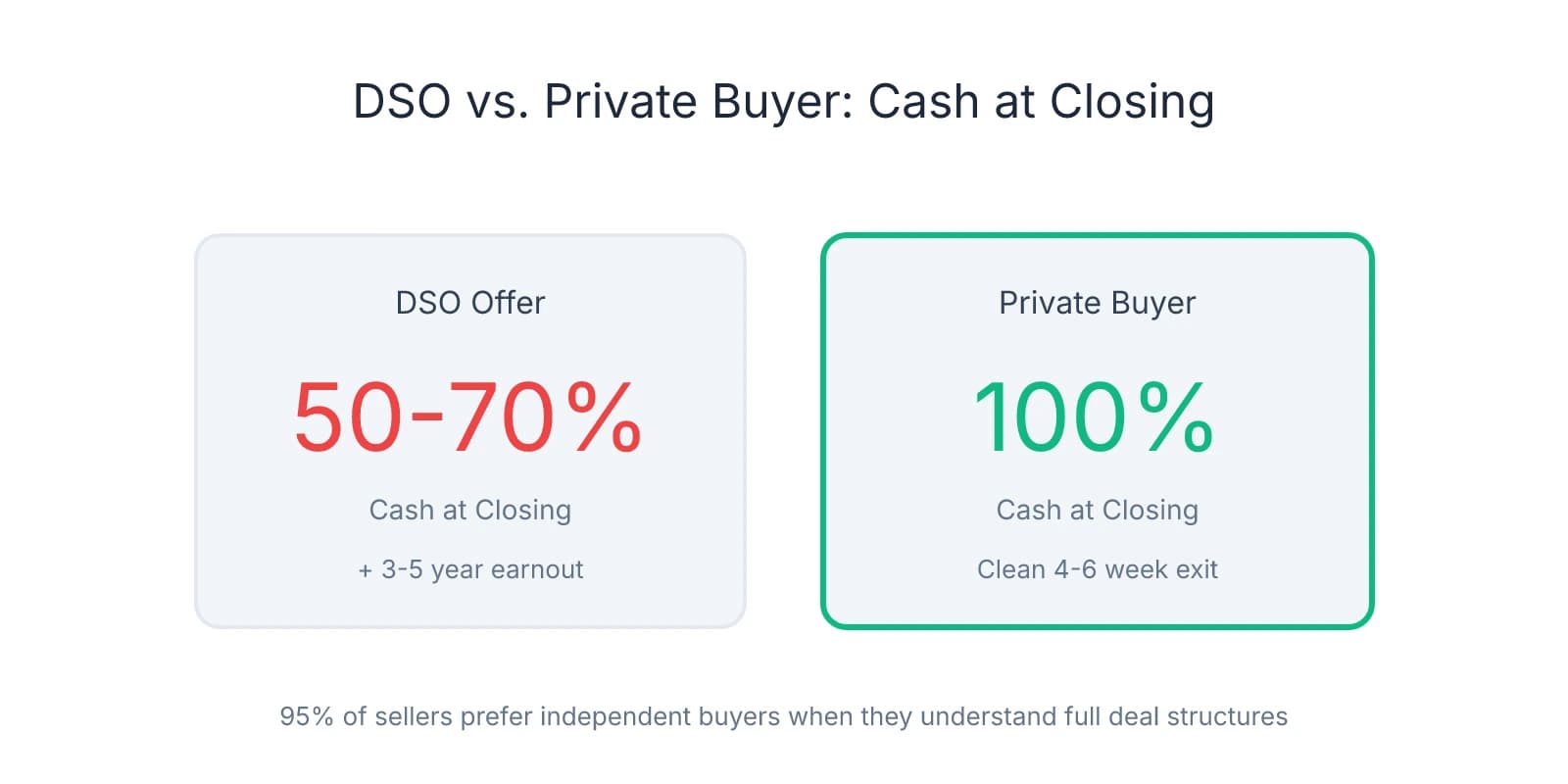
Here's what that misses: 95% of sellers prefer selling to independent buyers when they understand the full deal structure—because of economics, not sentiment.
A DSO offer might look larger on paper, but most corporate deals pay 50-70% cash at closing, with the remaining 30-50% tied to earnouts, production targets, or equity rollovers. The seller stays on for 3-5 years, often working harder to hit aggressive benchmarks that determine whether they see the rest of their money.
Compare that to a private buyer transaction: 100% cash at closing, a clean 4-6 week transition, and the seller walks away with their full payout. When you frame it that way—actual dollars received, actual timeline—the gap narrows significantly. In many cases, the private buyer delivers more money faster with fewer contingencies.
One pattern worth noting: DSOs evaluate the same fundamentals you do—profit margins, patient demographics, hygiene production, operational efficiency. The difference is they optimize for regional portfolio fit, not individual practice potential. If a practice doesn't slot into their existing footprint or meet system-wide metrics, they pass—even if the fundamentals are strong.
That creates opportunity. A practice that doesn't fit a DSO's acquisition model might be exactly what you're looking for: stable patient base, strong hygiene recall, manageable overhead, and a seller who values a straightforward transaction over a multi-year earnout.
Where buyers often lose confidence is in pricing conversations. You see a DSO offer at 95% of collections and assume you can't compete at 75-80%. But sellers who've been through corporate negotiations know what those numbers mean. They've seen colleagues stuck in work-back agreements, chasing production targets, waiting years for final payout. When you present a clean offer with 100% cash at close, you're competing on certainty, not price.
If you're worried about losing a practice to a DSO, start by understanding what the seller wants. Many are looking for a smooth exit, not the highest headline number. If they've built a practice culture they're proud of, they often prefer handing it to someone who'll preserve it rather than folding it into a regional portfolio. That's a rational preference for a transaction that closes cleanly and pays out fully.
The real competitive advantage isn't capital—it's clarity. DSOs bring complexity: earnouts, rollovers, work-backs, production hurdles. You bring simplicity: a clean offer, a short transition, and commitment to the practice they built. In most cases, that's what sellers are looking for. For more on recognizing when a deal structure doesn't align with your goals, see When Should You Walk Away From Buying a Dental Practice?
Asset Purchase vs. Stock Purchase: Why This Matters More Than Price
The structure determines your tax liability, legal exposure, and ability to write off the purchase over time. Most buyers focus on headline price and miss the structure—which is often where the real risk sits.
In an asset purchase, you buy individual components: equipment, patient records, goodwill, supplies. In a stock purchase, you buy the entity itself—and inherit every liability, known or unknown. Most dental acquisitions are asset purchases, and for good reason: they favor buyers.
Why Asset Purchases Protect Buyers
An asset purchase lets you cherry-pick what you're acquiring and leave behind what you're not. You take the patient base, equipment, and brand—but don't inherit unpaid payroll taxes, pending lawsuits, or regulatory violations. The seller's legal entity stays with them, along with its liabilities.
A stock purchase transfers everything. If the practice has an outstanding OSHA violation, a former employee claim, or an unresolved insurance audit, it's now your problem. Even if the seller discloses everything they know, there's no protection against what they don't know. That's why stock purchases are rare in dental transitions—and why buyers who agree to them usually demand significant price reductions.
How Allocation Determines Your Tax Write-Off Speed
Once you've structured the deal as an asset purchase, the next negotiation is allocation—how the purchase price divides across asset categories. This determines how quickly you can write off the purchase for tax purposes.
Supplies can be deducted immediately. Equipment can be accelerated through Section 179 or bonus depreciation, giving you a significant deduction in year one. Goodwill—typically the largest portion—amortizes over 15 years, meaning no immediate tax benefit.
Here's the tension: buyers want more allocated to equipment and supplies for faster write-offs. Sellers want more allocated to goodwill, which is taxed at lower capital gains rates. The difference can be tens of thousands of dollars in tax liability on both sides.
One step many buyers find valuable is pushing for higher allocation toward tangible assets—equipment, supplies, furniture—and lower allocation toward goodwill. The seller will resist, but there's often room to move if you frame it as part of the overall deal structure rather than a standalone demand.
A pattern across deals: buyers who negotiate allocation early—before the purchase agreement is signed—have more leverage than those who treat it as a post-LOI detail. Once the headline price is locked, sellers are less willing to shift allocation in ways that increase their tax burden.
Work with a CPA who specializes in dental transitions before you finalize the purchase agreement. They can model different allocation scenarios and show you the tax impact of each. In some cases, paying slightly more but negotiating better allocation results in lower net cost after tax benefits.
For more on structuring the deal to protect your interests from the start, see 5 Problems Every Practice Buyer Faces (And How to Handle Each One).
The Hidden Liabilities Buyers Discover Too Late
Due diligence is where the seller's narrative meets reality. The P&L shows strong collections, the patient base looks stable, and the equipment appears functional. Then you start pulling documents and discover what wasn't disclosed: deferred maintenance on critical equipment, accounts receivable that's mostly uncollectible, or a pending compliance issue that could result in six-figure fines.
What tends to happen is buyers focus on verifying what the seller told them rather than uncovering what the seller didn't mention. Financial statements show revenue, but not vendor contracts that weren't renewed, regulatory correspondence that was ignored, or cybersecurity gaps that expose you to HIPAA violations the day you take ownership.
Review Check Registers, Not Just Financial Summaries
One protection many buyers overlook is requesting check registers for the prior 6 months. Financial statements aggregate expenses into categories—supplies, lab fees, marketing—but check registers show actual payments to actual vendors. This reveals recurring expenses that weren't disclosed, vendor contracts the seller claimed were canceled, or payment patterns that don't match stated financials.
Where deals go sideways is when buyers discover post-closing that the practice has been paying for services the seller said were terminated—software subscriptions, equipment leases, or consulting agreements with auto-renewal clauses. The check register surfaces these before you're contractually obligated to honor them.
Examine Accounts Receivable Aging Reports
Practices with inflated collections claims often hide the problem in their A/R aging. If more than 20% of accounts receivable is over 90 days old, that signals collection problems that will become yours. The seller may be booking revenue that will never convert to cash, which means actual profitability is lower than reported.
Request a detailed aging report broken down by 30-day increments: current, 31-60 days, 61-90 days, 91-120 days, and over 120 days. Then ask for write-off history for the past 12 months. If the practice is carrying significant old receivables but rarely writing anything off, they're either not pursuing collections aggressively or inflating the asset value on paper.
Request All Regulatory Correspondence for the Past 5 Years
Asking for all correspondence from regulatory agencies over the past 5 years uncovers compliance issues or pending investigations the seller may not have volunteered. Licensing agencies, OSHA, state dental boards—any entity with enforcement authority should be part of your document request.
A pattern worth noting: sellers who've received notices of non-compliance often assume the issue is resolved because they responded to the letter. But unless you see formal closure documentation from the agency, the matter may still be open—and transferable to you as the new owner.
Verify Malpractice Claims History and Cybersecurity Posture
Request malpractice claims history for all licensed professionals going back 10 years, not just active claims. Closed claims can reveal patterns—repeated allegations of the same type of error, settlements that suggest systemic issues, or coverage gaps that left the practice exposed.
On cybersecurity, non-compliance with HIPAA can result in fines up to $1.5 million per violation. Many practices have never conducted a formal risk assessment, haven't updated software in years, or lack basic safeguards like encrypted email or multi-factor authentication.
Ask for documentation of the practice's HIPAA compliance program: risk assessments, business associate agreements, breach notification procedures, and staff training records. If the seller can't produce these, you're inheriting a compliance gap that could cost significantly more than the purchase price.
For more on recognizing when these liabilities should stop a deal entirely, see When Should You Walk Away From Buying a Dental Practice?. The goal of due diligence isn't to find a perfect practice—it's to understand the real condition of what you're buying and price the risk accordingly.
Why Collections Drop After Closing (And How to Diagnose It Before You Buy)
One of the most common post-acquisition surprises is an immediate drop in collections—sometimes 15-20% in the first quarter. The seller's numbers looked solid, the patient base seemed stable, and the transition felt smooth. Then deposits start coming in lower than projected.
What tends to happen is buyers verify that revenue existed historically but don't diagnose whether that revenue was sustainable. A practice can show strong collections for years while relying entirely on the seller's personal relationships, deferred maintenance that patients tolerated out of loyalty, or accounting practices that inflated reported revenue. When the seller leaves, those structural weaknesses surface immediately.
Patient Attrition Is Rarely the Problem—Staff Turnover Is
Average patient attrition following a practice sale is less than 10% when transitions are handled properly. Patients receive a letter from their dentist endorsing the new owner, and most give the new doctor a chance. They're already familiar with the location, hours, staff, and office systems.
Where buyers often get burned is assuming patient retention depends on the dentist. In reality, patients often have closer relationships with hygienists and front desk staff. If your hygienist of 10 years leaves two months after the sale, patients notice—and many follow.
One step many buyers find valuable is identifying which staff members have the longest tenure and strongest patient relationships, then structuring retention bonuses or transition incentives to keep them through the first 6-12 months. If the seller's hygienist has been there for 15 years and half the patient base requests her specifically, losing her is a bigger risk than losing a handful of the seller's personal friends.
Revenue Per Employee and Revenue Per Chair Reveal Operational Health
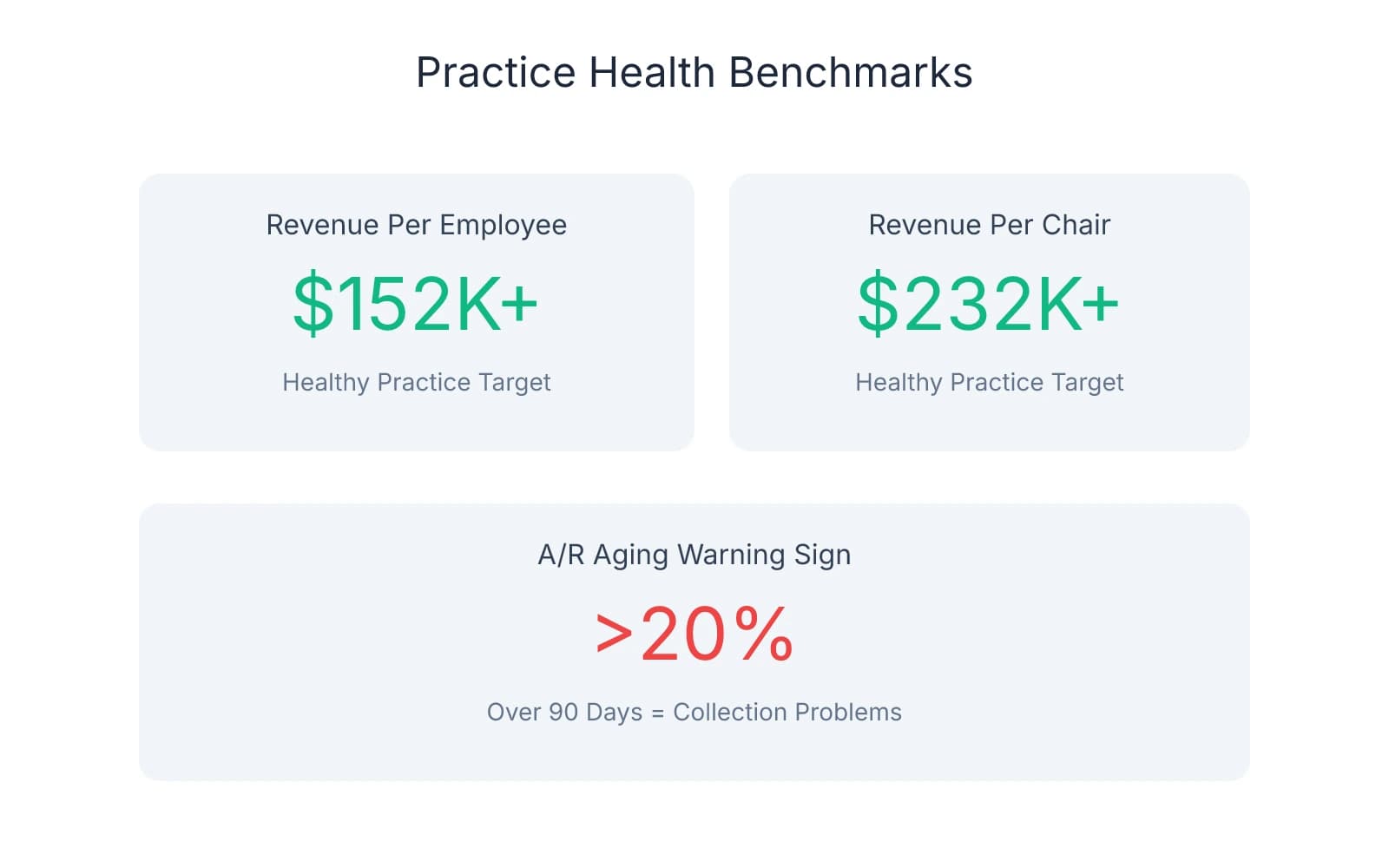
Before you assume a practice's revenue is sustainable, calculate two benchmarks: revenue per employee and revenue per chair. Healthy practices generate $152,448 or more per employee and $231,721 or more per chair. Numbers significantly below these thresholds signal operational inefficiency that won't improve just because ownership changed.
If a practice is generating $120,000 per employee, that suggests overstaffing, underutilized capacity, or low productivity across the team. If revenue per chair is $180,000, the practice either has too many chairs for its patient volume or isn't scheduling efficiently. These aren't problems you can fix by working harder—they're structural issues that require operational changes, which often take 12-18 months to implement.
Calculate these numbers during due diligence, not after closing. If the practice falls below benchmark, ask the seller to explain why. Sometimes there's a valid reason—recent staff expansion in preparation for growth, a temporary dip due to a hygienist on maternity leave. But if the seller can't explain it, you're looking at a practice that's been underperforming, and the revenue you're buying may not be repeatable.
High Accounts Receivable Signals Inflated Revenue
Practices with strong collections convert revenue to cash quickly. When accounts receivable exceeds twice the monthly collections, the seller may be booking revenue they haven't actually collected—and may never collect. This inflates reported revenue and makes profitability look stronger than it is.
Request an aging report and look at the percentage of receivables over 90 days old. If more than 20% of A/R is in that category, the practice has a collection problem. Either they're not pursuing old balances aggressively, or they're carrying uncollectible accounts on the books to inflate the asset value.
One pattern across deals: sellers who've been deferring collections to avoid difficult conversations with long-time patients often see a sharp drop in reported revenue once the new owner implements standard collection policies. The revenue was never real—it was just deferred conflict. When you take over and start enforcing payment expectations, patients leave or disputes surface, and collections drop accordingly.
Diagnose Revenue Quality Before You Close
The goal isn't to find a practice with zero risk—it's to understand which revenue is sustainable and which is propped up by factors that won't transfer. Pull the staff roster and identify key relationships. Calculate revenue per employee and revenue per chair. Review the A/R aging and ask hard questions about anything over 90 days old.
For more on navigating the transition from associate to owner and understanding realistic timelines for acquisition, see From Associate to Owner: How Long It Really Takes to Buy a Practice. And if the numbers reveal structural problems you're not equipped to solve, 5 Problems Every Practice Buyer Faces (And How to Handle Each One) walks through how to address operational weaknesses before they become financial liabilities.
Sources & References
The data and claims in this article are drawn from the following sources. We prioritize government data, peer-reviewed research, and established industry publications to ensure accuracy.
- Why Independent Buyers Aren't Really Competing Against DSOs— nxlevelconsultants.com
- Understanding the Taxes When Buying a Dental Practice— pmagroup.net
- Dental Transitions: Understanding an Asset Sale vs. a ...— www.dmcounsel.com
- 3 advantages (and one disadvantage) private buyers have ...— www.dentalbuyeradvocates.comIndustry
- Dental Benchmarking Key Financial Metrics— porterkinney.com
- Patient Retention Following a Dental Practice Sale— dentaltransitions.comIndustry
Frequently Asked Questions
Avoid costly mistakes in your practice acquisition
Navigating the complexities of dental practice valuation requires expert guidance to identify hidden liabilities and negotiate confidently. Minty Plus connects you with acquisition specialists who help you evaluate practices thoroughly and close successfully.