Dental PPO Leased Networks: Rates You Never Agreed To

Co-Founder, Minty Dental

In Summary
- A leased network (also called a shared or umbrella network) lets the carrier you signed with share your participation and fee schedule with other payers through a clause buried in your original contract.
- You never sign a separate agreement with the downstream carrier, yet you are legally bound to accept its payments because your original contract already granted consent.
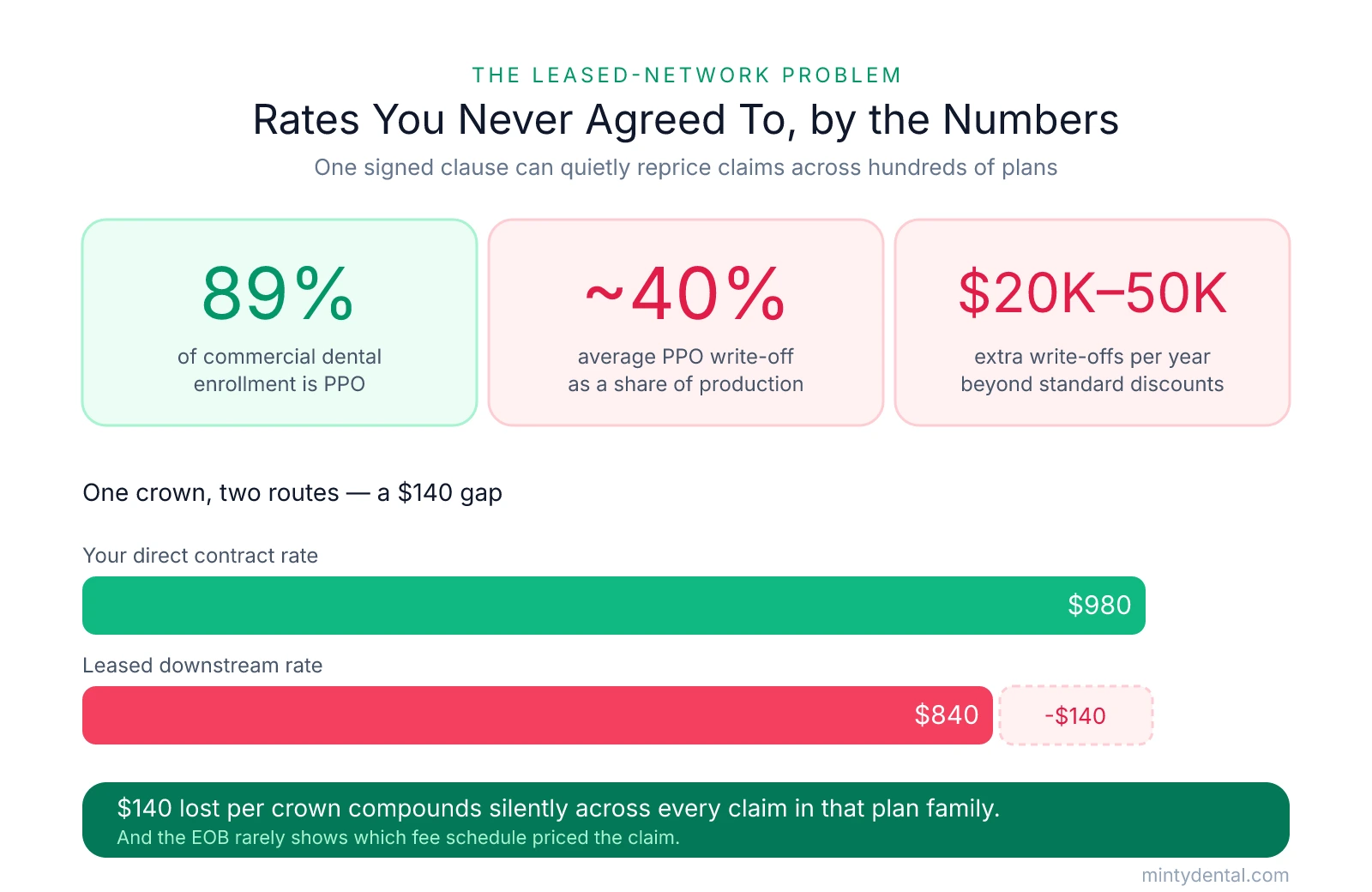
- PPOs cover roughly 89% of commercially insured dental patients, so a single signed contract can pull your fees into dozens or hundreds of plans.
- EOBs almost never tell you which fee schedule priced a claim, making leased-network underpayments nearly invisible without a deliberate audit.
- The difference between your negotiated rate and a leased rate on a single crown can run $100 or more, compounding quietly across every claim from that plan family.
A Leased Network Is Why You're Paid at Rates You Never Signed
Network leasing is a contractual arrangement in which the carrier you joined sells or shares access to your participation and fee schedule with other insurance companies, allowing those other payers to pay your claims at contracted rates without ever negotiating with you directly. It is also called a shared network or umbrella network arrangement, and the mechanism that makes it binding is a clause you almost certainly agreed to when you signed your original PPO contract.
That clause is usually called an affiliated-carrier clause, and its language tends to be easy to overlook. Phrases like "may lease, share, rent, or market its network to other payers" or "may be accessed by affiliated or associated plans" are the tell. They sound procedural. What they actually do is give Network A permission to hand your fee schedule to Network B, C, and D without any further notice to you. The ADA has confirmed this scenario directly: a dentist signs with Network A, Network A leases access to Network B, and the dentist appears in-network with Network B without signing a separate agreement.
The scale of the exposure matters here. PPOs represent roughly 89% of commercial dental enrollment, which means the leasing web can extend to dozens or hundreds of plans from a single contract. A regional carrier you signed with years ago may have since joined a national umbrella arrangement that routes claims from employers you have never heard of through your original fee schedule, or through a lower one the downstream payer accesses instead.
That last part is where the money goes. The downstream carrier does not always use your direct contract rates. It may pay at its own fee schedule or at the lowest rate it can access through the arrangement. To take a hypothetical example: your direct contract with Network A allows $980 for a crown. Network B accesses that relationship and prices the same crown at $840. That is $140 less on a single procedure, and it compounds silently across every crown, every bridge, every other covered service billed to any plan in Network B's family.
What makes this hard to catch is that the EOB does not tell you it happened. Across 70 EOB documents reviewed from 33 carriers, zero carried a non-boilerplate fee-schedule label — no schedule name, no identifier, nothing that would let your team trace the allowed amount back to a specific contracted rate. The document shows what was paid. It does not show where that number came from. If you have ever tried to renegotiate your PPO fees and found the math inconsistent across claims from what looked like the same plan family, a leased route is a plausible explanation.
How Payment Downgrading Works — and What It Costs
The write-off you take on a PPO claim is already a significant concession. The national average PPO adjustment runs roughly 40% of production, meaning you are collecting about sixty cents on every dollar you produce before a single claim problem appears. Payment downgrading is what happens when a payer, able to reach your rates through more than one network route, prices the claim on the cheapest schedule in view rather than the one you actually negotiated. It does not replace the standard write-off. It sits on top of it.
The contract language that controls whether this can happen is specific: does your agreement state that the signed fee schedule "remains effective and controlling" when the network is leased to another payer? That phrase keeps your negotiated rate in charge regardless of which downstream plan processes the claim. Without it, the floor is open, and a payer with access to a lower schedule through any leased arrangement can use it.
An analysis of 2,870-plus practices estimates that shared network arrangements add $20,000 to $50,000 per year in write-offs beyond what standard PPO discounts already cost. That range reflects real variation across practices, payer mixes, and production volumes, but the direction is consistent: the problem compounds rather than plateaus.
There are three mechanisms that produce downgraded payments, and each leaves a slightly different mark on an EOB.
| Scheme | What happens | EOB fingerprint |
|---|---|---|
| Cherry-picking | Your own lowest contracted rate across any of your active PPO agreements gets applied to a claim, even from a plan tied to a different, higher-rate contract | Payer name matches a plan you know, but allowed fee sits below that plan's negotiated schedule |
| Silent PPO | A rental network leases your fees to a payer that never steered you a patient, never credentialed you, and has no direct relationship with your practice | Unfamiliar payer name on the EOB; EOB references a "participating provider" status you never established |
| Stacking | A payer holds simultaneous access to multiple networks and selects the cheapest schedule on each individual claim | Allowed amounts vary unexpectedly from claim to claim under the same plan, with no clear pattern |
All three of these schemes are documented consequences of leased network arrangements, and each one produces the same outcome for the practice: a lower allowed fee than the rate you negotiated, with a contractual prohibition on billing the patient the balance. Without a claim-by-claim comparison against your actual contracted rates, that leakage stays invisible.
How to Find Leased Network Exposure in Your EOBs and Contracts
Running this audit does not require specialized software. What it requires is a stack of recent EOBs, your signed contracts, and about two hours of focused attention.
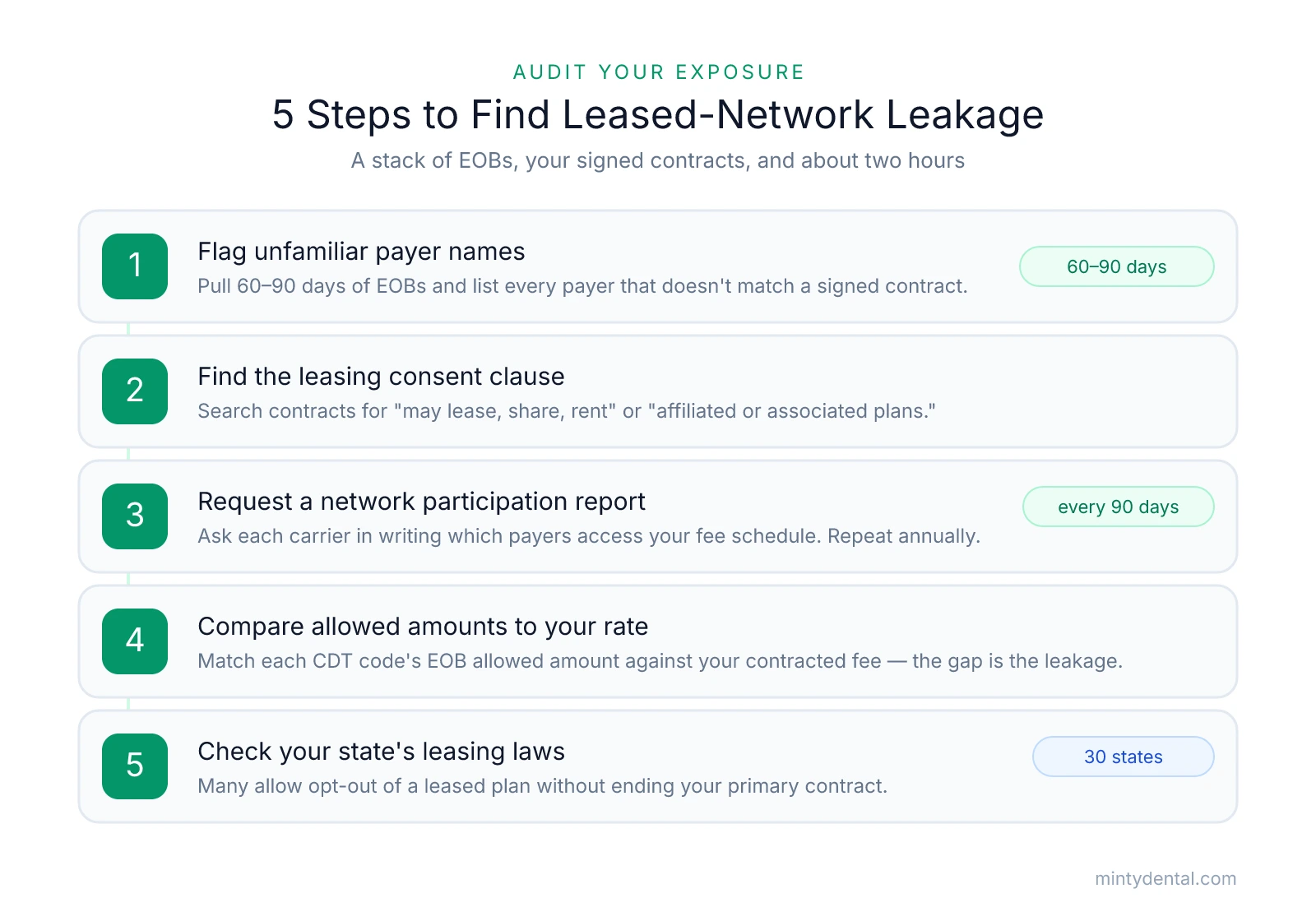
Step 1: Flag unfamiliar payer names on your EOBs.
Pull 60 to 90 days of EOBs and build a simple list of every payer name that appears on a remittance. Then compare that list against the carriers you have actually signed contracts with. Any name that does not match a signed contract is your first signal of a leased arrangement. The unfamiliar payer may be a self-insured employer plan, a regional carrier you have never dealt with, or a downstream network that accessed your fees through an upstream contract. Flag every one.
Step 2: Search your signed contracts for the leasing consent clause.
Pull each contract and search for phrases like "may lease, share, rent, or market its network" or "affiliated or associated plans." That sentence is where you gave consent. If it is there, downstream payers can access your fee schedule under that contract. Note which contracts contain it and which do not, because that distinction matters when you get to Step 5.
Step 3: Request a written network participation report from each carrier.
Contact every carrier you are contracted with and ask in writing which payers, plans, and networks currently have access to your fee schedule through that contract. Some carriers maintain this list on a website; California's AB 954, effective January 2020, requires carriers to publish it and update it at least every 90 days. Even outside California, you are entitled to ask. Request the report annually, because leases change without any obligation to notify you.
Step 4: Compare allowed amounts against your signed fee schedule.
For each flagged EOB, look up the allowed amount for the CDT code billed and compare it to your contracted rate for that same code under whichever signed contract should apply. If the allowed amount is lower than your negotiated rate, you are likely looking at downgrading through a leased route. A simple spreadsheet with the CDT code, your contracted allowed amount, and the EOB's allowed amount will surface the gap quickly. If you are also seeing unexpected claim rejections alongside unfamiliar payer names, it may be worth reviewing your denial rate by payer at the same time, since leasing arrangements can also introduce credentialing mismatches that trigger denials.
Step 5: Check your state's leasing laws.
Thirty states have passed legislation addressing PPO network leasing as of 2025, and many allow you to opt out of specific leased plans without terminating your primary contract. California's AB 954 is the model most state laws follow: it requires carriers to name all parties with access, allows written opt-out, and requires the remittance to identify the source of the discount. Before you send any opt-out notice, confirm the exact process your state requires. Opting out incorrectly can trigger a full contract termination rather than removing only the leased relationship.
If you want a professional review, the ADA's Contract Analysis Service is free for members and available through your state or local dental society. It covers unsigned contracts; for agreements you have already signed, your state dental association's practice support team can advise on what your options are under your existing terms.
Deciding Whether to Opt Out, Renegotiate, or Accept the Arrangement
Not every leased network arrangement costs you money in a meaningful way. If a leased plan is actually sending patients to your practice and the allowed fee lands close to your direct contract rate, the real issue is transparency rather than financial damage. You participated through a clause you agreed to, the downstream payer processed the claim at a rate that is roughly equivalent, and patients came through the door. That is a different situation from one where the allowed amount is materially lower and no patient steering is happening.
The distinction matters because your response should fit the actual problem.
If the allowed amounts from a leased plan are running below your contracted rate, start with your signed contract before doing anything else. Look for language stating that your negotiated fee schedule "remains effective and controlling" when the network is leased. If that clause is there, you have a basis to dispute the repricing in writing directly with the carrier. Put the specific claim numbers, CDT codes, your contracted rate, and the EOB's allowed amount in the letter. That paper trail also strengthens your position if the dispute escalates.
If your state allows opt-out and the leased plan is a net negative — lower rates, no patient volume, no steering mechanism you can identify — a written opt-out letter is the cleanest remedy. That letter needs to include your Tax Identification Number, practice address, contact information, an explicit opt-out statement naming the specific leased plan, and the billing dentist's signature. Send it certified mail and keep the return receipt. A properly scoped opt-out removes the leased relationship without touching the primary contract.
What you want to avoid is terminating the primary contract to escape a leased arrangement. That removes your direct relationship with the upstream carrier and every patient who finds your practice through it. The cure is worse than the problem in almost every case.
In states without opt-out legislation, your leverage arrives at contract renewal. That is the moment to negotiate controlling-terms language into the agreement, or to push for removal of the leasing clause entirely. 16 states enacted new dental insurance laws in 2026 alone, and that legislative momentum may expand your options before your next renewal window opens. If a broader shift away from PPO participation is something you are weighing, the sequencing involved in that transition deserves its own analysis before you make any contract decisions.
Sources & References
The data and claims in this article are drawn from the following sources. We prioritize government data, peer-reviewed research, and established industry publications to ensure accuracy.
- Dear ADA: I'm being paid as a network provider, but I never signed an ...— adanews.ada.orgIndustry
- PPOs represent roughly 89% of commercial dental enrollment— nadp.org
- How do I tell which fee schedule paid a dental claim?— kaylie.ai
- DENTAL BENEFITS Exploring the Landscape of Leased PPO Networks— www.agd.orgIndustry
- Shared Network Agreements Dental: 5 Hidden Traps Costing You ...— ppoadvisors.comIndustry
- Know your rights when it comes to dental benefit plan network leasing— cda.orgIndustry
- Dental Insurance Reform: 30 New Laws and 1 Big Warning— ppoadvisors.comIndustry
See What Your PPO Crown Fee Actually Pays Here
If your write-offs are running higher than your signed fee schedule should produce, the first step is knowing where your fees stand for your area and what group schedule access could change. Run a quick check on your crown fee to start the audit.