How to Read Adjustment Codes on a Dental Insurance EOB

Co-Founder, Minty Dental

In Summary
- Every reduction between your billed charge and what the carrier pays is explained by a standardized adjustment code on the EOB — not just a dollar amount.
- Adjustment codes follow a three-layer structure: a group code assigns financial responsibility, a Claim Adjustment Reason Code (CARC) states why the amount was reduced, and a Remittance Advice Remark Code (RARC) adds detail when needed.
- The four group codes are CO (contractual obligation, absorbed by the practice), PR (patient responsibility), OA (other adjustment), and PI (payer-initiated adjustment).
- CARCs and RARCs are standardized across all carriers under HIPAA's X12 835 transaction standard, so CO-45 means the same thing on a Delta Dental remittance as it does on a Cigna remittance.
- Reading these codes correctly lets you distinguish a legitimate write-off from a carrier underpayment and post the ledger accurately.
Dental EOB Adjustment Codes Explain Every Dollar the Carrier Didn't Pay
An adjustment code is the carrier's standardized, machine-readable explanation for every reduction between your billed charge and the amount it actually paid. When a carrier processes a claim, it doesn't simply send a check — it sends a remittance that accounts for every dollar of the gap, and each piece of that accounting is attached to a specific code.
That structure matters because not every reduction is the same thing. Some reductions are contractual write-offs your practice agreed to when you signed the PPO contract. Others are the patient's deductible or cost-share. Still others signal a coverage denial or a carrier-side adjustment you didn't expect. The codes are what separate one from another.
The three-layer structure
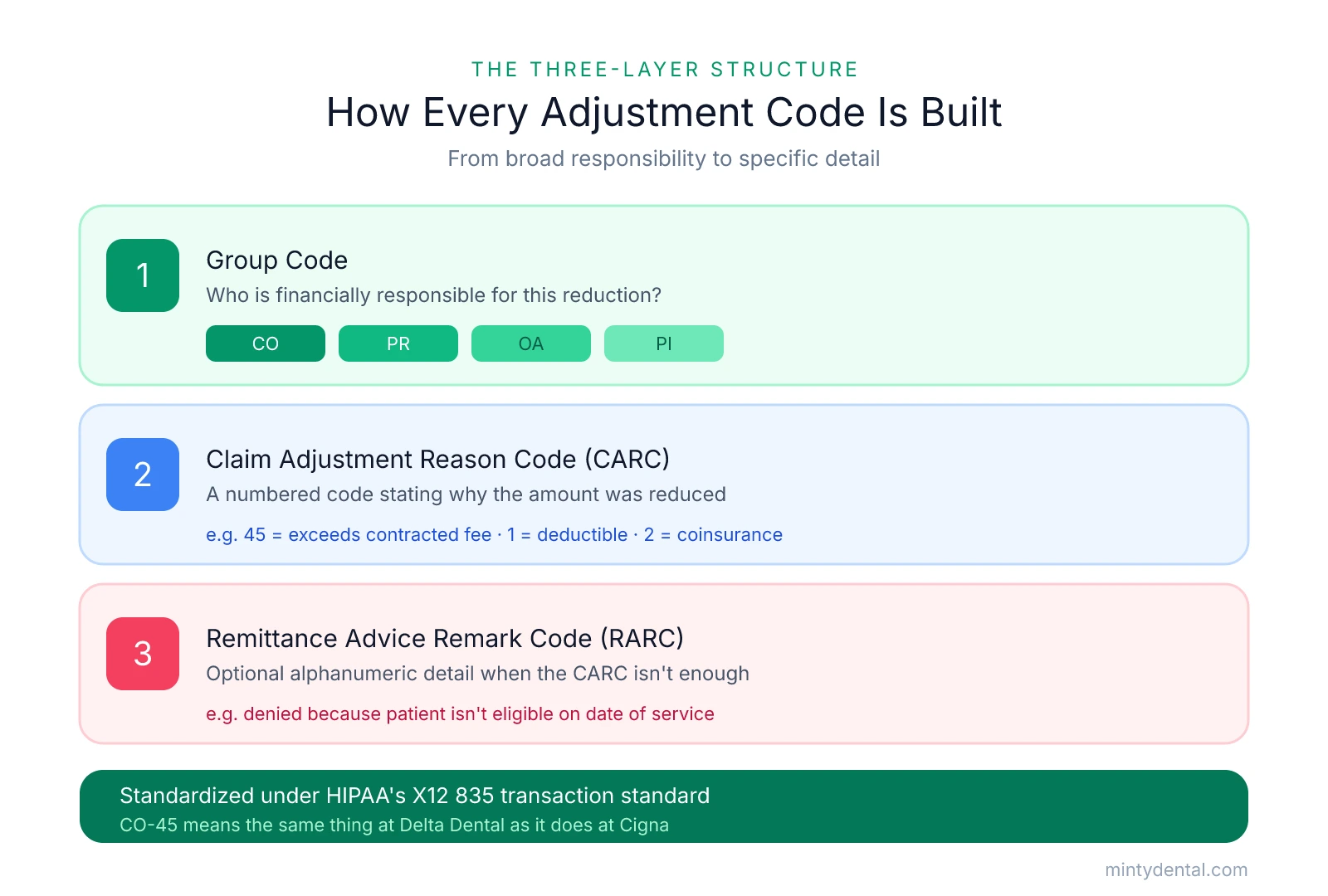
Every adjustment on an EOB works in three layers, moving from broad to specific.
The first layer is the group code. It answers one question: who is financially responsible for this reduction? The four group codes are CO (Contractual Obligation), PR (Patient Responsibility), OA (Other Adjustment), and PI (Payer Initiated). CO means your practice absorbs the reduction — it's the write-off that flows from your PPO fee schedule agreement. PR means the patient owes it. OA and PI cover adjustments that don't fit neatly into the first two categories, such as coordination of benefits or a payer correction.
The second layer is the Claim Adjustment Reason Code, or CARC. This is a numbered code that explains why the amount was reduced. CO-45, for example, means the charge exceeded the contracted fee. CARC 1 means the deductible applies. CARC 2 means coinsurance. There are more than 200 active CARCs, but a dental practice encounters a relatively small handful on most remittances.
The third layer is the Remittance Advice Remark Code, or RARC. This is an alphanumeric code that adds detail when the CARC alone isn't enough. A CARC might tell you a service was denied; the RARC tells you it was denied because the patient isn't eligible on the date of service. RARCs are optional — they appear when the carrier has something specific to add.
These codes are standardized under HIPAA's X12 835 electronic transaction standard, which means the same CARC carries the same meaning regardless of which carrier issued the remittance. CO-45 at Cigna is the same code as CO-45 at Delta Dental. That uniformity is what makes it possible to build consistent posting rules and spot patterns across carriers.
A worked example
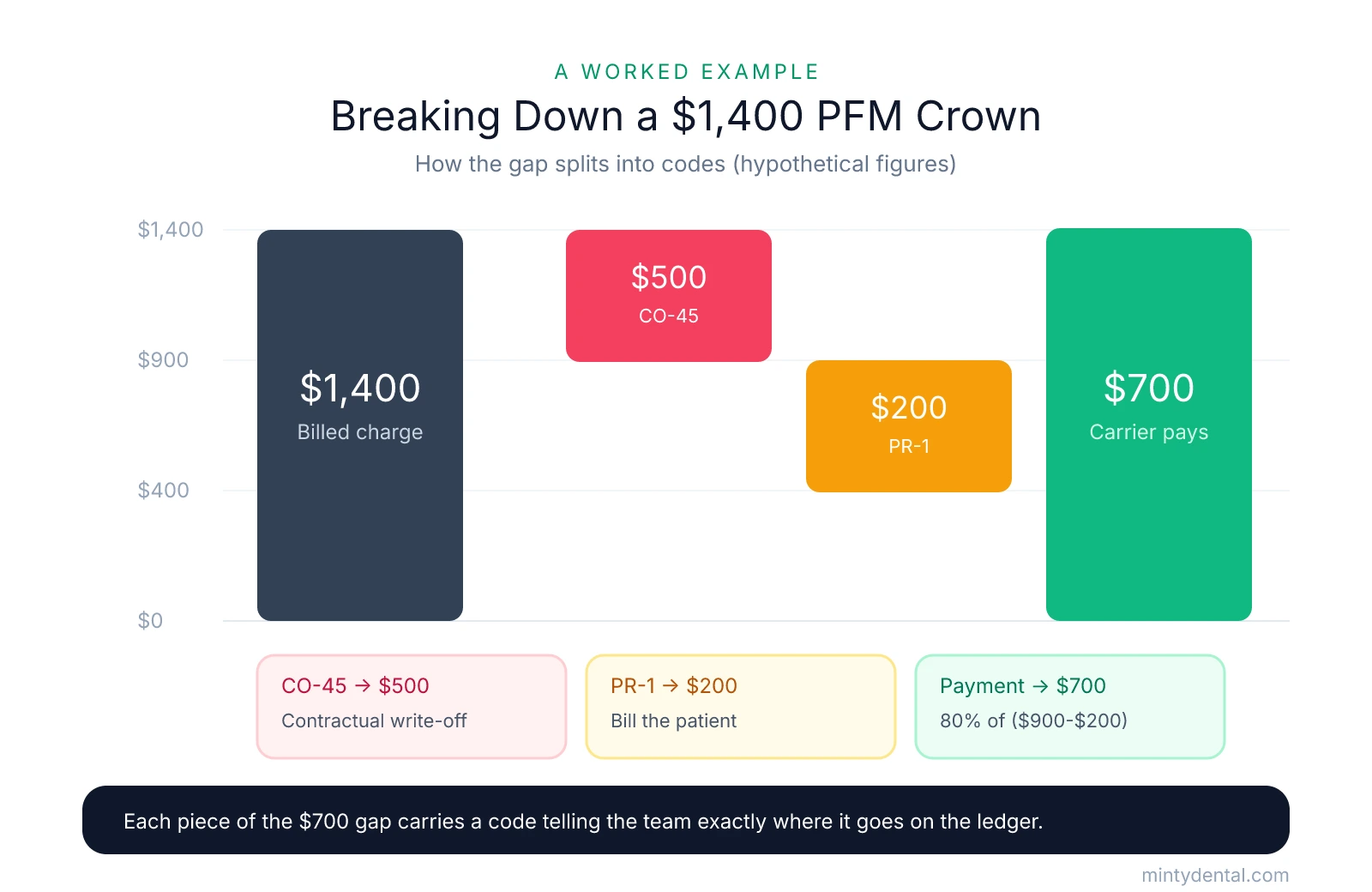
Say your practice bills $1,400 for a PFM crown. The carrier's contracted fee for that procedure is $900, the patient has a $200 remaining deductible, and the plan pays 80% after the deductible. Here's how the $700 gap breaks down in adjustment codes (hypothetical figures for illustration):
| Dollar amount | Group code + CARC | What it means |
|---|---|---|
| $500 | CO-45 | Reduction to contracted fee — practice write-off |
| $200 | PR-1 | Patient's deductible — patient owes this |
| $700 | (payment) | Carrier pays: 80% of ($900 - $200) |
The practice posts a $500 contractual adjustment to the ledger, bills the patient $200, and collects $700 from the carrier. Each piece has a code telling the billing team exactly where it goes. If you want to understand how that $500 write-off should be recorded versus a discretionary adjustment, the distinction matters for keeping your write-off reporting clean on the ledger.
Paper versus electronic remittances
Paper EOBs follow the same underlying logic, but carriers sometimes substitute plain-language labels for the standard codes or list reason descriptions without the alphanumeric code itself. You might see "fee reduction" instead of CO-45, or "applied to deductible" instead of PR-1. The financial meaning is identical — the presentation is just less standardized. If your practice receives a mix of paper and electronic remittances, it's worth mapping the carrier's plain-language labels back to the standard codes so your team posts them consistently.
The Codes That Appear on Almost Every Dental EOB
Most of what you see on a dental remittance comes down to a short list of codes. A PPO practice might process hundreds of EOBs a month, but the same seven or eight CARCs account for the vast majority of adjustments. Knowing what each one means — and what your team should do with it — is the difference between a ledger that's accurate and one that quietly accumulates errors.
| Code | Group | What It Means | Ledger Action |
|---|---|---|---|
| CO-45 | CO | Charge exceeds contracted fee | Post as contractual adjustment (write-off) |
| PR-1 | PR | Patient deductible applied | Bill patient |
| PR-2 | PR | Patient coinsurance portion | Bill patient |
| PR-3 | PR | Patient copay | Bill patient |
| CO-97 | CO | Procedure bundled into another service on the same claim | Verify bundling is correct; appeal if not |
| CO-4 | CO | Modifier inconsistent with procedure code | Review for downcoding; appeal if warranted |
| CO-119 | CO | Patient's annual maximum reached | Reclassify balance as patient responsibility |
| CO-29 | CO | Timely filing deadline missed | Write off as avoidable loss; correct internally |
CO-45: the code you'll see on nearly every PPO claim
CO-45 is the contractual write-off code. It represents the difference between your billed fee and the carrier's allowed amount — the reduction your practice agreed to when it signed the PPO contract. This is a legitimate adjustment, not a dispute. Post it as a contractual write-off and move on. If you're seeing CO-45 reductions that seem larger than expected, that's a fee schedule question worth investigating separately, but the code itself doesn't signal an error.
PR-1, PR-2, PR-3: the patient's share
These three codes mark amounts the patient owes — deductible (PR-1), coinsurance (PR-2), and copay (PR-3). None of them should be written off. Post them to the patient's ledger balance and collect accordingly. A common posting mistake is absorbing a PR code as a write-off when the billing team doesn't recognize it, which quietly reduces what the practice collects from patients.
CO-97: the bundling signal
CO-97 means the carrier considers the billed procedure to be included in the payment for another procedure already on the same claim. It's one of the two codes most directly associated with carrier bundling practices that reduce reimbursement without explanation in plain language. When you see CO-97, check whether the bundling is actually consistent with the CDT coding guidelines. If the procedures are clinically distinct and separately documented, the adjustment warrants a call or appeal.
CO-4: the modifier flag that can accompany downcoding
CO-4 signals that the modifier billed is inconsistent with the procedure code — but in dental billing, it often appears alongside a situation where the carrier has substituted a lower-reimbursing procedure code for the one you submitted. The carrier uses the modifier mismatch as the stated justification. Don't treat CO-4 as automatically legitimate. Check what code was actually paid versus what you billed, and if the carrier changed the procedure code, that's a downcoding situation worth appealing with clinical documentation.
CO-119: benefit maximum exhausted
CO-119 means the patient has hit their annual maximum. The remaining balance doesn't disappear — it becomes patient responsibility. Repost that balance to the patient's account rather than writing it off. If your team sees CO-119 and writes the balance off as a carrier adjustment, you're leaving collectible money on the table.
CO-29: timely filing, an avoidable write-off
CO-29 means the claim was submitted outside the carrier's filing window. Unlike CO-45, this isn't a contractual reduction you agreed to — it's a denial caused by an internal process failure. The balance typically can't be billed to the patient either, so it becomes a true write-off. When CO-29 appears, the right response is to track which carrier it came from and how old the claim was. A pattern of CO-29 denials points to a claims submission workflow problem worth fixing before it compounds.
How to Tell a Legitimate Write-Off From a Disputable Reduction
The adjustment code tells you what the carrier did. Whether that action was correct is a separate question you have to answer yourself.
A useful habit is to run three checks on each line item before posting: does the group code assign responsibility correctly, does the CARC match what actually happened with this claim, and does the allowed amount match the contracted fee loaded in your PMS? The first two checks catch misclassified adjustments. The third one catches underpayments that CO-45 can quietly disguise.
CO-45 is only legitimate if the allowed amount matches your contracted fee
This is the most important distinction on a PPO remittance. CO-45 tells you the carrier reduced the charge to the contracted fee. It doesn't tell you whether the contracted fee it used is the right one. If the carrier's allowed amount on the EOB is lower than the fee schedule in your PMS for that procedure code, you're looking at an underpayment, not a routine write-off. The code is correct in form but wrong in amount.
That gap won't surface unless you compare the two numbers directly. If your PMS fee schedule isn't kept current with your actual contracted rates, that comparison becomes unreliable, which is part of why discrepancies between PMS fees and insurance payments can go unnoticed for months. When the numbers don't match and you've confirmed your fee schedule is current, the claim is worth disputing.
Patterns matter more than individual claims
A single CO-45 that's slightly off might be a data entry issue. The same underpayment appearing on ten claims for the same procedure code is a fee schedule application problem worth escalating. The same CO-97 appearing repeatedly on a specific code combination suggests the carrier is applying a bundling rule you should either challenge or account for in your coding. These patterns are also the starting point for a PPO renegotiation request, because they give you documented evidence that the carrier is consistently paying below your contracted rate on specific procedures. If your write-off percentage has been climbing without a clear reason, repeated CARCs on the same codes are often where the answer is hiding.
Turning EOB Code Patterns Into a Reimbursement Review
The practical payoff from understanding these codes isn't faster claim posting — it's the ability to use your EOB data as a reimbursement diagnostic. That starts with one report most practice management systems can already generate: an adjustment code summary filtered by reason code and sorted by dollar volume.
Pull that report for the last 90 days. What you're looking for is which CARCs are generating the most write-off dollars, and whether those dollars concentrate on specific procedure codes. That combination tells you where to look next.
High CO-45 volume on a specific CDT code means that procedure is being reduced significantly on every claim, which makes it a natural starting point for a PPO fee schedule renegotiation conversation. The write-offs you're absorbing aren't spread evenly across your code mix, and knowing which codes drive the most CO-45 dollars lets you prioritize rather than negotiate blind.
Repeated CO-97 on the same code pair points to a carrier bundling pattern. If D4341 is consistently being bundled with another procedure on the same date, the question isn't just whether the bundling is correct this time — it's whether the carrier is applying a blanket policy you should challenge with clinical documentation or factor into your coding approach. The pattern is only visible when you're looking across claims, not evaluating each EOB individually.
CO-29 appearing in any volume on that report is a different kind of problem: it's an internal process failure rather than a reimbursement rate issue, and it needs to be fixed before anything else.
High PR-1 volume is worth reading separately. It doesn't reflect a carrier error, but a concentration of unmet deductibles can explain a gap between insurance production and collections if patient balances aren't being followed up consistently.
You don't need to run this analysis every week. A monthly or quarterly pass through the top adjustment codes by dollar volume is enough to surface the patterns worth acting on. The goal isn't to dispute every CO-45 — most of them are legitimate — but to catch the ones that aren't, identify the codes worth targeting in a fee schedule review, and confirm that plans dragging down your revenue per procedure are visible before they've affected a full year of collections.
Sources & References
The data and claims in this article are drawn from the following sources. We prioritize government data, peer-reviewed research, and established industry publications to ensure accuracy.
- EOB / Adjustment Reason / Remark Codes— mmis.georgia.govGovernment
See What Your PPO Actually Pays Per Procedure
Now that you can read what your EOB adjustment codes are telling you, the next question is whether your contracted fee is competitive for your area. A Rate Check shows where your current PPO fees sit and what a group fee schedule could look like.