How to Renegotiate PPO Fees Without Dropping Insurance

Co-Founder, Minty Dental
In Summary
- PPO fee renegotiation is a formal request to a carrier to revise the contracted allowable fees in your provider agreement, which keeps you in-network while collecting more per procedure.
- The average dental practice writes off 40 to 45% of production to PPO adjustments, yet only about 10% of dentists actively push back on their rates.
- Carriers build negotiation room into their initial fee schedules, so accepting an offer without countering can leave that margin unrecovered.
- Practices that negotiate typically see increases of 7 to 30% on negotiated codes, with the largest gains on high-volume procedures.
- Doing this well requires three inputs: an audit of your current fee position, a data-backed case, and correct handling of each carrier's process.
Renegotiating PPO Fees Is a Standard Business Practice, Not a Long Shot
PPO fee renegotiation is a formal request to an insurance carrier to revise the contracted allowable fees in your provider agreement. It is distinct from dropping a plan: the goal is to remain in-network while collecting more per procedure, rather than leaving the network entirely to bill your full fee.
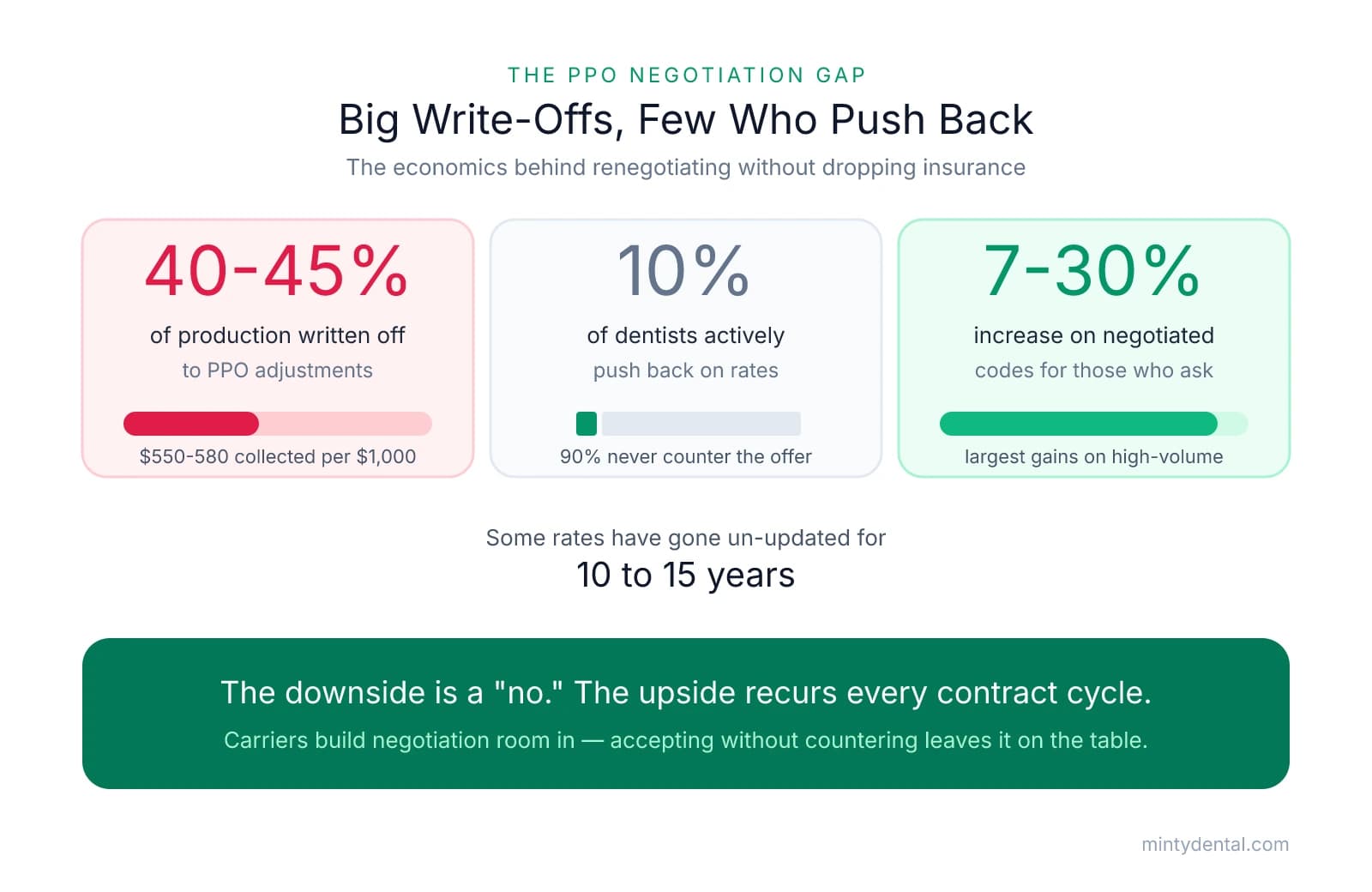
The average PPO adjustment runs 42 to 45% across general practices, which means that for every $1,000 of dentistry produced, a practice collects roughly $550 to $580. Some of those reimbursement rates have not been updated in 10 to 15 years, so the gap between production and collection tends to widen with each year of inflation.
Despite the size of that write-off, only about 10% of dentists actively push back on their contracted rates. When most providers accept the initial offer, carriers face little pressure to raise rates on their own. Fee schedules are not fixed figures. Carriers generally build negotiation room into their opening numbers because they expect a portion of providers to counter, so accepting without countering can leave that margin unrecovered for the life of the contract.
The downside of a well-prepared request is usually a "no," which leaves you no worse off than before. The upside, for practices that do negotiate, is an increase of about 7% on the low end, with some reaching as high as 30% on negotiated codes. Not every carrier will move, and not every request succeeds, but the asymmetry between a small time investment and a recurring revenue gain is what makes this worth building into routine operations.
For owners who have concluded that a plan no longer works at any rate, the separate decision of dropping a PPO while retaining patients follows a different playbook.
Audit Your Fee Position Before Contacting Any Carrier
Before you request higher fees from any carrier, assemble the data that shows where you stand today. A carrier is more likely to move when the request references your actual production, your geographic benchmarks, and a specific dollar figure.
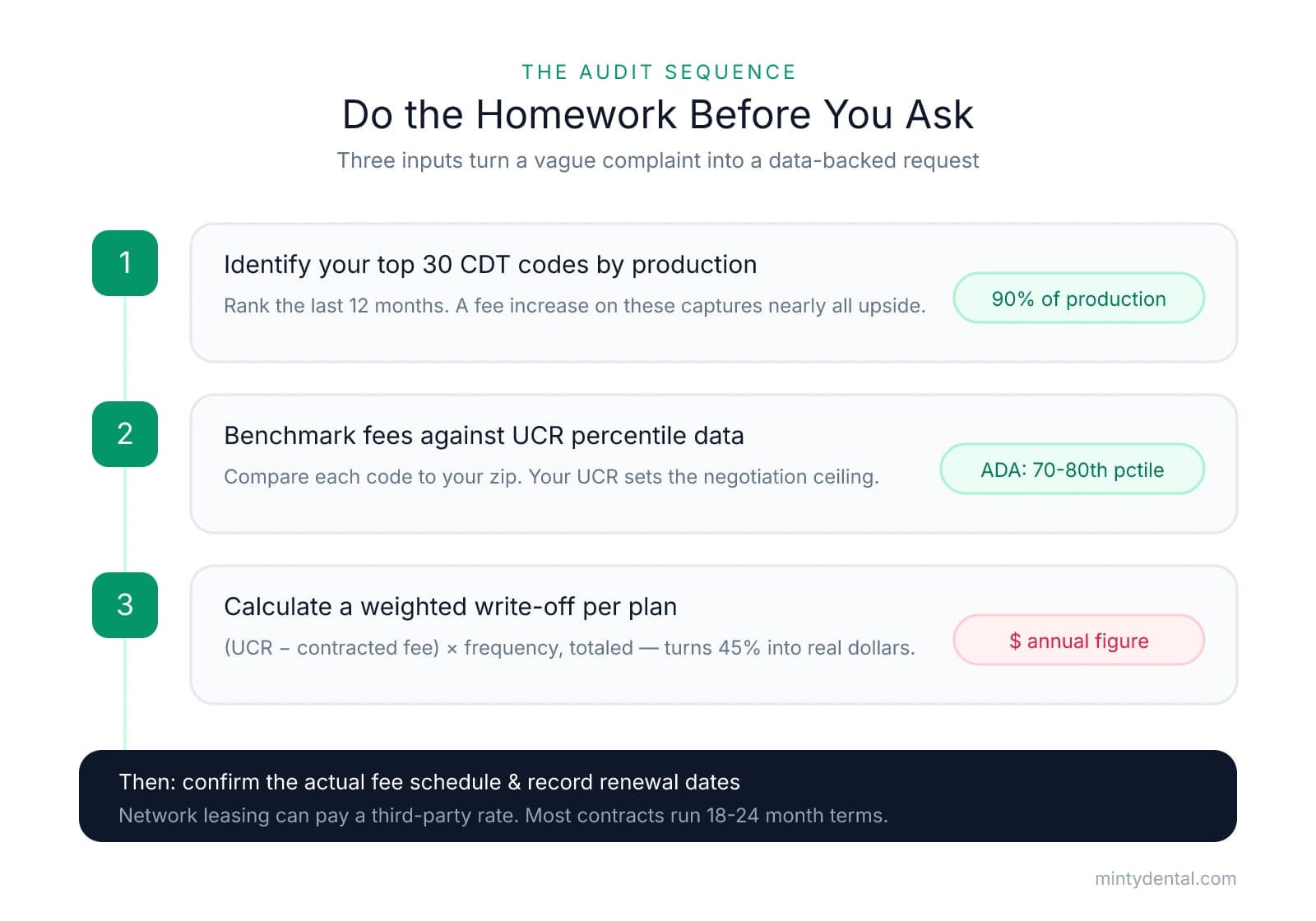
1. Identify your top 30 CDT codes by production volume. Run a production report by procedure code for the last 12 months and rank codes by total production. For most practices, 30 codes account for roughly 90% of billable production, which means a fee increase on those codes captures nearly all of the available upside. Codes outside this group are rarely worth the negotiation effort.
2. Benchmark your contracted fees against UCR percentile data for your zip code. Sources such as FAIR Health publish reimbursement data across 493 geographic areas, from the 50th to 95th percentile. Compare each of your top 30 codes against that percentile range to see how far your current contracted fee sits below regional norms. Your own UCR fees function as the negotiation ceiling, because carriers benchmark requests against your standard fee. The ADA has long recommended setting UCR fees within the 70th to 80th percentile of your geographic area, so an outdated or artificially low UCR limits what you can credibly ask for. If your UCRs have not been reviewed in several years, updating them first may be a prerequisite to negotiating, a step that connects to the broader question of raising fees without losing patients.
3. Calculate a weighted write-off per plan. For each code, multiply the write-off amount (your UCR fee minus the contracted fee) by the code's annual frequency, then total across all 30 codes. This converts a "45% write-off" abstraction into a concrete annual dollar figure per carrier, which is the number that makes the case for renegotiation.
One issue to confirm before you contact anyone: which fee schedule is actually being applied. Network leasing means a claim may be paid under a third-party administrator's rates rather than the direct contract you signed. Audit recent EOBs to identify the fee schedule driving each carrier's adjustments, since negotiating the wrong contract wastes effort.
Finally, record each carrier's renewal date in a tracking system. Most contracts run 18- to 24-month terms.
How to Build and Submit a Credible Renegotiation Request
1. Time the request to renewal or your track record. Submit a fee review request 60 to 90 days before your contract renewal date, because that window is when the carrier faces the clearest risk of losing you as an in-network provider. If renewal is far off, another credible trigger is 12 to 24 months in-network with a strong claims history, since that record demonstrates your value to the network.
2. Write a specific, data-backed request. A general complaint about low fees rarely moves a carrier. A credible letter names each CDT code you want reviewed, states the current contracted fee alongside your requested fee, and cites your claims volume and clean-claim rate as evidence that you reduce administrative cost for the network. Reference the weighted write-off figure from your audit so the request is grounded in dollars rather than sentiment.
3. Add market factors that support the increase. Carriers weigh network adequacy in each area, so documented provider shortages in your zip code strengthen your position. Include the number of months or years since your last fee update and any documented overhead increases, a topic that connects to the broader question of where practice overhead is climbing.
4. Counter the first offer. Carriers often respond with a smaller increase than requested, and their opening response is rarely their ceiling. Accepting the first offer without countering is among the most common negotiation mistakes, because the carrier generally has room to move on high-volume codes.
5. Ask about alternatives when a plan will not move. Some carriers, particularly Delta Dental, have limited negotiability on their standard PPO plans. Rather than treating a "no" as final, ask specifically what other fee schedules or plan types the carrier offers, since a different network tier may pay more.
For ADA members who want a second read on contract terms, the association offers a free Contract Analysis Service and a Third Party Payer Concierge reachable at 1-800-621-8099.
DIY versus a negotiation specialist: Handling renegotiation yourself is possible, but it is time-intensive, and the back-and-forth tends to favor the carrier, which negotiates full-time. Specialists who focus on this work often achieve higher increases because they know carrier-specific tactics and escalation paths. The tradeoff is their fee against the incremental revenue recovered, which depends on your production volume and how far your current fees sit below regional benchmarks.
Turning Renegotiation Into a Recurring Practice System
A single successful renegotiation recovers revenue for one contract cycle. Building the process into your annual operations is what keeps that revenue from eroding again. Practices that negotiate once and then move on tend to drift back toward outdated rates within a few years, because inflation continues and carriers do not raise fees on their own. Treating PPO fee management as a scheduled task rather than a reactive scramble is what sustains the gains.
1. Build a carrier renewal calendar. Using the renewal dates you recorded during your audit, set reminders 60 to 90 days ahead of each contract's renewal window. Scheduling this as a recurring calendar item removes the risk of missing the window.
2. Update your UCR fees annually before renegotiating. Because your UCR fees set the ceiling for what you can credibly request, letting them stagnate limits every future negotiation. An annual fee review in Q4, effective January 1, takes roughly two hours and aligns with most plan cycles. Refreshing your top 30 codes against current geographic benchmarks first means each renegotiation request starts from an accurate ceiling.
3. Track the dollar impact of each increase by code and plan. After a carrier agrees to new rates, record the per-code increase and multiply by annual frequency to capture the recovered revenue. This gives you a running ROI figure and shows which carriers responded and which resisted, so you can prioritize where to focus the next cycle.
This system also compounds into practice value. Buyers evaluate profitability through EBITDA, and practices carrying 30 to 45% write-offs across major plans are viewed as less predictable and less scalable, while optimized reimbursement rates signal efficiency and stability. High write-off rates suppress EBITDA and can reduce sale price, which makes ongoing fee management one of the levers that raises practice value before a sale.
The decision tree after each cycle follows from the results. If renegotiation produces meaningful increases, staying in-network and repeating the process annually is usually the stronger financial choice. When a carrier consistently refuses to move and the math no longer supports participation, that is the point at which dropping the plan while retaining patients becomes worth evaluating as the next decision.
Sources & References
The data and claims in this article are drawn from the following sources. We prioritize government data, peer-reviewed research, and established industry publications to ensure accuracy.
- PPO Write-Offs Are Just the Beginning: The Hidden Financial Burden ...— veritasdentalresources.comIndustry
- Steps to Negotiating PPO Fees as Inflation Rises - Cain Watters— www.cainwatters.com
- Contracting & Negotiating with PPOs - Burkhart Dental Supply— burkhartdental.com
- PPO Solutions - PPO Negotiations for Established Dental Practices— ppoadvisors.comIndustry
- Dental PPO Network Leasing: Who Is Really Paying You? - Solutions 101— www.solutions101.com
- provider shortages in your zip code— hrsa.gov
- Dental Insurance Contract Issues— ada.orgIndustry
- UCR Fees Dental 2026: Set And Optimize Your Fee Schedule— dentalpracticeinsider.orgIndustry
- How PPO Contracts Influence Your Dental Practice's Valuation— pponegotiationsolutions.comIndustry
Ready to maximize your PPO reimbursements?
Negotiating better PPO fees is just one piece of optimizing your practice's financial health. Minty's operations team handles insurance billing, fee negotiations, and revenue cycle management so you can focus on patient care.