Why Employer Group Dental Plans Pay Different Rates

Co-Founder, Minty Dental

In Summary
- When an employer buys dental coverage through a carrier, the plan may carry its own fee schedule that is separate from the standard PPO rates you negotiated with that carrier.
- Self-funded (ERISA) employer plans let the employer set or negotiate allowed amounts directly, with a TPA accessing the carrier's network — meaning the dentist never sees or agrees to that specific schedule.
- The ADA confirms that contracted dentists must accept the maximum allowable fee "as dictated by the plan," and the plan is the employer group's specific design, not necessarily the carrier's standard schedule.
- DPPO products make up 89% of commercial dental enrollment, so nearly every patient who walks in carries some form of PPO card — but the fee schedule behind it can vary significantly.
- EOB allowed amounts that are lower than your loaded fee schedule often trace back to employer group-specific rates, not errors or downcoding.
Employer Group Plans Can Carry Their Own Fee Schedules — Separate From Your PPO Contract
A carrier's standard PPO fee schedule is the allowed-amount table the carrier presented when you signed your participation contract. It is not the only schedule that carrier uses. When an employer purchases dental coverage, the carrier may negotiate a plan-specific allowed-amount table for that employer group, and that table can sit well below the standard rates you agreed to.
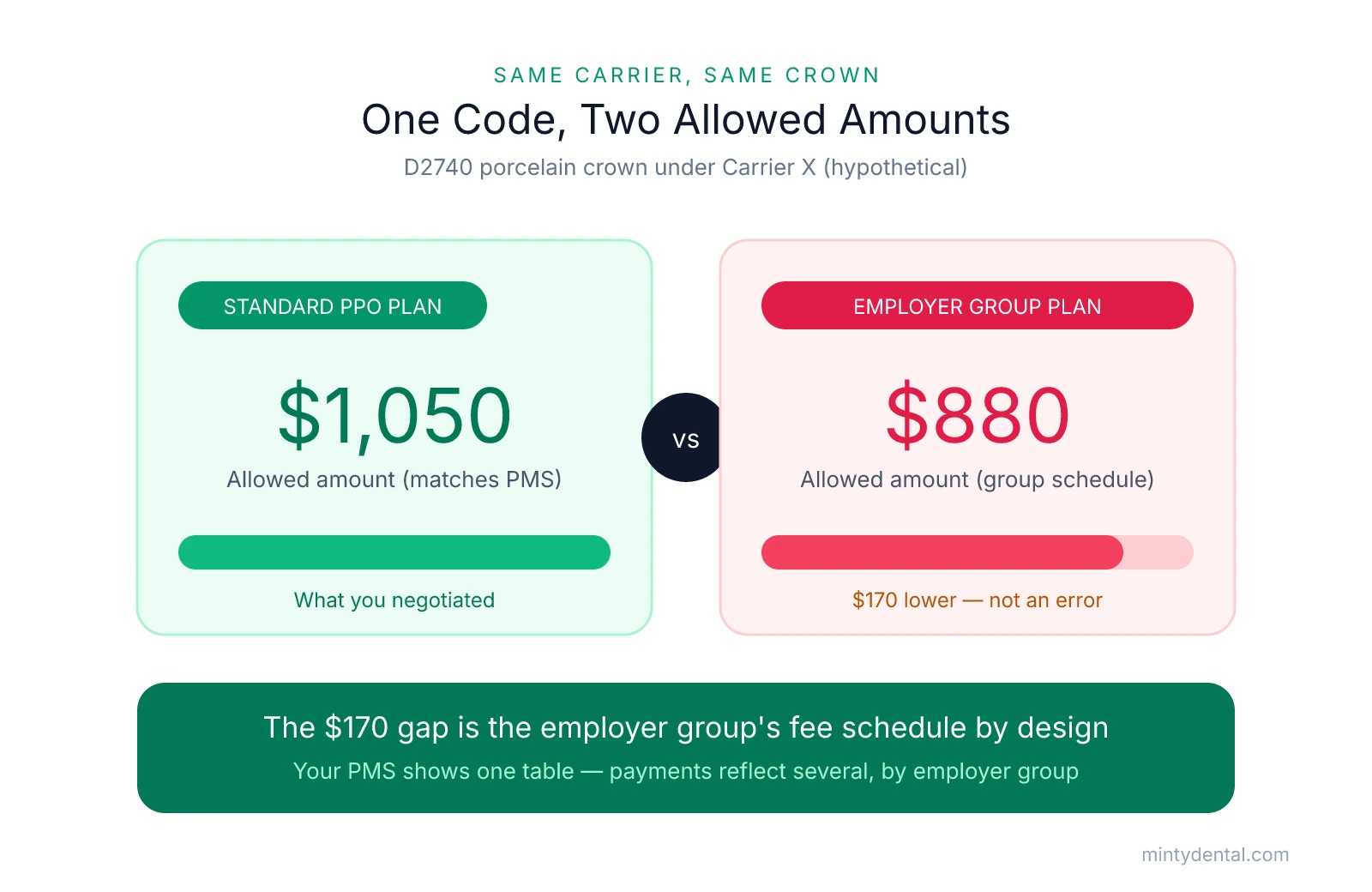
That distinction matters practically. Take a hypothetical example: Carrier X has a standard PPO allowed amount of $1,050 for a D2740 porcelain crown. Your office sees two patients on the same carrier card the same week. The first patient is on the standard PPO plan. The second works for a large regional employer whose group dental plan carries a custom fee schedule. The EOB on the second patient comes back with an allowed amount of $880 for the same crown (hypothetical figures). Your PMS shows $1,050 as the allowed amount for Carrier X, so the difference looks like an error. It is not an error. It is the employer group's fee schedule doing exactly what it was designed to do.
Three plan structures produce this kind of variation. First, fully insured group plans: the employer buys a carrier-designed plan, and the carrier may build a custom fee schedule for that group based on the employer's size, geography, or negotiating leverage. Second, self-funded (ERISA) plans: the employer bears the actual claims risk and contracts with a third-party administrator (TPA) to handle claims and access a carrier's network. Here the employer can negotiate the allowed amounts directly with the carrier or TPA, independent of whatever you signed. The leased network arrangement that often sits underneath these plans means your contract with the carrier network is what grants access, but the fee schedule applied to those claims is the employer's, not the standard one. Third, voluntary or worksite plans: the employer offers a carrier plan as a workplace benefit, sometimes with a fee schedule that differs from that carrier's retail PPO product.
Contracted dentists must accept the maximum allowable fee as dictated by the plan. The operative phrase is "as dictated by the plan." When an employer group has negotiated its own schedule, that group plan is the plan. Your participation contract with the carrier is what obligates you to accept those rates, even if you never saw the employer's specific schedule.
This is not a rare edge case. DPPO products represent 89% of commercial dental enrollment, which means the overwhelming majority of patients your practice sees are on some form of PPO. A significant share of those patients are covered through employer group plans, and any of them could carry a group-specific fee schedule that differs from the standard PPO rates loaded in your PMS. Geography adds another layer, since carriers already price standard PPO schedules by region, as covered in why the same PPO pays different rates by zip code — and employer group schedules introduce a second source of variation on top of that.
The result is that your PMS fee schedule for a given carrier reflects one allowed-amount table, but the payments coming in can reflect several different tables depending on which employer group each patient belongs to.
Network Leasing and Payment Downgrading Add a Third Layer of Rate Variation
Employer group-specific fee schedules are one source of variation. Network leasing adds another, and the two can stack in ways that make the allowed amount on an EOB genuinely difficult to trace.
Network leasing happens when the carrier you signed with shares or sells access to your participation agreement with another payer or plan. In this scenario, a dentist signs with one network, that network is leased to another plan, and the dentist appears as participating with the second plan without ever signing a separate agreement. From the patient's perspective, their ID card shows a carrier you may not recognize. From your perspective, the claim comes in under a fee schedule you didn't negotiate and may never have seen.
Payment downgrading is what happens when multiple fee schedules are attached to your practice through overlapping contracts and leasing arrangements. Because each of those contracts independently obligates you to accept the rates in that schedule, the carrier processing the claim can apply whichever schedule produces the lowest allowed amount. The Dental Advocacy Group illustrates this clearly: a practice expects $700 under Contract A, submits the claim, and receives $600 because the carrier found that Contract B's lower rate was also available through a sharing arrangement. Since the practice is contracted with both, it must accept the lower payment. The $100 shortfall isn't a processing error or a coverage dispute. It's the leasing arrangement working as designed, against the practice's interest.
The reimbursement gap this creates compounds over time. Billed-fee trends have run roughly 2.6% to 2.8% annually while reimbursement growth has tracked at only about 0.7% to 1.4% — meaning the spread between what practices charge and what they collect has been widening year over year. Network leasing is one of the structural mechanisms that keeps reimbursement anchored below what a practice's direct contracts would otherwise suggest. When a low-rate contract from one network gets applied across claims processed through a higher-rate network, that lower rate becomes the effective ceiling for all those claims.
It's worth being precise about what you're seeing when an unfamiliar payer name appears on an EOB. Not every unknown name signals leasing. A self-funded employer plan administered by a TPA may display the TPA's name on the EOB even though the underlying network contract is with a carrier you recognize. A carrier's subsidiary or branded product may appear under a different trade name. The practical effect on the allowed amount is the same regardless of mechanism: the number posted to the ledger may not match the fee schedule your PMS has loaded for that carrier. Understanding how leased networks affect the rates your practice actually receives is what allows you to identify whether a gap is structural rather than a one-time processing issue worth pursuing.
Why the EOB Won't Tell You Which Fee Schedule Priced the Claim
The EOB tells you two things about a completed claim: what you billed, and what the carrier allowed. It does not tell you which fee schedule produced the second number. That gap between the submitted charge and the allowed amount is visible in your records, but its source is not.
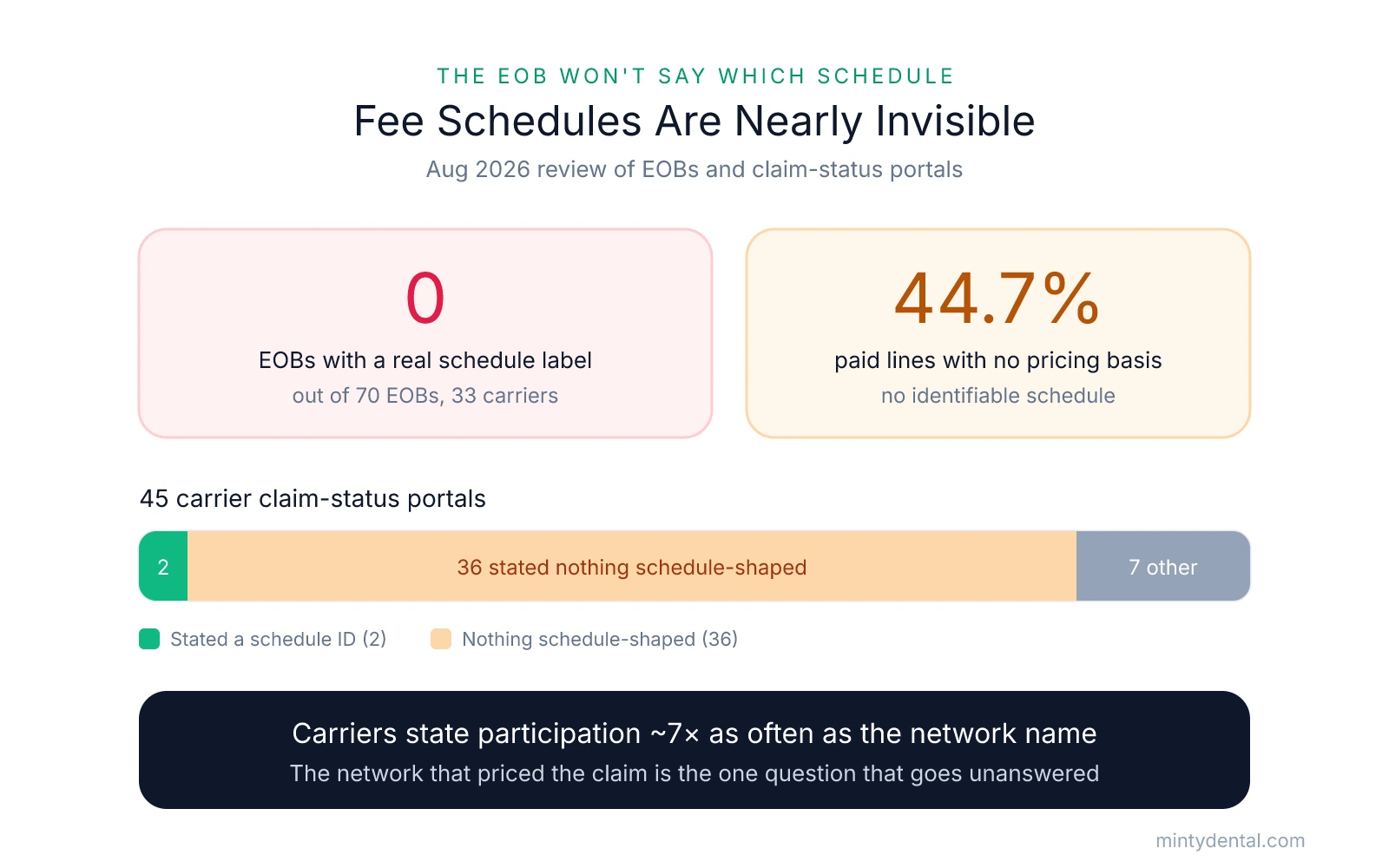
This isn't a carrier-specific quirk. An August 2026 review of 70 EOBs across 33 carriers found zero documents carrying a non-boilerplate fee-schedule label — no schedule name, no identifier, nothing that would let an office determine which of a carrier's several lists priced the claim. The same review looked at 45 carriers' claim-status portals: only 2 stated a schedule identifier, 36 stated nothing schedule-shaped at all, and 44.7% of paid claim lines had no identifiable pricing basis. MetLife's own provider documentation captures exactly what the document is designed to show: the EOB shows "the submitted charge and the allowable charge." Two numbers. Not the source of the second.
One finding from that research puts the problem in sharper relief. Carriers state a participation status roughly seven times as often as they state a network name. They'll confirm that you're in-network readily enough. Which network priced the claim is the question that actually determines the allowed amount, and that question almost never gets answered on the document.
What this means operationally is that the comparison between an EOB allowed amount and the fee schedule loaded in your PMS is a starting diagnostic, not a conclusion. If the EOB comes in lower than your PMS entry for that carrier, the gap could trace to a group-specific fee schedule, a leased network rate applied through a downstream contract, a PMS entry that hasn't been updated since you last renegotiated, or an actual carrier error. The EOB alone won't tell you which one it is. Understanding why your PMS fee schedule doesn't match what insurance pays matters here precisely because a stale PMS entry and a group-specific schedule look identical on the EOB — the allowed amount is just lower than expected.
This is also why tracking allowed amounts by payer and employer group in your own records has real financial stakes. Dental reimbursement rose only 1.5% from January through August 2026, against 2.3% inflation over the same period. That compression doesn't announce itself on a single EOB. It accumulates across hundreds of paid lines, each showing an allowed amount that looks plausible in isolation. The only way to see the pattern is to aggregate the data across claims, by payer, by group, over time. The ADA recommends reviewing contracted fee schedules annually for exactly this reason. The EOB is where the allowed amount first appears in your records; your production and collection data is where the cumulative effect of multiple fee schedules becomes measurable.
Measuring Group-Level Rate Variation in Your Own Records
The place to start is your PMS production and collections report, filtered by insurance plan. Most systems let you pull net reimbursement per CDT code by payer — run that report and look specifically for the same code paid at different allowed amounts under the same carrier name. D2740 reimbursed at $1,050 for some patients and $880 for others, all posting under Carrier X, is not a data anomaly. It's the first signal that more than one fee schedule is active under that carrier name.
Once you spot the variation, the group number is what separates one schedule from another. That number appears on the patient's insurance card and on the EOB itself, typically in a field labeled "Group Number" or "Group ID." When the same carrier produces different allowed amounts for the same CDT code across different group numbers, you're looking at group-specific fee schedules. Pull the EOBs for two or three patients who generated the lower allowed amounts and note the group numbers. Those are the employer groups driving the gap.
The only way to confirm what you're seeing is to call the carrier's provider relations line with the specific group number in hand and ask directly which fee schedule applies to that group. This conversation also surfaces whether the variation traces to a group-specific schedule negotiated by a fully insured employer, a self-funded plan where the employer set the allowed amounts independently, or a leased network arrangement. The answer matters for what you can do next, and it's not something you can determine from the EOB alone.
What you do with that information depends on the plan type. If the group carries a fully insured plan, there's at least a theoretical path to renegotiation, since the carrier controls the terms. Self-funded ERISA plans are a different situation. Because self-funded plans are governed by federal law rather than state insurance regulation, state-level protections and prompt-pay requirements don't apply, and the employer, not the carrier, holds the contractual leverage on allowed amounts. That makes renegotiation significantly harder. In practice, your options with a self-funded group that consistently produces low allowed amounts are to accept those rates as the cost of serving those patients, pursue a renegotiation conversation knowing the constraints, or factor that group's effective reimbursement into a broader payer mix analysis when you're deciding whether continued participation makes financial sense.
The goal here isn't to audit every EOB in your system. It's to identify which carrier-and-group combinations are generating the most write-off relative to your standard PPO allowed amounts. That's where the revenue gap actually lives. If a specific group number consistently produces lower reimbursement on your high-volume procedure codes, that group is worth understanding precisely. When you're deciding which codes to prioritize if a renegotiation opportunity does open up, the procedure codes that drive the largest volume-weighted shortfall are where a schedule change would have the most impact.
Sources & References
The data and claims in this article are drawn from the following sources. We prioritize government data, peer-reviewed research, and established industry publications to ensure accuracy.
- Types of Dental Plans— ada.orgIndustry
- Understanding Dental Benefits— www.nadp.orgIndustry
- Types of Dental Plans— ada.orgIndustry
- Network Sharing & Payment Downgrading— dentaladvocacygroup.comIndustry
- Inside the PPO Stack: A Technical Guide to Dental Network ...— www.dentalogic.comIndustry
- How do I tell which fee schedule paid a dental claim?— kaylie.aiIndustry
- Dental reimbursement rates still trail inflation: 5 things to ...— beckersdental.comNews
- Self-funded dental plans and how they work— healthpartners.comIndustry
See Where Your Crown Fee Stands by Group Plan
Your EOBs may already show allowed-amount variation across employer groups on the same carrier. A Rate Check shows where your current PPO crown fee sits in your area and what group fee schedule access could look like for your practice.