Delta Dental Premier vs PPO Fee Schedule: Which Pays More?

Co-Founder, Minty Dental
In Summary
- Delta Dental Premier and Delta Dental PPO are two distinct contracted networks, each with its own fee schedule and allowed amounts — they are not tiers of the same contract.
- A dentist can hold a Premier contract, a PPO contract, or both; being credentialed in one does not automatically enroll you in the other.
- Premier is Delta Dental's original indemnity-style network and generally pays higher allowed amounts per procedure than the PPO network.
- The dollar gap between Premier and PPO allowed amounts varies by procedure code and by state or region — it is not a flat discount applied uniformly across all codes.
- Understanding which contract governs a given patient's claim is the first step in knowing whether your EOB allowed amount is correct and whether your current participation is working for the practice.
Delta Dental Premier and PPO Are Two Separate Fee Schedules
When an EOB comes back showing a different allowed amount than you expected, the first thing to check is which Delta Dental network governed that claim. Premier and PPO are not benefit tiers for patients, and they are not the same contract with different cost-sharing splits. They are two separate networks, each with its own contracted fee schedule, and the allowed amount your practice accepts is determined entirely by which network contract applies to that patient's plan.
Premier is Delta Dental's original network, built on an indemnity model. The allowed amounts on a Premier fee schedule are generally higher than PPO allowed amounts for the same CDT code. PPO is a discounted network: patients get broader access and lower out-of-pocket costs, and in exchange, contracted providers accept more aggressively reduced allowed amounts. The trade-off for the practice is a larger pool of potential patients who are specifically directed toward in-network PPO providers.
You can hold a Premier contract, a PPO contract, or both simultaneously. Being credentialed in one does not automatically enroll you in the other. Many practices carry both contracts, which means the applicable fee schedule depends on which network the patient's employer plan is attached to. A patient with a Premier plan and a patient with a PPO plan sitting in the same chair on the same day can produce meaningfully different allowed amounts for the same procedure code.
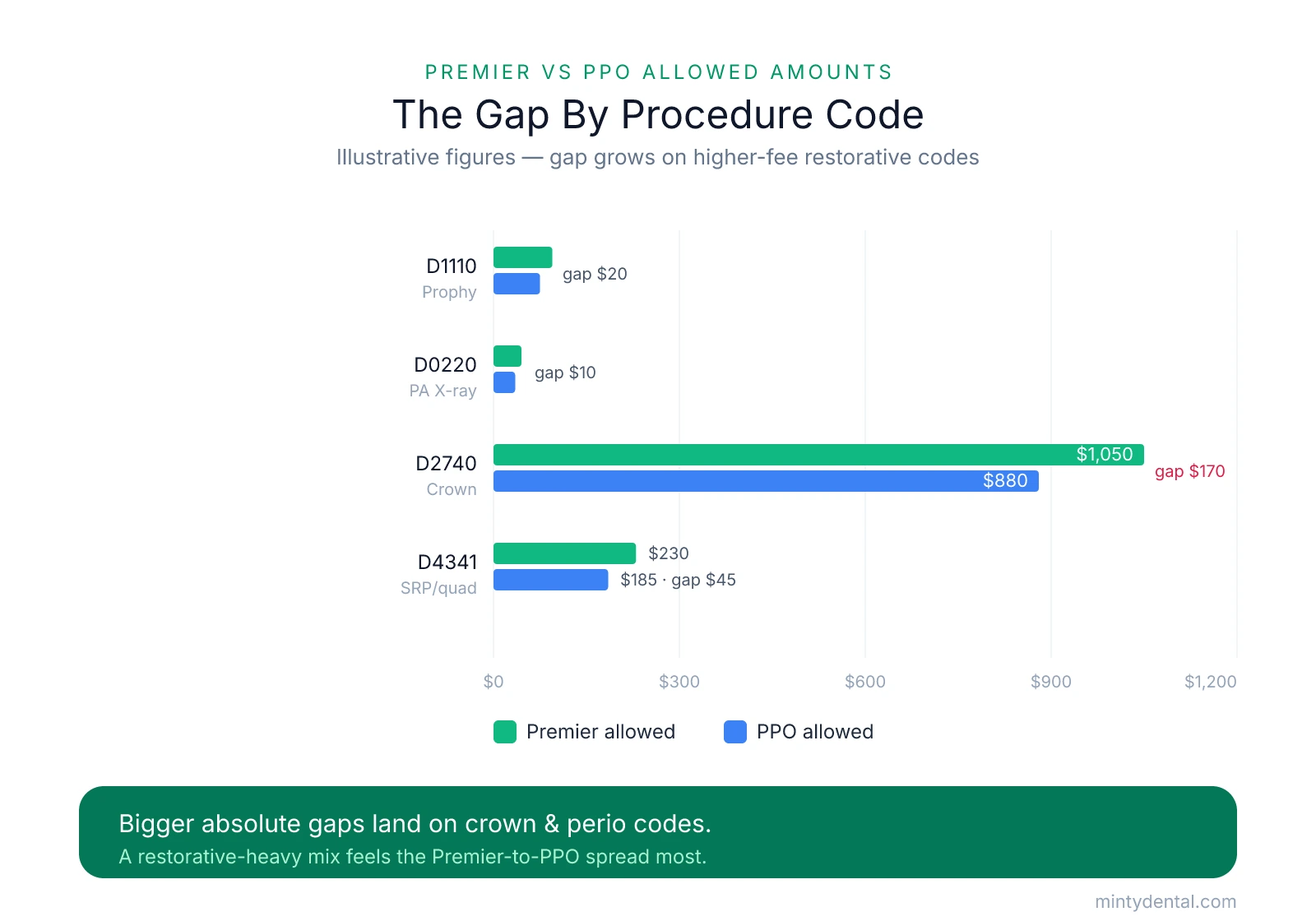
To make that concrete, consider a hypothetical D2740 porcelain crown. Under an illustrative Premier fee schedule, the allowed amount might be $1,050. The same code under a PPO fee schedule for the same area might allow $880. That $170 gap is not unusual, but it is also not fixed. The difference between Premier and PPO allowed amounts shifts by procedure code and by geographic region, so the same PPO network can pay different rates depending on your zip code and the Premier gap relative to PPO will follow a similar pattern.
The table below shows how that spread might look across a few common codes. These are illustrative figures only, not benchmarks or carrier data.
| CDT Code | Procedure | Hypothetical Premier Allowed | Hypothetical PPO Allowed | Illustrative Gap |
|---|---|---|---|---|
| D1110 | Adult prophy | $95 | $75 | $20 |
| D0220 | Periapical X-ray | $45 | $35 | $10 |
| D2740 | Porcelain crown | $1,050 | $880 | $170 |
| D4341 | SRP per quadrant | $230 | $185 | $45 |
The gap tends to be larger in absolute dollar terms on higher-fee restorative and surgical codes, and smaller on diagnostic and preventive codes. That pattern matters when you are thinking about your procedure mix, because a practice heavy in crown and perio work feels the Premier-to-PPO spread more acutely than one dominated by hygiene visits.
How the Two Fee Schedules Show Up in Your EOBs and Ledger
The network that applies to a given claim is determined by the patient's plan type, not by anything on your end. When a Premier subscriber comes in, Delta processes that claim against your Premier fee schedule. When a PPO subscriber comes in, the PPO schedule governs. You don't choose at the time of service, and you can't elect the higher schedule for a patient whose plan sits in the other network.
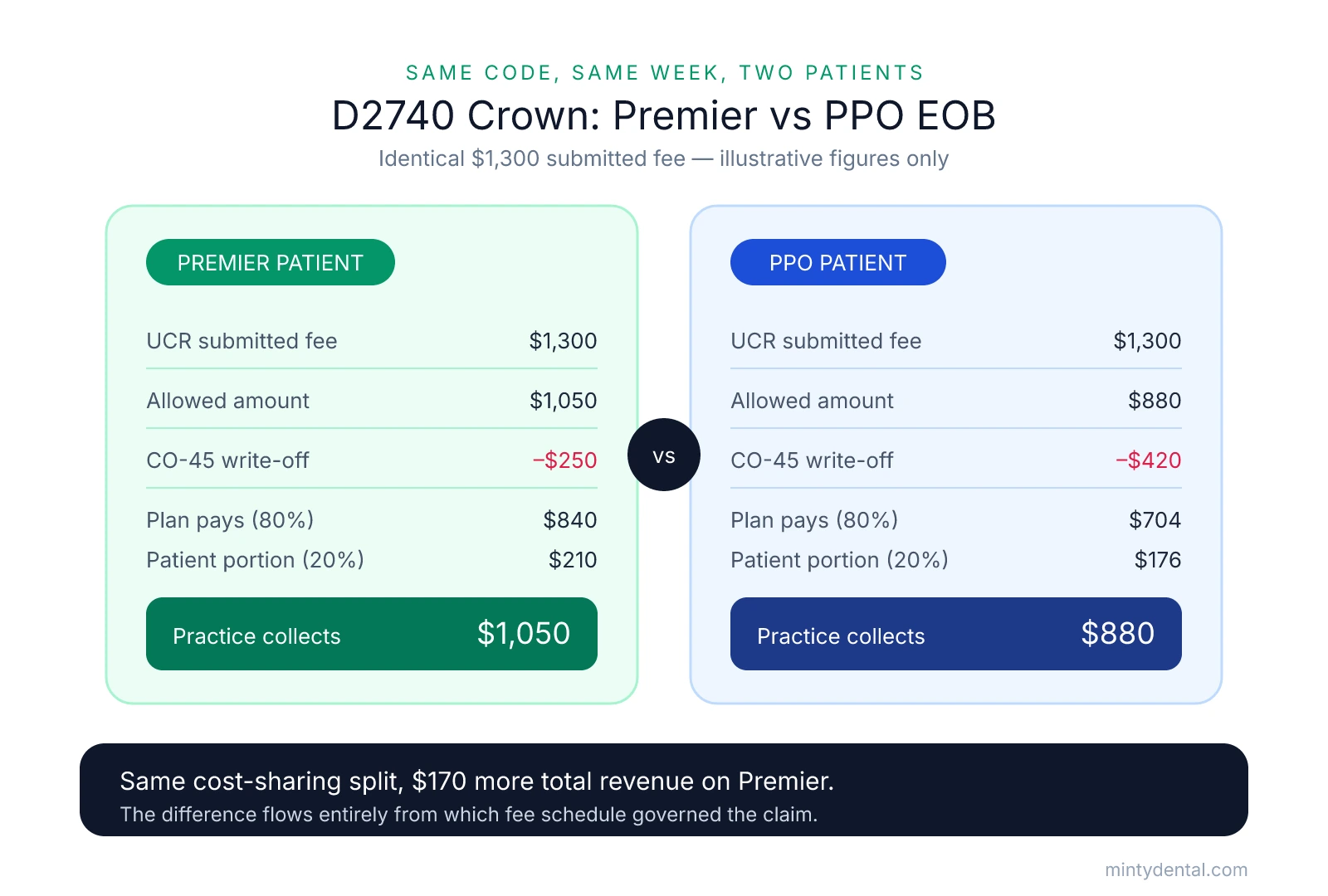
Where you actually see this play out is on the EOB. Look at the network or plan identifier field near the top of the form, then find the allowed amount line and the CO-45 contractual adjustment. Those two lines will differ between a Premier claim and a PPO claim for the same procedure code, even when your submitted fee is identical. The CO-45 is the contractual write-off — the gap between what you charged and what the applicable fee schedule permits — and understanding how CO-45 and other adjustment codes work on a dental EOB makes it straightforward to confirm which schedule applied.
Here is what that looks like for a hypothetical D2740 on two patients seen the same week. Numbers are illustrative only.
| Premier Patient | PPO Patient | |
|---|---|---|
| UCR (submitted fee) | $1,300 | $1,300 |
| Allowed amount | $1,050 | $880 |
| CO-45 write-off | $250 | $420 |
| Plan pays (80%) | $840 | $704 |
| Patient portion (20%) | $210 | $176 |
| Practice collects total | $1,050 | $880 |
The patient cost-sharing structure is similar in both scenarios, but the Premier claim produces $170 more in total allowed revenue. That difference flows entirely from which fee schedule governed the claim.
If your practice holds only the PPO contract, Premier subscribers are out-of-network. You are not bound by the Premier fee schedule in that situation, but their plan's out-of-network benefit structure determines what Delta will reimburse and what the patient owes. Depending on the patient's plan, the out-of-network benefit may be limited enough that it creates a balance billing conversation at checkout.
One thing worth checking: some practices discover they are enrolled in both networks without realizing it. Credentialing paperwork from years back, or a network participation update Delta processed automatically, can leave a Premier contract active alongside a PPO contract. Pull your most recent EOBs and look at the network identifier field. If you see Premier on some and PPO on others, both contracts are live. Your credentialing documents should confirm it.
If both contracts are active, your PMS needs to carry both fee schedules — one for Premier patients, one for PPO patients. When only one schedule is loaded, the estimated patient portion at the time of service will be wrong for whichever network isn't reflected, and you'll see ledger discrepancies once the EOB posts. A mismatch between your PMS fee schedule and the actual EOB allowed amount is a common source of ledger errors worth auditing if your adjustments don't reconcile cleanly.
Calculating the Revenue Impact of Each Network on Your Practice
Knowing that Premier pays more per procedure is a starting point, not an answer. The actual revenue impact depends on how many Premier versus PPO subscribers you're treating, because the per-procedure gap only matters in proportion to your patient volume. A $170 difference on crowns is meaningful if 60 of your Delta Dental crown patients are on Premier; it's irrelevant if none of them are.
The place to start is a claims report in your PMS. Filter by Delta Dental as the carrier, then segment by plan type or network identifier to separate Premier claims from PPO claims. Most practice management systems store a plan name or group identifier on each claim that will distinguish the two. Run that report for the last 12 months and count procedures by network for your high-production codes: at minimum, D2740 and other crown codes, D4341 and D4342 for perio, and high-volume diagnostic and preventive codes like D1110 and D0220. If you're not sure how to structure the report, pulling a payer mix analysis by plan is a reasonable first step, since it also shows you where Delta sits relative to your other carriers.
Once you have procedure counts by network, multiply the per-procedure allowed amount gap between your Premier and PPO fee schedules by the volume for each code.
As a hypothetical illustration: suppose your practice does 200 Delta Dental crown procedures per year, 60 on Premier patients and 140 on PPO patients. Using the illustrative $170 gap from earlier, those 60 Premier crowns produce $10,200 more in allowed collections than they would at PPO rates. That's not an industry benchmark, just the arithmetic of volume times gap. If your Premier-to-PPO spread on D2740 is narrower or wider in your region, the number shifts accordingly.
The same logic applies to high-volume codes, even where the per-procedure gap is smaller. Adult prophylaxis (D1110) and periapical X-rays (D0220) may show gaps of $10 to $20 per procedure in absolute dollar terms, but a busy hygiene schedule can run several hundred of those per year. At 300 D1110 procedures annually with a $20 gap, that's $6,000. The restorative codes tend to show larger gaps per claim; the preventive and diagnostic codes make up for smaller gaps through sheer repetition. Looking at which codes are most affecting your revenue per procedure across your full Delta Dental volume gives you a clearer picture than any single code in isolation.
If you're currently PPO-only and considering whether to add a Premier contract, the question isn't only "does Premier pay more?" It's "how many Premier subscribers are actually in my patient base or my local market?" If Premier plan penetration is low in your area, the incremental collections from adding the contract may not justify the administrative overhead of maintaining a second Delta fee schedule, managing two sets of credentialing documents, and ensuring your PMS applies the right allowed amounts by plan type. The revenue upside is a function of patient volume, not just the rate difference.
Deciding Whether to Hold, Add, or Drop a Delta Dental Network
The right Delta Dental participation structure depends on three variables that only your practice data can answer: your current patient mix by network, the Premier-to-PPO subscriber ratio in your local market, and how much write-off your collections can absorb. None of those are universal, which is why there's no single correct answer about which network to keep.
If you're currently in both networks and questioning whether PPO is worth it, start with two numbers from your PMS: your PPO write-off rate and the share of your active patient base on PPO plans. If PPO patients represent a substantial portion of your active roster, dropping the contract doesn't just affect future production. It risks attrition among established patients who may not follow you out-of-network. The per-procedure rate on PPO is lower, but losing a quarter of your active patients to practices that stayed in-network would cost considerably more than the ongoing write-off. The write-off rate tells you the cost per claim; the patient volume tells you the cost of leaving. You need both before making a move. If your write-off percentage already feels unsustainably high, that's worth quantifying first before attributing it entirely to PPO participation.
If you're PPO-only and considering adding Premier, the administrative lift is lower than it might seem. Premier credentialing often runs through the same Delta Dental application process you've already completed, so you're not starting from scratch. The more important step is confirming the Premier fee schedule for your specific region before signing. The gap between Premier and PPO allowed amounts varies by market, and in some areas the difference on common codes is narrow enough that the incremental revenue gain per claim is modest. Request the fee schedule, run the same procedure-volume calculation described earlier in this article, and decide whether the projected gain justifies maintaining a second schedule in your PMS and ensuring claims route to the correct network.
If you're Premier-only and considering PPO, the question is whether the PPO subscriber pool in your market is large enough to generate volume that offsets the lower per-procedure rate. This is a pure rate-versus-volume trade-off. A region with high PPO plan penetration through large employers may send you enough additional patients that total collections increase even with more aggressive write-offs. A market where Premier subscribers dominate may not.
For owners who want to improve what they're paid within their current Delta network rather than change participation, targeting the highest-volume procedure codes in a renegotiation is the next lever. For those weighing a broader exit from Delta Dental altogether, sequencing a transition to fee-for-service requires a different kind of patient-mix analysis before any contracts are dropped.
See Where Your Delta Dental Crown Fee Actually Stands
You have compared Premier and PPO allowed amounts on paper. A Rate Check shows how your contracted fees compare to group fee schedules available in your area, so you have a fuller picture before deciding what to do with either network.