Dental Practice Malpractice History: A Buyer's Checklist

Co-Founder, Minty Dental
In Summary
- Malpractice history in a practice acquisition covers paid claims, board disciplinary actions, OIG exclusions, pending litigation, and insurance claims history — not just lawsuits
- Dental malpractice is relatively rare compared to other medical specialties, but a single undisclosed claim or board action can affect deal structure, insurance costs, and post-closing liability
- In a stock purchase, a buyer may inherit the entity's legal history — making pre-closing review especially important
- There are four distinct categories of sources to check: public databases, direct seller disclosures, state licensing boards, and federal exclusion registries — each requires a different approach
- Reviewing malpractice history is low-effort relative to the risk of missing it — most checks can be completed in a few hours with the right checklist
Malpractice History Is a Due Diligence Item — Not an Afterthought
Malpractice history, in the context of a practice acquisition, refers to the full picture of a seller's clinical and regulatory record: paid malpractice claims, state dental board disciplinary actions, OIG exclusions from federal healthcare programs, pending or threatened litigation, and the claims history on their professional liability insurance.
Most buyers spend the bulk of their due diligence on financials — production reports, overhead ratios, patient retention trends. That's reasonable. But a seller's regulatory and legal history deserves the same structured attention, because what you don't find before closing can surface in ways that are expensive to unwind afterward.
The stakes vary by deal structure. In an asset purchase, you're generally buying equipment, goodwill, and patient records — the seller's legal history stays with them. But in a stock purchase, you're acquiring the entity itself, which means its history can follow you into ownership. That distinction shapes how aggressively you should investigate, and it's worth confirming with your attorney early in the process. If you're working with a broker and want to understand what else might not be surfacing in the seller's disclosures, the patterns brokers sometimes miss or minimize are worth understanding before you get deep into a deal.
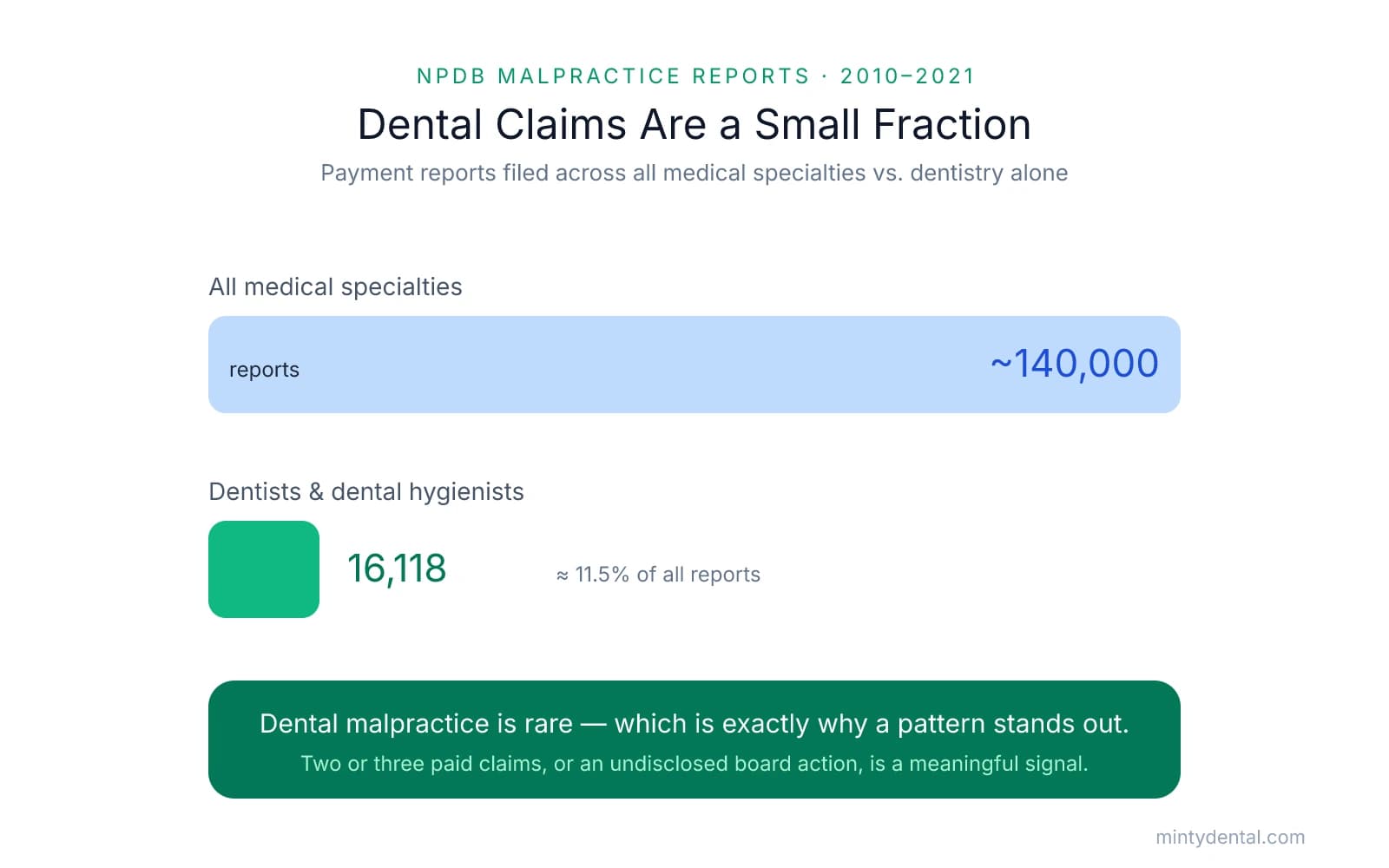
The good news: dentistry has a relatively clean track record compared to other medical specialties. According to the NPDB, roughly 16,118 malpractice payment reports were filed for dentists and dental hygienists between 2010 and 2021 — a small fraction of the approximately 140,000 reports filed across all medical specialties in the same period. Most practices you evaluate will have no reportable history at all.
But the rarity of claims is exactly why a pattern stands out. A seller with two or three paid claims, or a board action that was never disclosed, is a meaningful signal — and one that's easy to miss if malpractice review isn't built into your process from the start.
This article walks through four categories of sources: public federal databases, state dental board records, direct seller disclosures, and insurance claims history. Each requires a different approach, and together they give you a complete picture of what you're actually buying.
Four Public Databases Every Buyer Should Search Before Closing
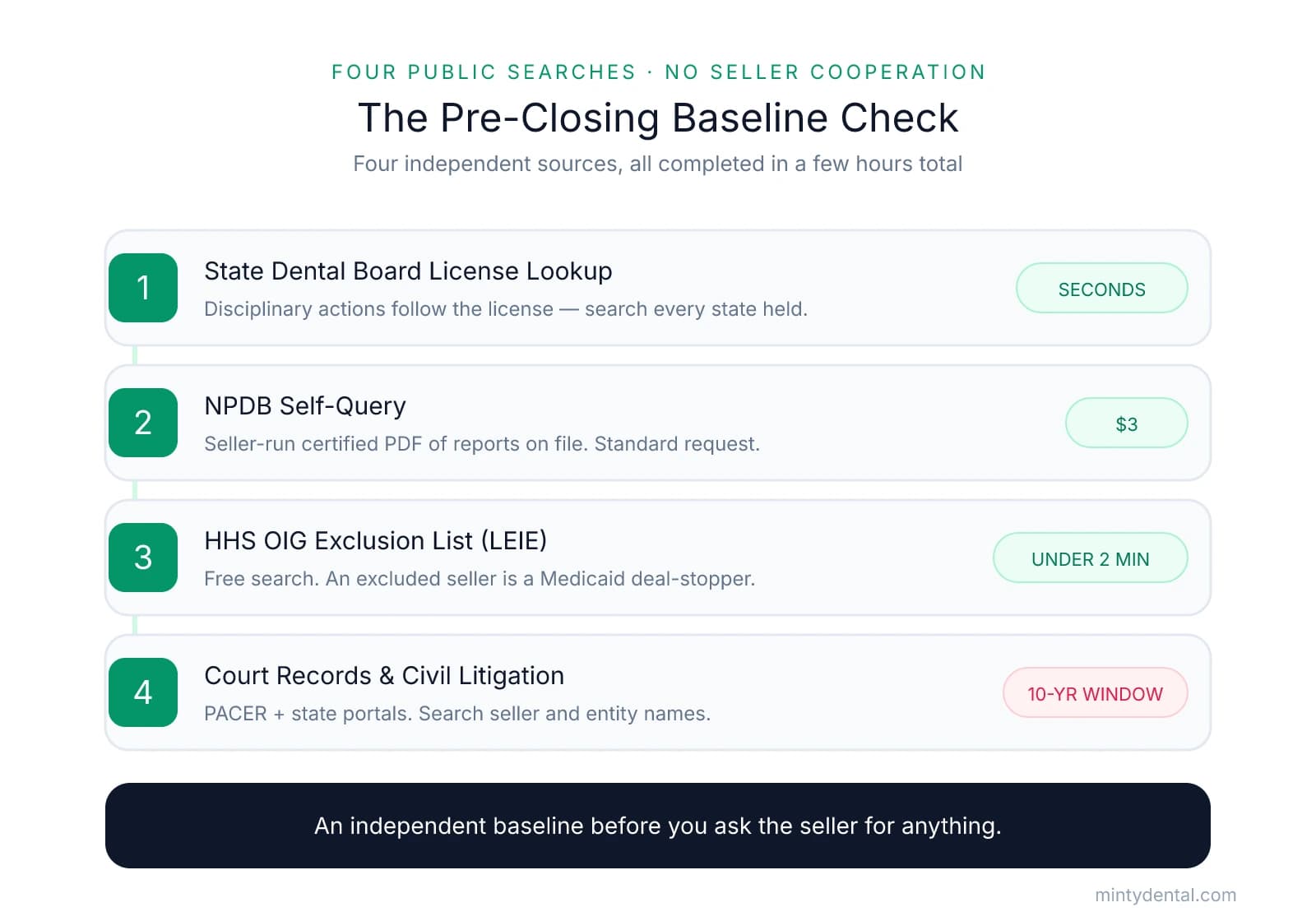
These four sources are publicly accessible — no seller cooperation required. Running all four typically takes a few hours, and together they cover the federal, state, and civil dimensions of a seller's professional history.
1. State Dental Board License Lookup
Every state dental board maintains a public license verification portal showing license status, disciplinary actions, consent orders, and probationary conditions. The critical detail many buyers miss: disciplinary actions follow the license number, not the practice address. A seller who practiced in Illinois before relocating to Florida may have a board action that only appears on the Illinois record.
Search every state where the seller has ever held a license — not just the current one. State board portals vary in depth, but most surface formal disciplinary actions within seconds. Examples worth bookmarking: California's Dental Board of California license lookup, Florida's DOH MQA portal, and Illinois's IDFPR license search.
2. NPDB Self-Query
The National Practitioner Data Bank (NPDB): Buyers cannot directly query the NPDB for a specific dentist — that access is reserved for eligible healthcare organizations. But sellers can run their own self-query at npdb.hrsa.gov, which generates a certified PDF listing any reports on file, including malpractice payment reports, adverse licensure actions, and criminal convictions. The cost is $3 through an annual subscription.
Make this a standard due diligence request alongside financial statements. A seller who hesitates to provide a $3 certified document is worth paying attention to. There's no equivalent source for this information.
3. HHS OIG List of Excluded Individuals/Entities (LEIE)
The LEIE is a free, searchable public database maintained by the HHS Office of Inspector General. An exclusion means the provider is barred from billing Medicare or Medicaid — for any items or services they furnish, order, or prescribe. Per the HHS OIG, entities that hire or contract with an excluded individual may face civil monetary penalties.
For a practice with meaningful Medicaid volume, an excluded seller is a deal-stopper. This search takes under two minutes and should happen before you invest significant time in a deal.
4. Court Records and Civil Litigation
Pending malpractice lawsuits may not yet appear in board records — a case filed last year won't show a disciplinary action until the board acts, which can take years. Check PACER for federal cases and your state's court portal for civil suits. Search both the seller's name and the practice entity name.
As a baseline window, the Mirza Health Law due diligence checklist explicitly calls for "malpractice history and claims history on all licensed professionals going back 10 years" — a reasonable standard to apply to your court records search as well.
These four searches give you an independent baseline before you've asked the seller for anything. What you find — or don't find — shapes how you approach the direct disclosure requests in the next section.
What to Request Directly from the Seller — and How to Read It
Public databases give you an independent baseline, but some of the most important information in a malpractice review only surfaces through the seller directly. Experienced buyers treat this part of the process as a structured conversation — one where the right requests, made early, tell you a lot about what you're walking into.
The written claims history letter is the single most valuable document to request. Most professional liability carriers will provide this directly to their insured on request — it's a standard document, not an unusual ask. The letter typically covers 5–10 years of claims, settlements, reserves, and any open matters. Ask the seller to request it from their carrier and share it with you as part of due diligence.
What you're looking for isn't just the presence of claims — it's the pattern. A single resolved claim from eight years ago reads very differently from two extraction complication claims in three years, or back-to-back failure-to-diagnose settlements. According to the Dentist's Advantage/CNA Dental Professional Liability Claim Report, the average total incurred for closed dental professional liability claims has risen to $148,655 — and failure-to-diagnose claims, particularly those involving cancer or tumorous growths, average over $400,000. Claims in that category are especially hard to spot in a clinical chart review, which is exactly why the written history matters.
A pattern of claims in the same procedure category — repeated nerve injuries, multiple crown failures, recurring extraction complications — can signal a systemic clinical issue rather than an isolated event. That's worth a deeper conversation, and potentially a clinical review by a third-party dentist before you proceed.
Representations and warranties in the purchase agreement are where this disclosure becomes legally binding. The agreement should include explicit seller representations covering pending litigation, open regulatory investigations, and insurance claims history. One protection many buyers overlook is the survival period — the window after closing during which you can bring a claim if a representation turns out to be false. Pushing for 12–24 months is reasonable and common in well-structured deals; a shorter window leaves you exposed if something surfaces in the first year of ownership.
Patient records transfer is a related issue worth clarifying before closing. As the ADA notes, original records carry stronger evidentiary weight in malpractice defense than copies — which is why sellers often retain originals and provide buyers with copies, or negotiate contract language giving them access to records held by the buyer. A well-drafted agreement should require the buyer to maintain existing patient records for at least 10 years and give the seller access for defense of any future claims — this is also directly relevant to your own malpractice tail coverage decisions post-closing.
Finally, ask the seller directly about open dental board complaints — including informal ones that haven't resulted in formal action. Board investigations can move slowly, and a complaint filed six months ago may not appear in any public database yet. A seller who discloses proactively is a good sign; one who resists the question is worth paying attention to.
How Deal Structure Determines How Much History Follows You
Everything gathered through public databases, seller disclosures, and insurance claims history ultimately feeds one final question: how much of that history can actually follow you into ownership?
The answer depends heavily on deal structure.
| Factor | Asset Purchase | Stock Purchase |
|---|---|---|
| Pre-closing malpractice liability | Generally stays with seller | Transfers with the entity |
| Board disciplinary history | Stays with seller's license | Entity history transfers to buyer |
| OIG exclusion exposure | Buyer starts clean | Buyer inherits entity's compliance record |
| Indemnification importance | Moderate | Critical |
| Malpractice due diligence urgency | Important | Essential |
Asset purchases — the most common structure in dental transitions — generally allow buyers to leave the seller's pre-closing liabilities behind. But "generally" is doing real work in that sentence. As Taft Law's analysis of successor liability makes clear, courts have found asset buyers liable under de facto merger and mere continuation theories when the buyer continues the same operations, location, staff, and management. In practice, most dental acquisitions look exactly like that — same office, same team, same patient base. That's why malpractice history research matters even in asset deals, and why the purchase agreement's indemnification language needs to be airtight regardless of structure.
Stock purchases transfer the entity wholesale — every liability, every regulatory history, every undisclosed claim. The dental attorneys at dentalattorneys.com frame it plainly: stock buyers inherit all liabilities, including every lawsuit, tax lien, and compliance violation that traveled with the entity. If you're evaluating a stock purchase, the malpractice review process described in this article isn't optional — it's the foundation of your negotiating position.
Two structural protections worth building into any deal:
-
Tail coverage confirmation. If the seller carried a claims-made malpractice policy, that policy only covers claims filed while it's active — not pre-closing treatment delivered after the policy lapses. The seller needs tail coverage to remain insured for work performed before closing, and this should be addressed explicitly in the purchase agreement. An uninsured seller doesn't expose you to direct liability in most asset deals, but it creates real complications if a patient files a post-closing claim for pre-closing treatment.
-
Indemnification holdback or escrow. A portion of the purchase price — typically 10–15% — held in escrow for 12–24 months provides structural protection against undisclosed liabilities that surface after closing. Similar to how accounts receivable disputes can surface weeks after closing, malpractice-related complications often don't appear immediately — an escrow gives you a mechanism to address them without reopening the deal.
Your practical sequence from here:
- Run the public database checks first — state board lookup, NPDB self-query request, LEIE search, and court records. These require no seller cooperation and take a few hours.
- Request seller-provided documents — the written insurance claims history letter and a completed NPDB self-query PDF.
- Ensure the purchase agreement's representations and warranties cover the full 10-year history window, with a survival period of at least 12–24 months post-closing.
- Confirm tail coverage obligations are explicitly addressed in the agreement before you sign.
Most practices you evaluate will have a clean record. But the ones that don't are exactly why this process exists — and running it thoroughly is what separates a confident close from an expensive surprise.
Sources & References
The data and claims in this article are drawn from the following sources. We prioritize government data, peer-reviewed research, and established industry publications to ensure accuracy.
- Public Use Data File - NPDB - HRSA— www.npdb.hrsa.govGovernment
- Consumer Complaint Frequently Asked Questions— dbc.ca.govGovernment
- DOH MQA portal— mqa.doh.state.fl.us
- IDFPR | Enforcement Actions - Illinois.gov— idfpr.illinois.govGovernment
- Self-Query Basics - The NPDB— www.npdb.hrsa.govGovernment
- Search the Exclusions Database | Office of Inspector General— exclusions.oig.hhs.govGovernment
- Exclusions Program | Office of Inspector General - OIG - HHS.gov— oig.hhs.govGovernment
- PACER— pacer.uscourts.gov
- Dental Practice Purchase Due Diligence Check List— mirzahealthlaw.comIndustry
- Dental Professional Liability Claim Report - Dentist's Advantage— dentists-advantage.comIndustry
- What to Do with Patient Records When Selling a Practice— ada.orgIndustry
- Successor Liability Risks in Asset Purchase Agreements - Taft Law— taftlaw.comIndustry
- Legal Pitfalls to Avoid When Buying a Dental Practice— www.dentalattorneys.comIndustry
Frequently Asked Questions
Ready to acquire your ideal dental practice?
Thorough due diligence—including malpractice history review—is essential when evaluating a practice acquisition. Minty's acquisition experts guide you through every step of the buying process, ensuring you have complete visibility into practice records and potential liabilities before closing.