How Much Do Dental Practice Brokers Charge Buyers?

Co-Founder, Minty Dental

In Summary
- Dental practice brokers typically charge sellers 6-12% of the sale price at closing—buyers don't write a check to the broker, but the structure shapes whose interests drive the deal
- Expect $10,000–$20,000 in legal, accounting, and due diligence costs that sit outside your loan amount—these protect you from problems that would cost far more to fix after closing
- Direct seller transactions can save money through creative deal structures, but require significant time investment and stronger advisory support to manage risks brokers normally handle
- Budget transaction costs before you start looking and assemble your advisory team early—advisors who know your situation can flag problems before you've invested in full due diligence
Brokers Work for Sellers—Which Means You're Not Paying the Commission
One question that surfaces early in most practice searches: how much will the broker charge me? The short answer is usually nothing—at least not directly. In most dental practice transactions, the broker's commission is paid by the seller, typically 6-12% of the final sale price, deducted at closing.
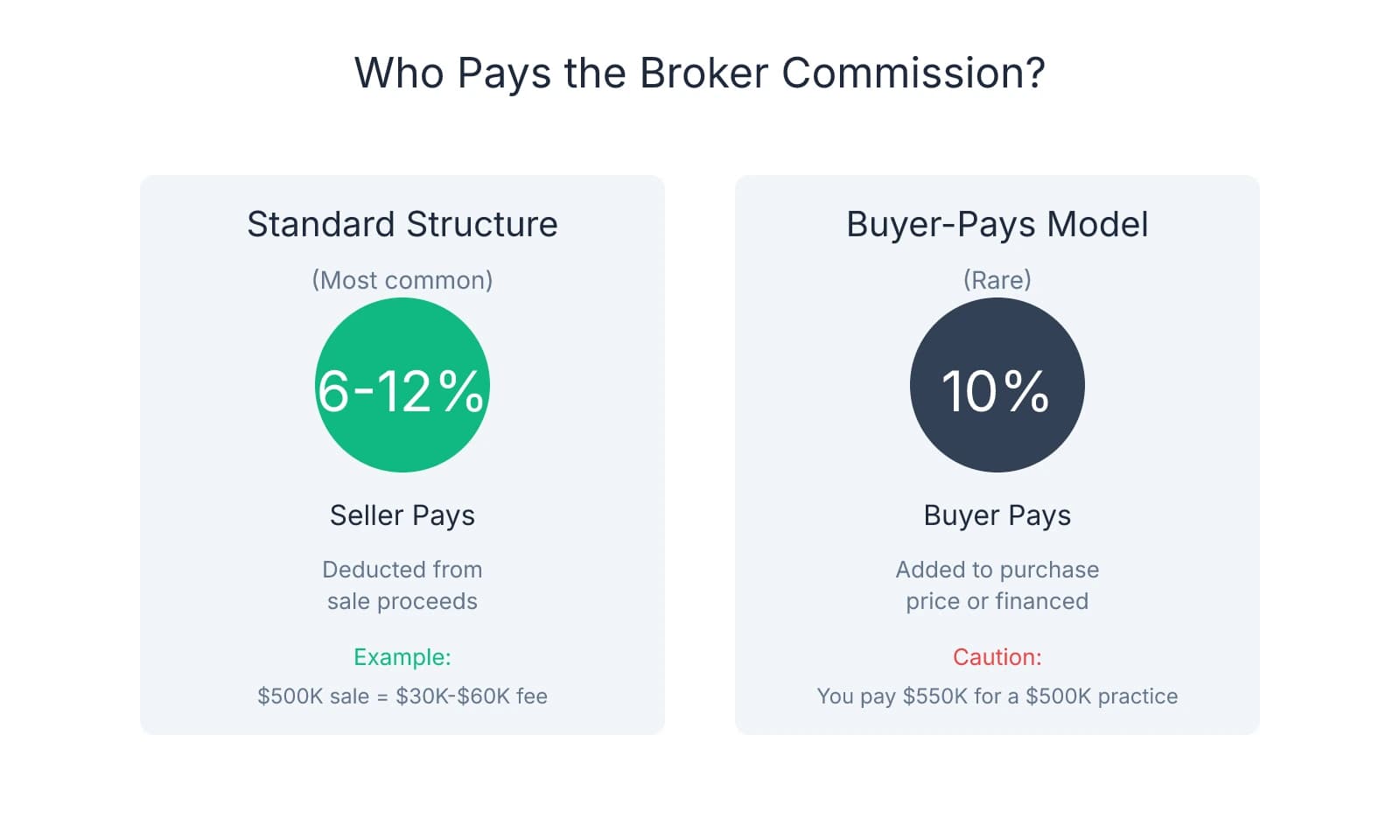
For a $500,000 practice, that's $30,000 to $60,000 coming out of the seller's proceeds. Smaller practices—those under $300,000—often sit at the higher end because the work required to market, qualify buyers, and shepherd the deal through due diligence doesn't scale down proportionally.
This structure clarifies whose interests the broker represents. The broker's paycheck depends on closing the deal and maximizing the sale price—both seller priorities. That doesn't make brokers adversarial, but their incentives tilt toward speed and price optimization, not necessarily toward the depth of due diligence a first-time buyer might need. When a broker pushes to "move quickly before another buyer steps in," that urgency serves the seller's timeline more than yours.
Occasionally, a broker will pitch a "buyer pays the fee" arrangement. This sounds appealing to sellers—no commission deducted from their net proceeds. But the economics don't disappear. In most cases, the buyer's fee gets rolled into the purchase price or financed as part of the loan. If the practice is listed at $500,000 and you're covering a 10% broker fee, you're effectively paying $550,000—either upfront or through higher monthly loan payments over 10-15 years.
This structure can work for corporate buyers who model all acquisition costs into their projections, but for private buyers relying on bank financing, it creates a problem. Lenders calculate loan amounts based on the practice's appraised value and your ability to service debt. Adding $50,000 in broker fees to the purchase price doesn't increase the practice's cash flow—it just increases what you owe.
In rare cases, one broker represents both buyer and seller—a dual representation arrangement. This happens most often when a buyer approaches a broker directly about a listed practice. The broker collects the full commission but owes fiduciary duties to both parties, which creates inherent tension. When dual representation comes up, ask for written disclosure of the fee structure and how conflicts will be managed. Many buyers in this position bring in their own attorney or advisor early—not to replace the broker's role, but to ensure someone at the table is focused solely on protecting their downside.
What Buyers Actually Pay: Legal, Accounting, and Due Diligence Costs
While the broker's commission doesn't land on your balance sheet, acquiring a practice still requires writing checks to advisors who protect your interests. These costs are unavoidable—but they're also where many buyers either overspend on services they don't need or underinvest in protections that would have saved them significantly more down the line.
Legal fees typically fall between $3,000 and $10,000, with most straightforward transactions landing around $5,000–$7,000. What drives the number higher? Multi-location purchases, seller financing with complex earn-out provisions, commercial real estate included in the deal, or practices with messy corporate structures all add billable hours. A solo GP practice with a clean asset purchase agreement and standard bank financing sits at the lower end.
Where buyers often economize poorly is choosing a general business attorney over someone who works specifically in dental transactions. A dental-focused lawyer understands what a reasonable non-compete looks like in your market—not just what's legally enforceable, but what's standard enough that a seller won't balk. They know which representations and warranties actually matter versus boilerplate language that sounds protective but rarely surfaces in disputes.
One pattern worth noting: buyers who skip legal review during the letter of intent phase often pay for it later. An attorney reviewing the LOI before you sign costs an extra $500–$1,000 in fees, but catching problematic language early—like a non-refundable deposit structure or an unrealistic closing timeline—prevents expensive renegotiations once you're deeper into due diligence.
Accounting fees run $2,000–$5,000 depending on how much financial analysis the deal requires. At minimum, you need someone reviewing the seller's tax returns and profit-and-loss statements to verify that reported income matches what the practice actually generated. But the real value comes from tax strategy and deal structure advice—specifically, how the purchase price gets allocated across assets.
Asset allocation determines your tax treatment for years after closing. If $400,000 of a $600,000 purchase gets allocated to goodwill, you're amortizing that over 15 years. If more gets allocated to equipment, you can depreciate it faster and reduce taxable income sooner. A CPA who understands dental acquisitions will model different allocation scenarios and show you the cash flow impact over the first five years.
Where buyers underinvest is in pre-acquisition financial modeling. Many CPAs will review documents reactively—you send them the seller's financials, they confirm the numbers look reasonable, and that's it. A better approach is asking your CPA to build a proforma cash flow model before you make an offer. What happens to your take-home income if collections drop 10% during transition? Running those scenarios costs an extra $1,000–$1,500 in fees, but it tells you whether the deal works at $550,000 versus $600,000.
An independent valuation runs $2,500–$5,000 and isn't always required by lenders—many banks rely on their own internal appraisals or accept the broker's valuation if it aligns with comparable sales data. So when does paying for your own valuation make sense?
Most often, when the asking price feels disconnected from the practice's fundamentals. If a seller is asking $650,000 for a practice generating $500,000 in collections with 25% overhead in rent and lab fees, an independent valuation gives you objective leverage to renegotiate. It's also worth considering when you're competing against other buyers and need confidence that you're not overpaying just to win the deal.
Where buyers waste money is ordering a valuation after they've already signed a binding purchase agreement. At that point, the valuation might confirm you overpaid, but you've lost negotiating leverage. If you're going to invest in third-party valuation, do it before the LOI or make the purchase agreement contingent on an acceptable appraisal outcome.
Due diligence expenses—background checks, lease review, equipment inspection, patient record audits—add another $1,000–$3,000 to your closing costs. These feel optional because they're not required by lenders, but they're where buyers most often discover deal-breaking issues that the seller either didn't disclose or didn't realize existed.
A commercial lease review ($500–$800) tells you whether the landlord has the right to terminate if ownership changes. An equipment inspection ($800–$1,200) identifies whether that "recently serviced" panorex actually needs a $15,000 sensor replacement in six months. Patient record audits ($400–$600) confirm that the 1,800 active patients the seller claims aren't actually 1,200 active patients plus 600 who haven't been seen in three years.
The pattern across these costs: every dollar spent on due diligence either confirms the deal is solid or uncovers leverage to renegotiate. Buyers who skip these steps to save $2,000 often spend the first year discovering problems that cost $20,000–$50,000 to fix.
When Going Without a Broker Saves Money—and When It Doesn't
The math on direct seller transactions looks appealing at first glance: if the seller isn't paying a 10% broker commission, maybe they'll reduce the asking price by that same amount. But most sellers don't adjust pricing when they skip the broker—they pocket the commission savings themselves or anchor to the same valuation they would have used with representation.
The clearest advantage of buying directly from a seller is negotiating flexibility. Without a broker managing the process and pushing toward a quick close, you and the seller can structure creative terms that wouldn't survive a traditional brokered timeline. Seller financing with a lower interest rate than bank terms, extended transition support without additional consulting fees, or phased buyouts where you acquire equity over two years instead of all at once—these arrangements require trust and patience that brokers, juggling multiple deals, rarely have bandwidth to facilitate.
Direct transactions also eliminate the pressure to move quickly before another buyer steps in. When you're negotiating directly, you can take three months instead of six weeks to complete due diligence, spend more time shadowing the seller before closing, or structure contingencies that protect you if key staff members leave during transition.
One scenario where direct deals consistently outperform brokered ones: practices in rural or underserved markets where finding qualified buyers is already difficult. A seller in a town of 8,000 people knows they're not going to get fifteen competing offers. If you're willing to relocate and commit to the community, you have leverage to negotiate a lower price, favorable financing terms, or both.
What buyers underestimate is the time required to find off-market practices in the first place. Broker-listed practices appear in searchable databases, get marketed through dental society networks, and come with pre-screened financials. Off-market deals require proactive outreach—calling practices in your target geography, attending state dental association events, asking your dental school network if anyone knows a retiring dentist. That's not a weekend project.
Once you find a seller, you're also absorbing the transaction management work a broker would normally handle. Coordinating between the seller's attorney, your lender, the title company, and the landlord. Drafting marketing materials if you need to notify patients about the ownership change. Managing the timeline so lease assignments, financing approvals, and state licensing all align for a smooth closing. Many buyers in direct transactions end up hiring a consultant or attorney to manage these logistics—costs that can approach $8,000–$12,000.
The other risk: without broker facilitation, due diligence often gets less rigorous. Brokers push sellers to organize financials, document patient counts, and disclose operational issues upfront because incomplete information slows deals down. In direct transactions, sellers aren't always prepared with that documentation, and buyers—eager to close a deal they worked hard to find—sometimes skip steps they would have insisted on in a brokered process.
Where brokered deals consistently outperform direct ones is in competitive markets with strong buyer demand. A well-marketed practice in a desirable suburb will generate multiple offers, and that competition drives the final price closer to fair market value. But it also means the seller has already invested in presenting the practice well: updated financials, clear patient demographics, documented collections trends, and often pre-negotiated lease terms that make the deal easier to close.
That documentation benefits you even if it doesn't feel like it during negotiations. A broker-listed practice with three years of verified P&L statements, a patient breakdown by insurance type, and a lease with a ten-year renewal option gives you the data you need to verify collections are real and model cash flow accurately.
The other advantage: brokers absorb the emotional friction that derails many direct negotiations. When you're negotiating face-to-face with a seller who built the practice over thirty years, disagreements about price, transition timelines, or non-compete terms can feel personal. A broker creates distance that keeps negotiations professional.
If you're pursuing a direct deal, your advisory team needs to be stronger than it would be in a brokered transaction. At minimum, you need an attorney who understands dental acquisitions and a CPA who can model the deal's financial structure. But many buyers in direct deals also bring in a consultant—someone who has closed multiple practice transitions and can spot red flags you wouldn't recognize on your own.
That consultant might cost $5,000–$10,000 depending on how involved they are, but their value shows up in the questions they ask during due diligence and the deal terms they push you to negotiate.
Budget the Full Transaction Cost Before You Start Looking
Most buyers build their acquisition budget around two numbers: the down payment and the purchase price. But the transaction itself costs money before you ever write a check to the seller. Expect to spend $10,000–$20,000 on legal fees, accounting work, valuation, and due diligence—expenses that sit outside your loan amount and often need to come from savings or working capital reserves.
That range isn't arbitrary. A straightforward single-location purchase with clean financials and standard bank financing lands closer to $10,000. Add complexity—seller financing with earn-out provisions, commercial real estate included in the deal, multiple associates whose employment agreements need review—and you're approaching $20,000.
Some lenders will finance transaction costs as part of your working capital loan, which gives you breathing room if your savings are tight. Others require these expenses paid out of pocket, separate from the down payment. The distinction changes your cash position significantly. If you're putting 10% down on a $500,000 practice, that's $50,000. Add another $15,000 in transaction costs that can't be financed, and you need $65,000 liquid—not $50,000.
Clarify this early in financing conversations. When you're comparing loan offers, ask explicitly whether transaction costs can be rolled into working capital or if they need to be paid separately. Working capital in dental loans typically covers equipment repairs, payroll during transition, and short-term cash flow gaps—but not every lender includes advisory fees in that calculation.
Transaction costs don't all hit at once. Attorney and CPA retainers often get paid before you sign a letter of intent—you need legal review of the LOI itself, and you want financial analysis before committing to a purchase price. Valuation happens during due diligence, after the LOI but before closing. The bulk of legal and accounting fees come at closing, when final documents get drafted and the deal structure gets finalized.
Plan your cash flow around that timing. If you're three months from closing and you've already spent $4,000 on legal retainers and $2,500 on a CPA, you still have $8,000–$12,000 in costs ahead of you. Building a buffer—even $5,000–$10,000 beyond your projected transaction costs—gives you room to handle unexpected expenses without derailing the deal.
One pattern that separates smooth acquisitions from chaotic ones: buyers who build relationships with dental-specific advisors before they start looking. When you find the right practice, you're operating on the seller's timeline. If the seller wants to close in 60 days and you're spending the first two weeks finding an attorney who understands dental transactions, you've lost negotiating time you won't get back.
Start by identifying a dental-focused attorney and CPA in your market. Many will offer a free consultation to discuss their process and fee structure. That conversation costs you nothing, but it means when you're ready to make an offer, you're not choosing advisors under pressure.
The same logic applies to financing. Talk to lenders before you need a loan. Understand their underwriting criteria, their typical loan structures, and what documentation they'll require. How much cash you actually need depends partly on the lender's terms—some require 10% down, others want 15%, and a few will go as low as 5% for strong candidates.
Building your advisory team early doesn't just save time—it saves money. Advisors who know your situation can flag problems during initial practice evaluations, before you've invested in full due diligence. An attorney who reviews a practice listing and immediately spots a problematic lease structure or a CPA who sees revenue trends that don't support the asking price can steer you away from deals that would have cost you thousands in wasted due diligence fees.
Budget the full transaction cost as part of your acquisition planning, not as an afterthought. The $15,000 you spend on advisors protects the $500,000 you're borrowing—and often uncovers leverage that saves you more than the advisory fees cost in the first place.
Sources & References
The data and claims in this article are drawn from the following sources. We prioritize government data, peer-reviewed research, and established industry publications to ensure accuracy.
- Understanding Broker Fees When Selling Your Practice— practicetransitionsgroup.comIndustry
- Buyer Pays the Fees - Lily Head Dental Practice Sales— www.dentalpracticesales.co.ukIndustry
- Top 3 Expenses During a Dental Acquisition - Doctor's Choice— doctors-choice.comIndustry
- Selling Your Dental Practice– Comparing Brokered and Private ...— apexdp.comIndustry
- Do You Really Need a Broker To Sell Your Practice? Nope— dentistlawyers.caIndustry
Frequently Asked Questions
Find Your Next Practice Without Hidden Fees
Understanding broker costs is just the first step. Minty Marketplace connects you with dental practices nationwide while our transparent approach ensures you know exactly what you're paying. Ready to explore your options?