How Often Do Dental PPO Fee Schedules Update?

Co-Founder, Minty Dental

In Summary
- A PPO fee schedule is the contracted maximum a carrier will pay per CDT code — it stays frozen at whatever rate was last formally agreed to until you request a change.
- Carriers have no financial incentive to offer you an increase unprompted; a provider who never asks is a low-cost, stable contract from the payer's perspective.
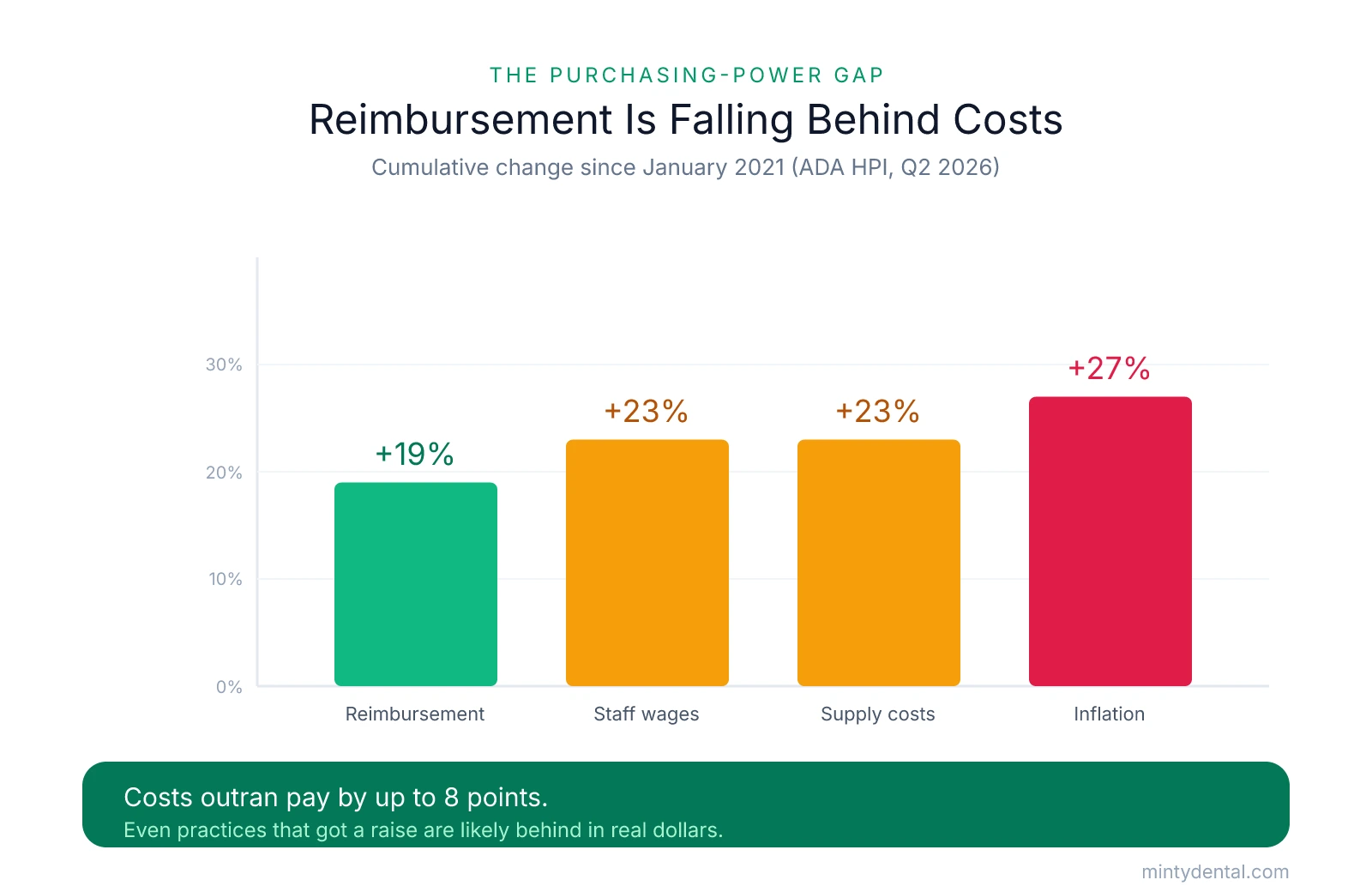
- Dental reimbursement across all payers rose only 19% since January 2021, while inflation ran 27% and both staff wages and supply costs climbed 23% over the same period.
- Even practices that received some rate movement over the past few years may still be losing ground in real purchasing power.
- The ADA recommends reviewing contracted fee schedules at least once a year, but many practices go five to ten years without submitting a formal review request.
PPO Fee Schedules Don't Update Automatically — They Stay Frozen Until You Act
A PPO fee schedule is the contracted maximum your practice has agreed to accept per CDT code from a given carrier. When a patient covered by that plan receives a service, the schedule determines the ceiling on what the insurer will pay — and what you're obligated to write off above it.
What catches a lot of practices off guard is the second part of that arrangement: the schedule has no expiration date. Once you're credentialed and contracted, those rates sit in force indefinitely. They don't adjust for the cost of living, they don't track your supply invoices, and they don't recalibrate when your front desk wages go up. The rate on that schedule is the rate until someone formally changes it, and the carrier is under no obligation to initiate that conversation.
That asymmetry matters. From the payer's side, a provider who stays quiet and never requests a review is a genuinely good outcome. The contract keeps performing, claims keep processing, and costs stay flat. There's no structural incentive for the carrier to send you a letter suggesting it's time to renegotiate.
The practical consequence shows up in your write-offs over time. If your fee schedule hasn't moved in several years, you're likely collecting a shrinking share of your actual cost to deliver care. ADA Health Policy Institute data from Q2 2026 puts the gap in concrete terms: dental reimbursement across all payers rose just 19% since January 2021, while general inflation ran 27% over the same period, and both staff wages and supply costs climbed 23%. That spread means even practices that did receive some increase from their carriers are likely still behind in real dollars. If your schedule hasn't moved at all, the gap is wider.
The ADA advises reviewing contracted fee schedules at least once a year, yet it's common for practices to go five to ten years without submitting a formal review request. That's often not neglect so much as the natural result of running a busy clinical operation where insurance administration competes with everything else. But a frozen schedule quietly erodes your margins in a way that a rising write-off percentage will eventually make visible — even if no single month looks dramatic enough to trigger a closer look.
How Carrier Update Cycles Work — and Why the PMS Is the Real Risk
There are two separate events that have to happen before a fee schedule change actually benefits your practice. First, the carrier revises its published allowances. Second, your team pulls the new schedule and loads it into the PMS. Both have to occur. If only the first happens, your software keeps writing off based on old numbers, and no one on your team will necessarily notice.
Carriers handle the first event on their own timeline and their own terms. Delta Dental of Kansas, for example, publishes its annual PPO fee schedule with a January 1 effective date and notifies providers by posting it to the Documents tab inside the online dentist account, with a mailed copy as backup. That's where it stays until someone at your practice logs in and retrieves it. The carrier is not pushing an update into Dentrix, Eaglesoft, or Open Dental. That second step is entirely on you.
The notification method matters because it's easy to miss. A PDF sitting in a provider portal documents tab doesn't generate the same urgency as a declined claim or an outstanding balance. If your front desk isn't watching for the annual notice, the new schedule may sit unloaded for months or longer.
The timing adds another wrinkle: not every carrier runs on a January 1 cycle. Some publish mid-year revisions, which means your team needs to check periodically rather than relying on a single year-end reminder. And then there are leased-network arrangements, where the practice may be paid on a fee schedule from a network it never directly contracted with. When a claim routes through one of these arrangements, the allowance applied may come from a schedule you've never seen and can't easily locate, adding another layer of staleness risk. Leased-network arrangements deserve their own scrutiny, because you may not even know which schedule is governing a given claim until you read the EOB carefully.
Here's a hypothetical example of how the gap becomes invisible: suppose a carrier raises its D2740 (porcelain crown) allowance from $900 to $960, but your PMS still has the old figure loaded. When that crown posts, your software calculates the write-off using $900 as the ceiling. The patient's EOB shows $960 as the allowed amount, but unless someone compares that EOB line to the fee schedule entry in the PMS, the $60 difference per crown just disappears. Multiply that across a moderate crown volume and the unrecaptured revenue adds up quickly, all without generating a denial or any other visible flag in the system.
| Carrier type | Typical update timing | How providers are notified | Where to find the current schedule |
|---|---|---|---|
| Large direct carrier (e.g., Delta Dental) | Annual, effective January 1 | Provider portal Documents tab; mailed PDF | Log in to provider account, Documents tab |
| Mid-year revision carriers | Varies; no fixed cycle | Provider newsletter or portal notice | Portal; call provider relations to confirm effective date |
| Leased-network arrangements | Varies by originating network | Often not directly notified | Request from carrier or network; compare EOB to PMS |
A carrier updating its published schedule is different from a practice formally requesting a rate increase, and the two processes run on different timelines. A carrier publishing a new annual schedule is a unilateral administrative act; it may help you, hurt you, or leave your codes untouched. A formal negotiation request, by contrast, requires you to initiate contact with the carrier's provider relations representative, make a documented case for higher allowances on specific codes, and work through a separate review process entirely.
Four Signs Your Fee Schedule in the PMS Is Stale
Before you can decide whether to request a formal review, you need to know whether your current loaded schedule is even accurate.
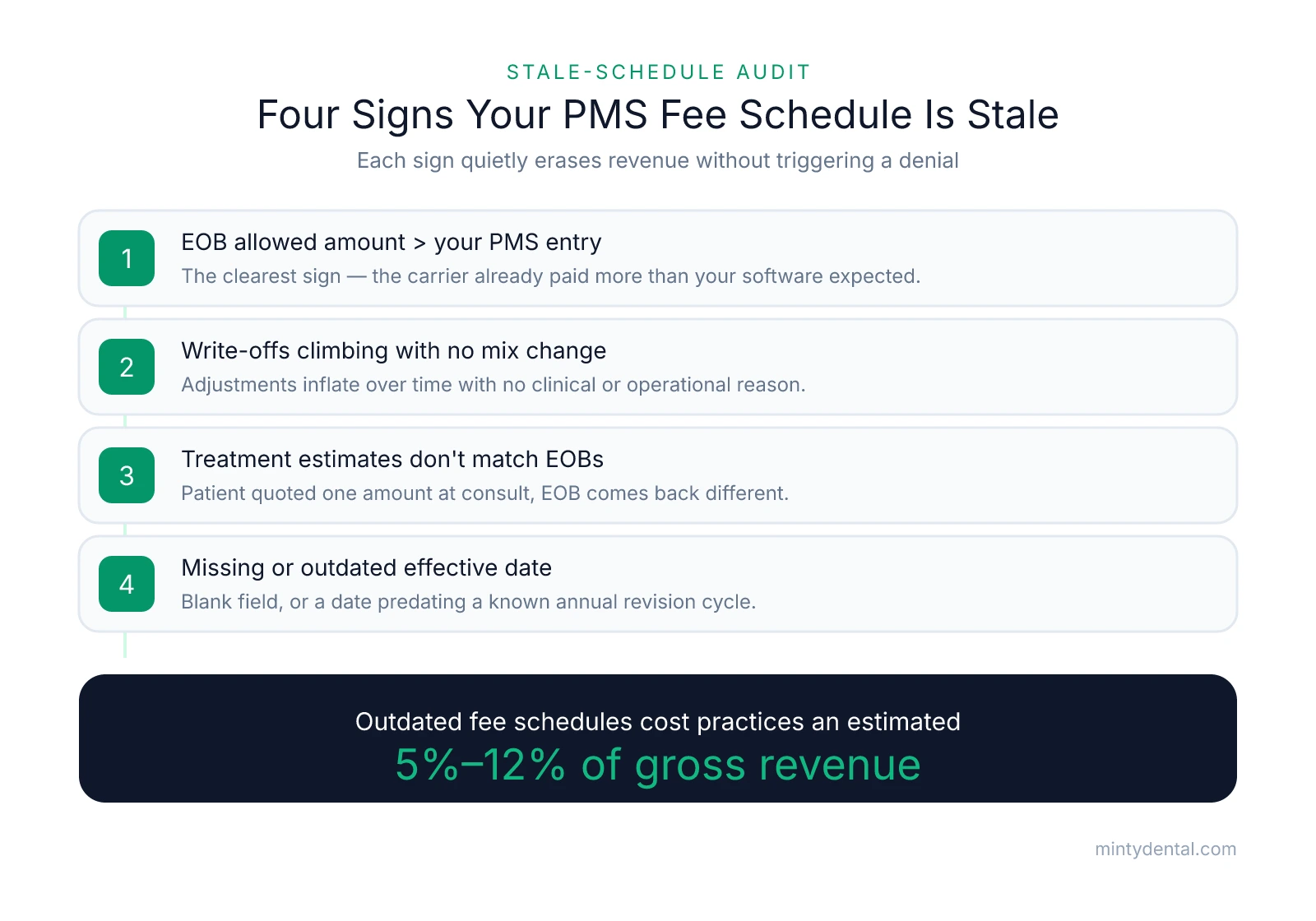
The EOB allowed amount is higher than your PMS fee schedule entry for the same code. Pull a recent EOB and compare the carrier's listed allowed amount line by line to the fee schedule loaded for that carrier in your PMS. If the EOB shows a higher figure, the carrier has already paid more than your software expected. That gap is real revenue the PMS never registered as collectable, because it was calculating everything against the older, lower entry. This is the clearest single sign of a stale schedule: the carrier's own remittance is telling you the numbers don't match.
Write-off percentages have been climbing without a change in payer mix or production volume. When a fee schedule entry in the PMS is lower than the carrier's current allowed amount, the system writes off the spread between your UCR fee and the PMS figure. If the PMS figure is too low, the system calculates a larger adjustment than your contract actually requires. The result is a contractual adjustment line that inflates over time without any clinical or operational reason. If you're seeing your write-off percentage creep upward while your carrier mix and procedure volume have stayed relatively stable, a stale fee schedule is one of the first things to check. It doesn't generate a denial or a flag; it just quietly erases revenue.
Treatment plan estimates don't match the EOBs. When your PMS generates a treatment plan, it uses the fee schedule entries to estimate the carrier's portion and the patient's portion. If those entries are out of date, the estimate is wrong before the claim even processes. The patient is quoted one amount at the consult, the EOB comes back different, and the front desk is left explaining a discrepancy that shouldn't exist. That friction is a symptom: the PMS and the carrier are working off different numbers.
No effective date appears on the fee schedule in the PMS, or the date predates a known carrier revision. Most practice management systems allow you to view the effective date attached to each carrier's fee schedule. If that field is blank, you have no way to know how old the loaded figures are. If it shows a date before a known annual revision cycle (say, a date in 2022 for a carrier that publishes January 1 updates every year), the schedule is almost certainly stale and needs to be pulled and compared against the current version in the provider portal.
Outdated fee schedules are estimated to cost practices 5% to 12% of gross revenue through uncollected PPO fee schedule adjustments, which makes comparing your PMS against the carrier's current published schedule worth the time even if the numbers look roughly right at first glance.
Auditing Your Schedules and Deciding What to Do Next
Start with the carrier portals. Log into each one, navigate to the documents or fee schedule section, and download the current published schedule as a PDF. The most important piece of information on that document is the effective date. If you can't find a fee schedule or an effective date in the portal, call provider relations and ask them to confirm both the current rate file and when it took effect. That date is your anchor for everything that follows.
Once you have the current carrier document, open your PMS and pull the fee schedule loaded for that same carrier. Pick twenty to thirty of your highest-volume CDT codes and compare the allowances side by side. If the carrier's current document shows a different figure than your PMS for the same code, the PMS is behind. That's not a negotiation problem yet. It's a data problem, and it needs to be fixed before you do anything else.
Load the current carrier schedule into your PMS before running any further analysis. A stale schedule in the PMS makes your write-off reports unreliable, your treatment plan estimates inaccurate, and your AR figures harder to interpret. Everything downstream of that loaded schedule is distorted if the schedule itself is wrong. Updating the PMS to reflect what the carrier has already approved is a billing operations task, not a negotiation. It doesn't require a written proposal or a 90-day review cycle. It just requires pulling the right file and entering it correctly.
Once the PMS is current, you're in a position to ask a separate and more important question: are the contracted rates themselves competitive? This requires comparing your high-volume code allowances to regional benchmarks, such as the ADA's Survey of Dental Fees, which breaks down fees by procedure and geography. If your allowances are well below regional norms for codes that drive significant revenue, that's the basis for a formal rate review request.
That process is distinct from updating the PMS. A formal negotiation means identifying the payers and codes where you're farthest behind, building a written proposal with supporting data, contacting the carrier's provider relations representative, and following through over a 90 to 120 day timeline. Include the date your fees were last revised as a key data point in that proposal, because it establishes how long the freeze has been in place.
If your schedules haven't been formally reviewed in more than two years, you're almost certainly behind in real dollars, so treat any schedule that hasn't moved in two or more years as a candidate for a formal request.
Sources & References
The data and claims in this article are drawn from the following sources. We prioritize government data, peer-reviewed research, and established industry publications to ensure accuracy.
- Dear ADA: Reimbursement rates | American Dental Association— adanews.ada.orgIndustry
- 2026 Delta Dental PPO Fee Schedule— deltadentalks.comIndustry
- [PDF] Fee Schedule Negotiation Guide - American Dental Association— ada.orgIndustry
- Dental Practice Fee Schedule Review for Optimal Billing— nxlevelconsultants.comIndustry
- [PDF] Fee Schedule Negotiation Guide - American Dental Association— ada.orgIndustry
Find Out If Your PPO Fee Schedule Is Current
If creeping write-offs prompted this read, the next step is seeing where your current crown fee actually stands for your area. Run a quick Rate Check to get a local comparison and see whether a group fee schedule could close the gap.