How to Drop a PPO Without Losing Too Many Patients

Co-Founder, Minty Dental

In Summary
- A PPO exit means terminating a provider agreement with a carrier, not dismissing patients. Patients can still be seen out-of-network, and their benefits still apply at a lower reimbursement tier.
- PPO write-offs average 30–45% below UCR fees, making insurance discounts one of the largest recurring costs in a dental practice.
- According to the ADA Health Policy Institute's Q3 2025 report, 25.7% of dentists had already dropped at least one insurer, and another 24.2% said they may do so later in the year.
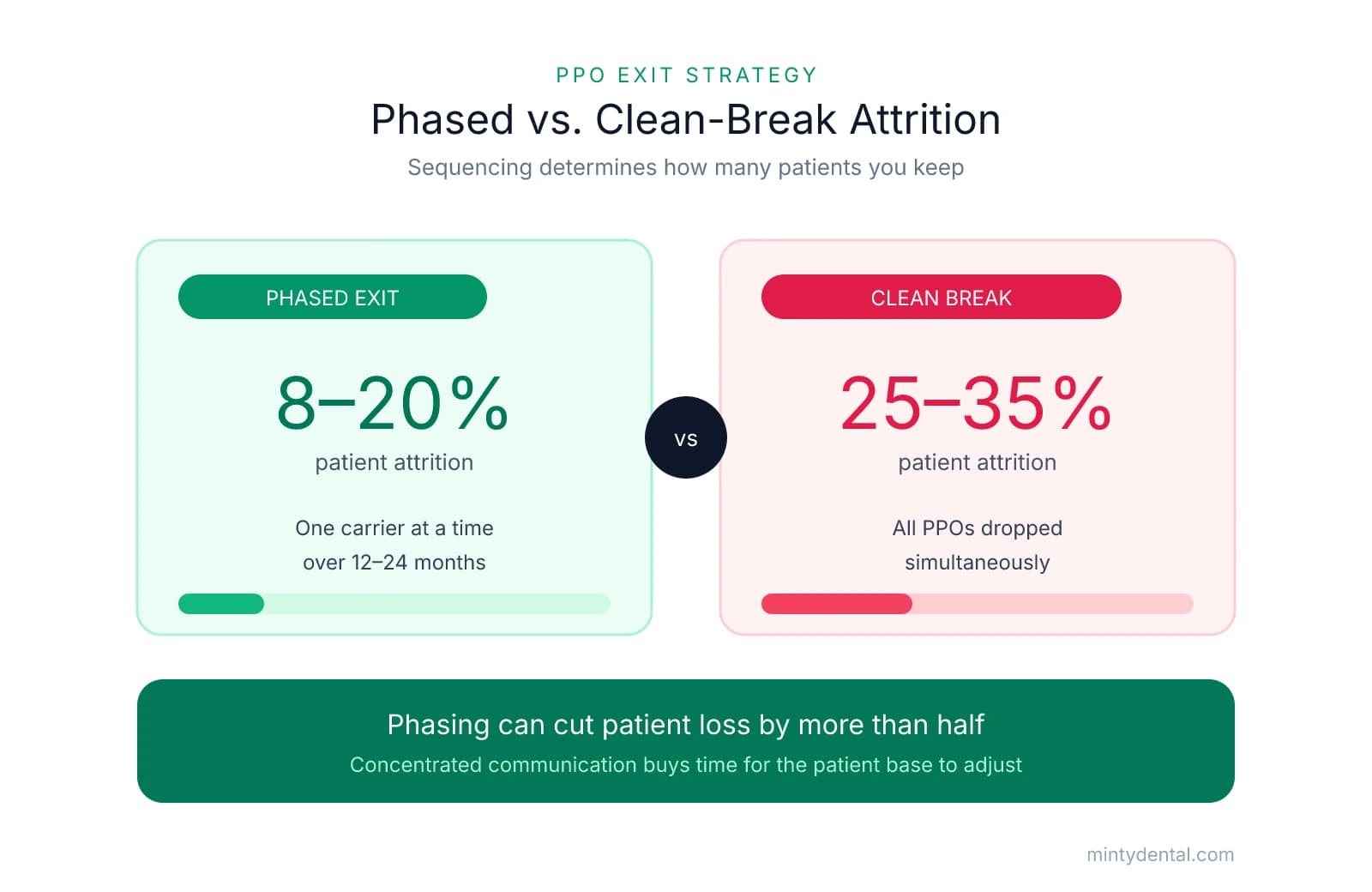
- Phased exits, dropping one carrier at a time over 12–24 months, produce 8–20% patient attrition. Dropping all PPOs simultaneously raises that range to 25–35%.
- The net-revenue outcome of any exit depends on three variables: the UCR fee lift multiplied by retained patients, minus attrition loss, minus the cost of replacing lost patients.
A Phased Exit Strategy Protects Revenue Better Than a Clean Break
PPO exit defined: Terminating a PPO contract means ending your provider agreement with a specific carrier. It does not mean dismissing those patients from your practice. Patients covered by that plan can still receive care at your office; their benefits still apply, but at the carrier's out-of-network reimbursement tier rather than the contracted in-network rate.
That distinction matters because the most common mistake practice owners make is treating the exit as a single event rather than a structured process. The decision to leave a PPO is one step. The sequencing of which contracts to exit, when to notify patients, and how to replace lost revenue is where the financial outcome is actually determined.
The underlying economics explain why so many owners are working through this now. PPO write-offs typically run 30–45% below UCR fees, which means a practice collecting $800,000 annually under contracted rates may be discounting $240,000 to $480,000 in production each year. According to the ADA Health Policy Institute's Q3 2025 Economic Outlook report, 50.3% of practice owners cite low reimbursement as a top challenge, and 25.7% of dentists had already dropped at least one insurer by Q3 2025, with another 24.2% considering doing so before year-end. That represents roughly half the profession actively reconsidering PPO participation.
The net-revenue impact of any exit follows a straightforward formula: the UCR fee lift multiplied by retained patients, minus revenue lost to patient attrition, minus the cost of acquiring replacement patients. Each section that follows addresses one of those variables in detail.
The attrition variable is where sequencing has the most leverage. Practices that drop all PPO contracts simultaneously face patient attrition in the 25–35% range, because every affected patient loses their in-network benefit at once and the practice has limited capacity to communicate the change clearly. A phased approach, exiting one carrier at a time over 12–24 months, holds attrition to 8–20% by concentrating communication efforts and giving the patient base time to adjust. That difference can determine whether the transition generates positive net revenue in Year 1 or requires two to three years to recover.
Payer mix also affects how this math interacts with practice financing and valuation. Owners who carry debt or are considering a future sale should note that a heavy PPO concentration affects borrowing capacity in ways that make a well-executed exit more valuable than the fee schedule recovery alone.
How to Rank Your PPO Contracts Before Deciding Which to Drop First
Before submitting any termination notice, build a carrier-by-carrier table using data you can pull directly from your practice management software. Three numbers determine the sequencing: revenue share, write-off rate, and current capacity utilization.
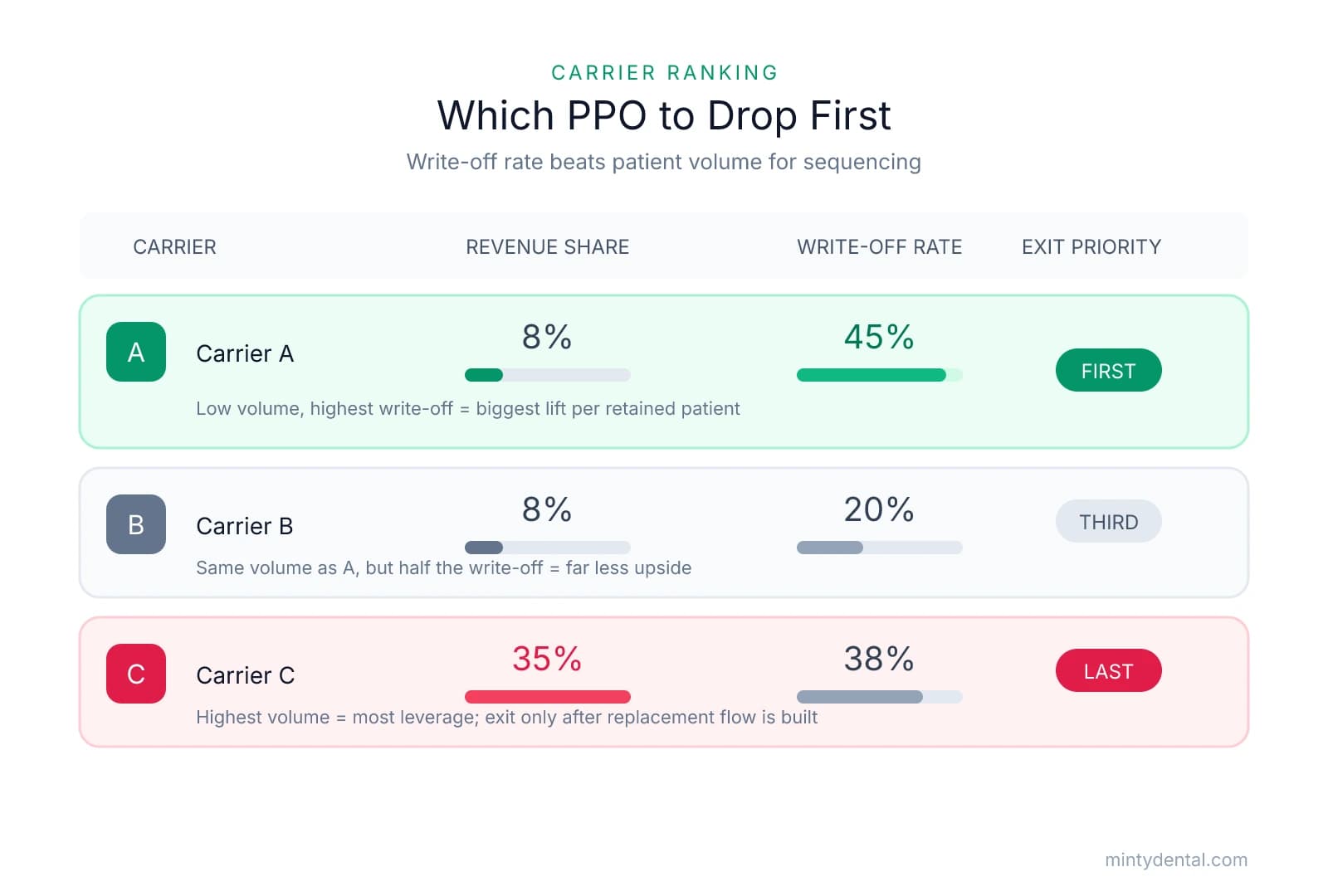
Setting up the analysis: For each carrier, calculate (1) the percentage of total collections that carrier represents, (2) the write-off rate using the formula (UCR fee minus allowed fee, divided by UCR fee), and (3) your overall practice capacity utilization. The table below shows how this looks across three hypothetical carriers.
| Carrier | Revenue Share | Write-Off Rate | Capacity Utilization | Exit Priority |
|---|---|---|---|---|
| Carrier A | 8% | 45% | 78% | First |
| Carrier B | 8% | 20% | 78% | Third |
| Carrier C | 35% | 38% | 78% | Last |
Carrier A and Carrier B represent identical revenue shares, but Carrier A's write-off rate is more than twice as high. That makes Carrier A the better first exit, even if patient counts are similar. The fee schedule, not the volume, determines where you recover the most revenue per retained patient.
This sequencing logic runs counter to what many owners assume. The instinct is to start with the smallest carrier by patient count, but a low-volume carrier with a 20% write-off rate offers less upside than a low-volume carrier with a 45% write-off rate. The UCR lift per retained patient is the key numerator, and a higher write-off rate means a larger lift when that patient stays.
Carriers with the highest patient volume, like Carrier C above, typically hold the most pricing leverage over the practice. Exiting a carrier that represents 35% of revenue before you have built replacement patient flow is the highest-attrition path available. These contracts are generally the last to exit, not the first.
Capacity utilization is the second variable. Practices running at 70–80% utilization have open chair time to absorb some attrition and fill it with new patients or fee-for-service growth. Practices running at 90% or above face a different problem: even dropping a small carrier creates a chair-time gap that takes time to fill, and the practice may not have the scheduling capacity to onboard replacement patients quickly. If utilization is above 90%, building new patient flow before submitting any termination notice is worth the delay.
Check for silent PPO arrangements before finalizing your list. Some carriers access your contracted fee schedule through third-party leasing networks, meaning you may be providing discounted rates to plans you never directly contracted with. As shared network agreements have expanded, most insurance companies now participate in multiple overlapping networks, and dentists are frequently opted in by default. Reviewing your contracts and running an explanation-of-benefits audit can surface these arrangements. If a carrier is accessing your fees through a lease, terminating the primary contract may not be sufficient to exit the leased network.
Finally, review each contract for notice period requirements, which typically run 60 to 90 days, and check for evergreen auto-renewal clauses that could lock you into another contract term if you miss the termination window. Both details affect your exit timeline before a single patient conversation takes place.
Communicating the Change to Patients Before the Termination Date
With your exit sequence and termination dates established, patient communication becomes the variable most likely to determine whether attrition stays in the 8–20% range or climbs toward the higher end. A structured timeline works better than a single announcement because it gives patients multiple touchpoints and reduces the volume of confused or frustrated calls arriving at once.
Communication timeline:
- 90 days out: Send the first written notice by both mail and email. This is the most important touchpoint. Patients who feel blindsided are far more likely to leave than patients who had time to ask questions and explore their options.
- 60 days out: Send a follow-up notice reinforcing the effective date and the alternatives available. Include any updated information about the in-house membership plan or financing options.
- 30 days out: Send a final written reminder. For patients with active treatment plans or long tenure, a phone call from the dentist or office manager at this stage meaningfully improves retention. A personal call signals that the relationship matters beyond the insurance arrangement.
- At the last appointment before the change: Front desk staff should briefly confirm the effective date and answer any remaining questions in person.
What the letter should say: The most common source of patient confusion is the assumption that going out-of-network means losing their insurance entirely. The letter should address this directly: patients can still use their benefits at your practice, but reimbursement will come from their carrier at the out-of-network rate rather than the contracted in-network rate. Their actual out-of-pocket difference depends on their specific plan's out-of-network coverage, which varies considerably. The ADA provides sample patient communication templates that practices can adapt for this purpose, and using them as a starting point reduces the risk of language that reads as dismissive or confusing.
The letter should also present concrete alternatives: an in-house membership plan, payment plans, and third-party financing options. Patients who see a clear path forward are more likely to stay. For patients who were relying on PPO coverage as their primary means of accessing care, an in-house membership plan is often the most effective bridge. Membership plan patients retain at 85–93% annually compared to 41–55% for uninsured patients without a plan, which makes enrollment a meaningful retention lever for this segment.
Staff preparation matters as much as the letter itself. Front desk teams should have scripted responses ready before any notices go out, because the first call a patient makes after receiving the letter will shape their decision to stay or leave. Scripts should cover the most common questions: what out-of-network means, what the new cost estimate looks like for their plan type, and how to enroll in the membership plan or set up a payment arrangement. Staff who are uncertain or inconsistent in their answers create the impression that the practice is unprepared, which accelerates attrition.
Measuring the Outcome and Deciding When to Drop the Next Plan
Once the termination date has passed and the practice is operating out-of-network with the first carrier, the priority shifts to measurement. What comes next is a structured observation period, not an immediate decision about the next exit.
Three metrics to track post-exit:
- Net collections per patient should rise as UCR fees replace contracted rates. If this number is not improving within 60 to 90 days, the fee schedule lift is being offset somewhere, either by billing errors, out-of-network claim denials, or patients delaying treatment.
- Active patient count should stabilize within 90 days. A continued decline past that window suggests the communication strategy did not reach enough patients in time, or that the plan's patient base was more price-sensitive than the pre-exit analysis indicated.
- New patient flow should return to pre-exit levels within six months, assuming the practice had available chair time. If new patient volume is still below baseline at the six-month mark, the replacement strategy needs adjustment.
Year 1 results are often misleading. One-time attrition, temporary billing friction with out-of-network claims, and the cost of patient replacement all compress the first year's numbers in ways that do not reflect the long-term outcome. Most practices need six to twelve months of post-exit data before they can accurately assess whether the first exit was net positive. Evaluating the decision at 90 days and concluding it did not work is one of the more common analytical errors in this process.
PPO mix also affects practice valuation, which matters for owners who plan to sell within the next several years. High write-off rates suppress EBITDA directly, and buyers, including DSOs, increasingly apply valuation discounts to practices with heavy PPO dependence. As PPO Negotiation Solutions notes, practices writing off 30 to 45% of production are viewed as less predictable and less scalable, which translates into lower multiples at the time of sale. Reducing PPO mix improves both current cash flow and the EBITDA figure a buyer will use to set a purchase price. Owners preparing for a transition can review how seller-reduced hours affect valuation for a related example of how operational decisions made years before a sale show up in the final number.
The decision rule for proceeding to the next carrier exit is specific: all three conditions must be met before submitting the next termination notice. Active patient count has stabilized, new patient flow has recovered to pre-exit levels, and net collections per patient have improved. Practices that move to the next carrier before all three conditions are satisfied tend to compound attrition rather than recover from it, because the patient base is still adjusting to the first change when the second one arrives.
The full sequence, applied once per carrier, looks like this: run the carrier analysis, select the plan with the lowest fee schedule relative to its revenue share, submit the 90-day notice, execute the patient communication timeline, then measure for six to twelve months before repeating. That cadence, one carrier at a time with a full measurement window between exits, keeps a multi-year PPO reduction on track without destabilizing the practice in the process.
Sources & References
The data and claims in this article are drawn from the following sources. We prioritize government data, peer-reviewed research, and established industry publications to ensure accuracy.
- Dental coverage, access & outcomes - American Dental Association— ada.orgIndustry
- Want to Drop a Few PPOs? Here is What You Should Consider— unlocktheppo.com
- Dental coverage, access & outcomes - American Dental Association— ada.orgIndustry
- Dental Membership Plan Statistics: 90% Retention vs 50% Without ...— ainora.lt
- How PPO Contracts Influence Your Dental Practice's Valuation— pponegotiationsolutions.comIndustry
Ready to optimize your practice's network strategy?
Dropping a PPO requires careful planning around operations, patient communication, and financial management. Minty's operations team handles the business complexities of network transitions, from billing adjustments to patient retention strategies, so you can focus on clinical care.