Pending Lab Cases When Buying a Dental Practice

Co-Founder, Minty Dental
In Summary
- Pending lab cases fall into three distinct categories — lab cases in transit, unseated restorations already returned from the lab, and multi-stage treatments like implants or clear aligner therapy — each carrying different financial and legal exposure
- For lab-in-transit cases, the buyer typically performs the seating appointment but may absorb the outstanding lab bill if the purchase agreement doesn't address it explicitly
- Multi-stage cases create the longest obligation: implant sequences, phased restorations, and orthodontic plans can extend months or years past the closing date
- Verbal handoffs are legally insufficient — clinical liability cannot be informally delegated, and unearned patient revenue cannot simply stay with the seller
- WIP needs to be audited, quantified, and resolved in the purchase agreement before closing — not treated as a scheduling task after the keys change hands
WIP Is a Financial and Legal Issue, Not Just a Scheduling One
Picture this: you close on a practice on a Friday, walk in Monday morning, and find a lab log with 15 pending crowns, 3 implant cases mid-integration, and 2 clear aligner plans in progress. The instinct is to treat it as a scheduling task — call the patients, seat the crowns, pick up where the seller left off. That instinct is understandable, and it's also where many buyers quietly absorb costs and liabilities they never agreed to take on.
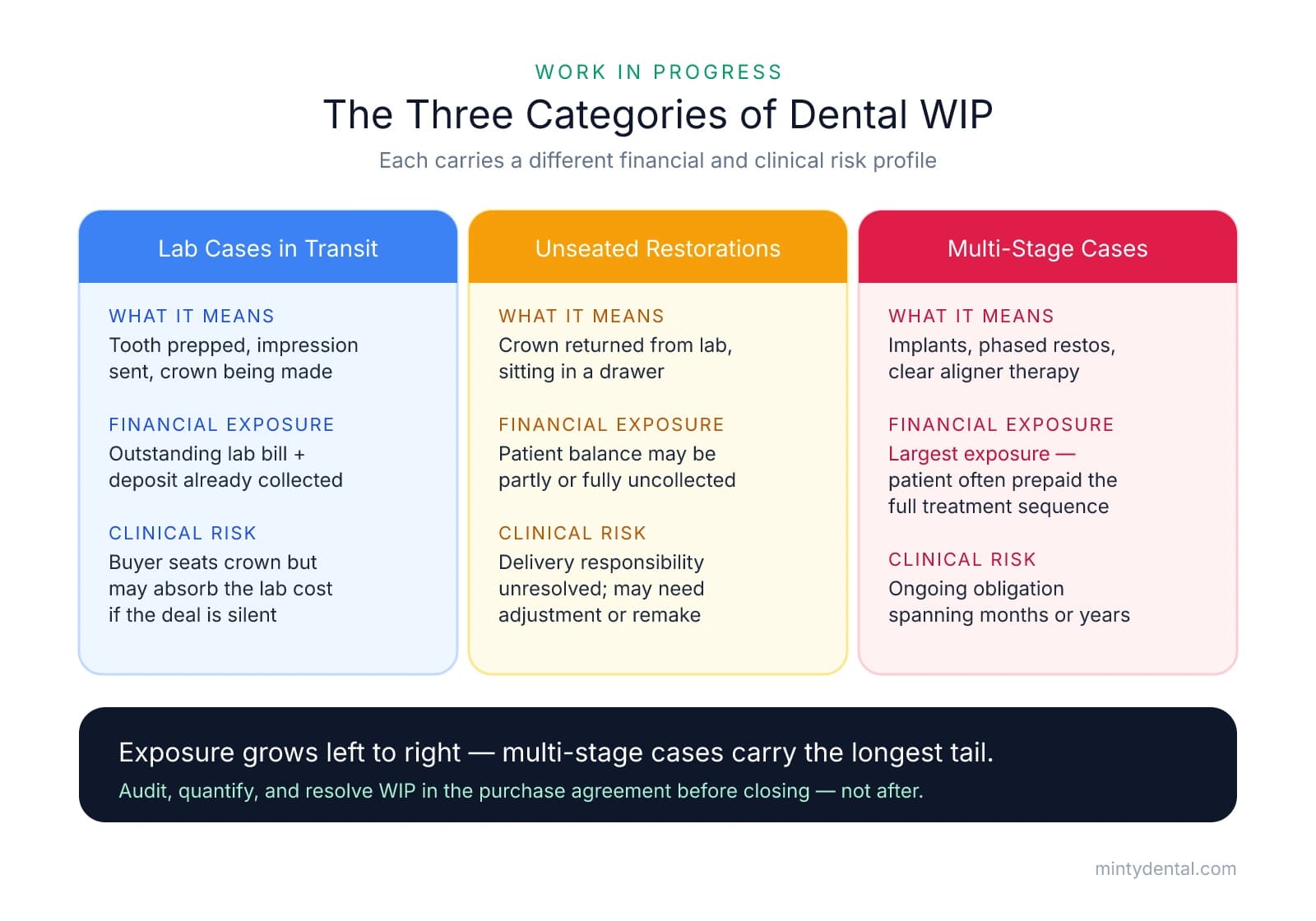
Work in progress (WIP) in a dental acquisition refers to any treatment that was initiated under the seller's care but remains clinically or financially incomplete at the time of closing. It's not a single category — and that distinction matters enormously for how you structure the deal.
The Three Categories of Dental WIP
| WIP Category | What It Means | Financial Exposure | Clinical Risk |
|---|---|---|---|
| Lab cases in transit | Tooth prepped, impression sent, crown being fabricated | Outstanding lab bill + patient deposit already collected | Buyer seats the crown but may absorb the lab cost if the agreement is silent |
| Unseated restorations | Crown or appliance returned from lab, sitting in a drawer | Patient balance may be partially or fully uncollected | Delivery responsibility is unresolved; restoration may need adjustment or remake |
| Multi-stage cases | Implants, phased restorations, clear aligner therapy | Largest exposure — patient has often prepaid for a full treatment sequence | Buyer inherits an ongoing clinical obligation spanning months or years |
Each category carries a different risk profile, and conflating them in a purchase agreement — or leaving them unaddressed entirely — creates gaps that surface at the worst possible moment.
For lab-in-transit cases, the financial gap is immediate: the lab bill is outstanding, and the patient has typically already paid a deposit toward the final restoration. If the purchase agreement is silent on who absorbs that lab cost, the buyer often ends up paying it by default — doing the seating work and covering the fabrication fee for a case the seller originated and collected on.
Unseated restorations are worth calling out separately. The crown exists — it's sitting in the lab drawer — but the patient's remaining balance may not have been collected, and the delivery responsibility hasn't been formally assigned. These cases can feel resolved because the lab work is done, but the financial and clinical handoff is still incomplete.
Multi-stage cases create the longest tail. An implant sequence that started six months before closing might require another six months of follow-up. A phased restorative plan or an aligner case mid-treatment represents an ongoing clinical commitment the buyer is inheriting — often without a clear accounting of what the patient has prepaid versus what remains to be delivered.
As Holt Law notes, simple verbal handoffs are legally insufficient — clinical liability cannot be informally delegated, and unearned patient revenue cannot simply be retained by a retiring dentist. The same logic applies to open insurance claims tied to in-progress treatment, which can compound the financial exposure if pending EOBs and unresolved billing aren't accounted for before closing.
The reframe here is straightforward: WIP isn't a scheduling problem to solve in your first week of ownership. It's a financial and legal problem that needs to be audited, quantified, and explicitly addressed in the purchase agreement — before you sign anything.
How to Audit WIP During Due Diligence
With the three WIP categories clearly defined, the next step is turning that framework into a number — one that can inform your offer, your purchase price negotiation, or a seller credit at closing. That process starts with a single document request.
Start with a Formal WIP Schedule
Ask the seller — or their broker — for a WIP schedule: a line-by-line log of every open case as of the due diligence date. A complete schedule should include:
- Patient name and procedure type
- Lab name and whether the lab bill has been paid or is still outstanding
- Patient payment status (deposit only, paid in full, or balance remaining)
- Expected delivery or next appointment date
- Case stage (in transit, returned from lab, or mid-treatment sequence)
Many sellers won't have this document ready-made — most practices don't maintain a formal WIP log as a matter of routine. The front desk or office manager can typically pull the underlying data from the practice management software. What you're looking for exists in the system; it just needs to be compiled.
What to Look For by Case Type
Once you have the schedule, review each category with a specific lens:
Lab-in-transit cases: Confirm whether the lab invoice has already been paid by the seller or is still outstanding. Then check the patient ledger — has the patient paid a deposit, their full balance, or nothing yet? The gap between what the lab is owed and what the patient has paid represents an immediate financial exposure that lands on the buyer if the agreement doesn't address it.
Unseated restorations: Verify the patient's remaining balance and whether they've been contacted about scheduling delivery. A crown sitting in a drawer with an uncollected patient balance is a receivable the buyer is inheriting — and as the accounts receivable disputes that often follow acquisitions illustrate, uncollected balances are harder to recover once ownership changes hands.
Multi-stage cases: Pull the full treatment plan and patient ledger side by side. What has been billed? What has been collected? What clinical work remains? The delta between collected revenue and remaining clinical obligation is your exposure.
Quantify the Total Exposure
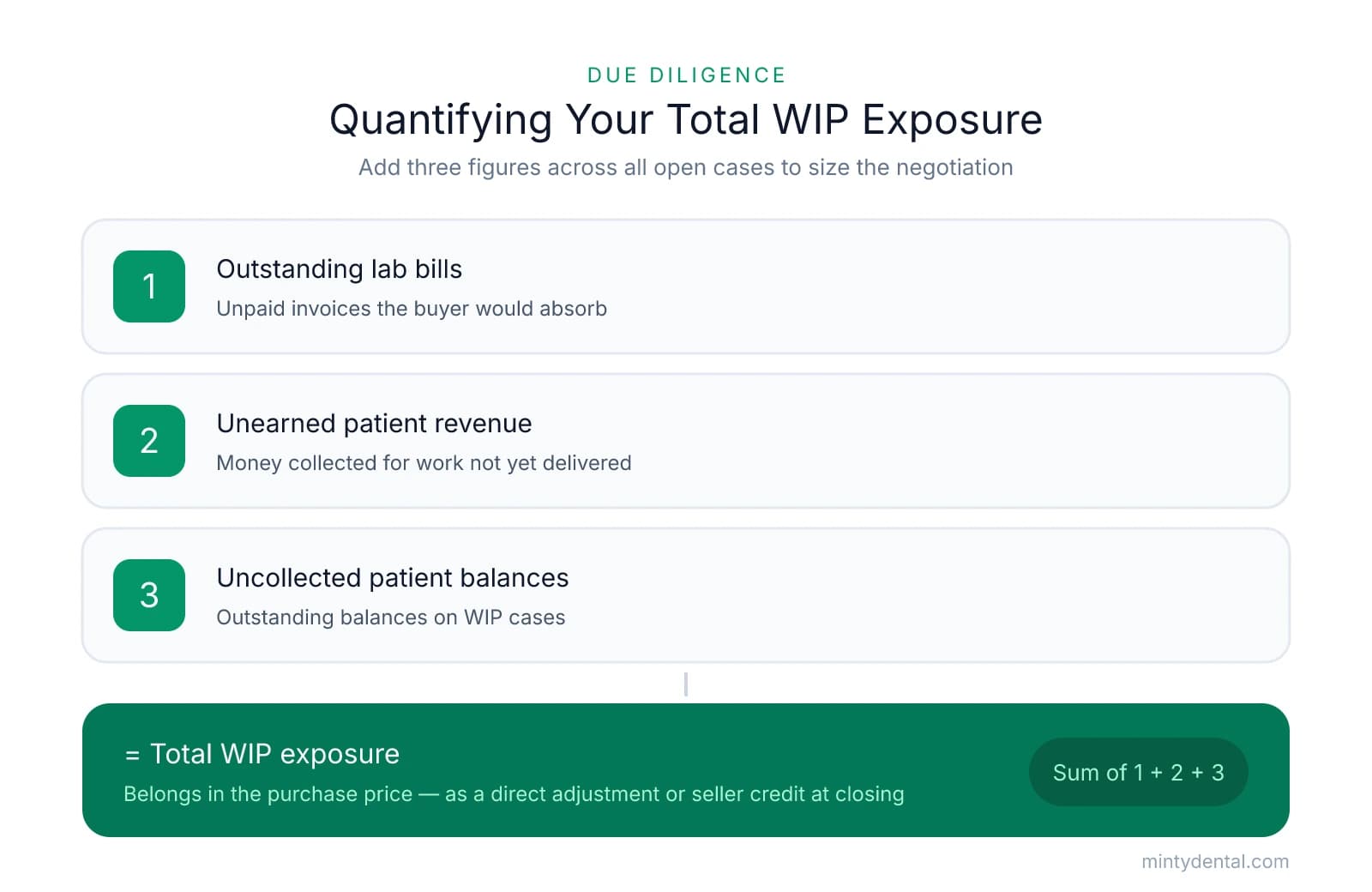
Add up three figures across all open cases:
- Outstanding lab bills (unpaid invoices the buyer would absorb)
- Unearned patient revenue (money collected for work not yet delivered)
- Uncollected patient balances on WIP cases
That combined number is your WIP exposure. It belongs in the purchase price conversation — either as a direct adjustment or a seller credit at closing. As Holt Law notes, most asset purchase agreements include post-closing adjustment mechanisms for WIP, but only when the WIP schedule is attached as a formal exhibit and the adjustment formula is explicitly defined. Without that language, the leverage to negotiate disappears the moment you close — a pattern worth understanding before you approach any due diligence findings as negotiating leverage.
Freeze New Submissions Before Closing
One protection many buyers overlook: ask the seller to document — or pause — new lab case submissions in the two to four weeks before closing. Every case sent to the lab after the LOI is signed adds to the WIP log you'll inherit. At minimum, any case submitted post-LOI should be logged immediately, with the lab fee and patient payment status recorded at the time of submission.
What the Purchase Agreement Needs to Say About WIP
Once you've quantified your WIP exposure, the next challenge is converting that number into enforceable contract language. Many buyers lose ground here — not because they missed the issue, but because they accepted vague placeholder language that sounds reasonable in negotiation and provides no protection when something goes wrong.
Four provisions need explicit coverage in the purchase agreement.
1. Lab Bill Responsibility
The agreement should state clearly that all lab fees for cases prepped before the closing date are the seller's financial obligation — even if the buyer performs the seating appointment after closing. Without this language, the buyer typically absorbs the lab cost by default: doing the delivery work and paying the fabrication bill for a case the seller originated and collected on.
The fix is a clause assigning pre-closing lab invoices to the seller, with a reimbursement mechanism if the buyer receives the invoice directly from the lab post-closing.
2. Patient Prepayment Allocation
Money a patient paid toward a restoration that hasn't been delivered yet is unearned revenue — and it needs to go somewhere explicit in the agreement. Two approaches tend to work in practice:
- Escrow and release: The seller deposits the total unearned WIP revenue into escrow at closing, and funds are released to the buyer as each case is delivered.
- Purchase price reduction: The purchase price is reduced by the total unearned WIP balance, effectively transferring the obligation to the buyer with corresponding compensation.
Either structure works. What doesn't work is leaving patient prepayments with the seller and assuming the buyer will "collect the balance" from patients — because in many WIP cases, the patient has already paid in full and owes nothing.
3. Clinical Liability by Phase
If a crown prepped by the seller fractures after the buyer seats it, the line between "seller's prep" and "buyer's seating" becomes genuinely contested. The agreement should define which party owns each clinical phase and include indemnification language for pre-closing clinical decisions. As Hatch Legal Group notes, vague "as mutually agreed" language is the most common failure mode — it sounds collaborative and provides no enforceable mechanism when a costly failure occurs. This is the provision most directly connected to retreatment liability.
Replace any "as mutually agreed" phrasing with specific notice periods, cost-sharing thresholds, and defined timelines for raising disputes.
4. Patient Abandonment Compliance
State dental boards treat incomplete treatment as a patient abandonment risk when a practice changes hands without proper documentation. Under 22 Tex. Admin. Code § 108.5, for example, a dentist must provide a minimum of 30 days written notice before discontinuing undertaken treatment — with specific documentation requirements for each patient's chart. Most states have comparable rules.
The purchase agreement should require the seller to formally document the transfer of every WIP case in the patient's chart before closing. This protects both parties: the seller from abandonment complaints, and the buyer from inheriting undocumented clinical obligations. An attorney familiar with dental transactions can confirm the specific requirements for your state — one reason having your own legal counsel matters more than many buyers expect.
Attach the WIP Schedule as a Formal Exhibit
Every provision above depends on the WIP schedule being attached as a binding exhibit to the purchase agreement, not referenced informally in the body of the contract. An informally referenced schedule has no enforceable effect in a post-closing dispute. When it's attached as an exhibit, it becomes part of the contract — and the allocation language tied to it becomes actionable.
Managing WIP in Your First 30 Days as the New Owner
The contract language is signed, the keys are in hand — now the WIP schedule shifts from a negotiating document to an operational one. The first week is where the groundwork you laid in due diligence either pays off or quietly unravels.
Start with a cross-reference. Pull the WIP exhibit from the purchase agreement and run it line by line against your practice management software. Every case on the exhibit should have a corresponding patient record, treatment plan, and ledger entry. Cases that appear in the software but not on the exhibit — or vice versa — need to be flagged immediately, while the seller is still reachable and the indemnification language is fresh.
Assign one staff member — typically the office manager or lead dental assistant — to own the WIP log from day one. Their job is to track each case to completion: lab status, patient contact, delivery appointment, and final billing. Without a single point of accountability, cases slip through, and a crown sitting in a drawer six months later is harder to resolve than one caught in week two.
Patient communication is a retention moment, not a formality. Patients with pending lab cases — especially those wearing temporaries — are anxious. A brief, warm call from the new owner explaining that their case is on track goes a long way. Many buyers underestimate how much goodwill this generates; a patient mid-treatment is evaluating whether to stay with the practice, and a proactive call answers that question before they have to ask. This is also where the groundwork for long-term patient retention begins.
For multi-stage cases, schedule a clinical review in the first two weeks. Implants mid-integration, phased restorations, and aligner cases each require a brief chart review to confirm you're comfortable continuing the treatment plan as designed. If something looks questionable, document it in writing immediately — that documentation is the paper trail needed to invoke the indemnification clause if the case fails later. Staying organized through this process is one of the most important things new owners can do in the first 30 days to prevent small oversights from becoming costly problems.
If the seller is staying on as a transition associate — common for 30 to 90 days — WIP cases are an ideal use of that time. Having the seller seat their own crowns and complete their own multi-stage cases where clinically appropriate keeps phase ownership unambiguous and reduces exposure on pre-closing clinical decisions. Structuring this expectation explicitly is worth negotiating in the seller employment agreement before closing, not after.
The buyers who navigate WIP cleanly aren't the ones who got lucky — they're the ones who treated the WIP schedule as a living document from due diligence through the first month of ownership.
Sources & References
The data and claims in this article are drawn from the following sources. We prioritize government data, peer-reviewed research, and established industry publications to ensure accuracy.
- What Happens to In-Progress Patient Treatments During a Dental Practice ...— djholtlaw.comIndustry
- How To Navigate Post-Closing Adjustments In A Dental Sale— djholtlaw.comIndustry
- 22 Tex. Admin. Code § 108.5 - Patient Abandonment | State Regulations— www.law.cornell.eduAcademic
- The First 30 Days After Buying a Dental Practice— www.practiceown.com
Navigate Lab Cases During Your Practice Acquisition
Pending lab work and unfinished cases are critical considerations when acquiring a dental practice. Minty's acquisition experts guide you through evaluating and managing these transition details to ensure a smooth takeover.