Evaluating Dental Practice Technology Before You Buy

Co-Founder, Minty Dental
In Summary
- The technology a practice runs on is a financial variable — a forced practice management software migration in year one can cost a $100K/month practice $30,000–$40,000 in lost output alone, before counting direct migration costs
- Two distinct categories require evaluation before closing: practice management software and data infrastructure, and clinical technology and physical equipment — each carries different risk profiles and negotiating implications
- Dental clinics are the fastest-growing segment of digital dentistry adoption globally, meaning practices with outdated tech face increasing competitive disadvantage
- The global digital dentistry market is valued at approximately $7.2 billion in 2026 and projected to reach $13.7 billion by 2033, signaling rapidly rising technology expectations among buyers and patients alike
- A technology gap isn't automatically a deal-breaker — it's negotiating leverage that can support a lower purchase price, a seller credit, or a realistic post-closing upgrade budget
Technology Gaps Are a Financial Variable, Not Just a Workflow Problem
The technology a practice runs on is a financial variable. A forced software migration in year one can cost a $100K/month practice $30,000–$40,000 in lost output during the productivity dip alone — before counting direct migration costs, staff overtime, or revenue lost when scheduling slows down.
Most buyers don't think about this until after closing. That's understandable — when you're navigating financials, lease terms, staffing, and financing, the practice management software feels like a detail to sort out later. The problem is that "later" arrives fast, and once you own the practice, the seller has no obligation to help untangle custom configurations, explain legacy workflows, or provide access to historical data you didn't verify upfront. What felt like a minor operational question becomes your problem to solve, on your dime, while you're still trying to keep production running.
Reframing technology as a due diligence priority changes what you can do with the information. A practice running outdated imaging systems or an unsupported PMS isn't automatically a bad deal — it's a practice with a quantifiable gap, and quantifiable gaps are negotiating tools.
Two distinct categories are worth evaluating before you sign anything. The first is practice management software and data infrastructure: the system the practice runs on, how patient records are structured, whether the software is cloud-based or server-dependent, and what a migration would actually cost in time and money. The second is clinical technology and physical equipment: imaging systems, CAD/CAM units, sterilization equipment, and chair-side tools — each with its own depreciation curve and replacement cost. These categories carry different risk profiles and different negotiating implications, which is why they're worth treating separately.
The market context matters here too. According to Oral Health Group, the global digital dentistry market sits at approximately $7.2 billion in 2026 and is projected to reach $13.7 billion by 2033, growing at 9.6% annually — with dental clinics emerging as the fastest-growing adoption segment. A practice that hasn't kept pace isn't just operationally behind — it's increasingly at a disadvantage in a competitive acquisition market.
The sections that follow walk through both evaluation categories in practical terms: what to look for, how to estimate the real cost of gaps you find, and how to use that information to structure a better deal — or build a realistic post-closing upgrade budget before you're surprised by one.
How to Assess the Practice Management Software Before You Close
The practice management software a seller runs tells you more than which platform they prefer — it signals the age of their infrastructure, the complexity of a potential migration, and what your first year of ownership might actually cost.
What Each Platform Signals
The major platforms divide along a critical architectural line: server-based vs. cloud-based.
Dentrix and Eaglesoft are the most widely installed server-based systems. Both are mature, well-supported platforms — but they require dedicated on-site hardware. When you see either in a practice, the first follow-up question isn't "which version?" It's "how old is the server, and what OS is it running?" A Dentrix installation on a Windows 10 machine with a three-year-old server is a very different situation than one running on aging hardware with an end-of-life operating system.
Open Dental is open-source and server-based, which gives practices flexibility but means infrastructure maintenance falls entirely on whoever manages their IT. It integrates broadly, but custom configurations can be difficult to document and even harder to inherit cleanly.
Dentrix Ascend is cloud-based, which eliminates the server hardware question — but introduces different considerations around integration compatibility and subscription licensing that transfers differently in an acquisition.
Three Scenarios That Force a Post-Closing Migration
Most buyers who end up migrating didn't plan to. What tends to happen is one of three things:
- Multi-location consolidation — Running separate PMS platforms across locations means separate subscriptions, separate reporting, and staff who can't move between sites without retraining. The operational friction compounds monthly.
- Integration incompatibility — Your existing imaging software, billing service, or patient communication platform doesn't bridge to the seller's PMS. You're either abandoning tools that work or running parallel systems indefinitely.
- Legacy software on unsupported hardware — A practice running on an end-of-life operating system isn't just inconvenient; it's a ticking clock. When that server fails, you're converting under pressure with no runway to plan.
What Actually Migrates — and What Doesn't
Patient demographics transfer cleanly in almost every migration. What often doesn't: treatment plans, fee schedules, custom procedure codes, clinical note formatting, and imaging file links — particularly DICOM files from older or proprietary systems. According to Dental Practice Insider, imaging file links that break and insurance fee schedules requiring manual rebuild are among the most common hidden costs of any migration.
The most reliable way to verify this during due diligence is to ask the seller to pull up a sample patient record — one with full clinical notes, attached images, and an active treatment plan — and walk through it with you. If they can't produce that, or the record looks incomplete, that's meaningful information.
The Real Cost of a Forced Migration
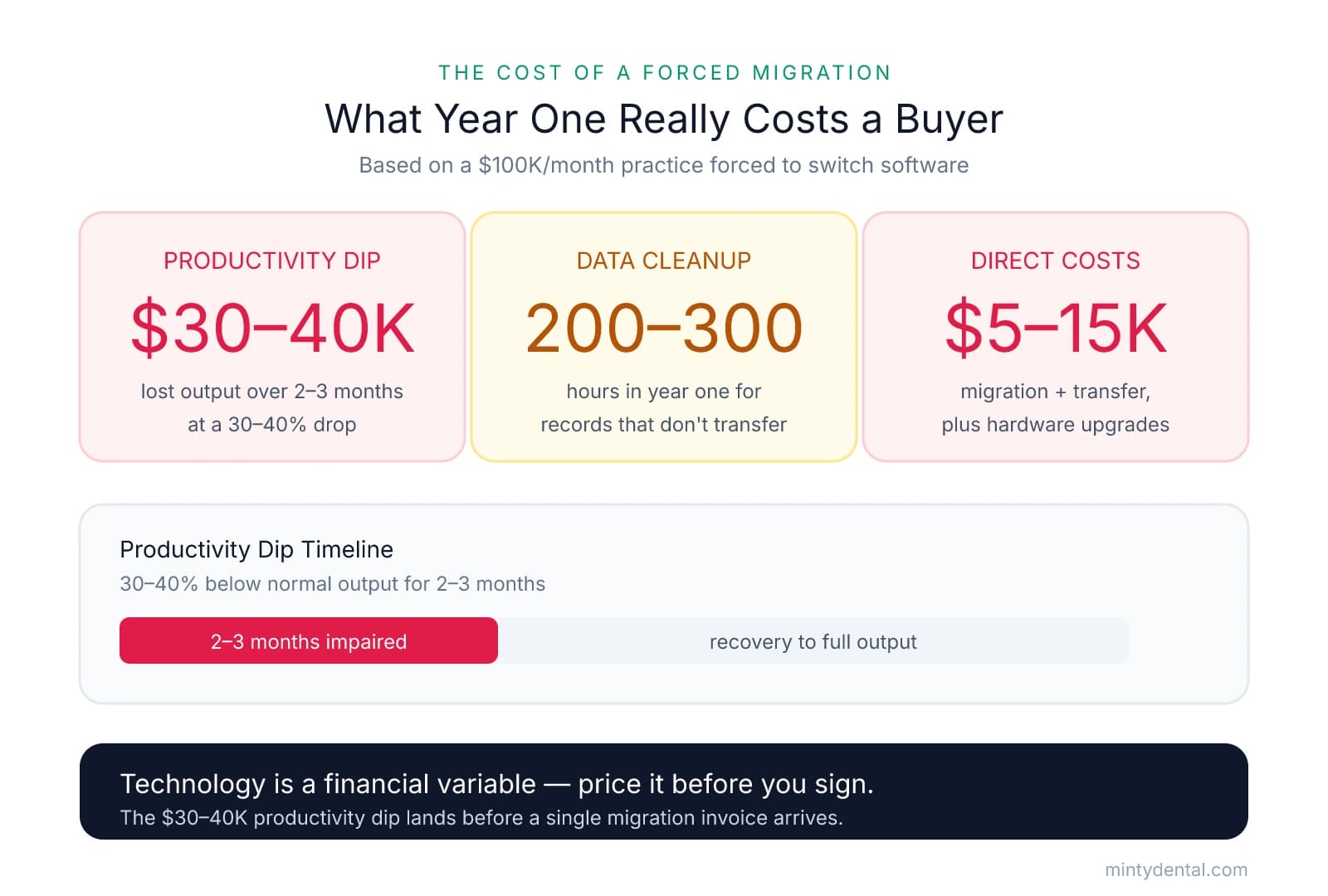
As detailed in Minty's software conversion guide, buyers should plan for:
- A 30–40% productivity drop for 2–3 months as staff rebuild workflows
- 200–300 hours of data cleanup in year one for records that don't transfer cleanly
- Direct costs of $5,000–$15,000 for migration and data transfer, plus hardware upgrades if the existing server can't support the new platform
For a practice producing $100K/month, the productivity dip alone represents $30,000–$40,000 in lost output — before a single migration invoice arrives.
The HIPAA Angle You Inherit
A practice running on an unsupported operating system or without a current Security Risk Analysis isn't just operationally behind — it's a compliance liability that transfers to you on day one. Per Dental Economics, annual HIPAA risk assessments are a legal requirement, not a best practice — and many practices let them lapse.
Questions to Ask During the Practice Visit
- What PMS are you running, and what version?
- What hardware does it run on, and how old is the server?
- What operating system is the server running?
- What imaging software is integrated, and how does it bridge to the PMS?
- Can you show me a sample patient record with full clinical notes, images, and an active treatment plan?
- When was your last HIPAA Security Risk Analysis completed?
The answers won't tell you whether to walk away — but they'll tell you exactly what you're buying into.
Auditing Clinical Technology: What to Inspect, What to Price In
Where software due diligence is largely a documentation exercise, auditing clinical technology requires you to physically walk the practice with a structured inspection mindset. The goal isn't to form a general impression — it's to leave with a categorized list of every major piece of equipment, its approximate age and condition, and a preliminary sense of what it will cost to maintain, upgrade, or replace.
The Book Value Problem
Start with a number worth distrusting: the equipment value on the seller's tax return. Most dental equipment depreciates under a 7-year MACRS schedule, which is a tax tool, not a valuation tool. As DentalAssetIQ explains, book value and fair market value move in opposite directions more often than buyers expect. A 6-year-old panoramic unit from a manufacturer that has released two product generations since purchase may be worth significantly less than book value because the secondary market has moved on — while a well-maintained sterilizer your books show as fully depreciated might still carry real resale value.
For any practice where equipment represents a meaningful portion of the asking price, an independent equipment appraisal gives you a defensible number to bring to the negotiating table — and often pays for itself in the adjustment it supports.
What to Inspect in Each Category
Digital imaging is typically the highest-value equipment category. For every intraoral sensor, panoramic unit, and CBCT, ask for the age, manufacturer, model, and service history. Sensor technology has advanced quickly — older sensors may produce diagnostically acceptable images but lack the resolution and software integration that newer systems offer. A CBCT unit purchased seven or more years ago may also carry higher radiation dose profiles than current models, which matters for patient communication and regulatory positioning.
Intraoral scanners and CAD/CAM systems deserve extra scrutiny around actual utilization. A pattern worth watching is the gap between what a seller lists as an asset and what they're actually using productively. A CAD/CAM unit that's been largely idle — or tied to a proprietary material ecosystem your preferred lab doesn't support — isn't worth its stated value. Confirm whether the scanner's output format is compatible with your intended lab workflow before assigning it any value at all.
Chairs, delivery units, and operatory equipment have long useful lives — often 15–20 years — but maintenance costs compound as they age. Request service records for each chair and ask when the last major service was performed. A chair that's 12 years old but well-maintained is a different situation than one running without documented service. These records also signal how the seller managed the practice operationally, which carries its own due diligence value.
The Three-Bucket Framework
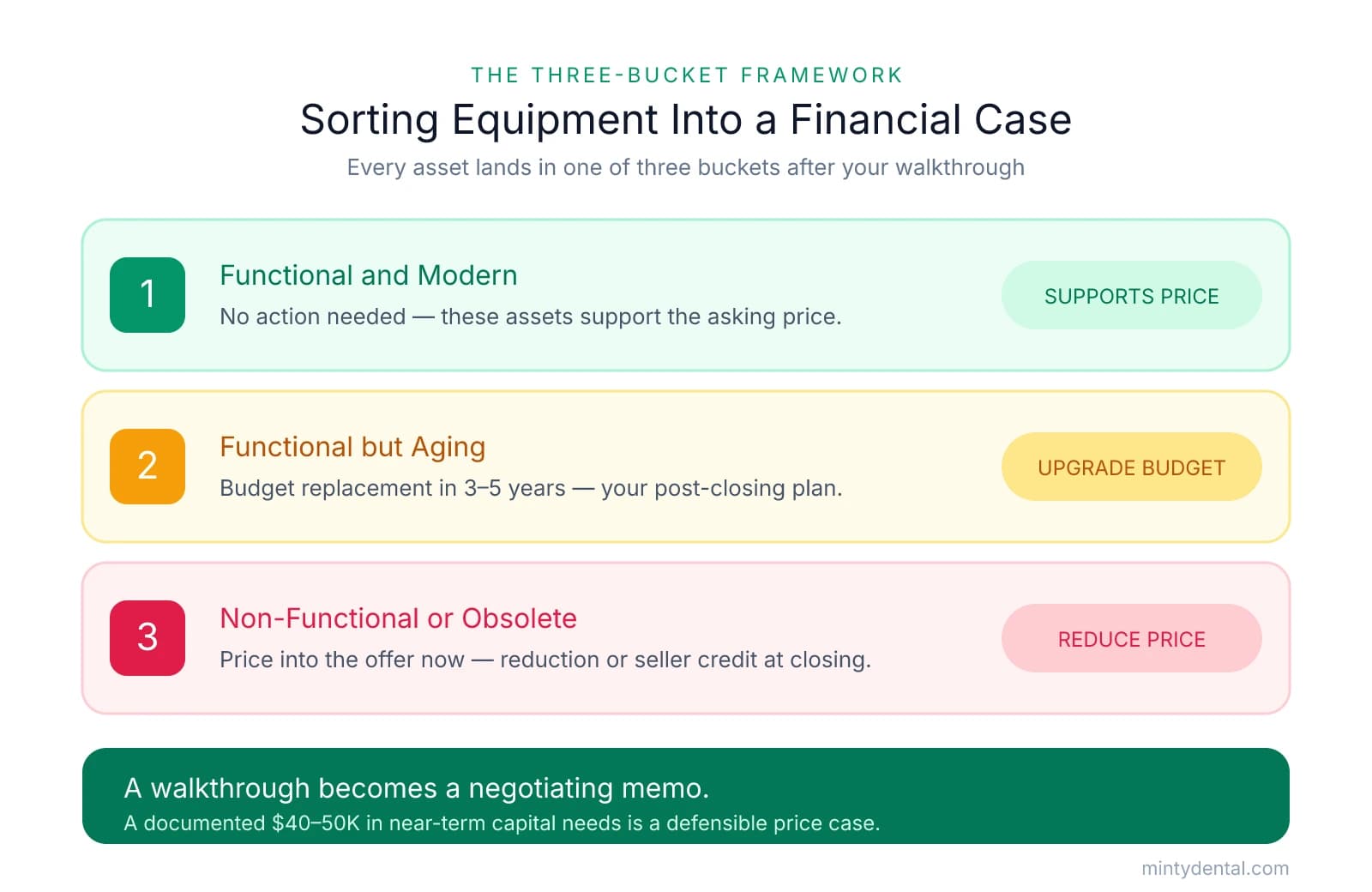
After your walkthrough, sort every piece of equipment into one of three categories:
- Functional and modern — No action needed. These assets support the asking price.
- Functional but aging — Budget for replacement within 3–5 years. These belong in your post-closing upgrade plan, not in the seller's favor column.
- Non-functional or obsolete — Price these into the offer now, either as a purchase price reduction or a seller credit at closing.
One additional check before closing: verify whether any equipment carries an outstanding UCC lien. Financed equipment that hasn't been paid off can complicate the asset transfer in ways that aren't always visible from the purchase agreement alone.
The three-bucket exercise transforms a physical walkthrough into a financial document — one that either validates the asking price or gives you a structured, evidence-based case for adjusting it.
Turning Your Tech Assessment Into a Pre-Offer Action Plan
Everything covered above — the PMS audit, the equipment walkthrough, the three-bucket framework — is only useful if you act on it at the right moment. Timing is the variable most buyers underestimate.
The tech assessment belongs during your initial practice visit, before you sign an LOI. Once a letter of intent is executed, the dynamic shifts. The seller has no legal obligation to walk you through system configurations, pull historical data, or explain why the server is running an end-of-life OS. Buyers who treat technology as a post-LOI concern don't just lose information — they lose leverage.
Turning Findings Into Negotiating Tools
A documented technology gap is worth more than a general sense that the price is too high. Sellers and their brokers are trained to deflect vague pushback. What's harder to dismiss is a line-item analysis: $12,000 in estimated migration costs, $8,000 in staff overtime during the productivity dip, $22,000 to replace a panoramic unit within two years. When you can show a seller a structured estimate totaling $40,000–$50,000 in near-term capital requirements, you have a concrete, defensible basis for a price reduction or seller credit — not a negotiating posture, but a documented case.
This is where the equipment walkthrough and software audit pay off directly. The three-bucket framework isn't just an organizational tool — it's the foundation of a negotiating memo.
When the Picture Is Still Unclear
If the technology situation feels murky after your visit — legacy systems you don't recognize, configurations the seller can't explain, imaging infrastructure that doesn't add up — a dental-specific IT consultant can complete a half-day assessment for roughly $500–$1,500. That cost is trivial relative to discovering a server failure or a HIPAA compliance gap after closing. Confirm what each system actually does before evaluating what it would cost to replace it.
One Structural Move Worth Discussing With Your CPA
How the deal is structured matters beyond the purchase price. The allocation between equipment and goodwill — the purchase price allocation — determines how quickly you can depreciate what you're buying. A higher allocation to equipment lets you accelerate deductions in year one, which can meaningfully affect first-year cash flow. If you've documented significant equipment value through your audit, that documentation supports a favorable allocation argument. It's worth a conversation with a dental CPA before the deal closes, not after.
A Final Reframe
A practice with aging technology isn't a bad practice. In many cases, it's a practice run by a dentist who invested in patients and staff rather than equipment — and those fundamentals often hold. The technology gap is real, but it's also priceable, plannable, and often an opportunity to modernize on your own terms, with your own systems, from day one. The buyers who do this well aren't the ones who avoided practices with tech gaps — they're the ones who knew exactly what those gaps were worth before they made an offer.
Sources & References
The data and claims in this article are drawn from the following sources. We prioritize government data, peer-reviewed research, and established industry publications to ensure accuracy.
- Hospitals dominate digital dentistry adoption globally, while clinics drive ...— www.oralhealthgroup.comIndustry
- Dental Practice Management Software Switching Cost (2026): The ...— dentalpracticeinsider.orgIndustry
- Is your practice IT-healthy? A security and compliance checklist for 2026— www.dentaleconomics.comIndustry
- Dental Equipment Depreciation Guide: Tax Benefits & Planning— privatedentalalliance.comIndustry
- How Much Is Dental Equipment Worth? (It's Not Book Value)— dentalassetiq.com
- What Your Practice Should Check Before Buying New Dental Tech— www.linkedin.com
Ready to evaluate your next practice?
Technology assessment is just one piece of practice acquisition. Minty's buying experts guide you through comprehensive due diligence—from clinical systems to financial operations—ensuring you make a confident investment.