How to Talk to a DSO Without Committing to Sell

Co-Founder, Minty Dental
In Summary
- DSO outreach is now routine for owners of successful practices, driven by dedicated business development teams whose job is to identify and approach acquisition targets, regardless of whether you plan to sell.
- Private practice ownership among dentists fell from 84.7% in 2005 to 72.5% in 2023, reflecting the scale of DSO consolidation.
- An exploratory conversation has real informational value: owners can benchmark market value, learn how DSOs calculate EBITDA multiples, and see what post-sale employment actually looks like, all without committing to anything.
- The goal of an early conversation is to gather information, not to negotiate, and that framing changes how you prepare and what you say.
- Engaging carefully differs from engaging naively, and the difference comes down to setting the terms of the conversation from the start.
An Exploratory DSO Conversation Is a Tool You Control, Not a Process They Run
Talking to a DSO is not the same as agreeing to sell, but the two can blur quickly if owners do not set the terms of the conversation from the start. Owners who treat early outreach as a pure information-gathering exercise tend to hold a stronger position than those who treat the first phone call as the opening move in a transaction.
DSO outreach has become routine. If you own a profitable practice, you have likely received direct mail, email, and cold calls from acquirers. Most established DSOs have built dedicated business development teams focused exclusively on pursuing acquisition opportunities, and many also pay referral fees to dentists who introduce colleagues. As a result, most owners will receive this outreach whether or not they are considering a sale.
The volume reflects a broader shift in ownership. The share of dentists in private practice fell from 84.7% in 2005 to 72.5% in 2023, a change driven in part by DSO consolidation. Acquirers have a steady interest in adding practices, which is why the calls keep coming.
An exploratory conversation, handled well, can be genuinely useful. Owners can benchmark where their practice might fall in the current market, learn how DSOs calculate EBITDA and apply valuation multiples, and hear what a post-sale work environment involves, including compensation structure, clinical autonomy, and expected hours. Understanding these criteria is also useful for owners focused on building practice value over the next several years, regardless of any sale timeline.
The distinction that shapes everything else is purpose. In an early conversation, your objective is to gather information, not to negotiate. That framing changes how you prepare, what you disclose, and how you respond to questions.
What to Read Before You Reply: NDAs, Exclusivity, and the Documents That Bind
Before responding to any DSO approach, the most useful first step is identifying what you actually received. DSO outreach typically escalates through three distinct instruments, and owners who treat them as interchangeable can trigger obligations they did not intend to accept.
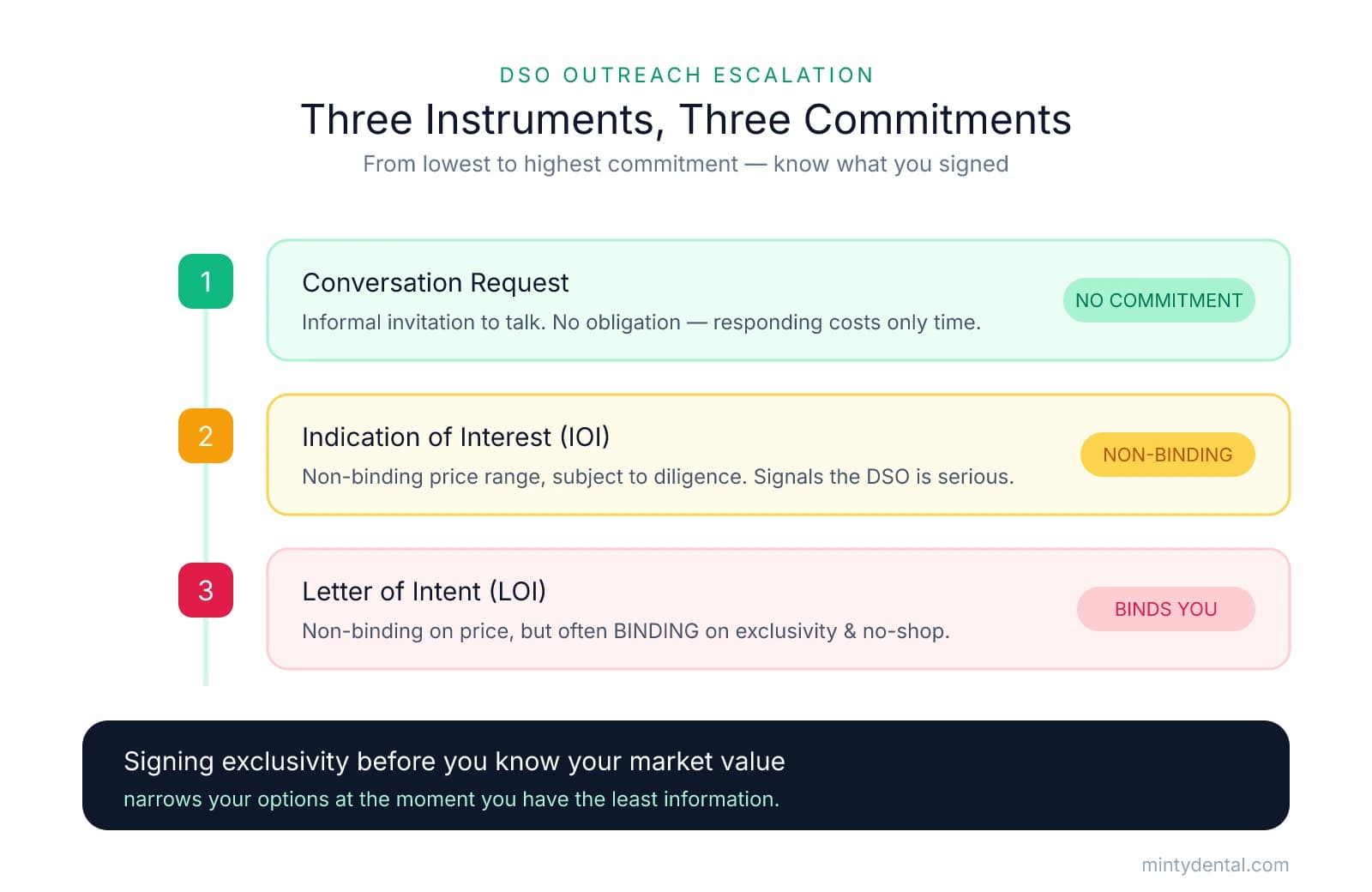
The three instruments, from lowest to highest commitment:
- Conversation request: An invitation to talk, usually informal. It carries no obligation, and responding costs you nothing beyond the time.
- Indication of interest (IOI): A preliminary, non-binding signal of a possible price range, often subject to diligence. It commits neither side but signals the DSO is serious.
- Letter of intent (LOI): A more detailed document that sets out key terms and signals willingness to negotiate exclusively for a set period. The LOI is typically non-binding on price but often binding on exclusivity and process.
Owners sometimes assume an LOI is safe to sign because the price is non-binding, without noticing that the exclusivity and no-shop provisions usually are binding. Signing exclusivity before you know your practice's market value narrows your options at the moment you have the least information.
The NDA deserves specific attention. A confidentiality agreement is standard and reasonable, because it protects the financials, patient lists, and staff information a buyer needs to evaluate the practice. However, some NDAs also carry no-shop, non-solicit, or standstill language that has nothing to do with confidentiality. These clauses can end your ability to explore other buyers for a defined period, effectively closing the auction before it opens.
Before signing any document, it helps to check for five things: an exclusivity or no-shop clause, a standstill provision, a non-solicit of your own staff, the duration of any restriction, and whether the confidentiality obligation runs in both directions.
What you can share safely also depends on the stage. Before a clean NDA is in place, general practice characteristics carry little risk: your specialty, geography, and approximate size. Detailed financials, patient counts, staff details, and fee schedules should wait until confidentiality is established.
Having a dental-specific attorney review any document before you sign is worthwhile because DSO transaction documents contain healthcare-specific provisions, including corporate practice of dentistry rules and management services agreement (MSA) structures, that a general business attorney may not recognize. The review cost is small relative to the terms these documents can lock in.
Questions That Reveal Whether a DSO Is Worth Taking Seriously
Once confidentiality is settled and you are ready to talk substance, a prepared set of questions lets you gather meaningful information without disclosing sensitive data or signaling readiness to sell. The questions fall into three categories: how the DSO pays, how it runs a practice after close, and what its track record looks like. Good groups treat these as ordinary diligence, so evasiveness at this stage is itself informative.
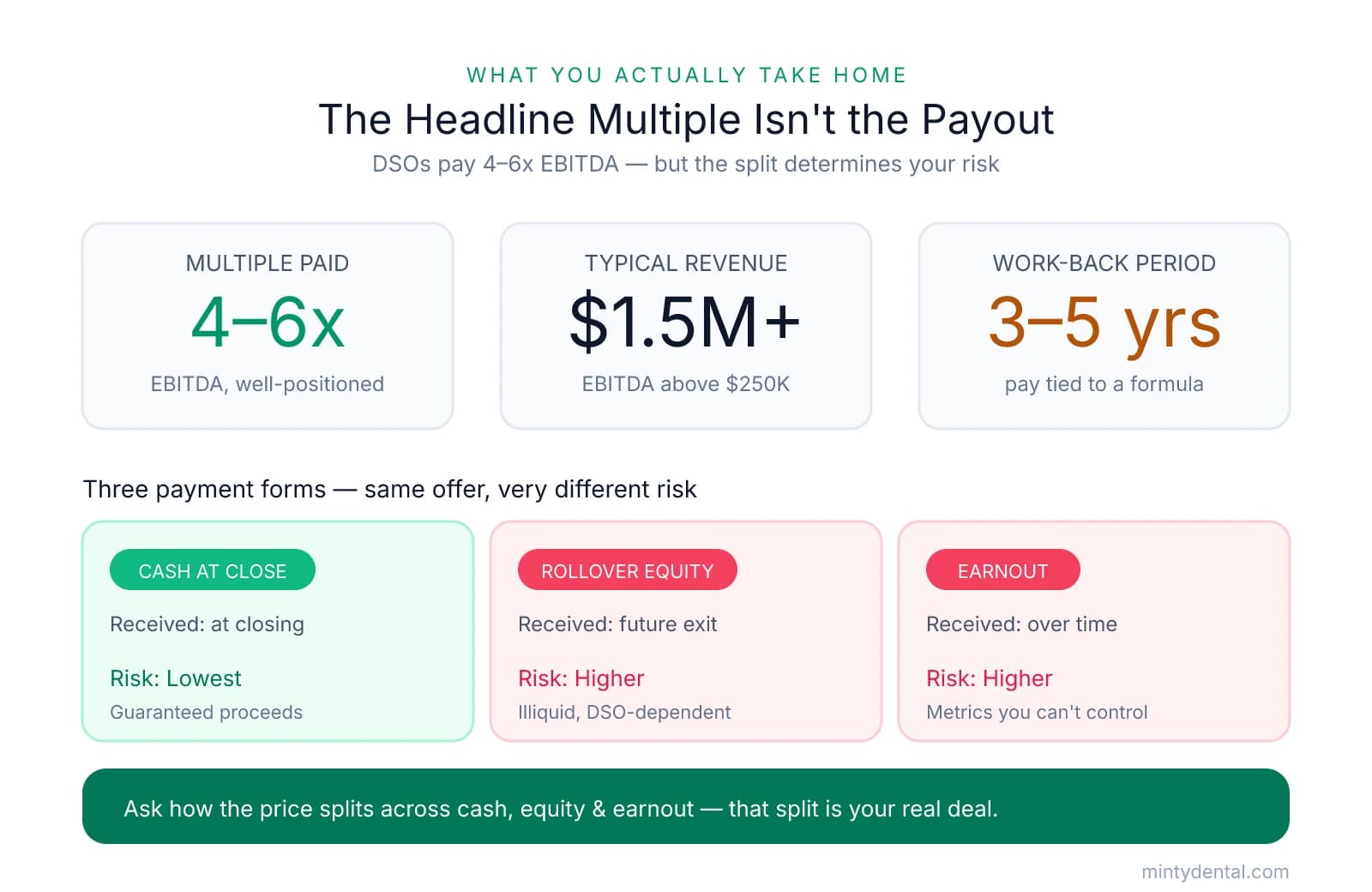
Financial structure questions matter most because the headline multiple does not describe what you receive. DSOs have been paying roughly 4 to 6x EBITDA for well-positioned practices, typically those with revenue above $1.5M and EBITDA above $250K. That number says little on its own. What you actually take home depends on how the purchase price is split, how long you are required to keep working, and how you are paid after close. Useful questions include:
- What percentage of the purchase price is cash at close versus rollover equity versus earnout?
- What EBITDA multiple is your group currently paying, and how do you calculate EBITDA?
- How is the management fee calculated after close, and how does it affect my take-home compensation?
- What is the required work-back period, and how is my post-close pay formula structured?
The three payment forms carry different risk profiles:
| Component | When you receive it | Risk to owner |
|---|---|---|
| Cash at close | At closing | Lowest; guaranteed proceeds |
| Rollover equity | At a future platform exit that may or may not occur | Higher; illiquid and dependent on the DSO's performance |
| Earnout | Over time, tied to performance targets | Higher; depends on metrics you may not fully control |
A work-back period of 3 to 5 years is common, and because post-close pay is usually a formula tied to production or collections, operational decisions you no longer control can move your paycheck.
Operational autonomy questions test what "clinical autonomy" actually means. Every group says clinical decisions stay with the dentist, so the more revealing questions concern operations. Ask who controls materials selection, lab relationships, the supply formulary, schedule templates, staffing decisions, and case-acceptance targets. Those operational controls can change daily practice life, and the answers vary significantly between groups.
Cultural fit questions reveal the track record diligence calls cannot. Ask for references from dentists who sold to the group two or more years ago, the staff retention rate in acquired practices, and how the management services agreement handles disputes over operational changes. Speaking with a selling dentist who is no longer the buyer tends to surface information no sales conversation will.
How to Use the Conversation — Whether You Decide to Sell or Not
An exploratory conversation can end in three ways.
Outcome one: you confirm you are not ready or interested. The conversation still produced benchmarking data. You now have a rough sense of how a buyer values your practice and which operational metrics, such as production per provider and overhead ratio, most affect that number. That information tells you where operational improvements would raise your position if you revisit a sale in a few years.
Outcome two: you find genuine interest in exploring a sale. At this point the preparation shifts from listening to negotiating. Two steps tend to matter most:
- Know your adjusted EBITDA before any substantive negotiation. Adjusted EBITDA is earnings before interest, taxes, depreciation, and amortization, recalculated to add back owner compensation, personal expenses, and one-time costs. This is the metric DSOs use to set offer price, so calculating it yourself lets you judge whether a headline multiple is actually attractive. Owners focused on improving that figure can review specific levers that raise practice value before a sale.
- Create competitive tension among multiple buyers. DSO buyers tend to pay materially more when they are put in a competitive situation with an experienced sell-side advisor negotiating, and responding to a single unsolicited offer without shopping the practice typically results in a lower valuation. A sell-side advisor or dental-specific M&A attorney can run a process that surfaces several offers, which improves both pricing and your ability to compare post-sale operational terms side by side.
Outcome three: the conversation surfaces red flags. Evasive answers on EBITDA calculation, poor staff retention in acquired practices, or restrictive early documents tell you this particular buyer is a poor fit. Because you disclosed only general practice characteristics at this stage, you protected sensitive financials and patient data while learning what you needed.
Across all three outcomes, the conversation is most useful when you enter it with your own goals defined: your timeline to exit, the post-sale role you want, your income expectations, and your non-negotiables around staff and clinical autonomy. If a sale becomes plausible, modeling what post-sale debt service or reinvestment might look like with a practice loan calculator helps you evaluate proceeds against your actual financial needs.
Sources & References
The data and claims in this article are drawn from the following sources. We prioritize government data, peer-reviewed research, and established industry publications to ensure accuracy.
- Top 5 Mistakes Dentists Make When Selling to a DSO— swspd.orgIndustry
- HIPAA 20 Questions | American Dental Association— ada.orgIndustry
- The Four-Phase DSO Transaction Process: What to Expect When ...— mblawfirm.comIndustry
- Unsolicited DSO Offer? The First 5 Things to Do in 2026— transitionselite.comIndustry
- Should You Sell Your Dental Practice to a DSO?— practicetransitionsgroup.comIndustry
- Questions to Ask Before Selling Your Practice to a DSO - Transitions Elite— transitionselite.comIndustry
Ready to explore ownership options on your terms?
Whether you're curious about DSO partnerships or prefer to remain independent, understanding all paths forward helps you make the best decision for your practice. Minty connects dentists with opportunities aligned to their goals, from acquisition guidance to operational support.