Adding a Dental Operatory: Cost, ROI, and When It's Worth It

Co-Founder, Minty Dental
In Summary
- The standard planning benchmark is 2 treatment rooms per full-time doctor plus 1 per full-time hygienist, with a flex room for emergencies or visiting specialists.
- A genuine physical constraint shows up as a schedule booked 3 or more weeks out, patients being turned away, or two providers competing for the same room.
- Operatory utilization (hours a room is in active clinical use divided by available hours) is the most direct measure; rooms running below 75 to 80 percent rarely justify expansion.
- Roughly 30 percent of dentists report being capacity-constrained, while about a third say they could treat more patients, so "feeling busy" can mean very different things.
- Scheduling optimization, block scheduling, and better case acceptance often unlock meaningful production from existing rooms before construction is needed.
Confirm the Constraint Before Committing to Construction
Adding an operatory pays off when a practice has a confirmed physical capacity limit, not simply a persistent feeling of being busy. Construction costs and weeks of clinical disruption are hard to justify if the bottleneck turns out to be the schedule template, the provider's available hours, or the rate at which presented treatment converts to booked appointments.
Start with the standard planning benchmark: 2 treatment rooms per full-time doctor and 1 per full-time hygienist, plus a flexible room for emergencies or a visiting specialist. Compare your current room count against that ratio. A practice already below the benchmark and running at high volume has a stronger case than one that meets the ratio but still feels overwhelmed.
Next, measure operatory utilization. Divide the hours each room is in active clinical use by the total hours it is available. Rooms consistently running below 75 to 80 percent utilization usually have room to absorb more production without any construction, because the constraint is how the time is filled rather than the number of rooms.
In Q4 2025, 18 percent of dentists reported treating all patients but feeling overworked, and another 12 percent said they were too busy to treat everyone requesting care. That leaves a substantial share with available capacity, which is why "busyness" alone is an unreliable signal.
Use these signals to distinguish a true constraint from an inefficiency:
| True capacity constraint | Scheduling or conversion problem |
|---|---|
| Booked out 3+ weeks consistently | Open blocks scattered through the week |
| New patients turned away or referred out | New patients accepted but not scheduled promptly |
| Two providers competing for one room | Rooms sitting idle during peak hours |
| High production per hour, no gaps | Low production per hour or weak case acceptance |
If the right column describes your practice, block scheduling and improved case acceptance often recover meaningful production first. If the left column fits, the constraint is likely real, and the next question is whether the room or a provider's time is the limiting factor.
What Adding One Operatory Actually Costs in 2026
Adding a room to an occupied practice is a renovation within a working clinical space, so its cost profile differs from a ground-up build. Because the shell already exists and the mechanical systems are partly in place, the per-square-foot cost usually falls at the lower end of the range, but disruption and coordination costs rise. Three buckets drive the total: construction and buildout, equipment, and soft costs plus contingency.
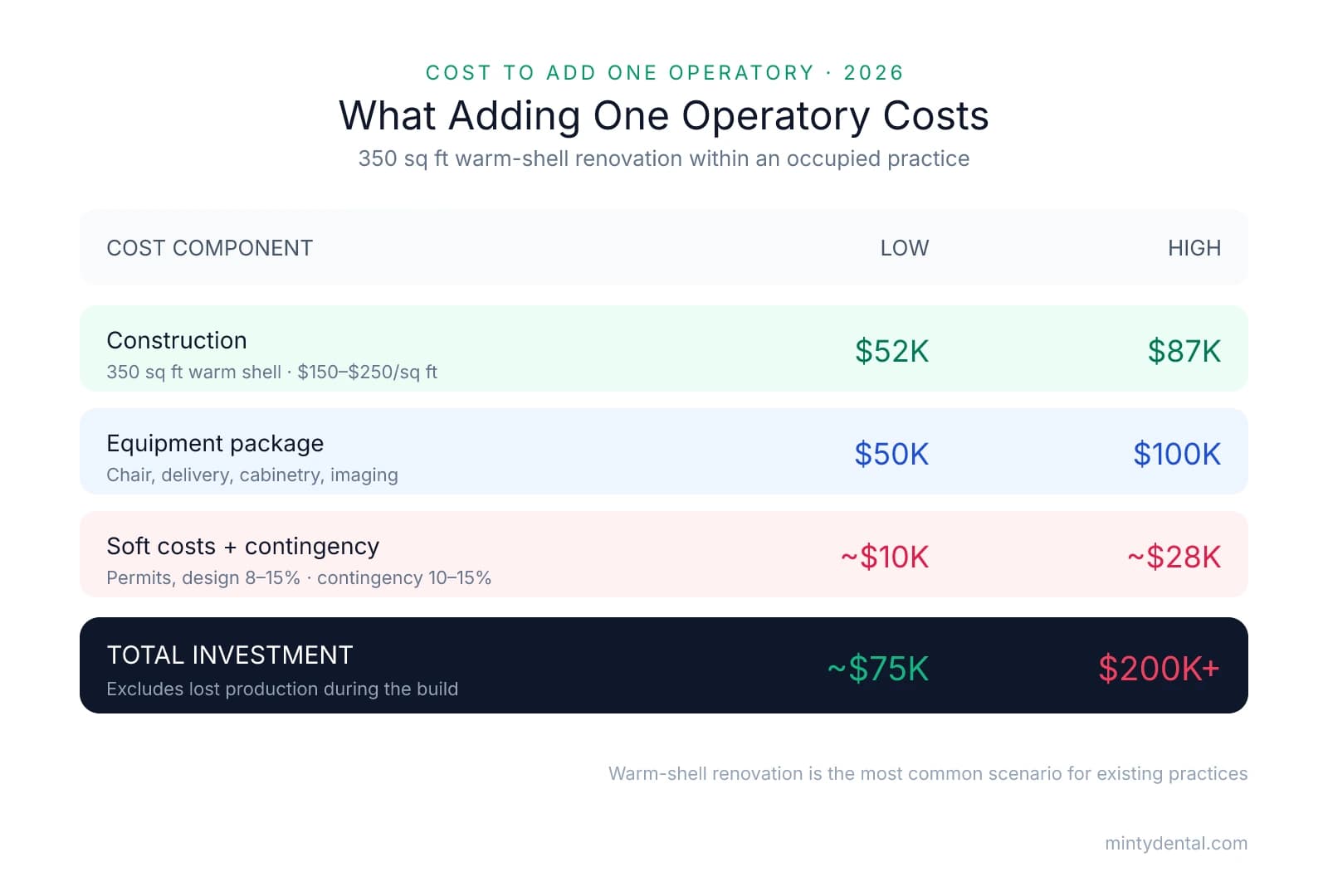
Construction and buildout. Dental office construction runs $150 to $450+ per square foot depending on shell type, and each operatory requires 300 to 500 gross square feet once you allocate hallway and support space. A warm-shell renovation, the most common scenario for an existing practice, typically lands at $150 to $250 per square foot. A 350 square foot operatory addition therefore runs roughly $52,000 to $87,000 in construction before any equipment. Dental offices are among the most plumbing-intensive commercial building types per square foot, because every operatory needs dedicated water supply, drain, air, and suction lines. That complexity is why a dental-specific contractor tends to produce fewer budget surprises than a general commercial contractor.
Equipment. Equipment runs $25,000 to $100,000+ per operatory. A complete package (chair, delivery unit, cabinetry, and digital radiography) generally adds $50,000 to $100,000 on top of construction, with the range driven largely by whether you add imaging such as a sensor versus a CBCT.
Soft costs and contingency. Permits, design fees, and construction documents typically add 8 to 15 percent, and a 10 to 15 percent contingency is standard given the plumbing and coordination involved.
| Cost component | Low | High |
|---|---|---|
| Construction (350 sq ft warm shell) | $52,000 | $87,000 |
| Equipment package | $50,000 | $100,000 |
| Soft costs + contingency | ~$10,000 | ~$28,000 |
| Total | ~$75,000 | ~$200,000+ |
Several costs sit outside the construction estimate and are easy to underestimate. Lost production during construction is real even on phased projects, because dust control, noise, and shut-off windows reduce available chair time. A larger footprint may trigger a lease renegotiation if square footage increases. Filling the new chair also requires a qualified assistant and provider hours, which adds ongoing payroll that shows up in overhead well before the room reaches full utilization.
How to Calculate Whether the Revenue Justifies the Investment
Before running expansion math, confirm that the existing rooms are already productive. High-performing practices generate more than $300,000 in production per operatory per year, and a widely cited planning range puts the target at roughly $250,000 to $300,000 per room. If a current operatory is producing well below that threshold, the limiting factor is production efficiency rather than room count, and adding a room simply spreads the same volume across more overhead.
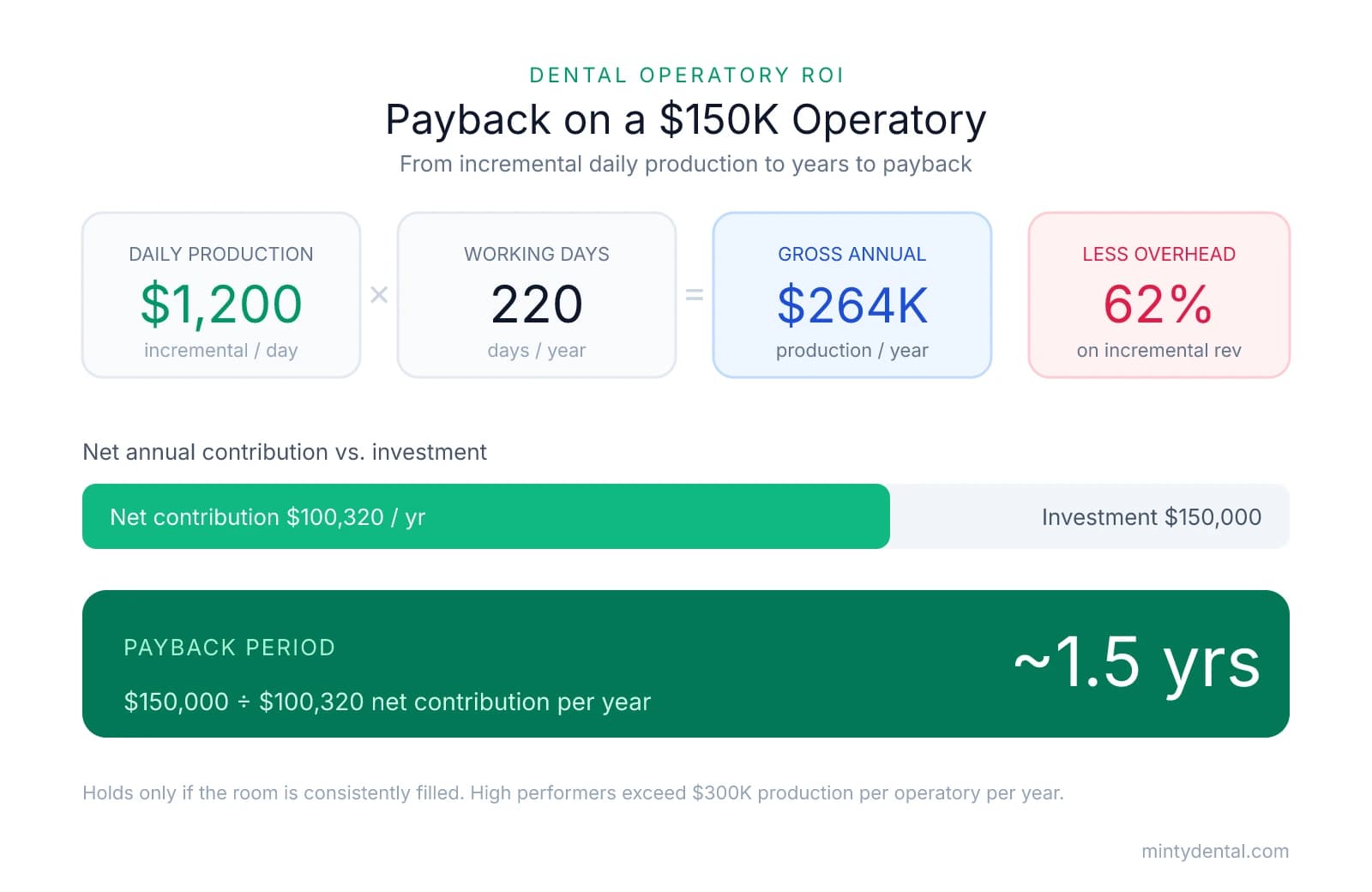
- Estimate realistic incremental daily production. Base this on the actual procedure mix and provider hours that will fill the new room, not the practice average. A room used for hygiene recall produces very differently than one used for restorative work.
- Annualize it. Multiply daily production by working days per year (often 210 to 230).
- Subtract overhead on the incremental revenue. Use your practice's real overhead percentage, which for many general practices runs 60 to 65 percent, rather than an industry average.
- Divide the total investment by the annual net contribution. The result is the payback period in years.
Here is the sequence applied to a $150,000 operatory addition:
| Step | Value |
|---|---|
| Incremental daily production | $1,200 |
| Working days per year | 220 |
| Gross incremental production | $264,000 |
| Overhead rate | 62% |
| Net annual contribution | $100,320 |
| Payback period ($150,000 ÷ $100,320) | ~1.5 years |
A payback near 18 months is generally attractive for a fixed asset a practice will use for years. The number shifts quickly with the inputs, so it helps to rerun it with a conservative production estimate and a higher overhead figure to see the downside case.
Section 179 can improve first-year cash flow. Practices can generally deduct the full cost of qualifying equipment purchases in the year they are placed in service, which reduces taxable income and shortens the effective payback on the equipment portion. The applicable limits and rules change year to year, so confirm current thresholds with your CPA before relying on the deduction.
The calculation only holds if the room is consistently filled. An empty operatory generates depreciation and overhead without offsetting production, which is why the decision often depends on whether you will add a provider, extend hours, or draw down a confirmed patient backlog. The tradeoff between a new room and a new provider is worth mapping deliberately, because adding an associate carries its own financial threshold.
Productive operatories also support practice value at sale. Because buyers and lenders view filled rooms as revenue-generating capacity, additional productive operatories can strengthen the case for a higher valuation.
Managing Construction Without Shutting Down Your Practice
Disruption is the second half of the "is it worth it" question. Most dental office renovations can be completed while the practice remains open when the project is carefully planned and managed by a contractor experienced with occupied healthcare environments. The core strategy is phased construction: the new room is built while the existing operatories continue treating patients, with work concentrated in a sealed section separated by dust barriers and negative-pressure containment.
- Phase the work so one section stays operational while the other is under construction.
- Schedule loud or disruptive tasks for evenings, early mornings, or weekends when patients are not in chairs.
- Set up a temporary operatory if an existing room must go offline, so provider hours are not lost entirely.
- Communicate with patients proactively, explaining what is being built, the expected timeline, and any scheduling changes before construction begins rather than after they notice the noise.
Plan for a realistic timeline based on the shell type. A warm-shell renovation adding one operatory typically takes 3 to 5 months from design to completion. A cold-shell buildout runs 4 to 6 months, and a ground-up project runs 8 to 14 months. Throughout the build, model a 10 to 30 percent production reduction depending on how many rooms are taken offline, and include that lost revenue in the total project cost so the payback figures from the previous section stay honest.
Closing entirely is rarely necessary and is more expensive than most owners realize. The costs stack up through lost revenue, staff payroll during downtime, a rescheduling backlog after reopening, and patients who find another provider during the gap. Keeping the practice open, even at reduced capacity, usually preserves more value than a clean shutdown.
Work through this pre-construction checklist before signing a contract:
- Confirm the lease permits modifications and defines who pays for improvements.
- Verify the contractor has dental-specific experience with plumbing, suction, and infection control requirements.
- Establish a patient communication plan before work starts.
- Model monthly cash flow through the build period, including reduced production.
If reduced capacity leaves open chair time once the room is complete, structured recall and scheduling systems help fill that time without discounting.
Sources & References
The data and claims in this article are drawn from the following sources. We prioritize government data, peer-reviewed research, and established industry publications to ensure accuracy.
- Calculating Your Ideal Dental Office - Integrated Design Studio— henryscheinintegrateddesignstudio.comIndustry
- Dental Practice Profitability: The Smart Way to Increase ROI - DENTALEZ— dentalez.comIndustry
- Average Cost to Build a Dental Office in the USA (2026)— terrapincg.comIndustry
- Average Dental Office Revenue: 2026 Data & Benchmarks - DentiMax— dentimax.comIndustry
- How to Renovate a Dental Office Without Closing Your Practice— www.squarefootconstruction.comIndustry
Ready to expand your practice capacity?
Adding an operatory is a major investment decision. Minty's operations team helps independent practices optimize their clinical and business infrastructure to maximize returns on expansion projects.