Is a Dental Practice's Active Patient Count Inflated?

Co-Founder, Minty Dental

In Summary
- An active patient, under the ADA's definition, is anyone who has received a dental service within the past 12 months (active) or within 12 to 24 months (patient of record); anyone beyond 24 months is inactive.
- Goodwill typically represents 70% to 85% of a dental practice's purchase price, and the active patient count is the primary number sellers use to justify that goodwill.
- A rough plausibility check: roughly 900 active patients per $500K in collections, or 1,600 to 1,800 for a full-time solo practice.
- Most practices never systematically archive inactive records, so a stated count of 3,000 patients on $500K in collections usually signals a database that has not been cleaned in years.
- The seller's number reflects whatever default window their software applied, so buyers should ask for the methodology, not just the output.
The Stated Patient Count Is a Starting Point, Not a Verified Fact
Active patient, defined: ADA policy defines an active dental patient of record as an individual who has received a dental service within the past 12 months, or within the past 24 months but not the past 12. Anyone who has gone more than 24 months without a service is considered inactive. That distinction matters because the definition a practice applies determines the count it reports.
The stakes are tied directly to how practices are priced. Most private dental practice sales fall between 65% and 85% of annual gross collections, and a large share of that price is goodwill rather than equipment or real estate. The active patient base is the primary input sellers and appraisers use to support the goodwill figure, because it stands in for recurring revenue and future demand. When the count is overstated, the goodwill built on top of it is overstated as well.
Overstatement is common, and it is often unintentional. Many practices never build a documented process for moving patients from active to inactive status, which the ADA specifically recommends. When no one archives inactive records, the database accumulates every patient the practice has ever seen. A seller reporting 3,000 active patients on $500K in collections is generally a signal that the list has not been cleaned in years, because the collections do not support that volume of genuinely recurring patients.
Two benchmarks help you test the number before requesting any data. A practice generating $500K in collections tends to carry roughly 900 active patients, and a full-time solo practice usually falls in the 1,600 to 1,800 range. These figures line up with the planning guideline that about 400 active patients support one doctor day per week. If the stated count sits well above what collections would predict, that gap is worth investigating rather than accepting.
The complication is that the seller's number reflects whatever query their practice management software ran by default, which may use an 18-month, 24-month, or even 36-month window. Two practices with identical patient activity can report very different counts depending on the cutoff. Before comparing the count to collections, or to the production and revenue figures on the P&L, ask which window the report used. Treating the stated figure as a hypothesis to test against independent data, rather than a settled fact, gives you a defensible basis for your offer.
Three Cross-Checks That Reveal the Real Patient Count
Use reports generated from the seller's practice management software during due diligence, then compare the three cross-checks. A plausible count should converge across methods; an inflated one tends to diverge sharply.
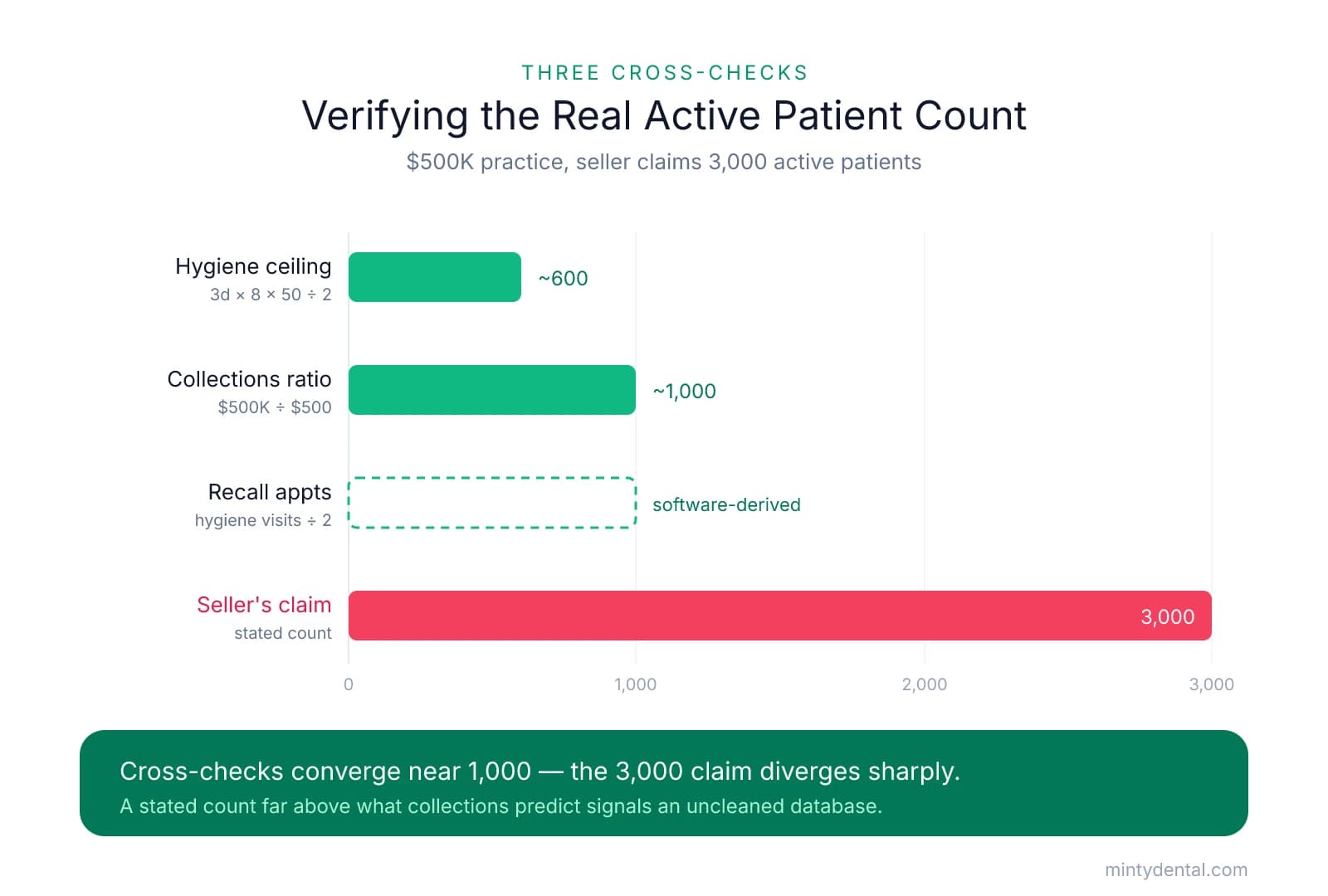
1. The hygiene capacity ceiling. A practice can only recall as many patients as its hygiene schedule physically allows. Multiply hygiene days per week by patients seen per day by 50 weeks, then divide by 2 to account for twice-yearly recall. A practice running 3 hygiene days per week at 8 patients per day supports at most about 600 active recall patients per hygiene column (3 × 8 × 50 ÷ 2). When a broker claims 2,400 active patients but the practice runs only three hygiene days per week, the numbers rarely reconcile. A stated count above this ceiling is not supportable given the existing infrastructure.
2. The collections-per-patient ratio. Divide annual collections by the stated active count. Active patients tend to generate roughly $450 to $500 in collections per year. A practice collecting $500K with a genuine active base should therefore report somewhere near 1,000 patients. If the seller claims 3,000, the implied ratio drops to about $167 per patient, which usually means the denominator is inflated rather than that each patient spends far below average.
3. The recall appointment count. Pull the total hygiene appointments completed in the past 12 months and divide by 2. Because most active patients return twice a year, dividing annual recall visits by two produces a direct, software-derived estimate of the active base. This is the hardest figure for a seller to dispute, since it comes straight from their own completed-appointment history.
To sharpen these estimates, request a "last visit date" report sorted chronologically. This shows the actual distribution of patient recency and lets you apply your own 18-month cutoff rather than accepting the software's default window.
| Method | Calculation | Estimate |
|---|---|---|
| Hygiene ceiling | 3 days × 8/day × 50 wks ÷ 2 | ~600 |
| Collections ratio | $500K ÷ $500 | ~1,000 |
| Recall appointments | Annual hygiene visits ÷ 2 | Software-derived |
If the three estimates cluster together and near the seller's figure, the count is plausible. If they land well below it, the gap needs a documented explanation, which a targeted chart audit can often provide, before you finalize an offer.
What an Inflated Count Actually Means for the Deal
A gap between the stated and verified count changes how you price the practice, but it does not automatically end the deal. The question that matters is whether the collections and cash flow are real and repeatable, regardless of how many names sit in the database. That answer separates two situations that look identical on a patient roster but point in opposite directions.
Scenario one: inflated count, legitimate collections. If your three cross-checks land near 1,000 active patients while the seller claims 3,000, but collections and per-patient revenue hold up, the practice is smaller than represented and more productive per patient than the headline number suggested. A base of 1,000 patients producing $500K collects roughly $500 each, which is a healthy, engaged patient base. In this case the inflated count is a database hygiene issue, and the underlying revenue is what you are buying.
Scenario two: inflated count, soft collections. If the verified count is low and collections per active patient also run below the $450 to $500 range, the practice is genuinely smaller than the price implies. Here the stated count was doing the work of justifying goodwill that the revenue does not support, and the price should reflect the verified base rather than the reported one.
The financial stakes are the same in both cases once you own the practice. A 20% patient loss after closing produces a 20% or greater revenue decline while fixed costs such as rent, staff salaries, and debt service stay constant. That risk compounds because the average practice loses about 17% of its patients annually through relocations, insurance changes, and natural attrition. A buyer who inherits an already-inflated count starts absorbing that attrition against a base that was overstated to begin with.
Match the negotiation response to the size of the verified-versus-stated gap:
- A price reduction that rebases goodwill on the verified active count instead of the reported one.
- A seller note tied to 12-month patient retention, so a portion of the price is contingent on the base holding.
- A shorter earnout period when retention risk is concentrated in the first year after transition.
Most sellers have not maintained their database rather than misrepresented it deliberately, which is worth keeping in mind when you open the pricing conversation after due diligence. The intent does not change the financial consequence, but it usually keeps the negotiation collaborative.
Putting the Patient Count in Context Before You Make an Offer
Use the gap between the stated and verified count this way:
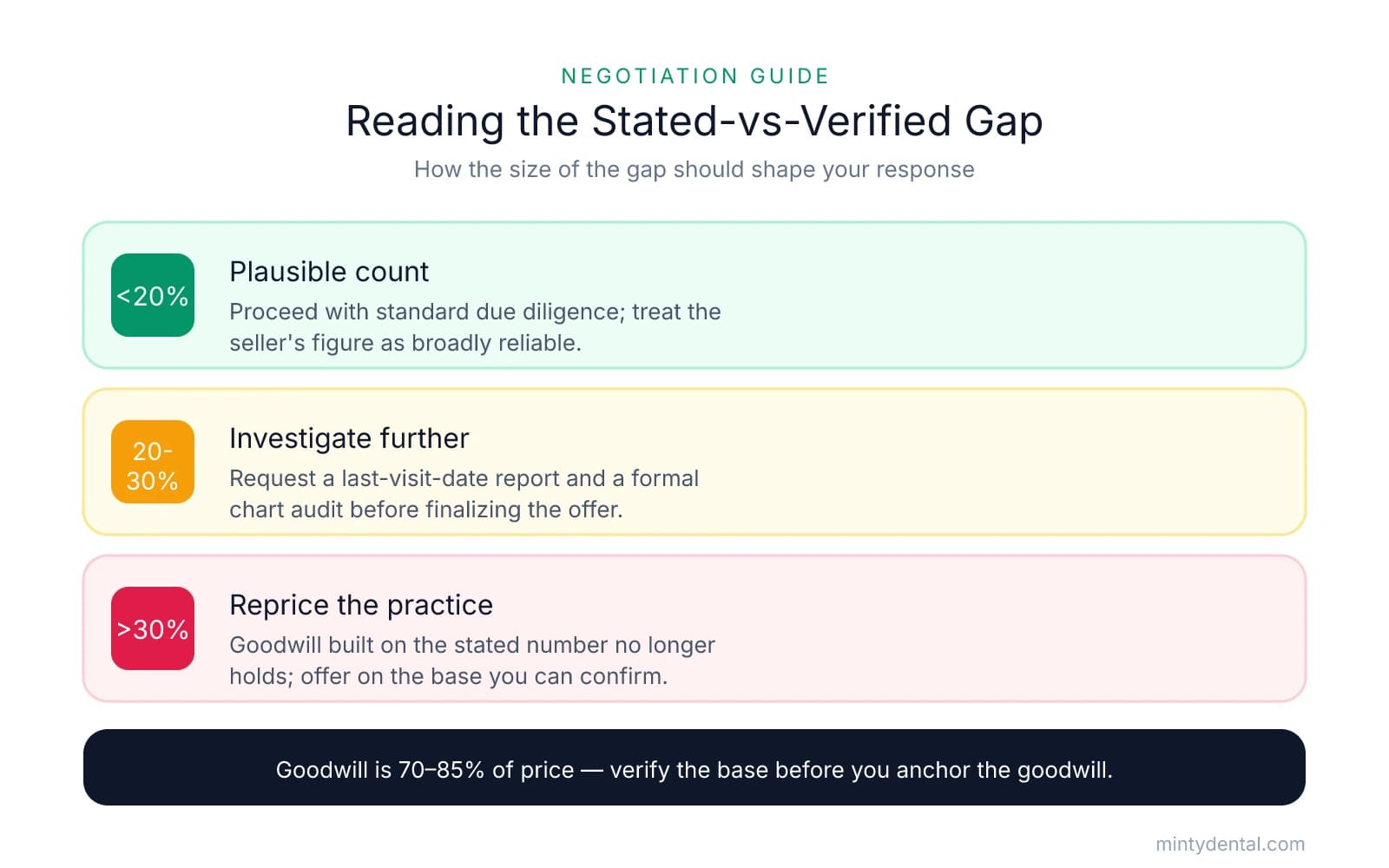
- Gap under 20%: The count is plausible. Proceed with standard due diligence and treat the seller's figure as broadly reliable.
- Gap of 20% to 30%: Request a last-visit-date report and a formal chart audit before finalizing the offer. This range is large enough to affect your revenue assumptions but small enough that a documented explanation may resolve it.
- Gap over 30%: Reprice the practice as if the verified count is the real count. A discrepancy this size means the goodwill built on the stated number no longer holds, and your offer should reflect the base you can actually confirm.
The patient count is one input among several, and it becomes far more useful when read alongside three other figures. Compare it against the hygiene recall compliance rate, the three-year new patient volume trend, and per-patient annual production. A practice with a smaller-than-stated base but strong recall compliance and steady new patient flow tells a different story than one where all three are declining together. Together these numbers describe the practice's revenue floor, which is what determines your financing math and your first-year projections.
The verified base also shapes an operational decision from day one. A buyer who inherits fewer active patients than expected will also inherit excess hygiene chair time, which affects staffing and scheduling immediately. That capacity question connects directly to the practice's hygiene department health, a related due diligence area worth examining on its own when you evaluate whether a rebuilt hygiene department can absorb new growth.
Treat the last-visit-date report as a standard due diligence document, requested alongside the P&L and the AR aging report, and make it part of the package before any offer is finalized. Patient count is foundational enough that evaluating it should come before nearly every other metric in the acquisition review.
Sources & References
The data and claims in this article are drawn from the following sources. We prioritize government data, peer-reviewed research, and established industry publications to ensure accuracy.
- Active vs Inactive Patients | American Dental Association— ada.orgIndustry
- Top Three Dental Practice Valuation Drivers - TransitionOne— transitionone.netIndustry
- Red Flags to Watch for When Buying a Dental Practice— engageadvisors.comIndustry
- Determining True Active Patients - OMNI Practice Group— omni-pg.comIndustry
- Dental Acquisition Due Diligence: Patient Retention Red— mybcat.comIndustry
- 29 Dental Patient Attrition Statistics to Know - Clerri— clerri.comIndustry
- Buying A Dental Practice: Focus On This First - YouTube— www.youtube.com
Verify patient counts before acquiring a practice
Understanding how to validate a practice's true patient base is crucial during acquisition due diligence. Minty's acquisition experts guide you through every step of evaluating practice metrics to ensure you're making an informed investment.