Expenses New Dental Practice Owners Don't Budget For

Co-Founder, Minty Dental

In Summary
- The seller's P&L reflects a mature, optimized practice — new owners typically face 5–10 percentage points more overhead in year one, not because of mismanagement, but because of structural transition costs
- According to the ADA Health Policy Institute, average dental practice overhead runs 60–65% of collections; new owners commonly land at 68–72% in year one
- A 7–8 percentage point overhead gap on a $900K practice translates to roughly $63,000–$72,000 less in take-home pay — a number worth building into your pre-closing budget
- The gap is temporary, but it's predictable — and the specific expense categories driving it are identifiable before you close
- This article names those categories with real dollar ranges so you can build a realistic 12-month budget before the ink dries
Year One Costs Are Structurally Higher Than the Seller's P&L Suggests
The seller's profit and loss statement is real — but it's not your P&L. It reflects years of operational efficiency: vendor relationships negotiated down over time, a credentialing file that insurance companies already recognize, a team that runs without hand-holding, and a patient base that shows up because they trust the person who built the practice. When you buy, you inherit the revenue potential. The efficiency that produced those margins takes longer to transfer.
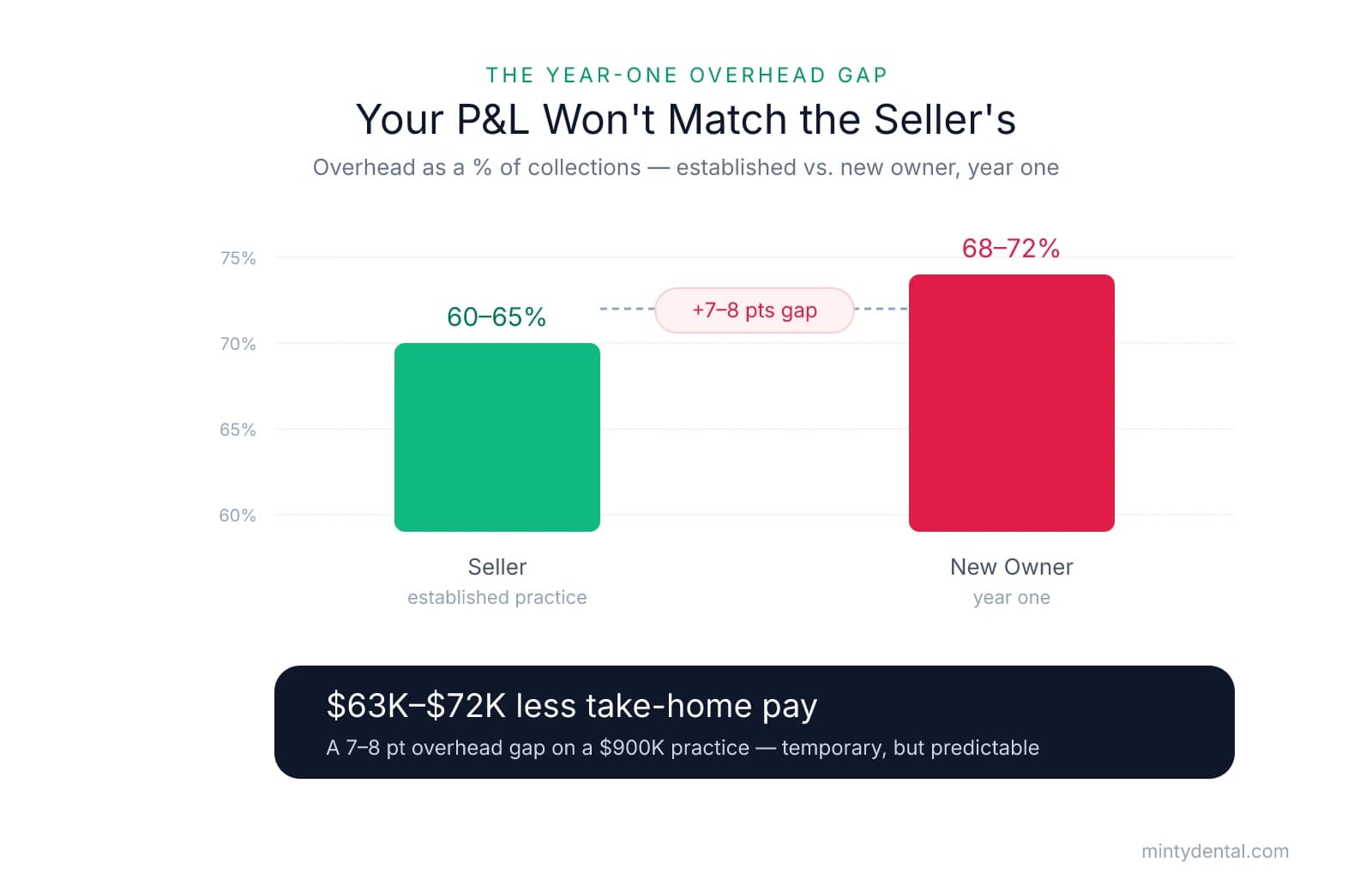
This gap is one of the most consequential things to understand before closing, and one of the least discussed. According to the ADA Health Policy Institute, average dental practice overhead runs 60–65% of collections for an established practice. New owners routinely land at 68–72% in year one — not because they're doing something wrong, but because the transition itself generates costs that don't appear anywhere in the seller's historical financials.
The math is worth sitting with. A 7–8 percentage point overhead difference on a $900K practice equals $63,000–$72,000 in reduced take-home pay for the year. That's not a rounding error — it's a car payment, a loan paydown, a year of retirement contributions. Many buyers focus on whether the practice can service the acquisition debt, which it usually can. What catches people off guard is the compression in personal income during the months they expected to feel like owners.
The overhead gap is structural, not a warning sign. It reflects a predictable cluster of transition costs — re-credentialing delays, vendor contract resets, team turnover and rehiring, deferred equipment issues that surface once you're responsible for them, and a marketing baseline that the seller never needed to spend. These costs fade as the practice stabilizes, typically by the end of year two. But in year one, they stack.
The goal of what follows is straightforward: name the specific expense categories where year-one costs run meaningfully higher than the seller's numbers, explain why each one tends to spike during transition, and give you real dollar ranges you can plug into a 12-month budget before you close. The seller's financials are your starting point — not your forecast.
The Three Costs That Hit Hardest in Months One Through Six
Most of that overhead gap doesn't arrive gradually — it front-loads. The first six months tend to absorb the sharpest hits, before the practice has had time to stabilize around your systems, your name, and your credentialing file. Three expense categories drive the majority of that early pressure.
| Cost Category | Typical Dollar Impact | When It Hits |
|---|---|---|
| Insurance credentialing gap | 2–3 months of reduced collections | Months 1–6 |
| Staff turnover (hygienist) | $47K–$100K+ in lost production + recruiting | Months 1–3 (highest risk) |
| Deferred equipment repairs | $10K–$30K first service cycle | Months 6–12 |
1. Insurance Credentialing: The Revenue Gap Nobody Warns You About
Credentialing is tied to the individual dentist at a specific location — not the practice entity, not the NPI, and not your existing in-network status elsewhere. Even if you were credentialed with Delta Dental or Cigna as an associate across town, you must re-credential at the new address with every carrier the practice participates with. That process typically takes 60 to 90 days, and sometimes stretches to 180 depending on carrier backlogs, paperwork completeness, and license verification timelines.
During that window, insured patients may be billed out-of-network — which creates both revenue loss and patient friction that's hard to recover from early in a transition. A reasonable approach is to budget for 2–3 months of reduced insurance collections and submit credentialing applications before closing if your attorney and the seller will allow it. The earlier you submit, the shorter the gap.
2. Staff Turnover: The Cost That Compounds
Ownership transitions are one of the most reliable triggers for staff departures, and the first 90 days carry the highest risk. A team member who was loyal to the seller may not extend that loyalty automatically — and if they leave, the cost is significant.
According to SHRM's benchmark data, replacing a salaried employee costs six to nine months of their annual salary. Applied to dental roles, that means replacing a hygienist can run $47,000–$100,000+ when lost production, recruiting, and training time are included. A front desk or assistant replacement typically runs $22,000–$34,000. Knowing how to evaluate the team before closing can help identify flight risks early — but even a well-prepared buyer should hold a contingency for at least one replacement in year one.
3. Deferred Equipment Maintenance: The Seller's Quiet Savings
A pattern worth paying attention to during due diligence: sellers often reduce discretionary spending in the 12–24 months before a sale, and equipment service is one of the first things to get deferred. The P&L may show minimal repair costs — not because the equipment is in great shape, but because nothing has failed yet.
New owners commonly face their first compressor service, chair repair, or sterilizer replacement within six to twelve months of closing. Requesting the full equipment service history as part of due diligence — and reviewing any vendor contracts you'll be inheriting for coverage gaps — can surface issues before they become surprises. Regardless of what the records show, building a $10,000–$20,000 equipment reserve into your year-one budget is a reasonable baseline.
None of these costs should change your decision to buy. But they should change your budget.
The Ongoing Costs That Run Higher Than the Seller's Numbers
Once the acute first-six-month costs settle, a second layer of pressure emerges — one that runs quietly elevated for the full first year. These aren't one-time hits. They're recurring expense categories where new owners structurally spend more than the seller did, for reasons that are entirely predictable once you understand the difference between a practice in maintenance mode and one in transition.
| Expense Category | Seller's Typical Spend | New Owner Year-One Spend |
|---|---|---|
| Marketing | 5–8% of collections | 10–20% of collections |
| Professional services (CPA, legal, consultant) | $5K–$10K/year | $15K–$30K/year |
| Working capital buffer | Sized for normalized ops | Needs 20–30% more headroom |
Marketing: The Seller Didn't Need to Spend — You Do
An established dentist with a 20-year patient base and a full schedule doesn't need to advertise aggressively. Their marketing spend reflects that reality: most mature practices run 4–7% of annual revenue on marketing, and some spend even less because referrals and reputation carry the load.
New owners start from a different position. Even retaining 80–90% of the patient base, you still need to introduce yourself, rebuild trust, and actively replace patients who leave. Spending 10–20% of collections on marketing in year one is typical for buyers who want to stabilize and grow. On a $1M practice, that's a $50,000–$100,000 gap relative to what the seller's P&L shows — and it's one of the most consistently underestimated line items in first-year budgets. Understanding what that first-year marketing spend actually covers can help you allocate it more strategically rather than simply spending more.
Professional Services: Year One Requires More of Everything
The seller's CPA bill reflects a practice that's been running the same entity structure for years. Yours won't. Entity formation, first-year tax planning, payroll setup, and owner compensation structuring all require significantly more professional time than ongoing maintenance accounting. Add employment agreements for key staff, vendor contract reviews, and potentially a practice management consultant to help optimize inherited systems — and the professional services line grows quickly.
A reasonable year-one budget for CPA, legal, and consulting combined runs $15,000–$30,000. That's not waste — it's the cost of building the infrastructure the seller already had in place.
Working Capital: Sized for the Seller's Reality, Not Yours
Most acquisition loans include a working capital component, but the amount is typically calculated against the seller's normalized operations. What tends to happen is that credentialing gaps, unexpected staff costs, and slower-than-projected collections in months two through four draw down that reserve faster than the model assumed — leaving buyers cash-constrained by month six.
The practical fix is to stress-test your working capital assumption against a scenario where collections run 15–20% below projection for the first 90 days. If that scenario drains your reserve, the buffer isn't sized for your transition — it's sized for theirs.
The benchmark worth building into your projections: plan for total first-year overhead to run 8–10 percentage points above the seller's historical overhead percentage. That gap isn't a red flag — it's the predictable cost of being new, and it belongs in your budget before you close.
Building a First-Year Budget That Actually Holds Up
The seller's P&L is the right place to start — but it's a baseline, not a forecast. The practical step is to take that P&L and layer five transition-year adjustments on top of it, each reflecting a cost category that runs structurally higher in year one than in the seller's historical numbers.
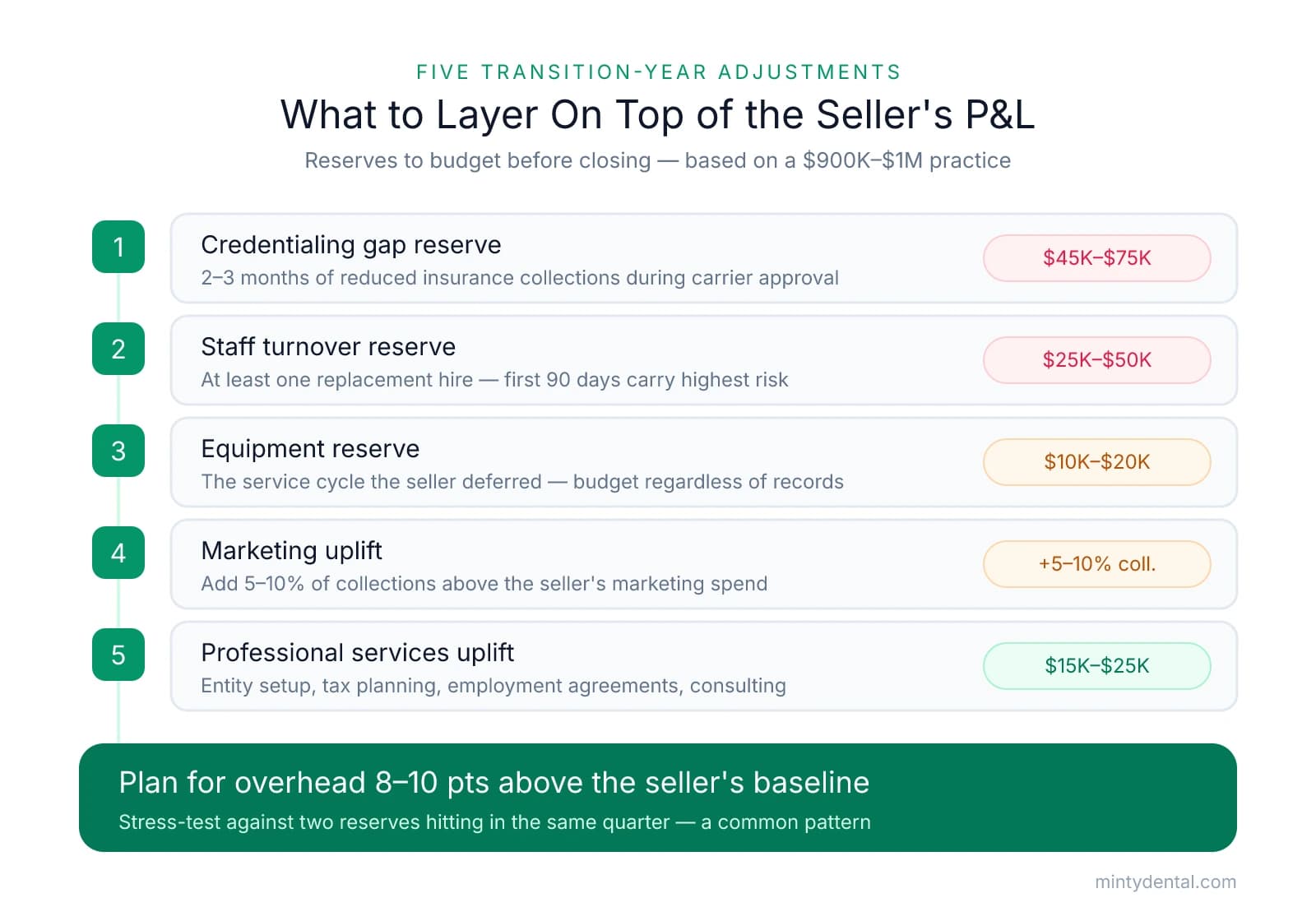
The five adjustments to add above the seller's baseline:
- Credentialing gap reserve — 2–3 months of reduced insurance collections while carrier approvals process. On a $900K practice, that can mean $45,000–$75,000 in deferred or reduced revenue during the window.
- Staff turnover reserve — $25,000–$50,000 set aside for at least one replacement hire, even if your team looks stable at closing. The first 90 days carry the highest flight risk.
- Equipment reserve — $10,000–$20,000 for the service cycle the seller deferred. Budget it regardless of what the service records show.
- Marketing uplift — Add 5–10% of collections above the seller's marketing spend. If they ran 5% and you need 12%, that delta needs to appear as a real line item.
- Professional services uplift — $15,000–$25,000 above the seller's CPA and legal spend, reflecting entity setup, first-year tax planning, employment agreements, and any consulting support.
Once those five adjustments are in, stress-test the budget against a scenario where two of them hit in the same quarter. That's not a worst-case scenario — it's a common one. Credentialing delays and a hygienist departure in month two is a pattern many buyers encounter, and your budget should survive that combination without requiring an emergency line of credit.
From there, compare your working capital number against what the lender actually included in your acquisition loan. Most lenders size working capital against the seller's normalized operations — which, as covered above, tends to underestimate what a transition year actually draws down. If there's a gap between what you need and what was funded, that's worth negotiating before closing, not discovering in month four.
Finally, set a monthly cash flow review for the first 12 months. Spotting cash flow pressure early — before it becomes a payroll problem — gives you time to course-correct. A quarterly cadence is standard for mature practices; monthly is what the transition year requires.
For modeling what the practice needs to generate to cover both debt service and these first-year costs, the associate pay calculator is a useful tool for working through the numbers before you finalize your budget. And if you're approaching closing, the post-closing adjustment guide covers a category of financial surprises that even well-prepared buyers sometimes miss.
Buyers who build these costs into their budget before closing are the ones who reach month 13 with their practice financially stable, their team intact, and a clear runway to grow. The overhead gap is real, it's temporary, and it's survivable — the difference is whether it surprises you or whether you planned for it.
Sources & References
The data and claims in this article are drawn from the following sources. We prioritize government data, peer-reviewed research, and established industry publications to ensure accuracy.
- Dental Practice Research - American Dental Association— www.ada.orgIndustry
- The Hidden Challenge in Dental Practice Transitions — Insurance ...— ameriprac.comIndustry
- SHRM's benchmark data— shrm.org
- Dental Marketing Budget Blueprint: How Much Successful Practices ...— vizisites.comIndustry
- Spotting cash flow problems in your dental office. - Commerce Bank— www.commercebank.comIndustry
Frequently Asked Questions
Navigate Ownership Costs With Expert Guidance
Unexpected expenses can derail new practice owners. Minty's acquisition experts help you understand true ownership costs and plan realistically before you buy, ensuring you're financially prepared from day one.