When Patients Complain About the Previous Dentist After You Buy

Co-Founder, Minty Dental

In Summary
- Patient complaints about the seller's clinical work are predictable during transitions — patients view a new owner as a fresh start and voice dissatisfaction they previously kept quiet.
- Most complaints reflect subjective factors like communication style rather than clinical negligence, making them a relationship challenge rather than a malpractice red flag.
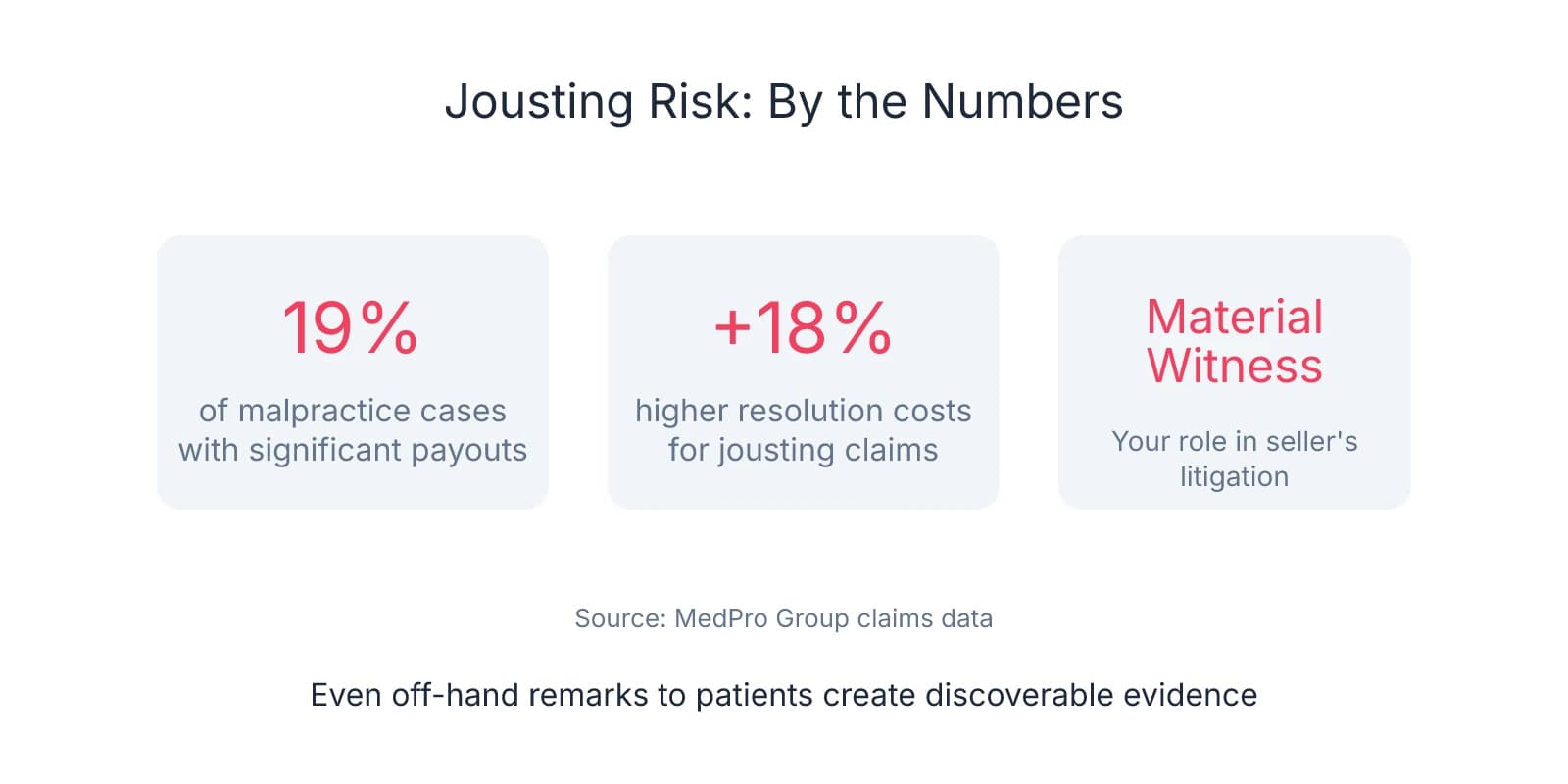
- "Jousting" — criticizing another dentist's work to a patient — creates legal liability even when you weren't the treating dentist, accounting for 19% of dental malpractice cases with significant payouts.
- The subsequent dentist often becomes a material witness in litigation against the seller, and their documentation of patient complaints can be used as evidence in court.
Patient Complaints After Acquisition Are More Common Than Liability Risk
Within the first few weeks of taking over a practice, you'll likely hear: "Dr. [Seller] was fine, but they always seemed rushed," or "I've been meaning to ask someone about this crown — it never felt quite right." These moments catch many first-time buyers off guard.
Patient complaints about the previous dentist are one of the most predictable parts of a practice transition. Patients view a new owner as a fresh start — someone with no loyalty to the seller and no reason to dismiss their concerns. Where they stayed quiet for years, they now feel emboldened to speak up.
The psychological dynamic is straightforward: patients who felt unheard finally have permission to say so. That doesn't mean the seller was negligent. In most cases, complaints stem from subjective factors — a communication style that felt dismissive, appointments that ran behind, or treatment outcomes that didn't match expectations. A patient who says "Dr. [Seller] never explained anything" may have received adequate care but felt the explanations were too technical or too brief.
Where this becomes a liability issue is in how you respond. In dentistry, "jousting" refers to criticizing another dentist's work to a patient. Even when you're not the treating dentist, validating a patient's complaint — "Yeah, that crown placement does look off" — can expose you to legal risk. MedPro Group claims data shows jousting accounts for 19% of dental malpractice cases with significant payouts. If the patient files a claim against the seller, your documentation of their complaints and any verbal criticism can be used as evidence. You may be called as a material witness, and a plaintiff's attorney may position your statements as expert testimony against the seller.
The risk isn't theoretical. When a subsequent dentist assumes inadequate care based on a patient's subjective account, they often document that assumption in the chart. Those notes become discoverable in litigation. Even if you never intended to criticize the seller, your clinical records can be read as validation of the patient's claims.
This doesn't mean you ignore complaints or refuse to address legitimate clinical concerns. It means recognizing that most post-acquisition complaints are a communication challenge, not a clinical crisis. Patients want to be heard and reassured that their new dentist will take them seriously. What they don't need — and what you shouldn't provide — is confirmation that the previous dentist failed them.
Why Validating Patient Complaints Exposes You to Legal Risk
The danger in jousting isn't that you're criticizing another dentist behind closed doors — it's that seemingly innocuous comments to patients create a paper trail that plaintiff's attorneys can weaponize. When you tell a patient "I can see why you're frustrated" or "It's good you came to me when you did," you're creating potential expert testimony against the seller and positioning yourself as a material witness in litigation you never agreed to participate in.
How off-hand remarks become courtroom evidence: If a patient files a malpractice claim against the seller based on dissatisfaction you appeared to validate, your clinical records will be subpoenaed. Any documentation of the patient's complaints — especially if paired with your own clinical observations — can be presented as corroboration of negligence. Plaintiff's attorneys look for subsequent treating dentists who documented concerns about prior work, because those notes carry more weight than the patient's testimony alone. A note that says "patient reports crown never felt right; upon exam, margin appears open" can be enough.
You may be called as a material witness. If the case goes to trial, you may be subpoenaed to testify about what the patient told you, what you observed clinically, and what you documented. Even if you refuse to criticize the seller on the stand, the plaintiff's attorney will use your records to build their case. Your presence in the courtroom — regardless of what you say — lends credibility to the patient's claims simply because you're a licensed dentist who examined the patient after the alleged harm occurred.
You're hearing one side of a subjective story: Patients rarely disclose their own role in suboptimal outcomes. The patient who complains that "Dr. [Seller] rushed through my crown prep" may have canceled three appointments, refused a temporary, or ignored post-op instructions. Professional Solutions Insurance Company notes that patients often present subjective opinions as objective facts, and subsequent dentists who accept those accounts at face value make assumptions that don't hold up under scrutiny.
The seller's records may tell a completely different story. Documentation of missed appointments, refusal of recommended treatment, or non-compliance with home care instructions can reframe a "bad outcome" as a predictable result of patient behavior. Without reviewing those records, you're making clinical judgments based on incomplete information — a liability risk not just to the seller, but to you.
Professional and ethical consequences: The ADA Code of Ethics is explicit: dentists should inform patients of their oral health status "without disparaging comment about prior services." When you validate a patient's criticism of another dentist, you're opening yourself to ethics complaints, peer review scrutiny, and reputational damage within your local dental community. Sellers talk. If word spreads that you're criticizing the previous owner to inherited patients, referral relationships dry up and future sellers become wary of negotiating with you.
The financial exposure is measurable. MedPro Group data shows that jousting claims involving documentation issues are 18% more expensive to resolve than average malpractice cases. Even if you're not named as a defendant, your involvement as a witness increases the seller's defense costs, and those costs can strain professional relationships long after the case closes.
One pattern worth noting: patients who disparage multiple previous dentists are often predatory patients. They appeal to your ego by positioning you as the competent dentist who finally "gets it," but you may be next on their list. When a patient's complaint history spans multiple practices, that's a signal to proceed cautiously — not to validate their narrative, but to document thoroughly and set clear expectations from the start.
How to Respond When Patients Criticize the Seller's Work
The moment a patient starts criticizing the seller's work, you're navigating a conversation that has legal, professional, and clinical dimensions. What you say in the next 30 seconds can either defuse the situation or create liability that follows you for years. The goal isn't to defend the seller or validate the patient's complaints — it's to redirect the conversation toward your own clinical assessment without commenting on decisions you didn't make.
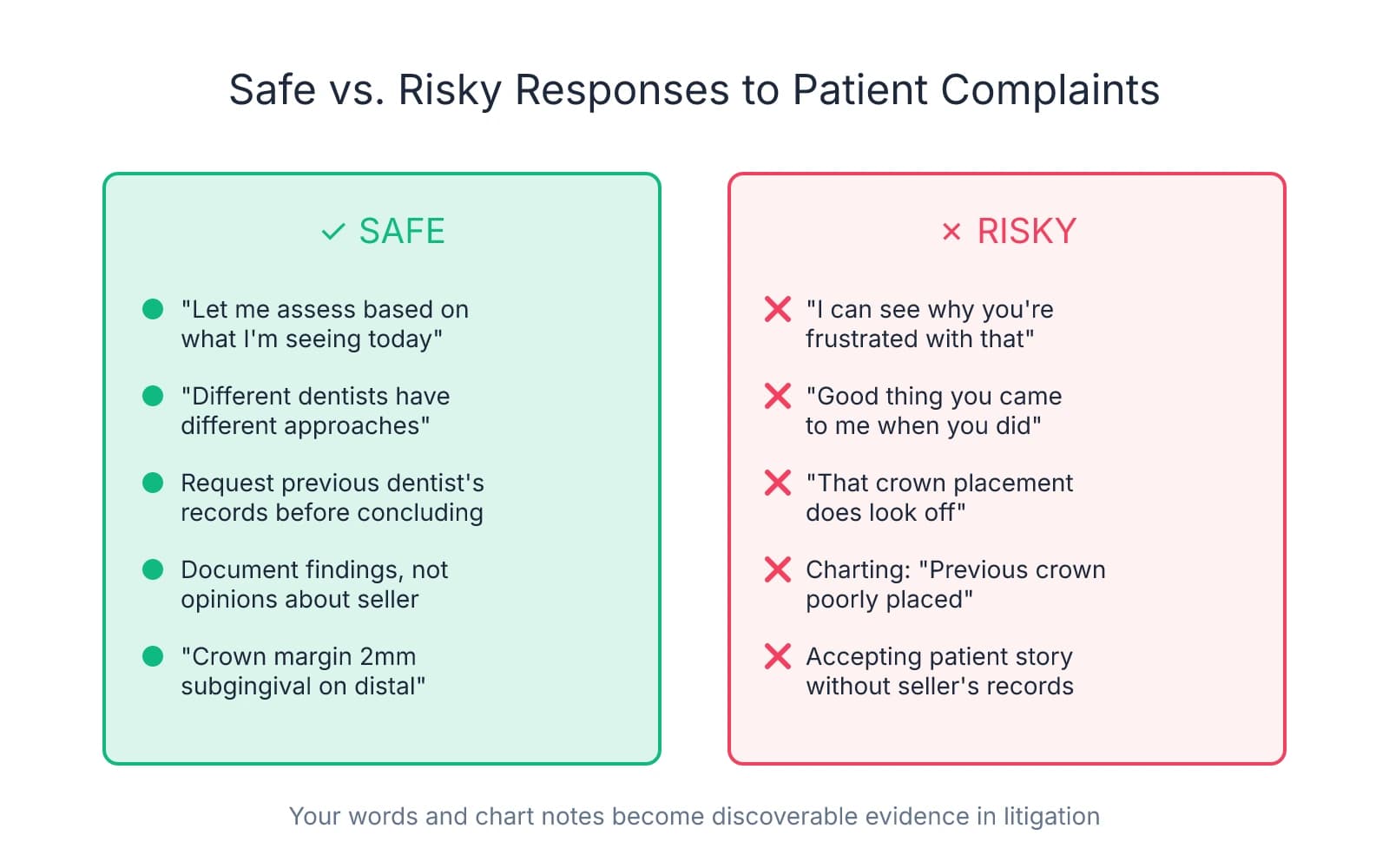
Use neutral framing that acknowledges different approaches: When a patient says "Dr. [Seller] told me I needed a crown, but I'm not sure they were right," your response should sidestep judgment entirely. Try: "There are different ways to approach this problem — let me take a look and we'll figure out the best path forward for you." Or: "I have a different practice style than Dr. [Seller], so I'll assess this based on what I'm seeing today." This language acknowledges the patient's concern without agreeing or disagreeing with the seller's clinical judgment.
Where many buyers stumble is offering reassurance that sounds like validation. Phrases like "I can see why you'd be frustrated" or "It's good you came to me" read as confirmation that the seller failed. A safer approach: "I hear what you're saying — let's start fresh and see where we are now." This acknowledges the patient's experience without endorsing their interpretation of it.
Request records from the previous dentist before forming conclusions: One step many buyers skip is pulling the seller's clinical records for patients who voice complaints. You need to see what was documented — not just the treatment plan, but notes on patient compliance, missed appointments, informed consent discussions, and any documented refusals of care. A patient who claims "Dr. [Seller] never told me about the risks" may have signed a detailed consent form.
To request records, you'll need the patient to sign a release authorizing the previous dentist to share their file. If the patient refuses to authorize the release or won't reveal the previous dentist's name, that's a red flag. Professional Solutions Insurance Company notes that a strong objection to records release often signals there's more to the story than what you're hearing.
Watch for predatory patients who have a pattern of disparaging dentists: Some patients move from practice to practice, each time positioning the previous dentist as incompetent and the new dentist as their savior. They appeal to your ego: "The last dentist was hopeless, but I've heard great things about you." This is a setup. You're not the exception — you're next on their list. When a patient's complaint history spans multiple providers, proceed cautiously. Document thoroughly, set clear expectations about treatment outcomes, and avoid being drawn into criticism of their previous care.
Document what you observe clinically, not your opinions about the seller's decisions: Your chart notes should describe findings, not judgments. Write "crown margin 2mm subgingival on distal, patient reports sensitivity to cold" — not "previous crown poorly placed." The first statement is a clinical observation you can defend. The second is an opinion about another dentist's competence that can be used against the seller in litigation. If you need to recommend retreatment, frame it as addressing current conditions: "Based on today's exam, I'm recommending a new crown to address the open margin and restore function."
This approach also protects you if the patient later claims you promised to "fix" the seller's mistakes. Your documentation shows you assessed the patient's current condition and recommended treatment based on what you observed, not based on validating the patient's complaints.
Consult your practice attorney if you see repeated complaints about the same dentist: If multiple patients voice similar concerns about the seller — especially if those concerns involve clinical competence rather than communication style — you may have a mandatory reporting obligation. Most states require dentists to report colleagues who pose a risk to patient safety. This is a gray area, and the threshold for reporting varies by jurisdiction. Before you act, consult your practice attorney to understand your legal obligations and the potential consequences of reporting versus not reporting.
When Complaints Signal a Bigger Problem You Inherited
Most patient complaints after acquisition reflect normal transition friction — subjective dissatisfaction with communication style, perceived rushed appointments, or personality mismatches that have nothing to do with clinical competence. But occasionally, complaints reveal something harder to dismiss: a pattern suggesting you bought a practice with systemic quality issues. The question isn't whether to panic — it's how to investigate concerns without jousting, and when to escalate to your malpractice carrier or attorney.
Distinguish between normal complaints and systemic problems: A handful of patients voicing subjective concerns — "Dr. [Seller] never listened to me" or "I didn't like how they explained treatment" — is predictable noise. What demands attention is when multiple patients complain about the same procedures or outcomes. If three patients in your first month mention failed crowns, or five patients report the same endodontic retreatment, or you're seeing a cluster of patients with untreated perio that was documented but never addressed, that's a pattern worth investigating. The difference is volume and specificity. Subjective complaints are scattered and personal. Systemic problems show up as repeated clinical failures across unrelated patients.
Another signal: staff members who volunteer concerns about the seller's clinical approach without you asking. If your inherited hygienist mentions that the seller routinely skipped perio charting, or your office manager notes that patients frequently called back with post-op complications, listen carefully. Staff see patterns that individual patients don't.
Review charts systematically and consult specialists for objective assessment: If you're seeing patterns that concern you, pull a sample of charts for the procedures in question. Look for documentation of informed consent, treatment planning rationale, and follow-up care. Are complications documented? Were patients informed of risks? Did the seller address post-op concerns or dismiss them?
For cases where you're genuinely uncertain about the quality of care, consider consulting a specialist for a second opinion. If you're seeing multiple failed endo cases, send records to an endodontist and ask for an objective assessment of the treatment approach. Frame this as risk assessment for your own practice, not as building a case against the seller.
Contact your malpractice carrier and practice attorney before taking action: If your investigation suggests substandard care affecting multiple patients, this is no longer a clinical question — it's a legal one. Contact your malpractice carrier immediately. They need to know you've identified potential liability, and they can guide you on documentation, patient communication, and whether you have reporting obligations. Most carriers have risk management hotlines staffed by attorneys who specialize in dental malpractice.
Your practice attorney should also be involved. Depending on your state, you may be required to report the seller to the state dental board if you believe their care posed a risk to patient safety. The threshold for mandatory reporting varies — some states require reporting only when there's clear evidence of gross negligence or impairment, while others have broader standards. Your attorney can review the records, assess whether reporting is required, and help you navigate the process if it is.
One scenario that catches buyers off guard: discovering during due diligence or shortly after closing that the seller has pending malpractice claims or board complaints they didn't disclose. If this happens, contact your attorney immediately. Depending on how the purchase agreement was structured, you may have recourse against the seller for misrepresentation.
Most complaints don't indicate systemic problems — neutrality protects your investment: The reassuring reality is that the vast majority of patient complaints after acquisition are normal transition friction. Patients voicing long-held frustrations, subjective dissatisfaction with communication style, or unrealistic expectations about what dentistry can deliver. These complaints don't require investigation. They require listening, clinical assessment, and a neutral response that redirects the conversation toward your own care philosophy.
Maintaining professional neutrality isn't just about avoiding jousting liability — it's about protecting your reputation and your investment. When you stay neutral, you signal to inherited patients that you're focused on their care, not on criticizing your predecessor. You signal to your local dental community that you're a professional who respects colleagues even when you disagree with their clinical decisions. And you signal to future sellers that you're someone they can trust to handle a transition with integrity.
If you're genuinely concerned about the quality of care you inherited, investigate systematically, consult experts, and involve your attorney and malpractice carrier early. But if you're hearing the normal complaints that come with any transition, the best response is the simplest: listen, assess, document what you observe, and move forward. Most buyers who regret their purchase do so because of financial surprises or cultural mismatches — not because of clinical quality issues they didn't catch in due diligence. If you're facing the latter, you're in the minority, and you have clear steps to take. If you're facing the former, focus on building trust with the patients you inherited, not on validating their complaints about the dentist who came before you.
Sources & References
The data and claims in this article are drawn from the following sources. We prioritize government data, peer-reviewed research, and established industry publications to ensure accuracy.
- Liability Implications Associated With Jousting in Dentistry— medprodental.comIndustry
- Help! A New Patient Is Complaining About Their Previous Dentist— www.profsolutions.com
- Difficult Patient Sues Dentist After Improper Dismissal and Jousting— medprodental.com
Frequently Asked Questions
Navigate Patient Transitions With Expert Support
Inheriting a practice comes with inherited patient relationships—and sometimes complaints about the previous owner. Minty Plus provides hands-on guidance through practice transitions, helping you rebuild trust and manage the complexities of taking over an established patient base.