Buying vs. Leasing Dental Practice Real Estate

Co-Founder, Minty Dental

In Summary
- Lenders treat the practice and building as two distinct assets with separate appraisals, loan products, and risk assessments—bundling them doesn't simplify the deal, it adds a parallel transaction
- SBA 504 loans for real estate require 10% down and offer 25-year fixed rates, but they come with stricter property requirements than the SBA 7(a) loans used for practice acquisition
- Structuring real estate in a separate LLC protects building equity from malpractice claims and creates clean separation for future sale or transition planning
- The practice must pay fair market rent to the real estate entity—this isn't optional and must be documented to preserve liability protection and tax treatment
Real Estate Isn't Part of the Practice—It's a Separate Investment Decision
When a seller offers to include the building, many buyers treat it as a package deal—one price, one closing, one set of paperwork. That assumption breaks down the moment you start talking to lenders. The practice and the building are two distinct assets with different financing structures, different risk profiles, and different legal entities.
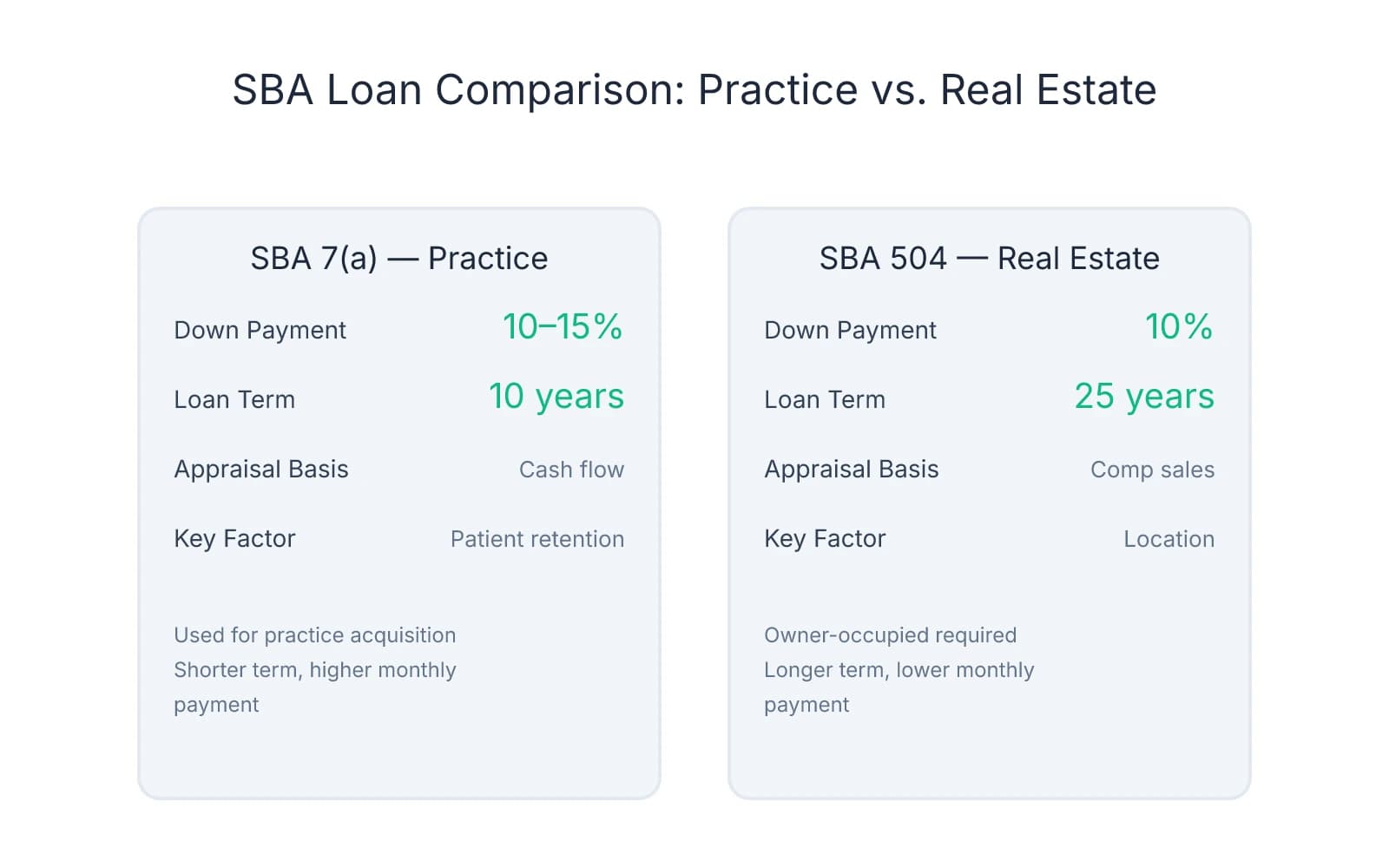
Lenders appraise the practice based on cash flow and patient retention. They appraise the building based on comparable sales and location. Those valuations happen independently, and the loan products that finance them operate under different terms and requirements. Practice acquisition typically uses an SBA 7(a) loan with 10–15% down and a 10-year term. Real estate financing often uses an SBA 504 loan with 10% down and a 25-year fixed rate. The 504 structure offers longer amortization and lower monthly payments, but it comes with stricter property requirements—the building must be owner-occupied, and the business must meet job creation or economic development criteria.
One pattern worth paying attention to is how lenders separate risk. A practice can generate strong cash flow in a mediocre building. A building can hold value even if the practice underperforms. Lenders evaluate those scenarios independently, which means your approval for one doesn't guarantee approval for the other. If the building appraises below asking price or fails to meet SBA occupancy standards, the real estate portion can collapse even if the practice financing is solid.
Where buyers often get burned is assuming the practice entity can own the building. In most cases, that structure exposes building equity to malpractice claims and operational liabilities. The standard approach is to form a separate LLC to hold the real estate, then lease the space back to the practice entity at fair market value. This isn't a formality—it's a liability firewall. If a malpractice claim targets the practice, the building sits in a separate legal entity outside the reach of that judgment.
The leaseback arrangement requires documentation. The practice pays rent to the real estate LLC at a rate that reflects what an independent tenant would pay for comparable space. That rent must be set in advance, documented in a written lease, and paid consistently. Lenders expect to see this structure, and skipping it can jeopardize both your liability protection and your tax treatment.
What tends to happen is buyers focus on whether they can afford the building and miss the structural complexity underneath. The real question isn't just affordability—it's whether the building supports the practice's growth trajectory, whether the added financing burden leaves enough working capital, and whether the equity play justifies the operational and legal overhead.
The Building's Location and Demographics Matter More Than Current Revenue
A practice generating $800,000 in annual collections can relocate if demographics shift. A building can't. When you buy real estate alongside the practice, you're locking in a 20-year bet on the location's trajectory—not just its current performance.
Where many buyers focus their analysis is backward. They evaluate whether the practice can afford the building based on current cash flow, then assume the location must be viable because the practice is profitable. That logic misses the structural question: does this location support growth, or does it cap your upside regardless of how well you operate?
Population growth matters, but raw headcount doesn't predict viability. What you're looking for is core patient density—families with employer-sponsored dental insurance, stable employment, and income levels that support regular preventive care. The national average sits around 1.7 dentists per 1,000 residents, but that ratio becomes meaningful only when you filter for insured households, median income above $60,000, and employment in sectors that offer benefits.
One protection many buyers overlook is evaluating whether the area is growing or contracting. Census data, school enrollment trends, and commercial development permits signal momentum better than the seller's patient count. If new housing developments are breaking ground and employers are expanding, the location is positioned for long-term growth. If schools are consolidating and storefronts sit empty, you're buying into a market that peaked years ago.
Building size and operatory count should align with your growth plans, not just current utilization. A 2,000-square-foot office with four operatories might feel efficient for a solo practitioner doing $700,000 annually, but if your goal is to add an associate and scale to $1.2 million, you'll outgrow the space within three years. On the other hand, buying a 4,000-square-foot building with eight operatories when you're only using four creates excess overhead—higher property taxes, more maintenance, and wasted rent that could have gone toward working capital.
Visibility, accessibility, and parking influence new patient acquisition in ways that don't show up in the seller's historical numbers. A building tucked behind a strip mall with limited signage and shared parking might work fine for an established patient base, but it creates friction for new patients comparing options on Google Maps. Practices in high-visibility locations with dedicated parking consistently outperform comparable practices in less accessible buildings—even when the clinical quality is identical.
Ownership Adds Costs and Responsibilities That Don't Exist in a Lease
With the location fundamentals established, the next consideration is what ownership actually costs beyond the monthly payment. Closing on a building involves expenses that don't appear in practice acquisition. Appraisal fees run $3,000–$5,000 for commercial dental real estate, and environmental inspections add another $2,000–$4,000. Title insurance typically costs 0.5–1% of the purchase price. Legal fees for real estate transactions run separately from practice acquisition legal work, often adding $3,000–$7,000. When you total these costs, closing typically lands between 2–4% of the purchase price—on a $500,000 building, that's $10,000–$20,000 before you own anything.
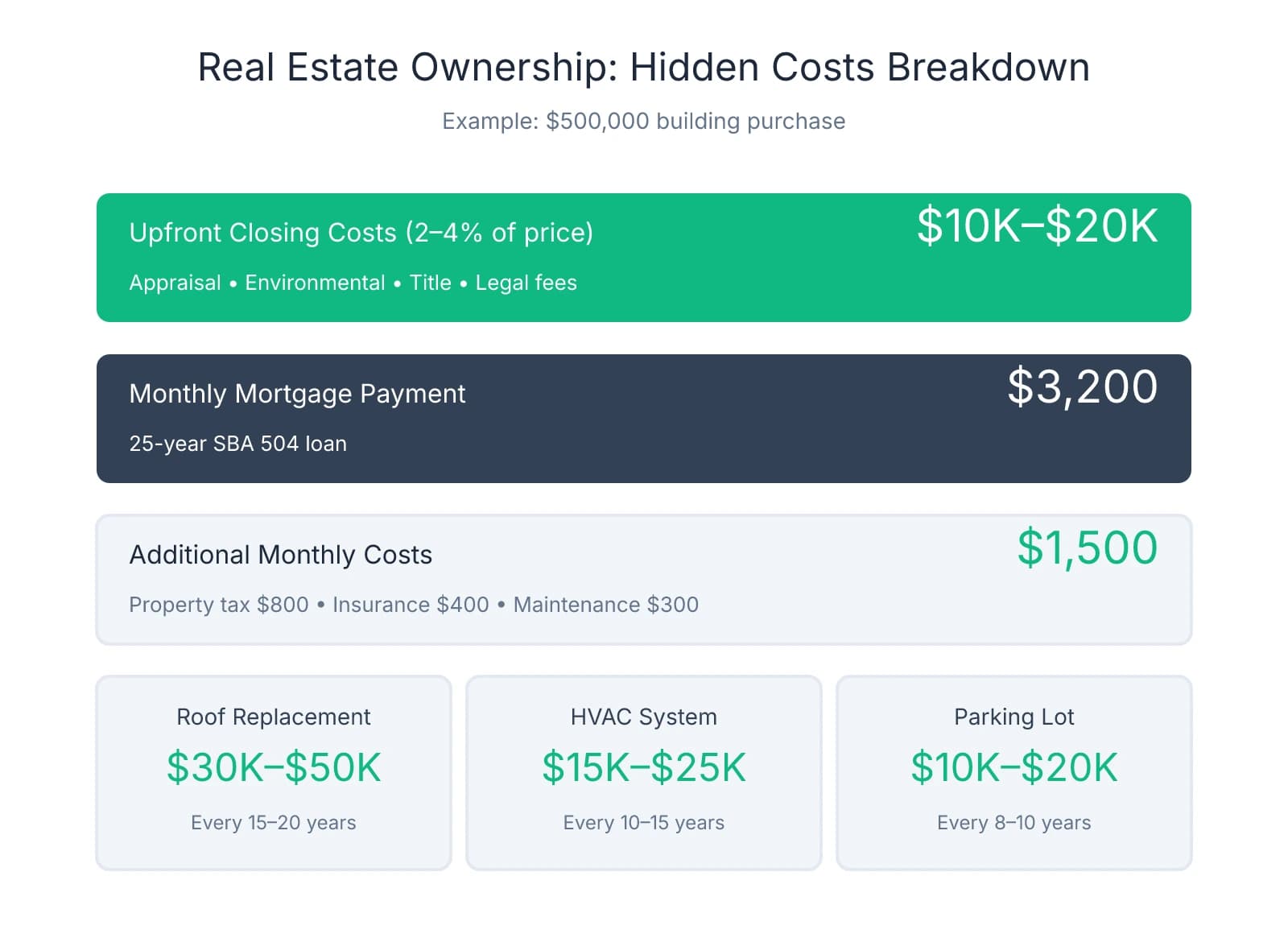
Once you close, the ongoing costs shift from predictable rent to variable expenses you control but can't eliminate. Property taxes, building insurance, and maintenance become your responsibility. A leased space might cost $4,000 per month with taxes and insurance included. Ownership might reduce your monthly loan payment to $3,200, but then you're writing separate checks for property taxes ($800/month), building insurance ($400/month), and maintenance reserves ($300/month).
Facility costs should stay within 5–10% of collections whether you lease or own. If your practice collects $900,000 annually, you're budgeting $45,000–$90,000 per year for facility expenses. Where ownership becomes problematic is when the building's condition or location pushes you above that threshold. A $600,000 building with deferred maintenance might require $40,000 in immediate repairs on top of your annual facility budget.
Maintenance costs in owned buildings follow a pattern tenants never see. Small repairs run $200–$500 per incident and happen quarterly. Larger replacements happen on a cycle: roofs last 15–20 years and cost $30,000–$50,000 to replace, HVAC systems last 10–15 years and run $15,000–$25,000 per unit, and parking lot resurfacing happens every 8–10 years at $10,000–$20,000. A leased building shifts those costs to the landlord. An owned building makes them your problem.
One pattern worth paying attention to is how ownership eliminates rent escalation but introduces capital expenditure risk. A lease might include 3% annual increases, which compounds over time. Ownership locks in your mortgage payment for 25 years, but a $50,000 roof replacement in year seven isn't predictable—it's a lump sum that hits your cash flow hard if you haven't reserved for it.
Where buyers often get burned is treating the building as a passive asset. A leased space comes with a landlord who handles structural issues and coordinates repairs. Ownership means you're fielding calls about broken water heaters and negotiating with contractors for parking lot striping. Some buyers hire property management firms to handle this work, which adds another 5–10% of rental income to your annual costs.
Deciding Whether to Buy: A Framework for Buyers
Start with the location test: if the building weren't for sale, would you lease space in this area for the next 10 years? If the answer is no—if the demographics feel uncertain, the visibility is poor, or the market is contracting—don't buy the building just because the seller is offering it.
Ownership becomes worth the complexity when three conditions align: you're committed to the location for 10+ years, the area's demographics support sustained patient growth, and the building's size and layout match your operational model. If you're planning to add associates, scale to $1.5 million in collections, and build equity in a market where commercial real estate appreciates steadily, buying the building turns facility costs into forced savings.
Where ownership stops making sense is when the building introduces constraints the practice doesn't need. A 4,000-square-foot building with eight operatories sounds like room to grow, but if you're solo and collecting $700,000 annually, you're paying property taxes, insurance, and maintenance on space you won't use for five years. The same logic applies to buildings in secondary markets or satellite locations where you're testing demand before committing long-term.
Cash position matters as much as growth timeline. SBA 504 loans require 10% down, but closing costs, environmental inspections, and immediate capital expenditures can push your total upfront investment to 15–20% of the purchase price. On a $500,000 building, that's $75,000–$100,000 before you own anything. If that outflow leaves you with less than three months of operating expenses in reserve, the building is creating liquidity risk even if the monthly payment is affordable. Knowing whether you're ready to own a practice includes knowing whether your balance sheet can handle the real estate component without compromising working capital.
Risk tolerance plays a role that financing calculations don't capture. Ownership shifts structural costs—roof replacements, HVAC failures, parking lot resurfacing—from the landlord to you. Those expenses arrive on a timeline you can't control, and they don't pause when the practice has a slow quarter. If a $40,000 roof replacement in year six would force you to delay associate hiring or cut marketing spend, that's a signal that ownership introduces more volatility than your cash flow can absorb.
One decision framework that cuts through the noise: calculate your total facility cost as a percentage of collections under both scenarios. If leasing costs 6% of collections and ownership—including mortgage, taxes, insurance, and maintenance reserves—costs 9%, the building is adding 3% in annual overhead. That's $27,000 per year on a $900,000 practice. Over 10 years, you're paying $270,000 in extra facility costs to build equity in a $500,000 asset. The equity play works if the building appreciates and you stay long enough to realize that gain.
The right decision depends on your growth timeline, cash position, and risk tolerance—not just whether the seller is willing to finance or the bank approves the loan. Ownership makes sense when the location supports long-term growth, the building aligns with your operational model, and your balance sheet can absorb both the upfront costs and the ongoing variability. When those conditions don't align, leasing preserves flexibility and keeps your capital focused on growing the practice. Knowing when to walk away applies to real estate as much as it does to the practice itself.
Sources & References
The data and claims in this article are drawn from the following sources. We prioritize government data, peer-reviewed research, and established industry publications to ensure accuracy.
- 504 loans | U.S. Small Business Administration - SBA.gov— www.sba.govGovernment
- How to Form an Entity to Own Dental Office Real Estate— dentalattorneys.comIndustry
- Buying or Selling a Dental Practice, Start with an Accurate Valuation— ada.orgIndustry
Frequently Asked Questions
Navigate Dental Real Estate With Expert Guidance
Real estate decisions can make or break a practice acquisition. Minty Plus provides hands-on support to help you evaluate ownership structures, financing options, and lease agreements—ensuring you make the right choice for your investment.