How to Know If You're Ready to Buy a Dental Practice

Co-Founder, Minty Dental

In Summary
- 73% of dentists eventually own practices, but recent graduates wait significantly longer than previous generations—ownership is still the end game, just on a delayed timeline
- True readiness spans four dimensions: clinical competence to handle the full patient mix, financial positioning to secure favorable terms, personal timing that aligns with life circumstances, and operational preparedness to manage the business side
- Most buyers confuse desire with readiness, leading to either premature purchases that strain capacity or missed windows when conditions align
- Answering four honest questions now—before you start looking—saves you from costly mistakes and helps you recognize when your moment has actually arrived
Readiness Isn't About Wanting Ownership—It's About Being Positioned for It
Most dentists who start looking at practices aren't actually ready to buy one. They want ownership—eventually—but wanting it and being positioned for it are different things. The gap between the two is where buyers either move too early and struggle, or wait too long and miss favorable conditions.
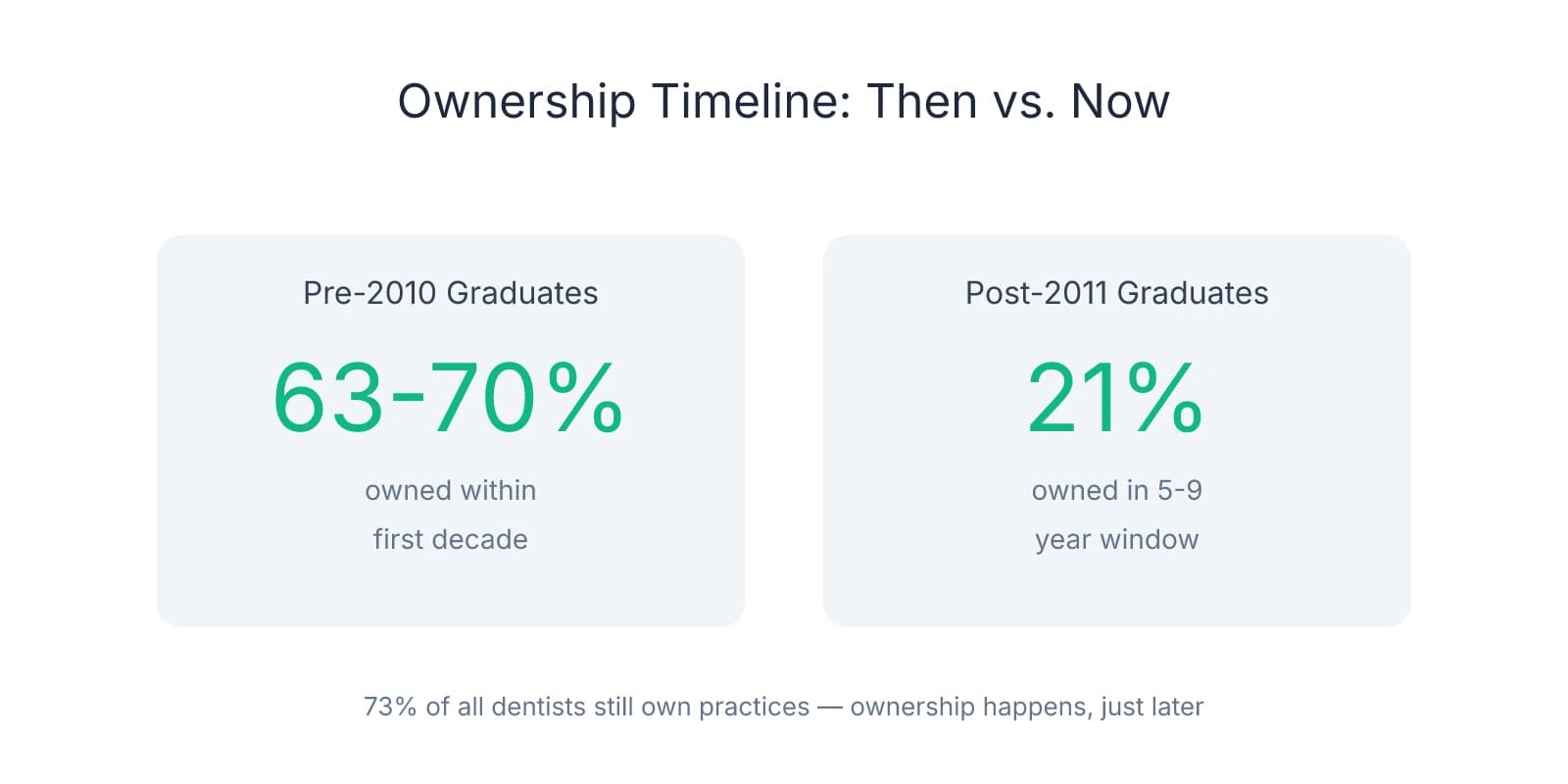
The data supports what many practitioners sense: practice ownership remains the career end game for most dentists. As of 2023, 73% of dentists own practices. What's changed is the timeline. Among dentists who graduated before 2010, 63-70% owned practices within their first decade. For those who graduated after 2011, that figure drops to 21% in the 5-9 year window. Ownership still happens—it just takes longer to get there.
The question isn't whether you'll own a practice someday. It's whether now is the right time, or if you need another year or two of preparation. That distinction matters because timing affects everything: the terms you can negotiate, the stress you'll carry in year one, and whether the practice grows under your ownership or plateaus while you catch up.
Readiness breaks into four dimensions, and you need all four aligned before you start making offers. Clinical competence means you can handle the full scope of procedures the practice generates. Financial positioning means lenders see you as low-risk and you can structure a deal that doesn't leave you cash-strapped. Personal timing means your life circumstances support the intensity of ownership. Operational preparedness means you understand what it takes to manage the business side—staff, systems, compliance, marketing.
Most buyers evaluate one or two of these dimensions and assume the rest will work itself out. The timeline from associate to owner varies widely depending on how many boxes you've checked. Where buyers get into trouble is treating readiness as binary, when it's really a scorecard across multiple areas.
The framework that follows gives you a structured way to assess where you stand. Each dimension has specific criteria that signal whether you're positioned to move forward or need more time.
Clinical Readiness: Can You Deliver the Full Scope of Care This Practice Requires?
Lenders don't finance potential—they finance proven production. Before you tour a single practice, you need an honest assessment of whether your clinical skill set can sustain the revenue that practice generates. If the answer is no, you're not buying a business—you're buying a problem.
The baseline many practitioners use is the 25-case threshold: completing at least 25 cases of any procedure you plan to offer before you take ownership. That applies to implants, Invisalign, sleep apnea appliances, or any specialty service the practice markets. Twenty-five reps gives you enough experience to handle complications, manage patient expectations, and maintain quality without constant second-guessing.
Pull the practice's procedure mix from the last 12 months. What percentage of revenue comes from procedures you've performed independently? What shows up frequently that you've only done under supervision, or not at all? If 30% of collections come from endo and you've completed six root canals total, that's a gap. You can't assume you'll refer those cases out without losing revenue—and lenders won't assume it either.
Production per day matters as much as procedure mix. If the seller averages $4,000 per day and you're currently producing $2,200, that's not a small gap to close. Some of that difference comes from speed—experienced clinicians work faster. Some comes from case acceptance. But a significant portion comes from clinical confidence. When seller production is the only thing keeping a practice profitable, buyers who can't match that output inherit a declining asset.
Banks evaluate your clinical readiness through your production reports, not your resume. They want proof you can generate the revenue necessary to service the loan. If you're paid on percentage of production, they'll back into your numbers from your pay stubs. If you're on a daily rate, they'll ask for production reports directly. Either way, they're looking for a track record that shows you can handle the clinical load without a significant drop in output.
Where buyers misjudge readiness is assuming they'll grow into the role after closing. That works if the gap is small—maybe you need to get faster at crown preps or improve case acceptance. It doesn't work if the practice offers services you've never performed independently. Bridging that gap takes time: additional CE, mentorship, or another year in an associateship where you can build those reps in a lower-risk environment.
Clinical confidence affects every other dimension of readiness. If you're struggling chairside—second-guessing treatment plans, running behind schedule, or managing complications you haven't seen before—you won't have bandwidth to handle staff issues, billing problems, or marketing decisions. The business side of ownership assumes the clinical side is stable.
Before you make an offer, answer these: Can you independently perform 80% of the procedures this practice offers? Do you have at least 25 cases completed for any specialty service you plan to continue? Can you match or exceed the seller's production per day within six months? If the answer to any is no, the next step isn't finding a practice—it's building the clinical foundation that makes ownership sustainable.
Financial Readiness: The Numbers Lenders Actually Care About
With your clinical capabilities established, the next hurdle is proving to lenders that you can service the debt. They evaluate three financial metrics: credit score, production history, and cash reserves. These aren't arbitrary benchmarks—they're the data points that predict whether you'll service the loan without defaulting. Talk to lenders before you start looking, and they'll tell you exactly what needs to improve in your financial profile.
The credit score threshold sits at 680 minimum, with 700+ putting you in a stronger position for favorable terms. Below 680, most dental-specific lenders won't move forward. Check your credit now through a free service, not six months from now when you've found a practice and need approval fast. If your score sits below the threshold, you have time to fix it: pay down credit card balances, correct reporting errors, and avoid opening new lines of credit.
Production history gives lenders proof you can generate the revenue needed to cover loan payments. They want at least 12 months of consistent production reports. If you're paid on percentage of production, they'll calculate backward from your pay stubs. If you're on a daily rate, they'll ask for production reports directly. The pattern matters more than any single month. A dentist who produces $18,000 one month and $9,000 the next looks less stable than one who consistently hits $13,000-$15,000.
Cash reserves signal financial discipline. For a $500,000 loan, many lenders want to see $25,000-$50,000 in liquid savings. That reserve proves you can handle unexpected expenses in the first year without missing loan payments—equipment failures, staff turnover, or a temporary dip in collections.
Student loan debt doesn't disqualify you—this is the myth that keeps more buyers on the sidelines than any other factor. What lenders evaluate is your debt-to-income ratio and your ability to generate revenue, not whether you're carrying $300,000 in loans. A high monthly student loan payment does affect your DTI, which is why income-driven repayment plans can sometimes improve your loan application—they lower your monthly obligation, even if the total debt stays the same.
Building financial readiness while still an associate comes down to four actions. First, track your production monthly—this creates the paper trail lenders need. Second, save at least 10% of your income. Lenders want to see you're living below your means. Third, avoid lifestyle inflation. The raise you get as an associate should go toward reserves and debt paydown. Fourth, keep your student loan payments covering interest plus principal.
The step most buyers skip is talking to lenders early—before they've found a practice, before they've even started looking. Reach out to three or more lenders now and ask them to review your financial profile. They'll tell you what's strong, what needs work, and what timeline makes sense. Many of the problems buyers face trace back to skipping this step and assuming their financial position is stronger than it actually is.
Common red flags that delay or derail financing: a credit score under 680, inconsistent production that swings month to month, high credit card balances relative to your limits, or an inability to show any cash reserves. Each of these is fixable, but not in 30 days. If any apply to you, the timeline to ownership just extended—not because you're unqualified, but because you need another 6-12 months to strengthen your application.
Personal and Operational Readiness: Are You Ready for What Ownership Actually Demands?
Clinical competence and financial positioning get you to the closing table. What determines whether you succeed after that comes down to two dimensions most buyers underestimate: personal timing and operational preparedness.
Start with the geographic commitment. Practice ownership isn't a three-year experiment you can walk away from. Most buyers need 15-20 years in one location to build equity, pay down the loan, and extract meaningful value when they eventually sell. Before you make an offer, answer this: Are you ready to commit to this specific location for the next two decades? If the answer includes qualifiers—"probably", "I think so", "unless something changes"—you're not ready. Knowing when to walk away from a deal often comes down to recognizing that the location doesn't align with where you actually want to build your life.
Family considerations matter more than most buyers acknowledge upfront. If you have young children, ownership means less flexibility for school events, vacations, and daily routines—especially in the first two years. If you're planning to start a family soon, factor in how maternity or paternity leave affects cash flow when you're the owner. If your spouse's career requires relocation potential, ownership creates tension between two competing priorities.
The operational side of readiness centers on a reality many clinicians resist: successful practice ownership requires balancing three roles—clinician, entrepreneur, and manager. Excelling at dentistry covers one-third of what the job demands. The entrepreneur role means making strategic decisions about marketing, growth, and competitive positioning. The manager role means hiring, training, resolving staff conflicts, and maintaining culture.
Ask yourself these questions now: Do you enjoy making business decisions, or does the idea of choosing a payroll system, negotiating with suppliers, and reviewing P&L statements feel like a burden? Can you manage a team—not just delegate tasks, but handle performance issues, mediate conflicts, and maintain morale when things get tense? How well do you handle risk and uncertainty? Ownership means payroll comes out of your account every two weeks whether collections were strong or weak.
Where many buyers misjudge their own readiness is assuming operational skills will develop naturally once they're in the role. Some do—you get better at decision-making through repetition. But the baseline temperament either fits or it doesn't. If you need clear structure, dislike ambiguity, and prefer having a boss who makes final calls, ownership will feel like constant low-grade stress. If you're comfortable with autonomy, can tolerate imperfect information, and don't mind being the person everyone turns to when something goes wrong, the operational side becomes manageable.
One pattern worth noting: buyers who spend another 1-2 years as an associate often use that time to test their operational readiness in low-stakes ways. Volunteer to help with staff scheduling. Sit in on a marketing meeting. Ask the owner if you can review the P&L. Shadow the office manager for a week. These experiences give you a preview of what ownership demands day-to-day.
The infrastructure question matters as much as the mindset question. Before you start looking at practices, assemble your advisory team: a lender who understands dental practice financing, an attorney experienced in practice transitions, an accountant who works with dental clients, and ideally a transition consultant who can guide you through due diligence. Having this team in place before you make an offer signals to sellers that you're a serious buyer. It also protects you from costly mistakes during negotiation and closing.
The honest self-assessment comes down to this: Do you want to own a practice because you're drawn to the autonomy, the equity-building, and the challenge of running a business? Or do you want to own a practice because it feels like the next expected step in your career? The first motivation sustains you through the hard parts. The second one doesn't. If you're not sure yet, that's a legitimate answer—and it suggests another year or two as an associate will give you the clarity you need.
Sources & References
The data and claims in this article are drawn from the following sources. We prioritize government data, peer-reviewed research, and established industry publications to ensure accuracy.
- 5 Financial Must-Dos Before Buying a Dental Practice— ada.orgIndustry
- 5 Skills for Practice Owners— www.njda.orgIndustry
- 5 Financial Must-Dos Before Buying a Dental Practice— www.ada.orgIndustry
- Do Student Loans Affect My Ability To Buy A Practice?— panaceafinancial.comIndustry
- Do You Have What It Takes to Be a Successful Practice Owner?— watsonbrownsales.comIndustry
Frequently Asked Questions
Ready to Take the Next Step?
If you've answered yes to these readiness questions, it's time to explore actual practice opportunities. Minty connects qualified buyers with available dental practices nationwide and provides expert guidance through the entire acquisition process.