Adding a New Service Line to Increase Dental Practice Revenue

Co-Founder, Minty Dental

In Summary
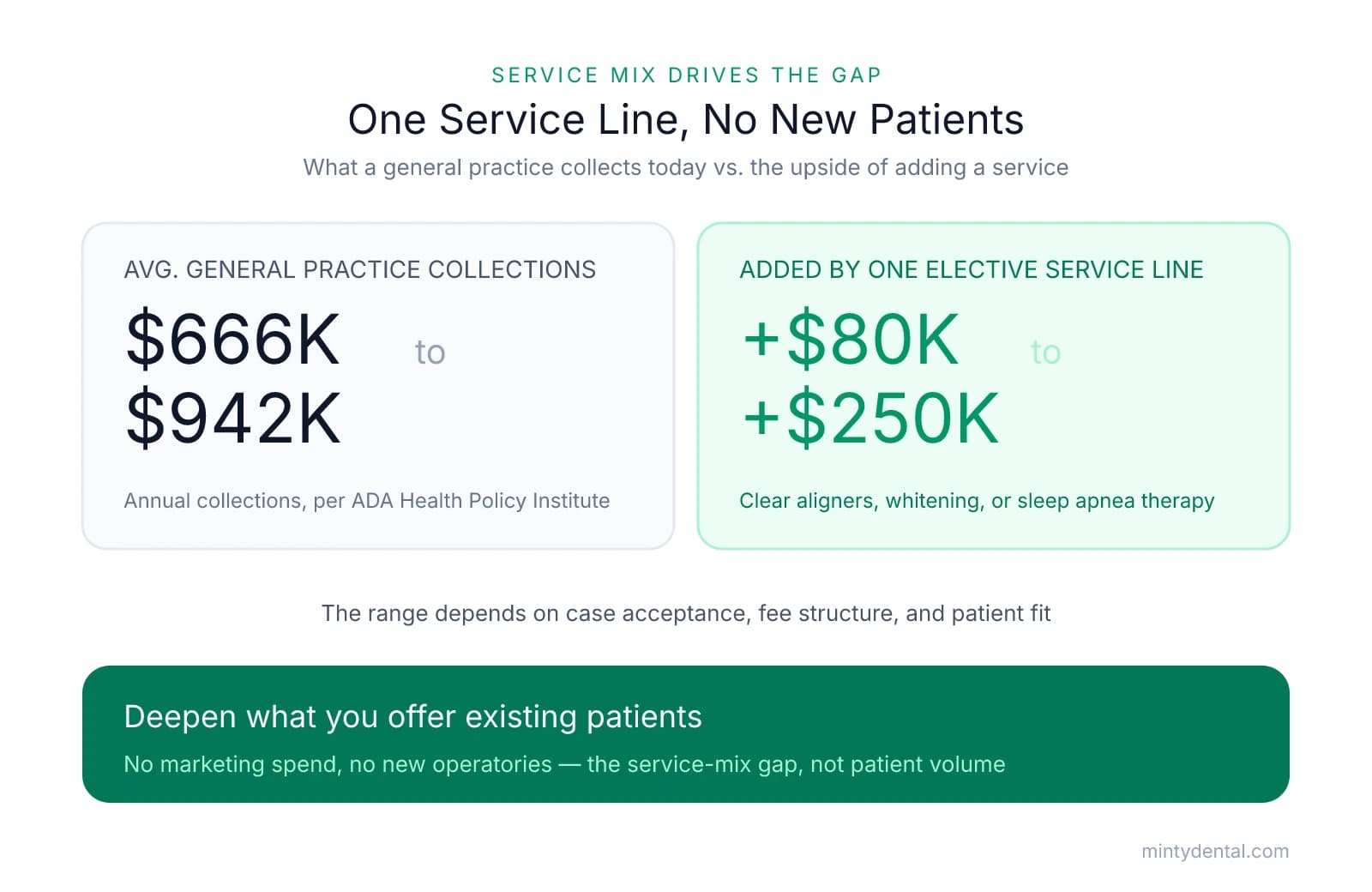
- The average general dental practice collects between $666,000 and $942,000 annually, according to ADA Health Policy Institute data — specialty practices earn substantially more, and much of that gap comes down to service mix.
- Adding a single elective service line such as clear aligners, whitening, or sleep apnea can add $80,000 to $250,000 in annual revenue without a single new patient.
- The right measure for any new service is profit per chair hour, not gross production — a procedure that looks impressive on a production report can quietly lose money once lab fees, chair time, and remakes are factored in.
- Two failure modes sink most service line expansions: picking a service because it is trending rather than because your patients are asking for it, and tracking success by production totals instead of contribution margin.
- Before committing to any new service, run it through three filters: demand fit, economic fit, and operational fit.
The Right Service Line Grows Revenue Without Requiring More Patients
A dental service line is a distinct category of treatment — implants, clear aligners, sleep medicine — that a practice adds to its procedure mix to serve existing patients more completely and attract new ones.
That distinction matters from the start. Growing revenue by acquiring more patients requires marketing spend, longer schedules, and often more operatories. Growing revenue by deepening what you offer to the patients already walking through your door is a different problem with a different set of levers.
ADA Health Policy Institute data show the average general practice collects between $666,000 and $942,000 annually. Specialty practices earn substantially more. That gap is not explained entirely by patient volume or geography — it reflects what procedures are in the mix. A practice doing implants, sleep appliances, or in-office aligner therapy is producing more per patient visit than one running a traditional restorative and hygiene schedule, often without a materially larger patient base.
Adding one elective service line can add $80,000 to $250,000 in annual revenue without adding a single new patient. That is a wide range, and the spread is intentional — clear aligners in a suburban practice with 1,200 active patients looks different from sleep apnea therapy in a practice whose hygienists are already screening for airway issues. The number you actually land on depends on case acceptance, fee structure, and how well the service fits your existing patient population.
Which brings up the metric that matters. Gross production is easy to report and easy to misread. A $2,000 crown sounds like straightforward revenue until you account for two appointments, a lab bill, the occasional remake, and the chair time lost to each. Profit per chair hour is the number that tells you whether a service is actually contributing to your bottom line or just filling the schedule. Two services can generate identical monthly production and have completely different economics once overhead is allocated properly. This is the lens the rest of this article uses to evaluate every option on the table.
Two patterns cause most service line expansions to fall short. The first is choosing a service because it is generating buzz in the industry rather than because your own patients have demonstrated demand for it. The second is declaring success when production numbers go up, without checking whether those numbers translate to actual margin. A service line that adds $120,000 in production but requires a new hire, a significant equipment investment, and two hours of chair time per case may not improve the practice's financial position at all, at least not in the first few years.
The decision framework this article walks through has three filters. Demand fit asks whether your patients are already expressing interest, or showing clinical need, for this service. Economic fit asks whether the math works at your actual case volume — not at the optimistic projections in a manufacturer's sales deck. Operational fit asks whether your team, your schedule, and your physical space can support the service without degrading what you already do well. Evaluating a service line expansion through the lens of growing revenue from your existing patient base means all three filters have to clear before the investment makes sense.
Choosing the Right Service: Demand Signals and Economic Reality
The most reliable demand signal you have is your own referral log. Before you spend time researching platforms or calling equipment reps, track every treatment you refer out for 60 to 90 days. Note the procedure, the patient, and where they went. This isn't a theoretical exercise — patients who accept a referral have already decided they want the treatment and already trust you enough to act on it. If 15 of them left your office in the past two months to see an orthodontist or an oral surgeon, that's a real number with a real dollar figure attached.
Patient request logs are the second source. Your front desk hears things that never make it into a clinical note: patients asking about "the tooth replacement option," inquiring about clear braces they saw advertised, or mentioning that their spouse was diagnosed with sleep apnea. A simple tracking sheet run for the same 60 to 90 day period gives you a crude but honest picture of where unmet demand actually lives in your practice.
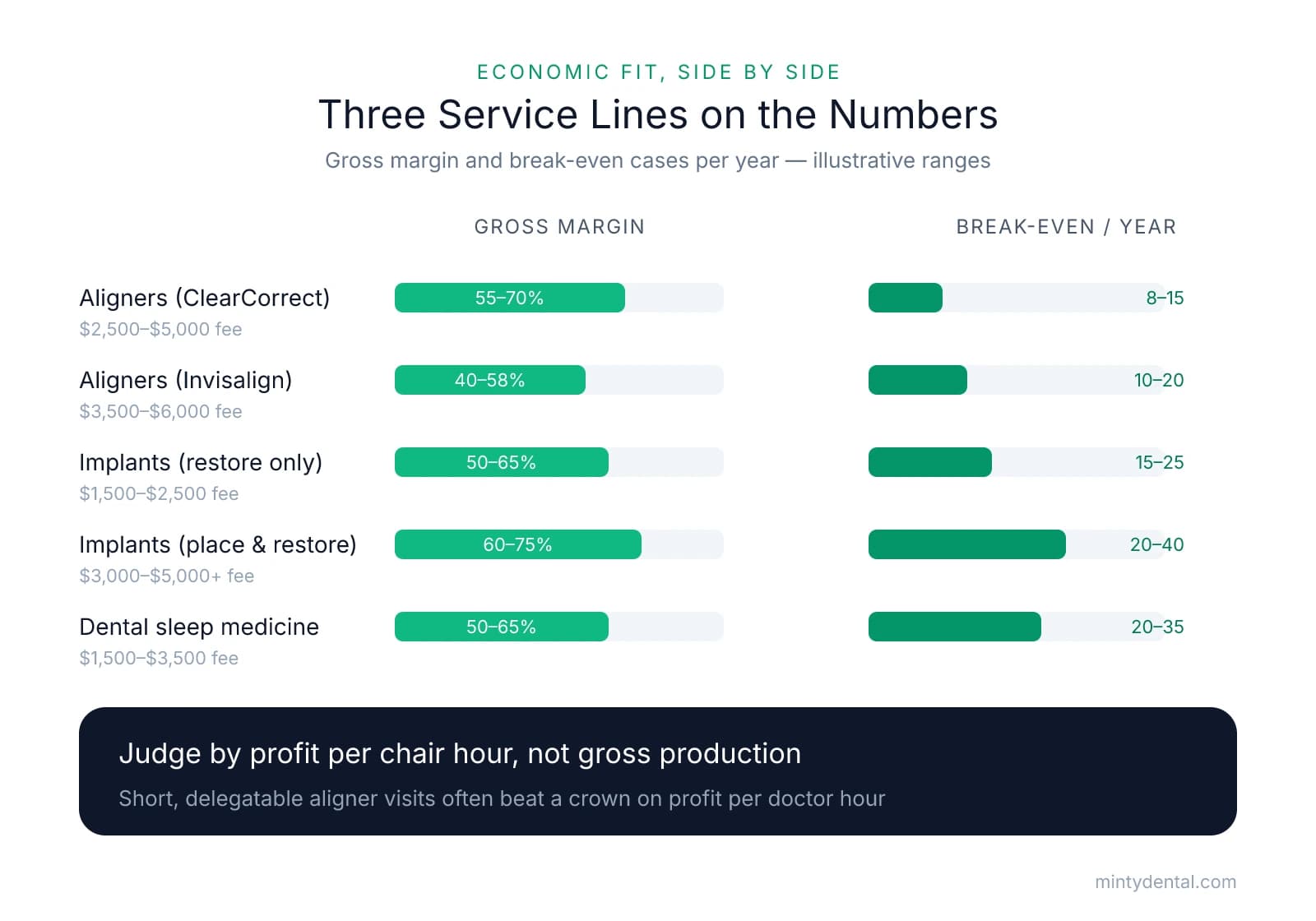
Once you have a shortlist from those two sources, the economics need to run before you commit. Here's how three commonly added service lines compare on the numbers that matter.
Clear aligners carry case fees in the $2,500 to $6,000 range. Lab cost is where the platforms diverge sharply: Invisalign runs $1,500 to $1,900 per case while ClearCorrect comes in at $700 to $1,200, producing gross margins of roughly 40 to 58% for Invisalign and 55 to 70% for ClearCorrect. Training investment is minimal — most platforms charge $0 to $500. The significant capital question is the intraoral scanner: if you don't already own one, budget $15,000 to $25,000. ROI timeline runs 18 to 36 months depending on your conversion rate and case volume.
Implants command $3,000 to $5,000 or more for a single-tooth restoration. The overhead load is heavier: surgical training, CBCT imaging ($80,000 to $150,000 if you don't own one), and longer chair time per appointment. Restoring implants placed by a specialist has a much lower barrier to entry than adding surgical placement — the economics improve either way once case flow is established and systems are running smoothly.
Dental sleep medicine addresses a genuinely large unmet need. An estimated 80% of OSA cases remain undiagnosed, and oral appliance fees typically run $1,500 to $3,500. The primary barrier isn't clinical — it's billing. Medical insurance reimbursement for sleep appliances requires a separate billing workflow, and practices that don't build that competency see unpredictable collections that erode what looked like a solid margin on paper.
| Service Line | Case Fee Range | Lab/Device Cost | Gross Margin | Training Cost | Break-Even Cases/Year |
|---|---|---|---|---|---|
| Clear aligners (ClearCorrect) | $2,500 to $5,000 | $700 to $1,200 | 55 to 70% | $0 to $500 | 8 to 15 |
| Clear aligners (Invisalign) | $3,500 to $6,000 | $1,500 to $1,900 | 40 to 58% | $0 to $500 | 10 to 20 |
| Implants (restore only) | $1,500 to $2,500 (crown/abutment) | $300 to $600 | 50 to 65% | $500 to $2,000 | 15 to 25 |
| Implants (place and restore) | $3,000 to $5,000+ | $400 to $700 | 60 to 75% | $5,000 to $20,000+ | 20 to 40 |
| Dental sleep medicine | $1,500 to $3,500 | $500 to $900 | 50 to 65% | $1,500 to $4,000 | 20 to 35 |
Hypothetical illustration based on published fee and cost ranges. Actual results will vary by market, fee schedule, payer mix, and case volume.
The profit-per-chair-hour lens reshapes how these compare. An aligner case involves 8 to 12 appointments, but most of those visits are short, hygienist-delegatable check-ins with minimal doctor chair time. That structure means aligner therapy frequently outperforms a crown on profit per doctor hour, even when the case fee is similar, because the doctor's time is concentrated in the scan and treatment-planning appointments rather than spread across multiple long clinical visits. If you want to see how your current production rate stacks up before adding a new service, the production-per-hour benchmarks give you a baseline to work from.
The pencil test here is simple: take your realistic case volume from the referral log, apply the gross margin from the table above, and subtract your estimated training and equipment costs. If the math doesn't work at a conservative case estimate, the service isn't ready for your practice yet regardless of how compelling the opportunity looks on a manufacturer's slide deck.
Launching Without Disrupting What's Already Working
The most common reason a new service underperforms in its first year has nothing to do with clinical quality. The dentist has completed the training, the equipment is in place, and the procedures get done competently. What fails is the operational layer around the procedure: the front desk doesn't know how to present the fee, the hygienist can't answer a patient's basic question about what the service involves, and there's no clear place in the schedule for it. A new procedure that lacks that infrastructure tends to get squeezed into whatever gaps exist in the existing schedule, handled inconsistently, and quietly abandoned after six months of disappointing case numbers.
Bringing new techniques into a practice requires the same investment in team training as it does in clinical preparation — the clinical work and the operational work have to move together. That sequence has a practical shape.
Start by identifying one service champion. This is the team member who owns the new service's workflow from the inside: tracking cases, staying current on scheduling protocols, and fielding questions from the rest of the team. It doesn't have to be the dentist. A treatment coordinator or experienced chair-side assistant often makes a better champion because they sit closer to the patient conversation and the scheduling process than the clinician does.
Train the full team on the patient journey before the first case goes on the books. That means everyone on the team understands what the service is, who it's for, how to answer the three or four questions patients reliably ask, how to schedule it correctly, and how to handle the fee conversation without defaulting to "let me ask the doctor." This last point matters more than practices usually expect. A financial coordinator who isn't confident presenting a $3,000 aligner fee will hedge, delay, and cost you cases. Covering the financial conversation in advance of launch is not optional.
Run three to five internal cases or structured role-plays before opening the service to your general patient base. Internal cases with team members or family smooth out the workflow gaps that aren't visible in a training course. Role-plays accomplish something similar for the front desk and financial conversations. Both approaches build confidence and surface problems before they affect paying patients.
Build a dedicated schedule block for the new service rather than fitting cases into existing slots. Squeezing new procedures into a full schedule creates pressure on both the clinical team and the patient experience. Dental block scheduling gives the service room to breathe and protects your existing production from the disruption that comes when timing runs long on an unfamiliar procedure.
Communicate to existing patients through the hygiene chair first, not a mass marketing campaign. The Scheduling Institute's view that the strongest demand signal is what patients are already asking for means the patients most likely to convert are already sitting in your hygiene chairs every six months. A hygienist who can identify a candidate, mention the service naturally, and answer a follow-up question will generate more cases than a website banner or a postcard. That requires training the hygiene team before launch, not after.
Operational readiness has to precede patient communication -- not follow it.
Measuring Whether the New Service Is Actually Paying Off
Five numbers tell you whether a new service is genuinely contributing to your practice or just occupying schedule time: cases started per month versus your target, production per chair hour for the new service compared to your existing procedure mix, contribution margin per case (revenue minus direct lab or device costs and clinical time), case acceptance rate for the new service specifically, and time from patient identification to case start. That last one is often overlooked, but a long lag between "the hygienist mentioned it" and "the patient scheduled" usually points to a breakdown in the financial conversation or the follow-up process, not a lack of interest.
Gross production totals are the wrong scorecard. A service can appear on your monthly report as $50,000 in production and still be a net drag if it's displacing higher-margin restorative cases or consuming team time that isn't reflected in the production number. The only way to see that clearly is to track contribution margin per case alongside chair time consumed, and compare both to what would have filled that time otherwise. Knowing your numbers is the number one priority of a profitable practice — and that applies just as much to evaluating a new service line as it does to managing overall overhead.
A practice adds clear aligners and targets three cases per month at a $4,500 average fee with a $1,200 lab cost. That's $3,300 in gross margin per case, or $9,900 per month across three cases, before accounting for doctor chair time. If each case averages 10 visits at 20 minutes of doctor time, the whole three-case month consumes roughly 600 minutes, or 10 hours, of doctor chair time to generate $9,900 in gross margin. That works out to approximately $990 per doctor hour in gross margin terms. Framed differently against total fee collected, three cases at $4,500 across 10 hours of doctor time is $1,350 per doctor hour in production, which compares favorably to restorative benchmarks for most general practices. (This is a hypothetical illustration; your numbers will depend on your fee, lab platform, and visit structure.)
The evaluation window matters as much as the metrics. Use the 90-day mark to assess whether the operational systems are functioning: are cases being identified consistently, is the team presenting the service with confidence, are appointments being scheduled correctly, and is the acceptance rate in a reasonable range? At 90 days you probably don't have enough cases to draw financial conclusions, but you can see whether the infrastructure is working.
The financial evaluation belongs at six to twelve months, when you have enough case volume to calculate a reliable contribution margin trend. If the service isn't covering its direct costs by month twelve, the problem is almost always case volume or case acceptance rather than the service itself, and both of those are fixable before you consider cutting. Low case volume usually traces back to identification gaps in the hygiene chair; low acceptance usually points to the financial presentation. Neither requires abandoning the service line.
One number that has to be in the model from day one: if the service required equipment financing, debt service is a fixed cost that belongs in your break-even calculation before the first case is scheduled, not after you've already committed. You can run those figures through the dental loan calculator to confirm how many cases per month you need to cover principal and interest alongside direct costs. A service that breaks even on lab fees alone may still be cash-flow negative once equipment payments are factored in, and catching that early changes how aggressively you pursue case volume in the first few months.
Sources & References
The data and claims in this article are drawn from the following sources. We prioritize government data, peer-reviewed research, and established industry publications to ensure accuracy.
- Six Ways to Strengthen Your Practices Bottom Line— ada.orgIndustry
- Dental Practice Profitability: A Complete Guide— dentalpracticeinsider.orgIndustry
- Clear Aligner Profitability 2026: ClearCorrect Vs Invisalign— dentalpracticeinsider.orgIndustry
- Calculating the ROI of dental sleep medicine— www.dentaleconomics.comIndustry
- Implementing Dental Techniques: Team Training & Communication— www.dentalmanagers.com
- How to Introduce a New Service Line Into Your Dental Practice— schedulinginstitute.comIndustry
- The fee-for-service practice: The importance of knowing your ...— www.dentaleconomics.comIndustry
Turn New Services Into a Thriving Practice
Expanding your service offerings is just one piece of building a profitable independent practice. Minty helps practice owners handle the operational complexity so you can focus on patient care.