How to Set Up an In-House Dental Membership Plan

Co-Founder, Minty Dental

In Summary
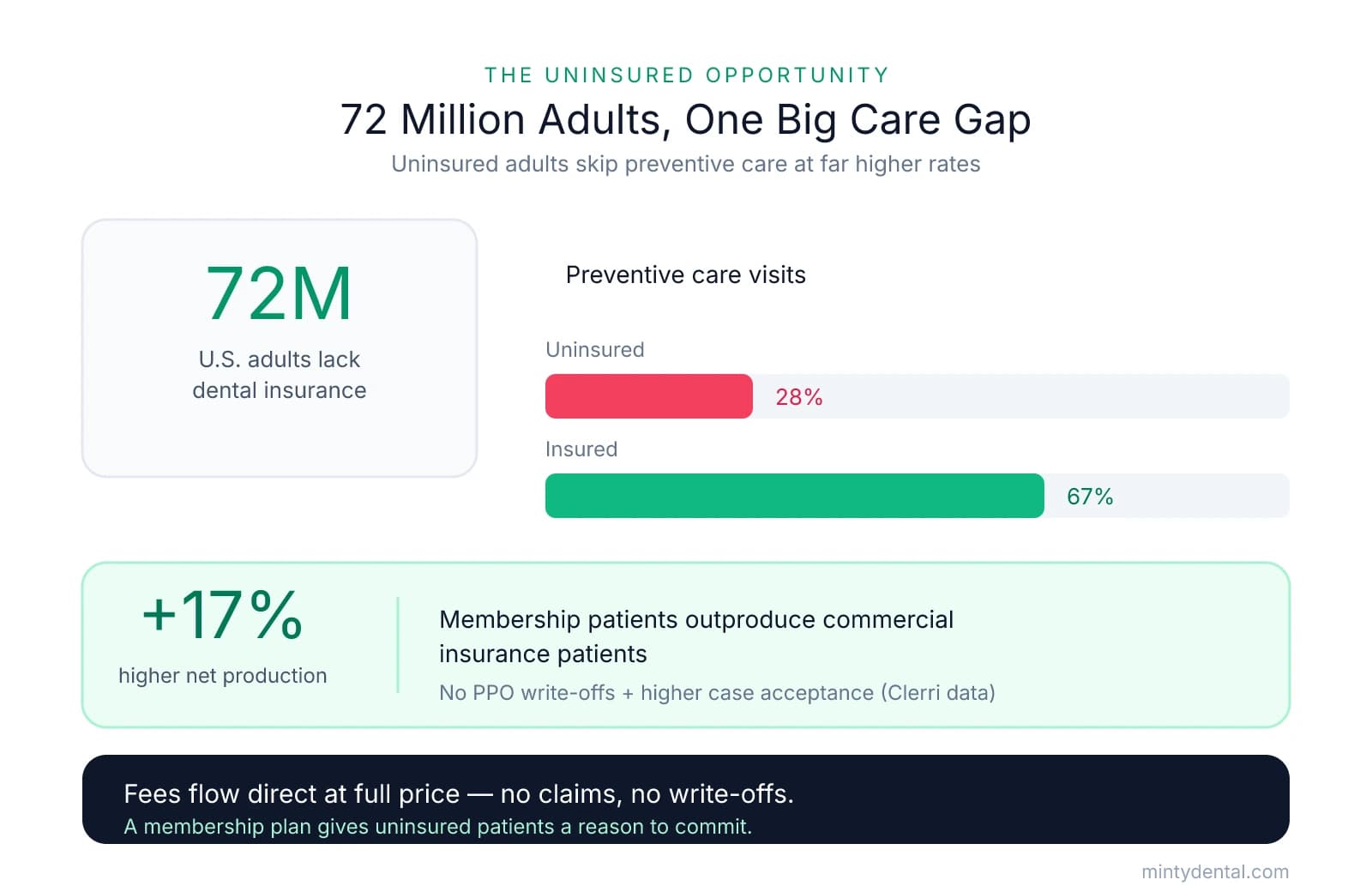
- About 72 million U.S. adults lack dental insurance, and only 28% of uninsured adults visit a dentist for preventive care compared to 67% of insured adults.
- An in-house membership plan is a direct subscription between your practice and the patient: no insurance company, no claims, no write-offs.
- The typical structure covers two cleanings, exams, and X-rays for a fixed annual or monthly fee, plus a percentage discount on other treatment.
- Because fees flow directly to the practice at full price, there are no PPO adjustments; Clerri data shows membership patients generate 17% higher net production than commercial insurance patients.
- The practice owner sets the terms, controls the pricing, and owns the patient relationship entirely.
A Membership Plan Converts Uninsured Patients Into Recurring Revenue
An in-house dental membership plan is a direct subscription contract between your practice and the patient. The patient pays a fixed monthly or annual fee; in return, they receive a defined set of preventive services and a percentage discount on additional treatment. That's the entire structure. There's no insurance company in the middle, no claims to file, no EOBs to reconcile, and no contracted write-offs reducing what you actually collect.
That distinction matters both legally and operationally. Because the plan isn't insurance, it isn't regulated by state insurance commissioners the same way a carrier would be. It's a services contract, and you're the one writing it. That said, most states have specific statutes governing how these plans must be structured and disclosed, which is why the legal setup deserves its own attention before you finalize any pricing or member agreements.
The patient population these plans are designed to reach is substantial. Roughly 72 million U.S. adults lack dental insurance, and the gap in utilization is stark: only 28% of uninsured adults visit a dentist for preventive care, compared to 67% of insured adults. Those patients aren't skipping care because they don't value their teeth. They're skipping it because they have no cost framework and no reason to commit to a practice. A membership plan gives them both.
The economics on your end are meaningfully different from a PPO arrangement. Under a typical PPO contract, you agree to a fee schedule that may run 20% to 40% below your full fees, then file a claim, wait for reimbursement, and write off the balance. With a membership plan, the fee comes in directly at whatever rate you've set. No adjustment, no lag. Membership patients generate 17% higher net production than patients covered by commercial dental insurance — a gap that reflects both the absence of write-offs and the tendency of engaged, paying members to accept more treatment. It's worth noting that this production difference is one reason some owners use membership plan growth as leverage when thinking through whether to drop a PPO or reduce their insurance dependence more broadly.
The plan is entirely yours. You set the fee, define the included services, choose the discount percentage, and decide who administers it. Unlike a third-party discount network, there's no outside organization taking a cut or dictating your fees to other participating providers. The patient relationship stays with you, and the recurring payment trains patients to think of your practice as their dental home year-round, not just when something hurts.
Legal and Contractual Checks Before You Launch
Before you enroll a single patient, two distinct compliance issues need to be resolved: your state's rules for the plan itself, and what your existing PPO contracts say about the fees you offer to patients outside the network.
State regulation of discount medical plans
When a patient pays a periodic fee to access discounted dental services, that arrangement is classified as a discount medical plan (DMP) in most regulatory frameworks. DMPs are currently regulated in 35 states, and the requirements vary enough that you can't assume what applies in a neighboring state applies in yours. Common obligations include registering or obtaining a license from the state insurance department before selling the plan, using written member agreements that meet specific disclosure standards, including compliant marketing disclaimers, offering defined cancellation rights, and in some states, posting a surety bond.
The good news is that a number of states have passed direct primary care agreement legislation that explicitly carves out single-provider in-house plans from insurance regulation. If your state is one of them, you may face significantly fewer requirements. But you need to confirm your state's status rather than assume it; the insurance department's website is the right starting point.
Non-compliance carries real consequences. A plan that gets suspended or terminated mid-year leaves members without coverage they've already paid for, creates refund obligations, and damages the patient trust the plan was designed to build.
PPO contract conflicts and MFN clauses
The second risk is quieter but worth taking seriously. Many PPO contracts include a most-favored-nation (MFN) clause, which requires you to give that carrier your lowest available fee. If you offer membership patients a 20% discount on crown fees and your PPO contract includes MFN language, the carrier could argue you're obligated to extend that same discount to their insured patients, or that you've violated the contract terms.
This doesn't mean a membership plan and your PPO contracts can't coexist; it means you need to review the contracts before you set your membership discount. Pull each carrier agreement and search for MFN language, "most favored nation," or "lowest fee" provisions; legal review is the first step before any plan design decisions. If you're also weighing whether certain carrier contracts are worth keeping at all, the process of renegotiating PPO fees often surfaces the same contract language.
A dental attorney with health law experience can read both your state's DMP statutes and your carrier agreements in an hour or two. The cost is minimal relative to the exposure. Get this done before you finalize any pricing or member agreements, not after you've already started signing patients up.
Designing and Pricing the Plan Your Patients Will Actually Join
Keep the tier structure simple. Two or three options is enough: an adult plan, a child plan, and optionally a periodontal maintenance tier for patients on three- or four-month recall cycles. More than that and your front desk starts struggling to explain the differences, patients get confused during checkout, and enrollment stalls. Complexity is one of the most reliable ways to kill an otherwise sound plan.
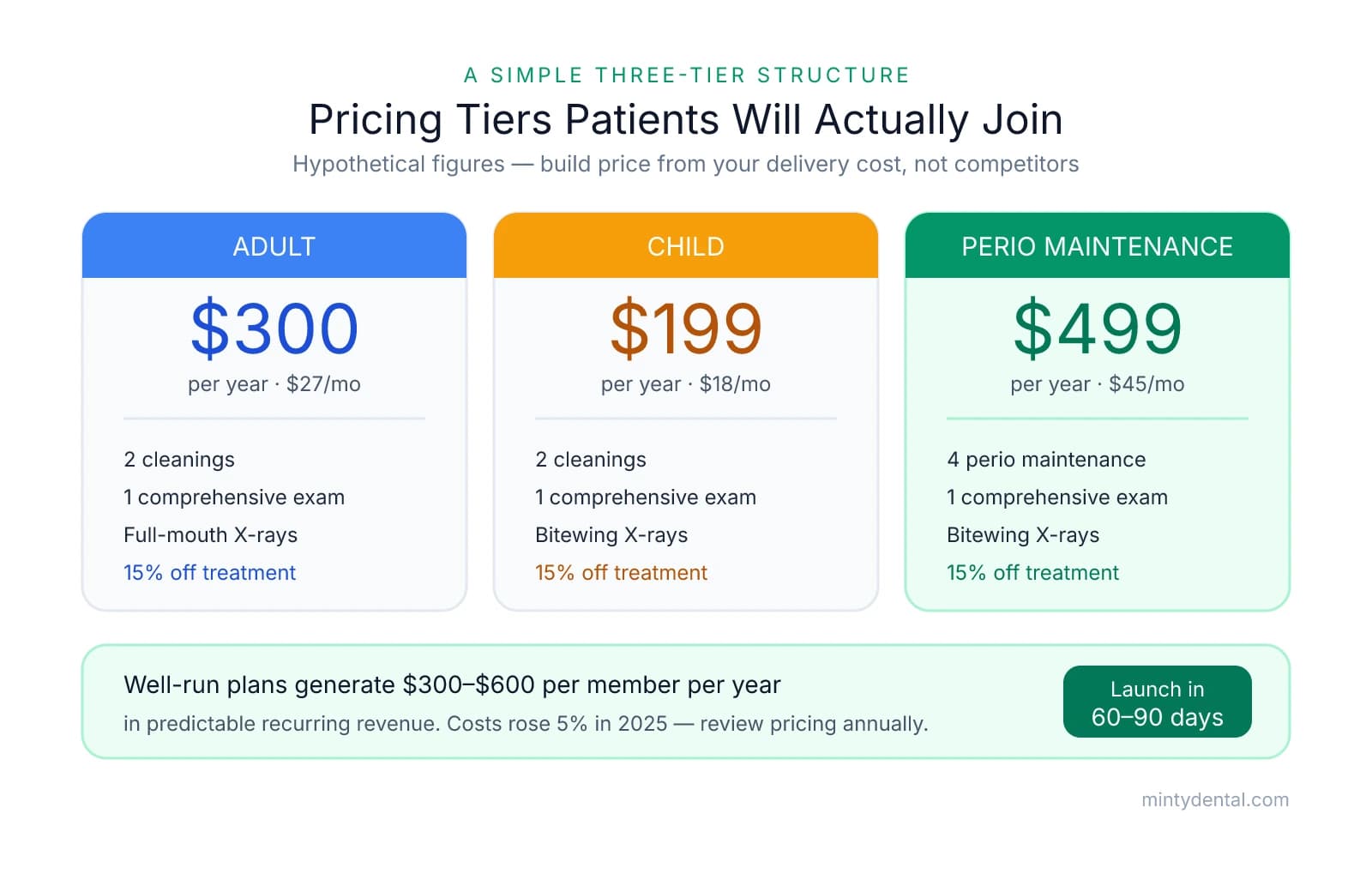
The standard adult plan typically includes two prophylaxis cleanings, one comprehensive exam, full-mouth X-rays, and a discount on any additional treatment — commonly 15% to 20%. That bundle maps to what an uninsured patient actually needs to stay current on preventive care, which makes it easy to present as a straightforward value proposition.
Build the price from your costs, not from what feels competitive
The most common pricing mistake is picking a number that sounds attractive and checking the math afterward. Start instead with what it actually costs your practice to deliver the included services: hygienist chair time, materials, and your allocated overhead for those appointments. If two adult cleanings and a comprehensive exam cost your practice $150 to deliver, a $25/month plan ($300/year) covers that cost and still leaves margin to absorb the treatment discount you're extending. That's the floor, not the target. Set your fee above it with enough room that the discount on other treatment doesn't push you into subsidizing care.
To make this concrete, here's how a simple three-tier structure might look (hypothetical figures):
| Plan | Included Services | Annual Fee | Monthly Fee |
|---|---|---|---|
| Adult | 2 cleanings, 1 exam, FMX, 15% off treatment | $300 | $27 |
| Child | 2 cleanings, 1 exam, BWX, 15% off treatment | $199 | $18 |
| Perio Maintenance | 4 perio maintenance visits, 1 exam, BWX, 15% off treatment | $499 | $45 |
Well-run plans typically generate $300 to $600 per member per year in predictable recurring revenue, with the range reflecting differences in fee levels, local markets, and what's included.
Offer both billing options, but favor annual
Annual billing is better for the practice on nearly every dimension: you collect the full year upfront, you eliminate twelve separate card-decline events per member, and the cash lands before you've delivered any of the included services. The downside is that a $300 lump payment is a harder ask, particularly for the fixed-income patients these plans are often designed to reach.
Monthly billing is the easier enrollment conversation, especially when you're framing the plan for someone who's used to thinking about insurance premiums. The practical answer is to offer both and let the patient choose. A useful parallel: the same framing that helps a patient say yes to a payment plan works here too, which is why the principles behind presenting financing without pressure apply equally to the membership conversation at checkout.
Review pricing every year
A plan priced correctly at launch will erode over time if you leave the fee flat. Dental supply and equipment costs rose 5% in 2025 alone, and staff wages have climbed alongside broader inflation. A membership fee that covered your costs in year one may be running at a loss in year three without a single change to the plan itself. Build an annual pricing review into your calendar, treat it the same way you'd review your procedure fees, and adjust before the gap between your costs and your collections becomes a problem.
Enrolling Patients and Tracking What the Plan Is Actually Doing
The fastest path to your first members is already inside your practice management system. Pull a report filtered for active patients with no insurance on file, and focus first on patients who've visited in the last 18 months but whose treatment plans show incomplete or declined work. These are people who already trust your practice enough to come in; the cost barrier is the only thing standing between them and consistent care.
Once you have that list, the front desk is your primary enrollment channel. The conversation almost always starts the same way: a patient declines a treatment estimate or mentions at checkout that they don't have insurance. That's the moment to introduce the plan naturally, not as a sales pitch but as a direct answer to the problem they just named. The script doesn't need to be elaborate. Acknowledge the cost concern, explain that the practice offers a direct-pay membership that covers their preventive care and reduces fees on other treatment, tell them what's included and what it costs per month, and offer to enroll them before they leave. Patients who are already in the chair and engaged in a care conversation are far more likely to say yes than patients you try to reach by postcard later.
The infrastructure question shifts as your member count grows. A spreadsheet handles the basics when you have 10 members: names, plan tier, billing dates, renewal dates. By the time you're managing 30 to 100 members, manual tracking becomes genuinely costly in ways that aren't obvious at first. Failed payments sit unnoticed until the next billing cycle. Renewals get missed. The front desk carries an informal system in their heads, and when someone leaves, that knowledge leaves with them. Dedicated membership software handles recurring billing, automatic retries on declined cards, renewal reminders, and benefit usage tracking, and it integrates with your practice management system so you're not reconciling two separate records. The administrative load of a manual plan tends to increase faster than membership does, which is the core reason practices that start with a spreadsheet eventually stop enrolling aggressively just to keep the overhead manageable.
Watch active member count and monthly recurring revenue (MRR) to understand plan size and cash flow. Track your renewal and retention rate to see whether members are staying or lapsing after year one. And compare production per visit for membership patients against your uninsured cash patients. That last comparison tends to be the most compelling internal argument for growing the plan: once a patient has paid into a membership, the financial friction around additional treatment drops significantly. The discount is already built in, the relationship feels more like a health commitment than a transaction, and case acceptance tends to rise as a result. Member production per visit consistently exceeds that of uninsured patients who pay out of pocket without any prior commitment. These four metrics belong in your monthly KPI review alongside collections, overhead, and hygiene reappointment rate.
Set a specific launch date within 60 to 90 days. A date forces the prep work to actually happen.
Sources & References
The data and claims in this article are drawn from the following sources. We prioritize government data, peer-reviewed research, and established industry publications to ensure accuracy.
- Out of Pocket: A Snapshot of Adults' Dental and Medical Care Coverage— carequest.orgIndustry
- Why dental membership plans are outperforming insurance in ...— www.dentaleconomics.comIndustry
- Membership Plan Regulations: Everything You Need to Know to ...— groupdentistrynow.comIndustry
- [PDF] In-Office Dental Plans— ada.orgIndustry
- How Much Should You Charge for a Dental Membership Plan? Pricing ...— mconsent.netIndustry
- [PDF] In-Office Dental Plans— ada.orgIndustry
- Dental Membership Software vs. Manual Plans: What It Costs to DIY— illumitrac.comIndustry
- Managing In-Office Dental Membership Plans— www.planforward.ioIndustry
Turn Your Membership Plan Into Managed Revenue
A well-designed membership plan adds a recurring revenue layer, but the billing, tracking, and renewal workflows behind it determine whether it scales. Minty handles the operational infrastructure so your front desk can focus on enrollment.