Managing Two Dental Offices Without Being at Both Every Day

Co-Founder, Minty Dental

In Summary
- Physical presence at a location is not a management system — it is a substitute for one, and that substitution breaks down the moment you open a second office.
- Each location needs a site-level leader with genuine authority over daily scheduling, staffing coverage, and patient flow — not a senior front-desk employee who escalates every decision.
- The ADA describes the dental office manager role as overseeing daily operations, scheduling, staffing, and compliance — not flagging problems upward for the owner to resolve.
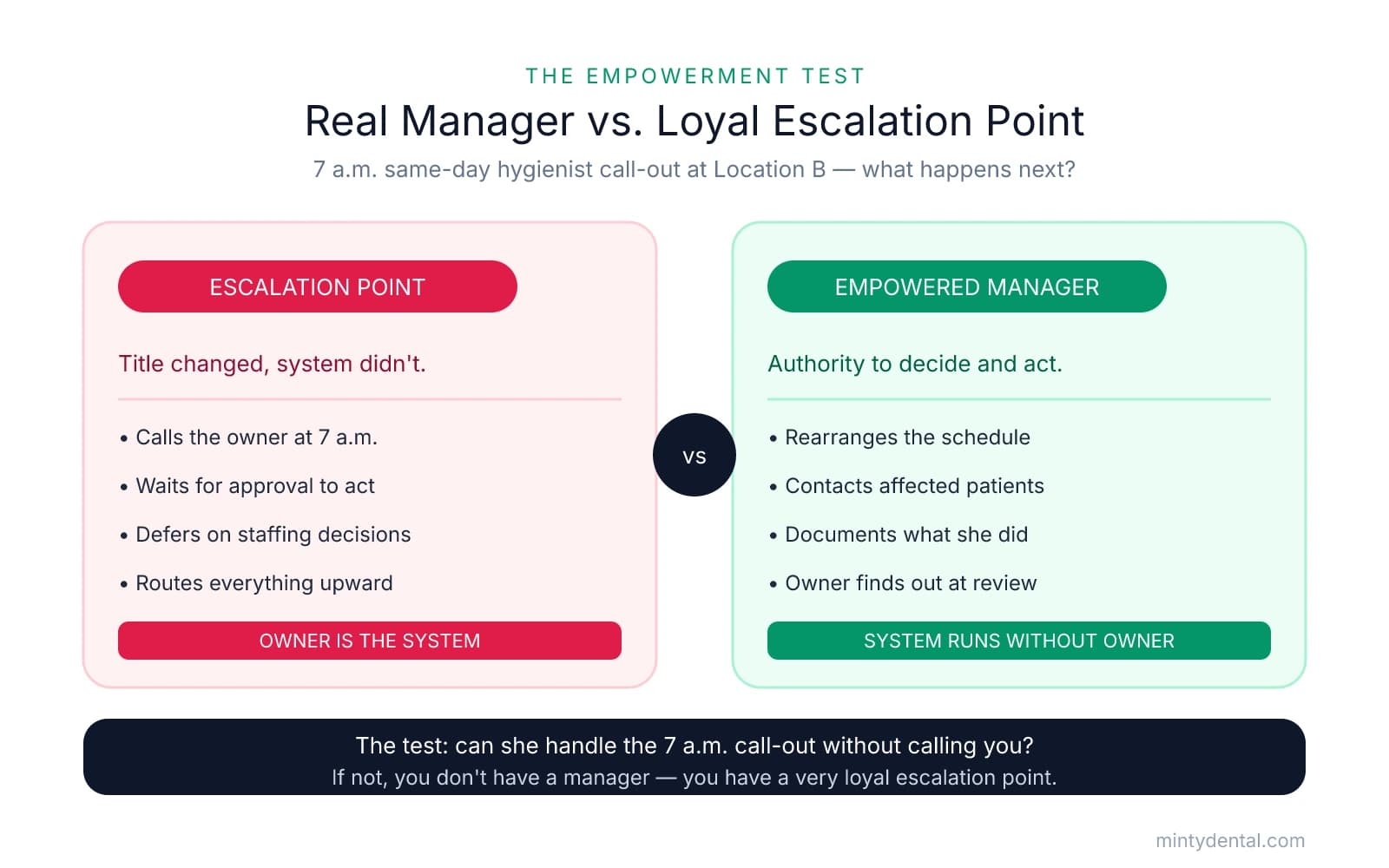
- The clearest test of whether your manager is truly empowered: can she handle a same-day hygienist call-out at 7 a.m. without calling you?
- At a second location, the associate dentist's clinical scope and the office manager's operational scope both need to be explicitly defined — overlapping or unclear authority creates daily friction.
Running Two Locations Requires a Leadership Layer Between You and Each Team
Site-level leadership means a designated person at each location has real authority to make daily operational decisions and is accountable for the outcomes. Not authority to recommend, not authority to ask — authority to decide and act. That distinction is where most two-location owners run into trouble.
When you run a single practice, your physical presence fills in for a lot of structure that isn't actually there. You know when the morning huddle drifts, when the front desk is falling behind on confirmations, when the hygienist is running forty minutes late. You course-correct in real time without a formal system, because you're there. That works — until it doesn't. The day you open a second location, you can only be in one place, and the location you're not at starts running on whoever happens to be senior on the floor. That's not management. That's improvisation.
A dental office manager's role is overseeing daily operations, scheduling, staffing, and compliance. That's the right scope. The owner's job, once a second location is operating, is to set the standard and review whether it's being met — not to execute the daily tasks that role is supposed to cover.
The practical test is a same-day staffing problem. If your Location B hygienist calls in sick at 7 a.m., what happens? An empowered office manager rearranges the schedule, contacts affected patients, and documents what she did. You find out when you review the day's notes. A senior front-desk coordinator who has been given a manager title does the same thing she's always done: she calls you. If that's your current situation, you don't have a manager — you have a very loyal escalation point.
The failure mode here is common and usually well-intentioned. An owner promotes a trusted front-desk employee who knows the practice inside-out, hands her the title, and leaves the authority structure unchanged. She's still asking for approval on schedule changes, still deferring on staffing decisions, still routing everything upward because that's how the practice has always operated. The title changed; the system didn't. If you're wondering whether your current manager is genuinely managing or just staying busy, that question is worth examining directly before you spread yourself across two locations.
At a second location specifically, there's an additional complication: the associate dentist also has legitimate authority over clinical decisions, and those two domains need clear edges. The associate decides what treatment gets done and how. The office manager decides how the schedule is structured, how staffing gaps get covered, and how the front desk operates. Where those domains overlap — say, the associate wants to extend an appointment that the schedule can't absorb — there needs to be a defined process, not a power struggle. Leaving that ambiguous means both people end up calling you to referee, which is exactly the situation you're trying to get out of.
Building a practice that doesn't route every decision through the owner is the underlying project here. The site-level leadership layer is the first structural piece that makes the rest of it possible.
Written SOPs Are What Keeps Both Offices Consistent When You're Not Watching
Left to their own devices, two separate teams will solve the same problems two different ways. Not because anyone is doing something wrong, but because people default to whatever is easiest in the moment. At Location A, the front desk has always verified insurance three days out. At Location B, someone started doing it the morning of the appointment because the software was different and nobody corrected it. Six months later, you have a surprise balance problem at one location that you don't have at the other, and the root cause is a workflow that was never written down.
This is the consistency problem SOPs solve. A written procedure encodes your standard into something that doesn't depend on your presence to enforce it.
Clinical SOPs are usually already documented, because OSHA, HIPAA, and state boards require it. The gap in most two-location private practices is operational: how a new patient call is handled, how treatment plans are presented at case acceptance, how the morning huddle runs, how end-of-day reconciliation is completed, how insurance verification fits into the pre-appointment workflow. These are the processes that directly shape patient experience and revenue, and they're exactly the areas where multi-location practices see the most variability without clear documentation. In a single office, the owner fills the gap by being present. In two offices, that gap stays open.
Staffing makes this more urgent. Across practices nationally, staffing shortages have reduced dental practice capacity by roughly 10%, which means turnover is expensive in ways beyond just replacement cost. When a front desk coordinator leaves Location B, the remaining team falls back on whatever habits they've accumulated, and the new hire learns from them rather than from a standard. A written SOP cuts that ramp-up time considerably, because the new person isn't reverse-engineering the process from observation. That's one of the more direct connections between onboarding speed and how quickly new staff actually become productive at either location.
On format: elaborate procedure manuals don't get used. A one-page checklist with the steps in order, the role responsible for each step, and the expected outcome at the end is enough for most operational workflows. If someone can't scan it in two minutes and know what to do, it's too long. The goal is a reference a new hire can actually follow and a manager can audit against.
The review trigger matters too. Most practices write SOPs once and file them. A more useful habit is treating a problem at one location as a signal to examine the relevant SOP at both. If Location B's morning huddle has been running long and unfocused, that's worth checking against what a well-structured huddle is actually supposed to accomplish and whether the written process reflects that. A broken workflow at one location often means the SOP is missing, outdated, or was never communicated clearly to the team running it.
Cloud-based practice management software, platforms like Dentrix Ascend or Curve Dental, gives you access to scheduling, production, and billing data from either location without being on-site. That technical access matters, but it only tells you what is happening. SOPs are what determine what should be happening — and whether the gap between the two is a staffing issue, a training issue, or a process that was never defined in the first place.
The Reporting Cadence That Lets You Monitor Both Locations Remotely
The first thing to get right is the structure of your financial data. A combined P&L that rolls both locations into a single set of numbers is one of the more common mistakes in multi-location bookkeeping, and it's genuinely hard to fix after the fact. Class tracking needs to be configured before the first transaction — not retrofitted after a year of blended entries. Once you've been booking revenue and expenses into combined accounts, separating them requires reconstructing every transaction. Get this right at setup, and you'll have per-location financials automatically. Skip it, and your monthly P&L can show two healthy-looking offices while one of them quietly drains cash.
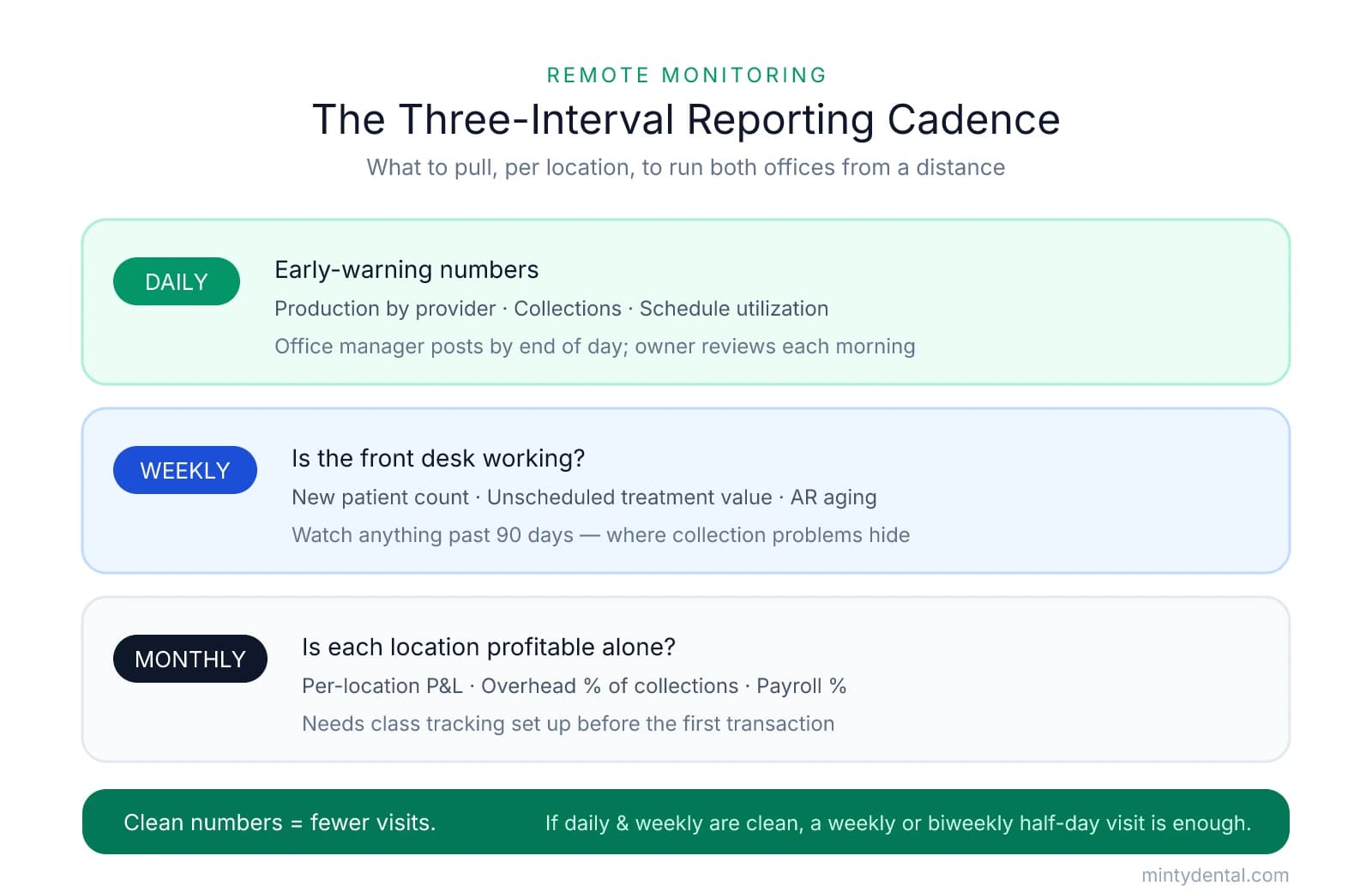
With the structure in place, the cadence itself runs at three intervals.
Daily: Production by provider and collections at each location, plus schedule utilization. These are the early-warning numbers. If Location B collected 60% of what it produced on a given day, you want to know that today, not when the month closes. Most practice management systems generate these automatically — the issue is usually that no one is pulling them on a consistent schedule. Assign the office manager at each location to post these by end of day, and build a quick review into your morning.
Weekly: New patient count, unscheduled treatment value, and AR aging, all broken out by location. These tell you whether the front desk and scheduling workflows are actually functioning. A drop in new patients at one location may reflect a referral problem or a phone-handling issue. Rising unscheduled treatment value means diagnosed work isn't converting, which points to case presentation or follow-up gaps. AR aging, specifically anything past 90 days, is where collection problems accumulate quietly. You can find a fuller breakdown of which monthly KPIs to track and what targets are reasonable if you want to build these into a standing review format.
Monthly: Per-location P&L, overhead as a percent of collections, and payroll as a percent of collections. These are the numbers that tell you whether each location is actually profitable on its own — not whether the combined practice is profitable. Dental practice KPIs need to be more than end-of-month reporting; they're the operating dashboard that shows what's happening across both sites.
Learning to read a warning sign matters as much as knowing what to pull. If Location B's collections-to-production ratio drops while production holds steady, that's not a clinical problem — it's a billing or insurance follow-up problem. Someone isn't posting payments correctly, claims are going out with errors, or denials aren't being worked. The specific places where collection rate leaks are almost always on the administrative side, and a per-location view is what lets you see them clearly rather than having them absorbed into a combined number.
The reporting cadence also determines how often a physical visit to your secondary location is actually necessary. If the daily and weekly numbers are clean, the manager is escalating appropriately, and the monthly P&L shows the location performing within normal ranges, a weekly or biweekly visit is probably sufficient. The visit becomes a check-in and a culture touchpoint rather than a search for problems you couldn't see from a distance. When the numbers flag something, you visit with a specific question to answer — which is a much more efficient use of your time than showing up on a fixed schedule hoping to catch what's wrong.
Structuring Your Own Schedule Across Two Locations
The right time split depends on a question you need to answer honestly first: are you clinically producing at both locations, or are you primarily overseeing one? If you're the primary producer at both, you have a capacity problem, not a scheduling problem. Adding an associate at the understaffed location is the more direct fix, and the financial case for that decision is worth working through before you try to optimize your own calendar. This section assumes you already have an associate carrying the clinical load at one or both locations and you're trying to figure out how to divide your time as an operator.
A realistic starting point for many two-location owners: produce three clinical days at Location A and visit Location B once a week for a half-day. That visit has a specific agenda. You're sitting down with the office manager to review the week's numbers, walking through any AR items that flagged in the weekly report, doing a brief team check-in, and spot-reviewing a handful of charts. You're not there to troubleshoot a scheduling crisis or cover a gap. If the visit consistently turns into firefighting, that's a signal the leadership or reporting structure isn't working yet, not a reason to show up more often.
Only extend that on-site time when the reports flag a specific trigger — such as production sliding for three weeks or 90-plus-day AR growing — rather than letting anxiety about the location dictate visit length.
Keeping owner time in day-to-day operations below 50 percent is a readiness benchmark for expansion, the evidence that systems can function without constant owner involvement. The same standard applies once Location B is established. A well-run second location should be able to operate for a full week without you present and show no meaningful degradation in production, collections, or patient experience. If it can't, the systems aren't mature enough yet, and spending more time on-site is only deferring that problem.
Sources & References
The data and claims in this article are drawn from the following sources. We prioritize government data, peer-reviewed research, and established industry publications to ensure accuracy.
- [PDF] Dental workforce shortages: Data to Navigate Today's Labor Market— ada.orgIndustry
- SOPs for Dental DSOs: Master Multi-Location Management - Adit— adit.comIndustry
- [PDF] Dental workforce shortages: Data to Navigate Today's Labor Market— www.ada.orgIndustry
- 9 Bookkeeping Setup Rules for Dental Offices - Accountally— accountally.comIndustry
- Key Dental Practice KPIs Every Office Manager Should Track— www.dentrixascend.comIndustry
- How to Scale a Multi-Location Dental Practice - Duckett Ladd— duckettladd.comIndustry
Let Minty Handle the Business Side at Both Locations
When you are managing two offices, the administrative load doubles fast. Minty handles billing, marketing, and technology so you can focus on the leadership and clinical work only you can do.