Dental Block Scheduling: Is It Worth It and How to Implement

Co-Founder, Minty Dental
Block Scheduling Is a Production-Design System, Not a Calendar Rule
Dental block scheduling means reserving specific time slots for specific procedure types, organized around a daily production goal rather than simply filling whatever slot is open. That distinction matters more than it might sound.
Most schedules are built reactively. A patient calls, a slot is open, the appointment goes in. Repeat until the day looks full. The problem is that "full" and "productive" are not the same thing. Two days with identical appointment counts can differ by hundreds of dollars per hour in production depending purely on how those appointments are sequenced and which procedures claimed which chair-hours. Production per hour is the honest measure of scheduling efficiency, and general dentists average $350 to $600/hour, with top-producing practices exceeding $700/hour. Block scheduling's job is to move that number intentionally rather than leave it to chance.
A crown preparation, a molar endo, or an implant placement generates far more revenue per chair-hour than a single-surface restoration or a hygiene recall. That's not a criticism of recall appointments. They're essential for patient retention, hygiene department revenue, and case diagnosis. But if a crown slot fills with a small composite because the composite booked first and nothing was protecting that time, the practice gave away its highest-margin hour without noticing. Do that across a week of scheduling and the cumulative loss is significant.
Block scheduling addresses this by deciding in advance what an ideal day looks like. Protected blocks hold time for high-value procedures. Hygiene, new patient exams, and shorter restorative appointments fill around them. The schedule is designed rather than assembled, which is what distinguishes block scheduling from a calendar preference ("we like to do crowns in the morning") with no enforcement behind it.
The more important question isn't whether block scheduling is a good idea in the abstract. It is. The question is whether your practice has the conditions for it to work. Block scheduling succeeds when the practice has a clearly defined daily production goal, enough diagnosed and unscheduled treatment to fill protected slots consistently, and a team trained to hold those slots under the real-world pressure to fill open time with whatever is available. When those conditions exist, the system pays for itself quickly in recovered production.
When they don't, the blocks sit empty or fill with low-value appointments, and the schedule looks designed without functioning that way. An empty crown block is not a scheduling failure. It's either a case acceptance problem or a diagnosis problem, and those require different solutions. Block scheduling is worth implementing when you've confirmed the bottleneck is actually in the schedule.
What Reactive Scheduling Actually Costs You
The financial damage from reactive scheduling isn't always visible on a single day. What makes it a structural problem rather than a series of one-off bad days is how it compounds: high-value procedures don't get crowded out because the team is careless, they get crowded out because nothing protected their time in the first place.
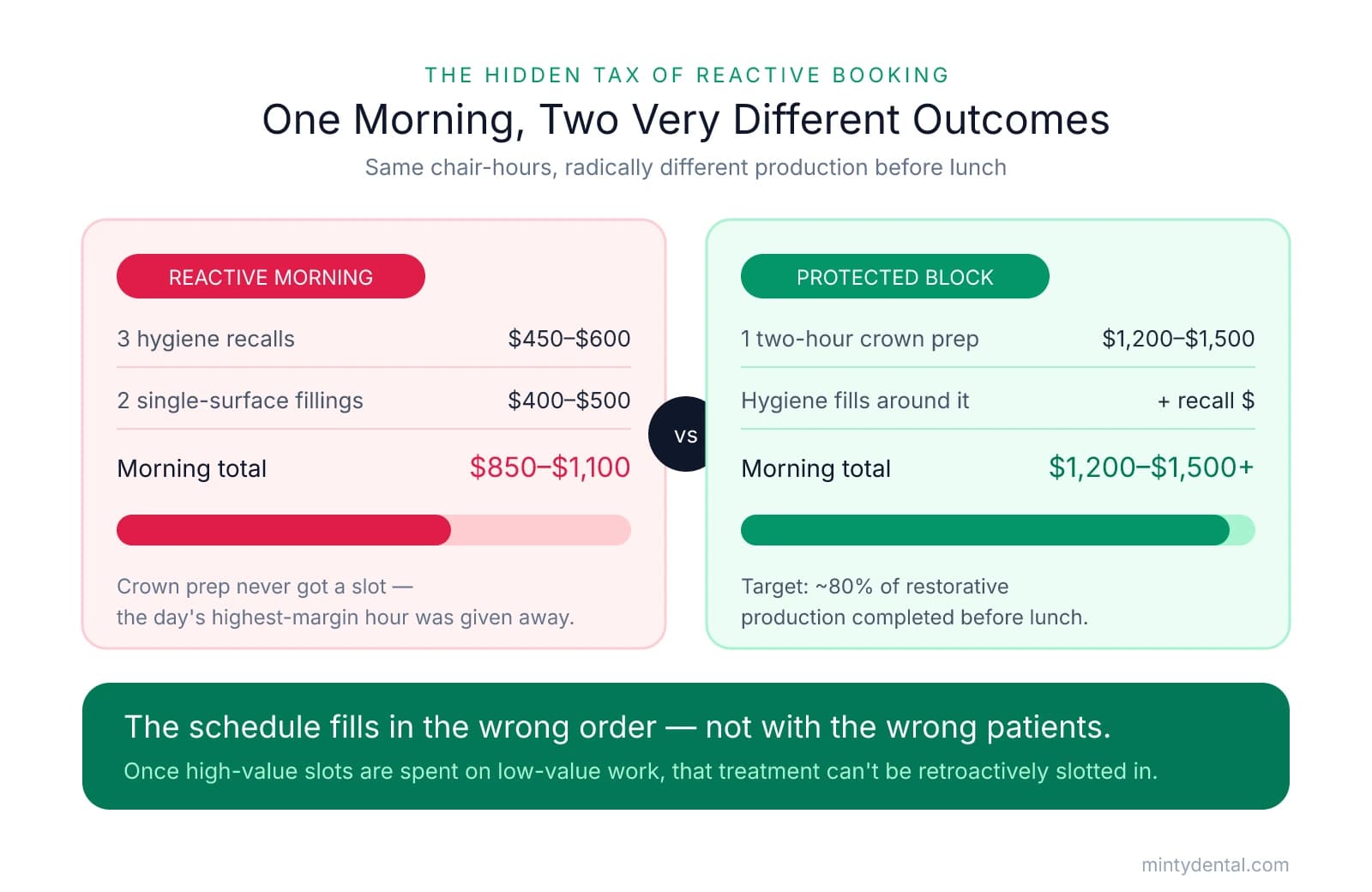
Here's how that plays out in practice. A patient calls Monday morning and books a hygiene recall into a 9 AM slot. Another calls the same afternoon and takes 10 AM for a single-surface composite. By Tuesday morning, the schedule looks full until noon. The crown preparation that was going to be scheduled for a patient who left with a treatment plan last week? There's nowhere obvious to put it, so it goes into the first available afternoon slot, or next week, or it waits until the patient calls back. The day reads as productive. Whether it hits a $5,000 goal is another question entirely.
Walk through the math. Three hygiene recalls at roughly $150 to $200 each, two single-surface composites at around $200 to $250 each: the morning generates perhaps $850 to $1,100 in production before lunch. A single two-hour crown preparation might produce $1,200 to $1,500 or more. The crown prep that never got scheduled didn't show up as a loss anywhere on the day's report, but the daily goal is unreachable before 1 PM because the morning's capacity was already spent on lower-value appointments.
This is the hidden tax of reactive scheduling: the schedule fills up not with the wrong patients, but in the wrong order, and once those slots are gone, high-value treatment can't be retroactively slotted in.
No-shows add a second layer. One no-show per day can cost a practice an estimated $70,000 in annual revenue, and practices with no-show rates above 15% show 23% lower profitability than those below 8%. In a reactive schedule, a no-show in a high-value slot is particularly damaging because there's no queue of appropriate replacement appointments ready. The slot goes unfilled, or it fills with whatever is shortest and easiest to move, which usually isn't the procedure that best uses that chair-hour.
There's also a staggered scheduling dimension that reactive booking ignores. In a two-hour crown preparation, the doctor is clinically active for roughly 60 minutes; the assistant handles impressions, temporization, and prep for the remaining time. A well-designed schedule accounts for this and sequences the doctor's actual chair time across multiple operatories. Reactive booking treats the full two-hour block as doctor time and effectively double-books the doctor's attention without realizing it, creating a bottleneck mid-morning that slows everything else down.
One important distinction worth keeping clear: if reserved crown blocks sit empty week after week, the problem probably isn't the schedule. Block scheduling will surface it, but it won't fix a case acceptance gap or a diagnosis volume problem. Those are upstream issues, and same-day treatment conversion is a separate lever worth examining before assuming the scheduling system is at fault. The schedule can only allocate time that diagnosis and case acceptance have already filled with committed treatment.
How to Build a Block Schedule for Your Practice
1. Set your daily production goal
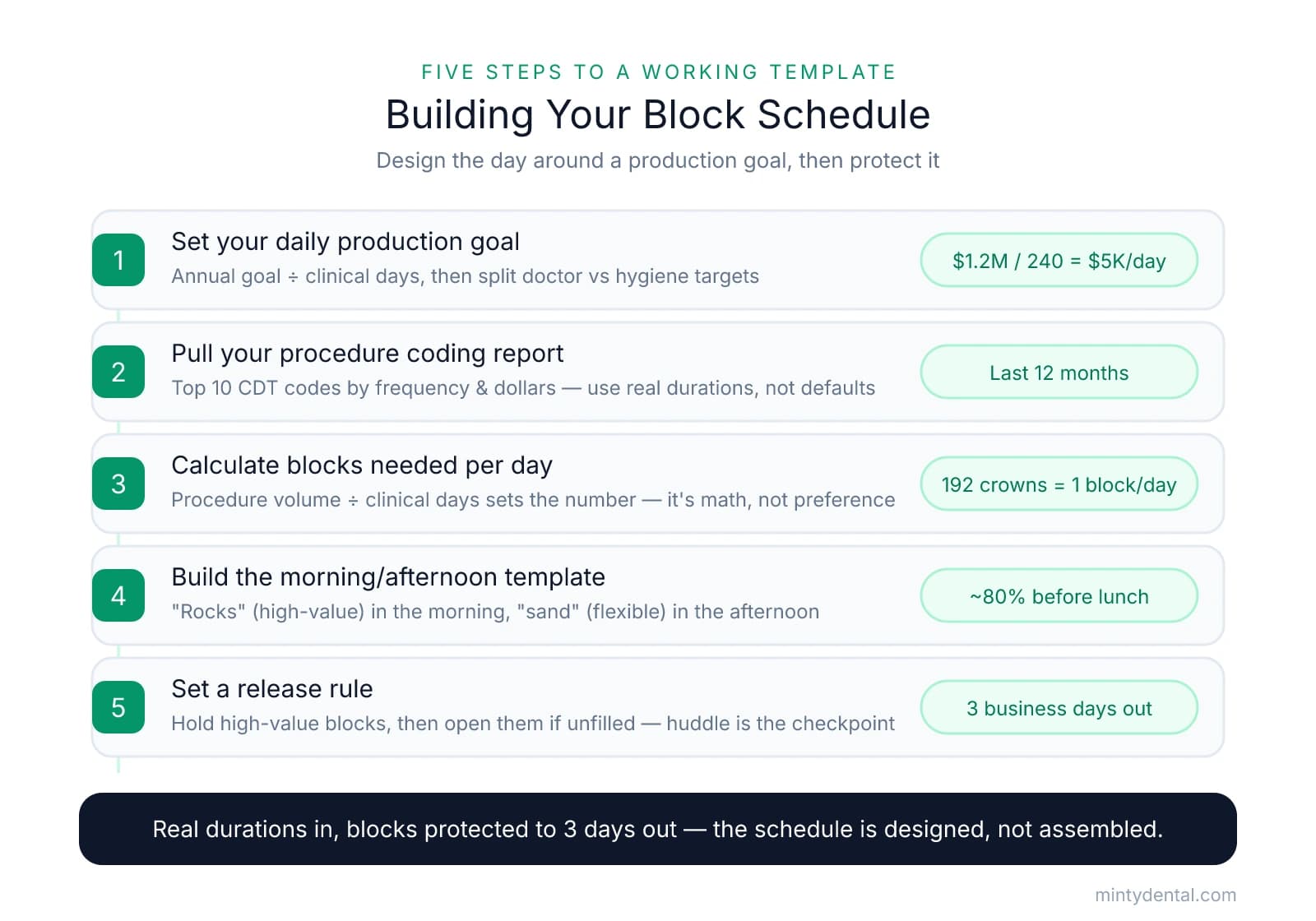
Divide your annual production goal by the number of clinical days you're actually open, excluding holidays and planned time off. If your annual goal is $1,200,000 across 240 clinical days, your daily target is $5,000. Then split that number into separate doctor and hygiene targets, because the scheduling logic for each is different. Hygiene production runs on appointment volume and reappointment rate. Doctor production runs on procedure mix and block structure. Treating them as one number obscures whether either side is actually on track.
2. Pull your procedure coding report
Your practice management software can generate a report showing which CDT codes you billed most frequently over the past 12 months. Pull the top 10 by both frequency and production dollars. Then check your actual appointment durations for those procedures, not the default times in your template, but how long they actually ran. Most practices find a meaningful gap between the two. If crown preps are booked at 90 minutes but consistently run 105, your template is structurally short, and that slips into the rest of the day. Real durations are the input; everything downstream depends on them.
3. Calculate how many high-value blocks you need per day
A zone-scheduling framework works this way: if you completed 192 crowns last year across 192 clinical days, and each crown appointment runs two hours, you need one two-hour crown block per day to absorb that volume. Run the same calculation for endo, quadrant dentistry, and SRP on the hygiene side. The number of blocks isn't a preference; it's a function of your actual procedure volume.
4. Build the morning/afternoon template
Anchor high-production procedures in the morning, when the doctor's focus is sharpest and the day hasn't accumulated delays. Lower-value appointments fill the afternoon.
| Time of Day | Procedure Type | Examples |
|---|---|---|
| Morning (Rocks) | High-production restorative and hygiene | Crown and bridge, endo, quadrant dentistry, implant placement, SRP (D4341/D4342), new patients |
| Afternoon (Sand) | Lower-production and flexible appointments | Single-surface fillings, crown seats, adjustments, emergencies, prosthetics delivery, consultations |
The goal is for roughly 80% of your daily restorative production to be completed before lunch, with the afternoon handling shorter appointments that don't require the same concentration or chair-hour value.
Map assistant-only time explicitly in your template so a second column can run simultaneously. That's how two operatories stay productive without actually double-booking the doctor.
5. Set a release rule
Protected blocks only work if someone is empowered to hold them. The standard approach is to reserve high-value blocks until three business days out, then release them for other treatment if they haven't filled. This keeps the schedule from running light in the near term while still protecting capacity in the planning window where diagnosis and case acceptance have time to generate appropriate appointments. A morning huddle is a natural checkpoint for reviewing which blocks remain open and whether unscheduled treatment in the chart can move into them — that connection between the huddle and the schedule is what keeps the system functioning day to day.
On the software side: Dentrix, Eaglesoft, and Curve Dental all support color-coded block templates. Setting this up is a configuration and training task, not a reason to change systems. The blocks need to be visible, labeled by procedure type, and understood by every team member who touches the schedule.
Why Block Scheduling Fails — and How to Make It Stick
Block scheduling erodes for one reason more than any other: the template gets designed correctly, then quietly abandoned under the pressure of a normal Tuesday. A patient calls, a block is open, it seems wasteful to leave it empty, and someone books a hygiene recall into a protected crown slot. That happens once, then again, and within a few weeks the template is decorative. The Scheduling Institute's assessment is that this is a training and standard-setting problem, not a software problem — the blocks are visible in the schedule, but the team has no clear rule about what belongs in them or who can override the protection.
The fix isn't stricter software settings. It's a written standard: which procedure types belong in which blocks, and who has the authority to release a protected slot. Without that, every person who answers the phone is making an individual judgment call under the implicit pressure of not leaving the schedule light. Most of the time, they'll fill the slot.
The second failure pattern is over-rigidity. A block system with no release rule punishes the practice on slow periods and high no-show days by leaving the schedule visibly light with no mechanism to recover it. In high-volume practices with 5,000 or more patients, rigid block scheduling can push patients out two to three weeks, which itself increases no-show risk. The answer isn't to abandon blocks. It's a three-day hold rule combined with a fast-fill waitlist of patients who've indicated they can come in on short notice. Once a protected block passes the release threshold unfilled, it opens for whatever treatment best uses that time. The waitlist makes that transition productive rather than chaotic.
The third failure pattern is a morning huddle that reviews the schedule without connecting to the block system. If the huddle confirms appointments and flags the day's production total without identifying which protected blocks are still open and who on the waitlist could fill them, the huddle isn't functioning as a scheduling tool. It's an attendance check. The scheduler's report at the huddle should answer three specific questions: which blocks are filled, which are still open, and which waitlist patients can realistically come in today. That framing turns the huddle into the daily enforcement mechanism for the entire system, and research suggests that the connection to specific production targets separates huddles that work from ones that don't.
At 90 days, success looks like this: production per hour trending upward, fewer afternoons where the team is scrambling to recover a day that went sideways before noon, and the team defending protected blocks without being reminded. That last indicator matters most. When the standard is internalized rather than enforced from outside, the system is self-sustaining.
The next step is to audit last month's schedule against your daily production goal. Count how many days the schedule appeared full, then check how many of those days actually hit the goal. If there's a consistent gap between "full" and "on target," you're looking at the cost of reactive booking in your own numbers. That gap is what block scheduling is designed to close.
Sources & References
The data and claims in this article are drawn from the following sources. We prioritize government data, peer-reviewed research, and established industry publications to ensure accuracy.
- Key Performance Indicators Every Dentist Should Monitor (And Why ...— veritasdentalresources.comIndustry
- One no-show per day can cost a practice an estimated $70,000 in annual revenue— dentaleconomics.com
- How to Reduce Dental No-Shows: 12 Patient-Attendance Tactics That Work— dentistrydashboard.comIndustry
- Constructing Zone Scheduling - Burkhart Dental Supply— burkhartdental.comIndustry
- Block Scheduling 101: A Schedule That Maximizes Production— schedulinginstitute.comIndustry
- Why Avoid Block Scheduling? - Classic Practice Resources, Inc.— classicpractice.comIndustry
Turn Your Schedule Into a Production Machine
A well-structured schedule is only as powerful as the team and systems behind it. Minty helps independent practices optimize operations so every hour in the chair counts.