Growing Revenue After Buying a Dental Practice

Co-Founder, Minty Dental

In Summary
- Loan payments begin the moment you close, but the patient base you just bought is the asset that services that debt — protecting it matters as much as growing it.
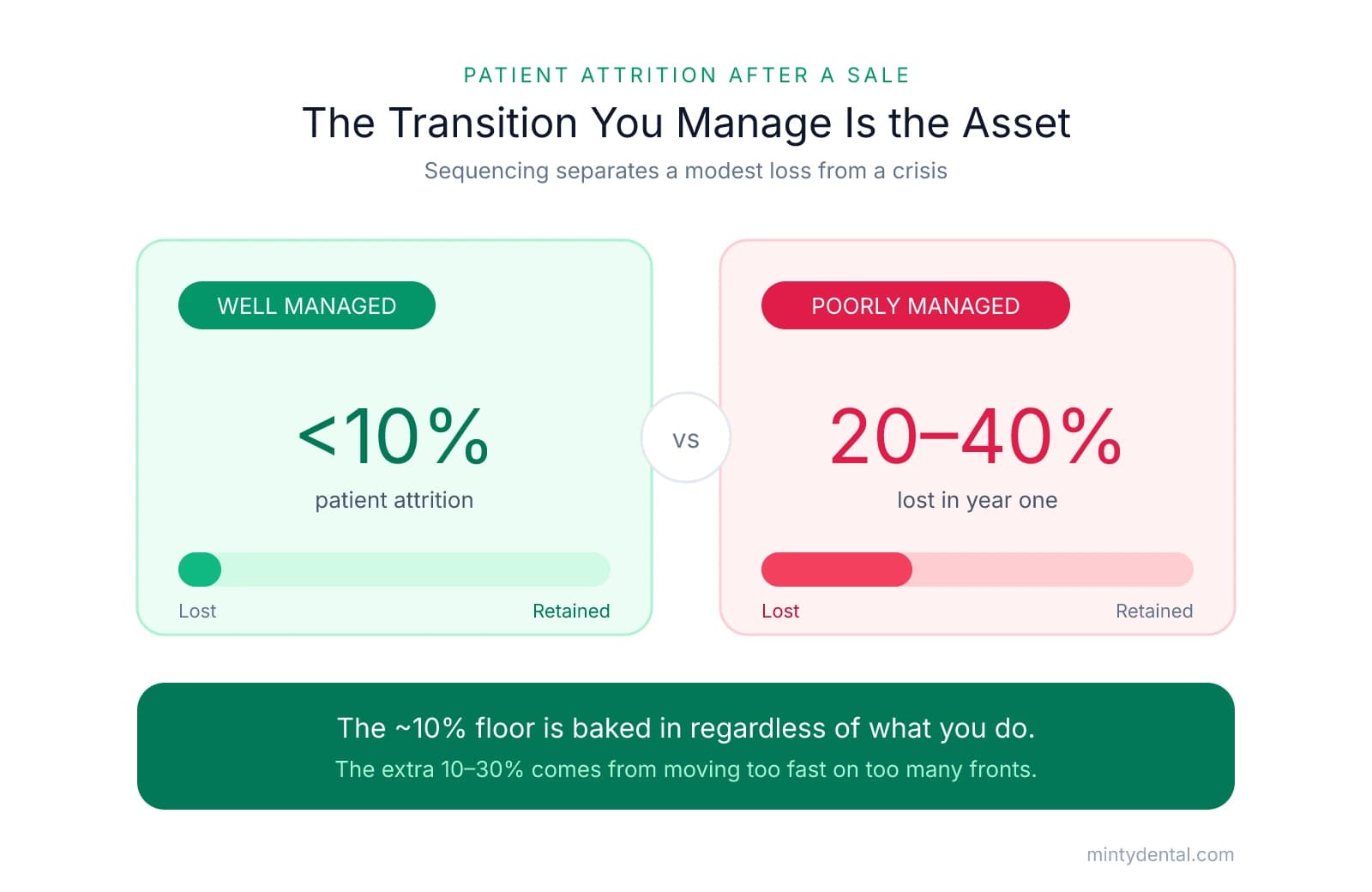
- Well-managed practice transitions see less than 10% patient attrition; poorly managed ones can lose 20–40% of the active base within the first year.
- Patients don't evaluate individual changes in isolation — they experience them as a cumulative signal about whether the practice is still theirs.
- A two-phase approach works: use months 1–6 to grow revenue from within the existing patient base, then introduce structural changes (fee increases, PPO drops, service additions) once trust is established.
- The tactics for growing revenue are well known; what most new owners underestimate is how much the sequence matters.
The Order of Operations Matters More Than the Tactics
The financial pressure after buying a dental practice is immediate and real. Your loan payments start the month after closing, but your revenue won't grow on its own. The instinct is to move fast: update the fee schedule, drop a low-reimbursing PPO, add technology, tighten the schedule. These are legitimate levers. The problem is that the changes most likely to move revenue quickly are also the ones most likely to push inherited patients out the door.
That tension is the central challenge of the post-acquisition period, and how you navigate it in the first six to eighteen months will shape the practice's trajectory far more than any individual tactic.
The good news is that patient attrition after a sale is usually modest when the transition is handled well. Well-managed transitions average less than 10% patient attrition, because most patients find the alternative — locating a new practice, re-establishing care, explaining their history — more disruptive than giving a new dentist a fair chance. That 10% or less is essentially baked in regardless of what you do. The risk comes from the other scenario: poorly managed transitions, where new owners move too fast on too many fronts, can lose 20–40% of the active base within the first year. The difference between those two outcomes is largely a question of sequencing.
The ADA's account of when Dr. Zelda bought Dr. Mario's longtime practice offers a vivid illustration of what simultaneous change looks like from the staff's side. She updated equipment throughout the office, dropped insurance plans, and compressed the schedule — all roughly at once. Within two years, her two best hygienists had quit, her experienced assistants followed, and patients were calling to have their records transferred. One hygienist put it plainly in her exit interview: "There's just been too much change." The patients saw new chairs, new technology, a higher out-of-pocket cost, and a schedule that felt rushed — not individually, but all at the same time. That cumulative experience read as a signal that the practice they knew was gone.
This is the mechanism worth understanding. Patients don't evaluate each change on its own merits. A new fee schedule, a dropped PPO, and a faster hygiene appointment might each be defensible decisions in isolation, but experienced together they feel like a different practice. The same applies to staff: their discomfort with rapid change becomes visible to patients, which accelerates departures on both sides. If the practice you bought relies heavily on relationships the previous owner built, that dynamic is even more pronounced — the kind of situation described in detail when a seller is the main source of new patient referrals.
The framework that makes sense of all this is a two-phase approach. In the first six months, focus entirely on internal growth from the patient base you already have: unscheduled treatment, recall gaps, case acceptance, and schedule efficiency. These levers are lower-risk because they improve revenue without signaling disruption to patients. Phase two, starting around months six to eighteen, is when structural changes become safer — because by then, patients have had enough positive experiences with you that a fee adjustment or a plan change reads as a practice decision rather than a warning sign.
Phase 1: The Revenue Already Sitting in Your Patient Database
Before you touch your fee schedule or drop a single PPO, run two reports in your practice management software: the unscheduled treatment report and the overdue hygiene list. These are the highest-ROI reports a new owner can pull, and neither requires you to change a single thing patients see or experience.
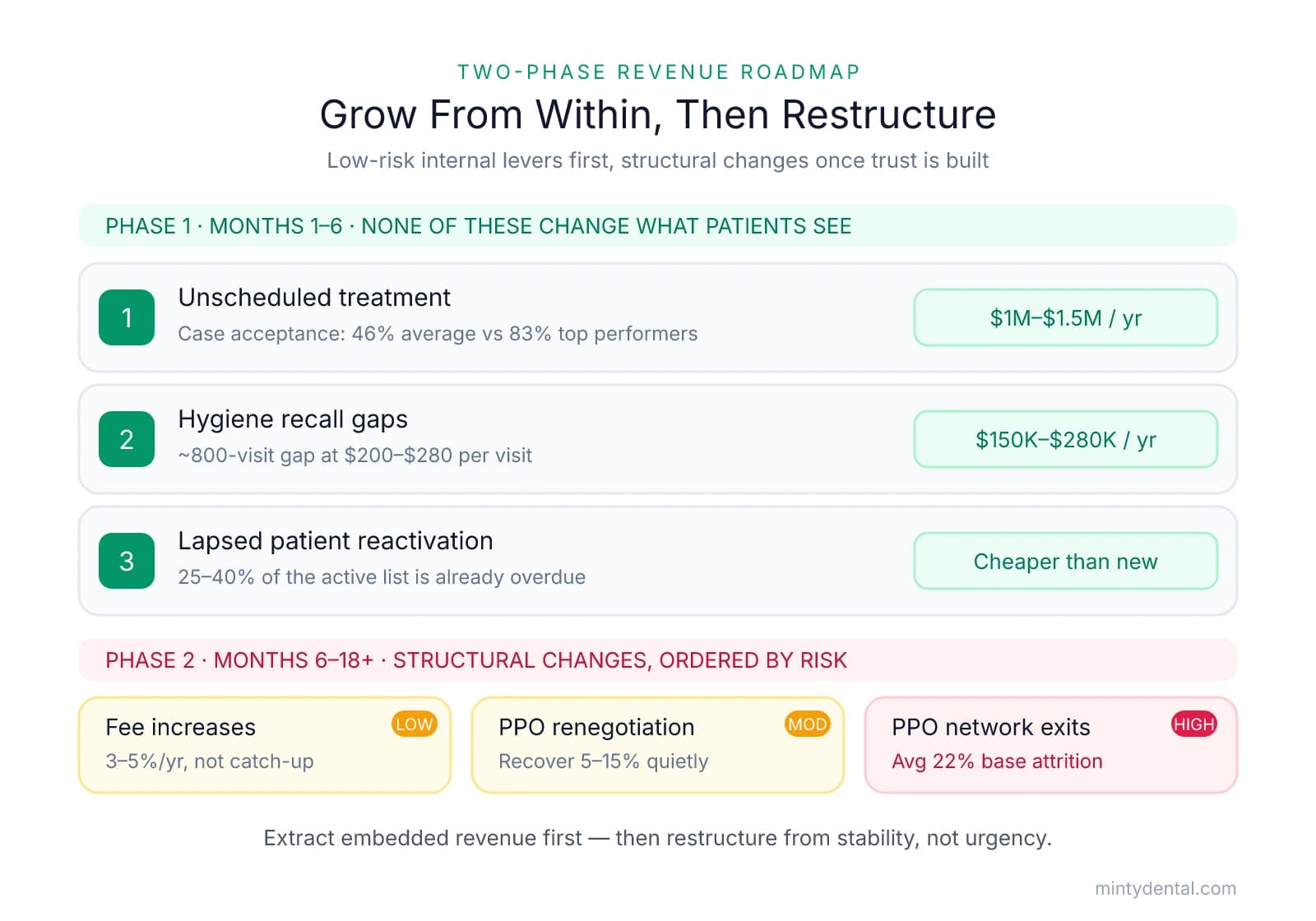
The three levers below all work the same way: they follow up on care patients already agreed to or are already clinically due for. No new fees, no new policies, no visible disruption.
Unscheduled treatment
The average dental practice has $1 to $1.5 million in annual revenue sitting in diagnosed-but-not-scheduled treatment. Average case acceptance runs at 46%, while top-performing practices hit 83%. That gap isn't mostly about clinical presentation; it's about follow-up. Structured follow-up alone can improve case acceptance by 10% or more. A simple huddle habit closes most of that gap: review which patients declined treatment the day before, assign a specific team member to call them within three days, and have a clear answer ready on financing options. The morning huddle is also where same-day capacity gets flagged, giving you a low-friction path to converting diagnosed treatment without adding appointments. If you want to build out that system further, the mechanics of increasing same-day treatment starts are worth reviewing once you've pulled the baseline numbers.
Hygiene recall gaps
A practice with 1,500 active patients on six-month recall should produce roughly 3,000 hygiene visits per year. Most practices produce closer to 2,200. That 800-visit gap, at $200 to $280 per visit, represents $150,000 to $280,000 in missing annual revenue. No dramatic change generates that kind of upside; the recall system just needs to work. For a new owner, the first task is confirming what "active patient" actually means in the inherited database — practices that have never cleaned their list often show inflated counts that make recall metrics look better than they are. Once the list is accurate, hygiene reappointment rate becomes the clearest leading indicator of whether the system is actually functioning.
Lapsed patient reactivation
Somewhere between 25 and 40% of a typical practice's active list is overdue for hygiene by the time a buyer takes over. These patients already know the practice, have established records, and are far cheaper to bring back than acquiring someone new. Reactivation outreach on a newly acquired base is particularly valuable because patients who drifted during any ownership uncertainty are often genuinely receptive to re-engagement from a new doctor who reaches out personally.
| Lever | Benchmark Gap | Revenue Opportunity | Patient-Facing Risk |
|---|---|---|---|
| Unscheduled treatment | Average 46% case acceptance vs. 83% for top practices | $1M to $1.5M annually (practice-level) | None — follow-up only |
| Hygiene recall | Most practices achieve 65–75% of theoretical visit capacity | $150,000 to $280,000 annually | None — existing care intervals |
| Lapsed reactivation | 25–40% of active list overdue | Varies by list size and reactivation rate | None — patients already know the practice |
None of these require patients to notice anything different. That's exactly why they belong in the first six months.
Phase 2: Structural Changes That Grow Revenue Without Losing the Base
Once you're six to twelve months in, patients have met you at a couple of appointments, staff have settled into the new ownership, and you have actual data on how the practice runs. That's when structural changes become worth the risk. Not because the risk disappears, but because the relationship capital you've built gives patients context for interpreting changes. A fee increase in month two feels like the new owner extracting value. The same increase in month fourteen, from a dentist patients trust and like, is easier to absorb.
The three levers in this phase are fee adjustments, PPO renegotiation or selective exits, and service additions. They're ordered here roughly by how much patient-facing disruption each one carries.
Fee adjustments
The ADA recommends reviewing and increasing fees annually to keep pace with rising overhead, particularly as team compensation grows. If the previous owner held fees flat for several years, you may have inherited a schedule that's meaningfully below your local market. The temptation is to close that gap quickly, but PKF O'D's guidance is clear: catching up all at once means patients experience a fee increase at both hygiene visits within the same calendar year, which amplifies the signal. A 3 to 5 percent annual increase is noticeable but rarely a reason to leave; a 15 percent jump to "catch up" is a different conversation entirely. If you want to walk through how to communicate these increases without triggering attrition, the mechanics of raising dental fees without losing patients cover the patient communication piece in detail.
PPO renegotiation and selective exits
PPO changes carry the highest attrition risk of anything in this section. 30.1% of owner dentists dropped insurance networks in 2024, and the data on what happens next is sobering: the average practice loses 22% of the affected patient base. That's not a rounding error when you're still servicing acquisition debt.
The underused alternative is renegotiation. Fewer than 20% of dentists regularly negotiate their PPO fee schedules, yet targeted negotiation on high-volume procedure codes can recover 5 to 15 percent on reimbursements with no patient-facing change at all. Patients never know it happened, and you don't risk the attrition that comes with a network exit. That's the right starting point for most new owners. If you do eventually decide certain plans aren't worth keeping, you'll be in a much stronger position to absorb attrition after patients have built loyalty to you personally. The full decision framework for renegotiating PPO fees without dropping and for dropping a PPO with minimal patient loss covers both paths in detail.
Service additions
Adding a service the previous owner didn't offer, whether that's implants, clear aligners, or sleep dentistry, is the lowest-risk structural change in this phase. It attracts new patients without threatening anything existing patients rely on. The contrast matters: removing a service patients depended on, or changing network participation they budgeted around, takes something away. Adding a service gives patients and referral sources a new reason to engage with the practice. It also doesn't require a difficult conversation with anyone.
| Change | Timing | Patient-Facing Risk | Notes |
|---|---|---|---|
| Unscheduled treatment follow-up | Months 1–6 | None | Works on existing diagnosed care |
| Hygiene recall and reactivation | Months 1–6 | None | No change to fees or insurance |
| Annual fee increases (3–5%) | Months 6+ | Low | Increase annually, not in catch-up jumps |
| Service additions | Months 6+ | Low | Attracts new patients without threatening existing ones |
| PPO renegotiation | Months 9–18 | Low to moderate | No patient impact if successful; builds leverage before exit decisions |
| PPO network exits | Months 12–18+ | High | Defer until patient relationships are well established; average 22% attrition |
By the time you're ready to make higher-risk structural decisions, you should have real data on which plans are worth keeping, a patient base that knows you, and enough runway that you're not making high-stakes decisions under financial pressure.
Putting the Plan Together: A 12-Month Revenue Roadmap
Months 1–3: Stabilize, communicate, and pull the data
The operational foundation covered in the first 90 days after closing is the prerequisite for everything else here. Staff stability comes first because your team's confidence in the transition is what patients actually see. Introduce changes quietly and selectively; this isn't the moment to overhaul office policy.
On the clinical data side, run the unscheduled treatment report and the overdue hygiene list in week one. You don't need to act on everything immediately, but you need to know what's there. These numbers establish your baseline, and they tell you where the practice's organic revenue capacity actually sits. Send a personal introductory letter to the patient base and set the morning huddle as a non-negotiable daily rhythm. That huddle is where follow-up calls get assigned, same-day openings get flagged, and recall outreach gets coordinated.
Months 4–6: Diagnose before you fix
By month four you have enough appointment cycles to see patterns. Pull your case acceptance rate. If it's below the 83% top-performer benchmark, the next question is why: is it how treatment is being presented, whether patients have a clear path to financing, or simply that no one is following up after the appointment? Each of those has a different fix. Track production per hour during this phase too, because scheduling gaps that look like a demand problem often turn out to be a structure problem that filling open time without discounting can address without touching fees or insurance. Most practices experience predictable revenue fluctuations caused by patient schedules, school calendars, and insurance benefits — knowing which months historically run lean helps you schedule production intentionally rather than react to gaps after they appear.
Months 7–12: Structural decisions from a position of strength
With six months of your own data and a patient base that has met you at least twice, you can now evaluate the decisions that carry real attrition risk. Check your fee schedule against local market rates and consider what a modest annual increase looks like given what patients have experienced with you so far. Review each PPO contract against your actual reimbursement and patient volume, and identify which plans are worth renegotiating before you consider exiting any of them. Look at your patient demographic and identify one service addition that fits it rather than one that simply interests you clinically. Keep in mind that buyers — and lenders — pay for sustainable, transferable profit, not top-line collections, so the structural choices you make now shape what this practice is worth if you ever refinance, bring on a partner, or sell.
The leading indicator to watch throughout
Patient retention rate is the metric that tells you whether everything else is working or quietly eroding the asset you paid for. Are the patients you inherited actually coming back? That number cuts through the noise of production per hour, case acceptance percentages, and reactivation rates. If retention is holding, you have room to keep building. If it's slipping, something in the sequencing needs attention before you move further into structural changes.
The practices that grow fastest after acquisition aren't the ones that change the most. They're the ones that extract the revenue already embedded in the patient base first, then make structural decisions from stability rather than urgency.
Sources & References
The data and claims in this article are drawn from the following sources. We prioritize government data, peer-reviewed research, and established industry publications to ensure accuracy.
- Patient Retention Following a Dental Practice Sale - McLerran & Associates— dentaltransitions.comIndustry
- Six Ways to Strengthen Your Practices Bottom Line— ada.orgIndustry
- Unscheduled Dental Treatment: Boost Revenue | Henry Schein One— www.henryscheinone.comIndustry
- The Dental Hygiene Recall System: Where Revenue Quietly Disappears— zeldent.comIndustry
- Four Crucial Mistakes Dental Practices Make … and Strategies to ...— www.pkfod.comIndustry
- Six Ways to Strengthen Your Practices Bottom Line— ada.orgIndustry
- Proven Guide To Reducing Dental Insurance Dependence— dentalpracticeinsider.orgIndustry
- Dental Practice Cash Flow: Effective Strategies for Every Season— www.speareducation.com
- How to Calculate & Improve Your Dental Practice Valuation: A Pre ...— sunrisedentalsolutions.com
Turn Your Acquisition Into a Thriving Practice
Owning a practice is just the beginning. Minty's operations support helps independent dentists build sustainable revenue through smarter billing, marketing, and patient engagement.