How to Reduce Dental Patient No-Shows Without a Fee

Co-Founder, Minty Dental
In Summary
- Your no-show rate is the percentage of scheduled appointments where patients did not arrive; dental practices average around 15% across the industry.
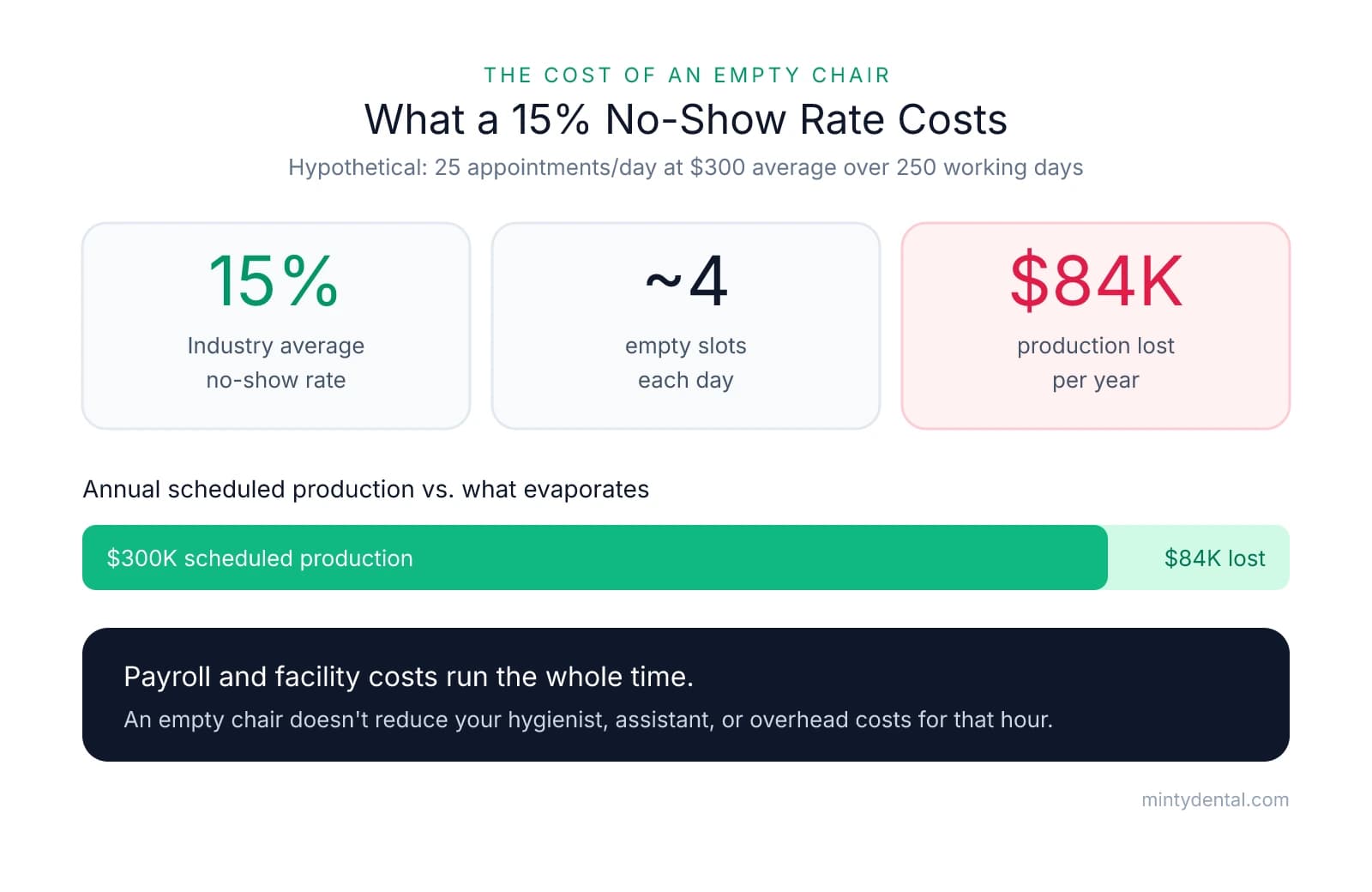
- Even a modest no-show rate compounds quickly: a hypothetical practice running 25 appointments per day at $300 average value loses roughly $84,000 in annual production while still paying staff wages for that time.
- The four main drivers of no-shows are forgetfulness, cost anxiety, scheduling friction, and long lead times between booking and appointment date.
- Cancellation fees do not fix any of these root causes and can damage relationships with reliable long-term patients who miss occasionally for legitimate reasons.
- Diagnosing which cause is dominant in your specific practice tells you which system to build first.
No-Shows Are a Systems Problem, Not a Patient Attitude Problem
Your no-show rate is the share of scheduled appointments where the patient never arrived and gave no advance notice:
No-show rate = (missed appointments / total scheduled appointments) x 100
Most practice management systems can pull this from a cancellation or no-show report filtered by date range. Dental practices average around 15%, which sounds manageable until you run the math against your actual schedule.
Take a hypothetical practice scheduling 25 appointments per day at an average production value of $300. At a 15% no-show rate, roughly four slots go empty each day. Over 250 working days, that's about $300,000 in scheduled production that never happens, and 15% of it, around $84,000, simply evaporates (hypothetical example; your numbers will differ based on specialty mix, payer type, and appointment length). The part that stings beyond the lost production: your hygienist's wages, your assistant's wages, and your facility costs are running the whole time. An empty chair doesn't reduce your payroll for the hour. You can see how no-show rate fits into the broader picture of tracking production and overhead KPIs monthly.
The natural response is to reach for a cancellation fee, and the logic seems sound. But the ADA advises applying any cancellation penalty judiciously, specifically because charging a fee can strain the patient relationship. A long-term patient who misses once because of a sick child or a work emergency is not the problem you're trying to solve. Fees create friction with exactly those patients, while doing nothing to change the behavior of chronic no-shows who often don't respond to financial disincentives either.
The deeper issue is that most no-shows aren't willful. Forgetfulness is the single most common driver, especially when an appointment was booked six weeks out. Cost anxiety causes patients to quietly avoid an appointment rather than call and have an awkward conversation about what they can afford. Scheduling friction, meaning a patient needs to reschedule but finds the process annoying or the next available slot too far out, turns a reschedule into a disappearance. And long lead times amplify all three: the further out the appointment, the more likely life intervenes and the more likely the patient forgets entirely.
All four of those causes are things your practice can address operationally. None of them are fixed by a fee.
Reminder Systems: Fixing the Forgetfulness Problem
Reminders are the most thoroughly studied intervention in appointment-attendance research, and the effect sizes are large enough to matter. A systematic review across 29 studies found automated reminders cut non-attendance by a weighted mean of 28.9%, and live phone reminders by 39.1%. A three-arm comparison of 9,835 patients put concrete numbers on the difference: no reminder produced a 23.1% no-show rate, automated reminder dropped it to 17.3%, and a live staff call brought it to 13.6%.
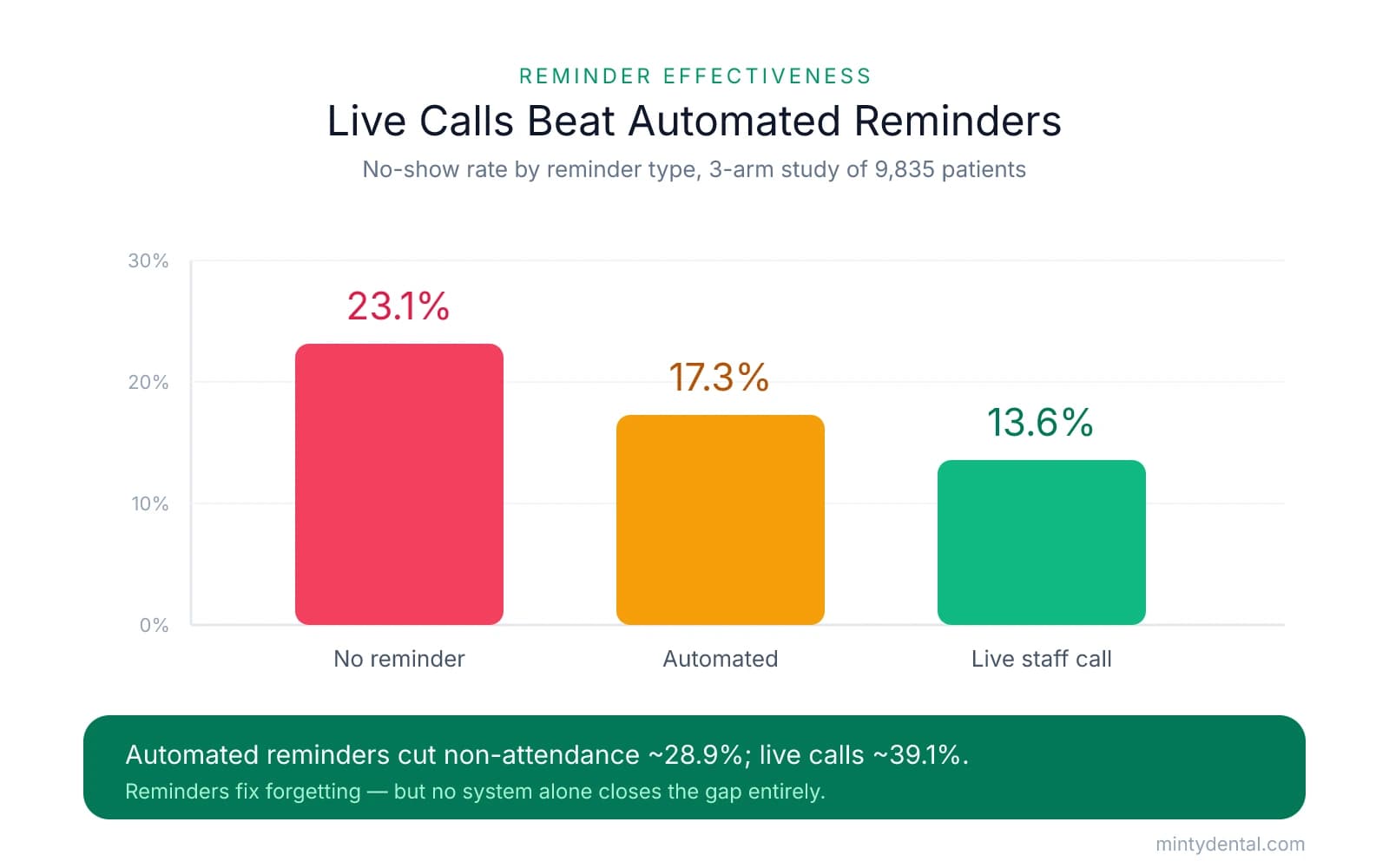
The other thing worth taking from that data: even the best-performing arm still shows meaningful no-shows. Reminders fix forgetting. They don't touch cost anxiety, scheduling friction, or lead-time drift, which is why no reminder system alone closes the gap entirely.
Build a Sequence, Not a Single Text
A single reminder the day before is better than nothing, but a sequenced approach does considerably more. The channel choice matters too: SMS carries a 98% open rate compared to roughly 20% for email, and practices using a combination of SMS, email, and voice see 12 to 15% lower no-show rates than those using a single channel. The practical design looks like this:
| Touchpoint | Timing | Channel | Format |
|---|---|---|---|
| First reminder | 7 days out | Appointment details, what to bring | |
| Second reminder | 48 hours out | SMS | Short message with two-way confirm |
| Day-of reminder | Morning of appointment | SMS or voice | Brief confirmation nudge |
| Live call | 48 to 72 hours out | Phone | High-value appointments only |
For appointments booked more than 15 days out, add a touchpoint at the two-week mark. Appointments scheduled 15 or more days ahead have no-show rates around 33% compared to much lower rates for same-week bookings, so a longer runway requires more contact, not just earlier contact.
Two-Way Confirmation Changes Behavior
The design detail that separates a useful reminder system from a passive one is requiring a response. When a patient receives "Reply C to confirm your appointment Wednesday at 2pm," they have to make an active decision. That small commitment is meaningfully different from reading a notification and moving on. Patients who don't respond become visible to your front desk before the appointment, which is exactly when you still have time to fill the slot.
For crown preps, implant placements, or any appointment where an empty chair costs you $800 or more, a live confirmation call is worth the five minutes of staff time. Your morning huddle is already the right moment to flag which next-day appointments haven't confirmed, so those calls can be made before end of day with time to backfill if needed. Building that check into your morning huddle routine turns the confirmation list into a daily production-protection habit rather than a reactive scramble.
Removing Cost Anxiety and Scheduling Friction
Reminders work well on forgetfulness. They don't do much for a patient who remembers the appointment perfectly and still doesn't show, because they're quietly dreading what the bill will be.
Roughly 27% of U.S. adults delay or forgo care due to cost, with dental services among the most frequently postponed. What the national data also shows is that cost-related avoidance and dental anxiety tend to compound each other. A patient who is already anxious about the procedure has a lower threshold for letting cost uncertainty tip them toward avoidance. The financial worry doesn't replace the clinical anxiety; it layers on top of it.
The fix isn't discounting. It's transparency, and specifically, transparency timed before the patient has to make a decision.
Give the Financial Picture Before Check-In
When a patient arrives at the front desk and learns their out-of-pocket portion for the first time, you've already lost the ability to help them. They're either absorbing a surprise number during the appointment, or they're mentally checked out before treatment even starts. Neither is good for attendance or same-day case acceptance.
Instead, run an insurance estimate as soon as the appointment is booked, and communicate the expected patient portion a few days before the visit. For routine hygiene this can be a brief line in the reminder message. For anything with a significant patient portion, a short financial coordinator call is worth making before the appointment date.
A useful threshold to work with (adjust for your fee schedule): for any appointment where the estimated patient portion is $500 or more, have someone on your team call to walk through the estimate, confirm the patient's questions, and mention financing if relevant. That five-minute conversation does two things: it removes the element of surprise, and it gives the patient a clear path forward rather than a reason to avoid the whole situation. When patients understand their options upfront, you'll often see same-day treatment acceptance improve alongside attendance.
Financing options should be visible before the patient has to ask. Introducing payment plans naturally, before the patient signals distress, removes the awkwardness that keeps patients quiet and at home.
Make Rescheduling Easier Than Not Showing
Scheduling friction is a different problem. A patient who knows they can't make their appointment will sometimes call, sometimes not. If your office is hard to reach, if hold times are long, or if the reminder message has no reply option, the path of least resistance is simply not showing up.
Adding a "reply to reschedule" option to your SMS reminders eliminates most of that friction. A patient who can send a text at 11pm to start the rescheduling conversation is far more likely to actually reschedule than one who has to call during office hours. Online rescheduling serves the same function.
For patients with a documented no-show history, shorter lead times between booking and appointment date substantially reduce the likelihood of another miss. Same-day or next-day scheduling, when your template allows it, keeps the appointment close enough that it doesn't drift out of focus.
When a patient with a no-show pattern does cancel, the ADA recommends rescheduling four to six weeks out rather than immediately offering the next available slot. That delay is a natural consequence without a fee, and it preserves the relationship while still signaling that the schedule is not unlimited.
When a Slot Goes Empty: Building a Waitlist That Actually Fills It
Prevention reduces no-shows but doesn't eliminate them. Even a practice running a tight three-touch reminder sequence and proactive financial conversations will still see cancellations. What separates practices that recover that production from those that don't is usually one thing: how fast they respond.
Most practices have some version of a waitlist. The problem is that it's a paper list, a sticky note beside the phone, or a field in the scheduler that nobody checks consistently. By the time a staff member works through it manually, it's often hours after the cancellation, and the patients have made other plans. Manual call-downs fill fewer than 30% of cancelled slots because the gap between cancellation and outreach is simply too wide. SMS outreach that fires within minutes of a cancellation reaches patients while they're still available and haven't yet committed their afternoon to something else.
Speed is the mechanism. But speed only works if the underlying data is accurate.
What a Functional Waitlist Actually Requires
The common failure isn't technology; it's incomplete availability data captured at booking. A list of names and phone numbers tells you who wants an appointment, not who can fill this specific opening at 2pm on Thursday. To match a patient to an opening, you need to know their preferred days and times, their preferred provider, the visit type they're waiting for, the appointment length required, and how much notice they need. A patient who can come in same-day is an entirely different resource than one who needs 48 hours.
That distinction is worth building into two separate lists. A short-call list holds patients who have explicitly said they can come in same-day or next-day with minimal notice. These are your first contacts when a same-day slot opens. A standard waitlist holds everyone else, and it's most useful for openings that emerge a few days out or when you're proactively trying to fill open time without discounting.
Matching also requires clinical fit. A 15-minute follow-up slot cannot absorb a new-patient exam that needs 60 minutes and a full-mouth series. Before anyone contacts a patient, the opening has to match on appointment length, treatment type, and operatory requirements. Skipping that check wastes the patient's time and your staff's, and it erodes trust in the process.
The Morning Huddle as the Last Line of Defense
For openings that appear overnight or early morning, the huddle is when you catch them. Reviewing the day's schedule, flagging unconfirmed appointments, and cross-referencing the waitlist before the first patient arrives turns a potential gap into a filled slot. That daily habit, covered in more detail in the context of production-focused huddle routines, is also where your block scheduling template and open chair time become visible together, which helps with longer-range schedule design decisions as well.
Where to Start
Pull your no-show rate report from your practice management system today. If you're running above 10%, the question isn't whether to act, but which of the four causes is doing the most damage.
A practice that addresses all four and maintains an active short-call list can realistically move from a 15% no-show rate toward the 5% to 7% range that well-run private practices achieve, without a cancellation fee in sight. Fix the system that matches your dominant cause first, and add the others as capacity allows.
Sources & References
The data and claims in this article are drawn from the following sources. We prioritize government data, peer-reviewed research, and established industry publications to ensure accuracy.
- No-Show Statistics & Data 2026 - Appointment Reminder— appointmentreminder.comIndustry
- Patient Cancellations - American Dental Association— ada.orgIndustry
- Predicting no-shows for dental appointments - PMC - NIH— pmc.ncbi.nlm.nih.govGovernment
- no reminder produced a 23.1% no-show rate, automated reminder dropped it to 17.3%, and a live staff call brought it to 13.6%— amjmed.org
- How to Reduce No-Shows: 15 Proven Strategies - Appointment Reminder— appointmentreminder.comIndustry
- Roughly 27% of U.S. adults delay or forgo care due to cost— kff.org
- Dental Waitlist: Fill Last-Minute Appointment Openings— logictechcorp.comIndustry
- realistically move from a 15% no-show rate toward the 5% to 7% range— mgma.com
Cut No-Shows Without Cutting Patient Relationships
Fixing your no-show rate is an operations problem, and the right systems make it a solved one. Minty handles the business side of your practice so your schedule stays full and your team stays productive.