Buying a Dental Practice with a Credit Score Below 680

Co-Founder, Minty Dental
In Summary
- 680 is the widely-cited minimum FICO score for conventional dental practice loans, but some SBA-backed lenders will consider scores as low as 620–650 with strong compensating factors
- Credit score is one input among several — lenders also weigh your production history as an associate, liquidity (typically 10% of the purchase price), debt-to-income ratio, and the target practice's own cash flow
- The nature of your credit issue matters: high utilization reads very differently to a lender than recent delinquencies or a bankruptcy
- Dental lenders are familiar with student debt and negative net worth in early-career dentists — what they're assessing is whether you're managing your finances responsibly, not whether your balance sheet looks perfect
- Engaging a lender before you find a practice gives you a roadmap to approval, not a rejection letter
680 Is a Threshold, Not a Verdict — Here's What Lenders Actually See
A credit score below 680 doesn't close the door on dental practice ownership — but it does change the conversation you'll need to have with lenders.
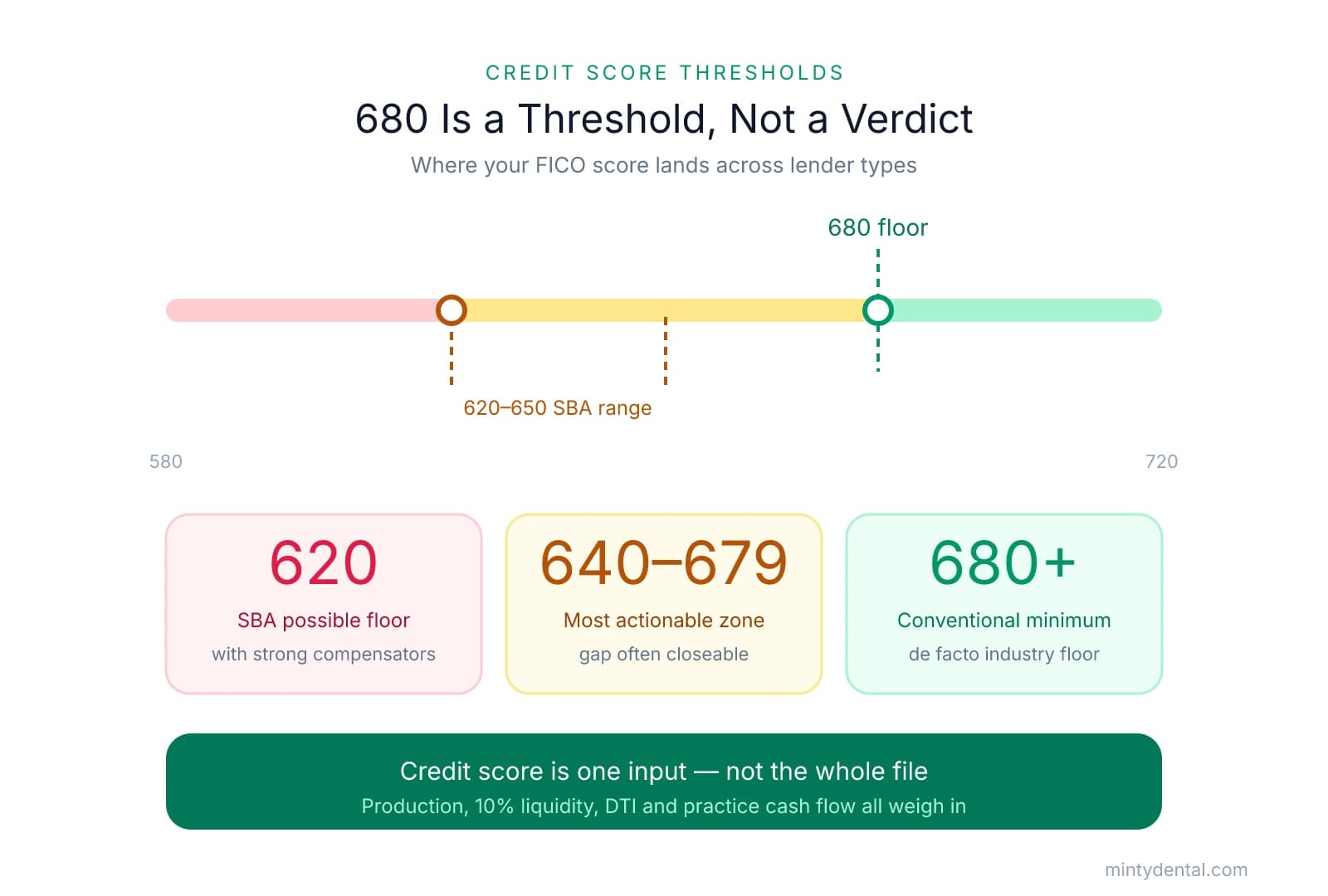
The 680 benchmark: Most dental lenders use 680 as a minimum FICO threshold for conventional practice acquisition loans, though some SBA-backed lenders will consider scores as low as 620–650 with strong compensating factors. Bank of America Practice Solutions explicitly lists 680+ as its minimum FICO requirement for conventional acquisition financing — a figure that has become the de facto industry floor. The ADA echoes it directly, noting that scores under 680 make financing significantly harder to obtain through conventional channels.
The distinction between conventional and SBA-backed lending matters here. Conventional dental lenders tend to hold tighter to that 680 threshold because they're underwriting to their own balance sheet. SBA loan products introduce a government guarantee that gives some lenders room to move, with certain programs approving borrowers in the 620–650 range when other parts of the application are strong. If you're navigating that decision, the tradeoffs between SBA and conventional loan structures are worth understanding before you apply.
What the Full File Actually Looks Like
Where many buyers get tripped up is treating the credit score as the whole story. In practice, lenders are building a picture across several dimensions:
- Production history: Can you demonstrate the clinical output to service the loan? Lenders want documented associate production — ideally through monthly reports, or reconstructed from compensation if you're paid on percentage
- Liquidity: Most lenders want to see roughly 10% of the purchase price in accessible cash or liquid assets — not borrowed, not retirement funds under lock
- Debt-to-income ratio: Student debt is expected and generally understood, but lenders are watching whether total obligations are manageable relative to income
- The practice's own cash flow: A well-performing practice with strong collections can offset borrower-side weaknesses — the asset itself is part of the underwriting
A pattern worth paying attention to is why your score sits where it does. High credit utilization — common among early-career dentists carrying student loans and credit card balances — reads differently than a 90-day delinquency or a prior bankruptcy. Dental lenders understand that negative net worth is nearly universal among recent graduates. What they're really assessing is whether you're managing obligations responsibly, not whether your balance sheet looks pristine.
One of the most useful things you can do before identifying a specific practice is to engage a lender early — ideally two or three of them. That conversation gives you a clear picture of what banks are actually evaluating and, more importantly, what you can do to strengthen the file before you apply. A pre-approval conversation is a diagnostic, not a commitment — and it's far better to hear "here's what needs to improve" before you're under contract than after.
What You Can Fix Before You Apply — and How Fast It Actually Works
For buyers sitting 20–40 points below 680, a focused 3–6 month effort can often close the gap. The key is knowing which levers actually move the needle, and how quickly.
The Highest-Leverage Moves, Ranked by Speed
Credit utilization is where most buyers should start. It accounts for roughly 30% of your FICO score and is the fastest variable you can actually control. Paying revolving balances below 30% — and ideally below 10% — can produce meaningful score movement within a single billing cycle. According to Equifax, you may see a change as soon as 30 to 45 days after taking steps that positively impact your credit report. If you're carrying balances across multiple cards, prioritize getting each one below 30% before paying any single card to zero — the utilization ratio on individual accounts matters alongside your overall ratio.
Many dentists accelerate student loan payments while carrying high credit card balances, assuming the larger debt is the bigger problem. For your FICO score, it isn't. Revolving debt has the greatest negative effect on credit scoring models, and dental lenders explicitly flag high card balances as a concern during underwriting. Redirecting extra payments to credit cards first is often the higher-leverage move.
Pull all three bureau reports before you do anything else. Errors are more common than most people expect — especially for dentists who've moved frequently between residency programs or had billing disputes with medical providers. Visit AnnualCreditReport.com and pull reports from Equifax, Experian, and TransUnion separately. A single reporting error can suppress your score by 20–50 points, and disputing it costs nothing but time.
Issue-by-Issue Timeline Reference
| Issue Type | Typical Fix | Estimated Timeline |
|---|---|---|
| High credit utilization | Pay revolving balances below 30% | 30–45 days after balance reports |
| Reporting errors | Dispute with bureau + creditor | 30–60 days per dispute |
| New credit inquiries | Wait — no action needed | 12 months to age off significantly |
| Recent delinquency (30–60 days) | Bring current; write explanation letter | 12–24 months to meaningfully recover |
| Bankruptcy (Chapter 7) | Rebuild with secured credit, time | 3–5 years for competitive positioning |
Two Moves That Cost Nothing
Avoid new credit applications in the 6–12 months before you apply. New inquiries and newly opened accounts both temporarily lower your score — and a cluster of recent applications can read as a red flag during underwriting.
Write a lender explanation letter for any derogatory marks on your report. Dental lenders tend to be more receptive to context than general business lenders — a medical billing dispute, a pandemic-era hardship, or a difficult period during residency reads very differently when you've addressed it directly. A clear, factual one-page letter can shift how an underwriter interprets what they're seeing.
Buyers with recent delinquencies or a bankruptcy face a longer runway — the timeline table above reflects that honestly. But for buyers who are close, the gap is often smaller than it feels. Understanding how much liquidity lenders expect alongside your credit profile gives you the full picture of what "application-ready" actually looks like.
When You Can't Wait: Financing Structures That Work Below 680
Not every buyer has a 3–6 month runway to rebuild their score. Sometimes the right practice surfaces before your credit profile is where you'd like it, and waiting means losing the deal. Several financing structures remain genuinely available below 680 — each with real trade-offs worth understanding before you commit.
SBA 7(a) Loans: More Flexibility Than Most Buyers Expect
The SBA itself does not set a personal credit score minimum for 7(a) loans — per the SBA's own program guidelines, lenders are responsible for determining creditworthiness within the program's framework. Individual lenders set their own floors, and some dental-focused SBA lenders will consider scores in the 620–650 range when the rest of the application is strong — particularly when the target practice shows healthy collections and stable cash flow.
The trade-off is real, though. SBA loans typically close in 60–90 days compared to 30–45 for conventional financing, require significantly more documentation, and often carry higher rates.
Seller Financing: The Structure That Changes the Math
When a seller agrees to carry a portion of the purchase price as a note, it reduces the bank's exposure — and that shift can move a borderline borrower into approvable territory. As American Practice Consultants notes, seller notes in dental transitions typically run 3–7 years at 6–9% interest, with the practice assets pledged as collateral.
There's a secondary benefit that lenders notice: a seller willing to carry paper is implicitly signaling confidence in the practice's performance, and that signal matters during underwriting.
Financing Structure Comparison
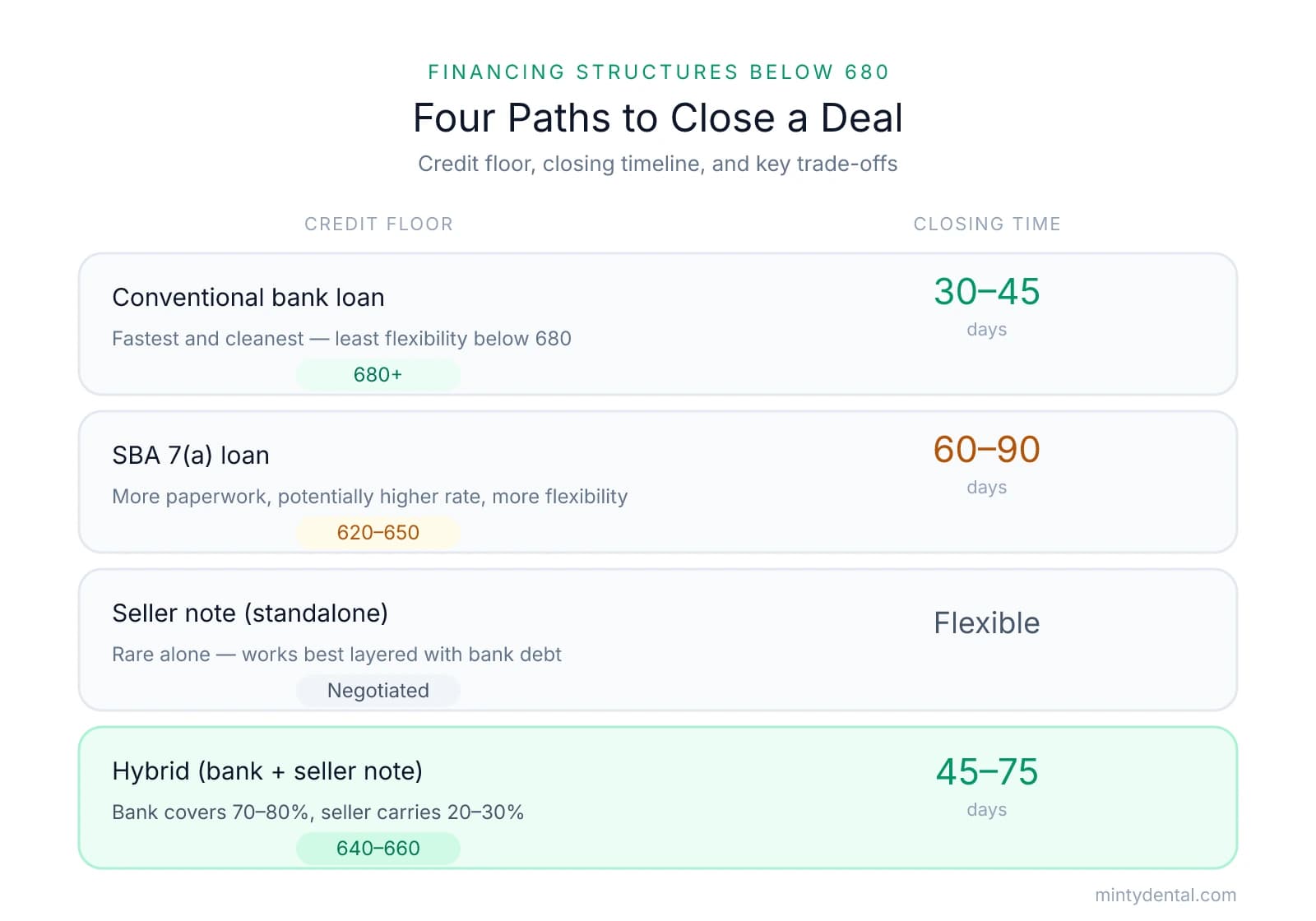
| Structure | Typical Credit Floor | Closing Timeline | Key Trade-offs |
|---|---|---|---|
| Conventional bank loan | 680+ | 30–45 days | Fastest, cleanest — least flexibility below 680 |
| SBA 7(a) loan | 620–650 (lender-dependent) | 60–90 days | More paperwork, potentially higher rate, more flexibility |
| Seller note (standalone) | Negotiated | Flexible | Rare as sole financing; works best layered with bank debt |
| Hybrid (bank + seller note) | 640–660 range | 45–75 days | Bank covers 70–80%, seller carries 20–30%; reduces lender exposure |
Why Hybrid Structures Work
The hybrid model — where a bank funds 70–80% of the purchase price and the seller carries the remainder as a note — is how many sub-680 buyers actually close deals. The bank's loan-to-value exposure drops, the seller's participation signals deal confidence, and the overall financing package becomes more defensible. It's worth noting that some lenders require the seller note to be on standby until the bank loan is serviced, so the specific terms matter.
One other distinction worth making: a regional bank's commercial lending team and a dental-specific lender are evaluating the same borrower very differently. Dental-specific lenders — including Live Oak Bank and Bank of America Practice Solutions — underwrite against the industry's historically low default rate and understand that negative net worth is common among early-career dentists. A general commercial desk doesn't carry that context, which often leads to faster rejections on files a dental lender would approve. If you've already heard no from one or two lenders, that's a different conversation than whether financing is possible at all.
Your Decision Framework: Fix First, Buy Now, or Both
Everything covered here points toward one practical question: what do you actually do first? The answer depends less on a single number and more on where your score sits, why it's there, and what the rest of your file looks like.
Score is 640–679 with no recent delinquencies. This is the most actionable position to be in. An SBA 7(a) loan or hybrid structure is likely within reach now — and the gap to 680 is often closeable in parallel with the application process. Focus on getting revolving utilization below 30% immediately; that single move can push a borderline score over the threshold before your application is formally submitted. Start lender conversations now, not after you've found a practice.
Score is 600–639 with high utilization as the primary driver. A 3–6 month focused paydown effort may be enough to cross into approvable territory. The most useful thing you can do right now isn't to wait quietly — it's to get pre-qualified with a dental-specific lender who can tell you exactly what they need to see. Use the months in between to document your associate production history, which strengthens any future application regardless of where your score lands.
Score is below 600 or includes recent delinquencies or a bankruptcy. A longer rebuild is likely required, and that's worth accepting honestly rather than pursuing financing that isn't ready. But the waiting period doesn't have to be passive. Document your production history now — the ADA recommends running monthly production reports as a baseline step before any purchase. Build liquidity. Identify target practices and begin conversations with sellers who might be open to carrying a note when you're ready to move.
Your Next 30 Days — Regardless of Scenario
- Pull all three credit reports at AnnualCreditReport.com and flag any errors for dispute
- Contact at least one dental-specific lender for a pre-qualification conversation — treat it as a diagnostic, not a commitment
- Run or request a production report from your current employer; if you're paid on percentage, your compensation can be used to reconstruct output
- Assess your liquid assets — lenders typically want to see roughly 10% of the purchase price in accessible cash
- Identify whether any practices you're tracking might be open to seller financing as part of the deal structure
Production history is worth treating as a parallel track throughout all of this. Whether you're applying in 60 days or 18 months, documented clinical output is one of the clearest signals a lender can evaluate — and it's entirely within your control to build now. If you're also carrying significant student debt, understanding how lenders weigh that alongside your credit profile gives you the complete picture of what "application-ready" actually looks like.
A score below 680 is a starting condition, not a final answer. The buyers who close deals from this position are the ones who know exactly what they're working with — and start working on it before the right practice appears.
Sources & References
The data and claims in this article are drawn from the following sources. We prioritize government data, peer-reviewed research, and established industry publications to ensure accuracy.
- Bank of America Practice Solutions Dental Loans: 2026 Review— dentalpracticeloanguide.com
- 5 Financial Must-Dos Before Buying a Dental Practice— www.ada.orgIndustry
- How to Raise Your Credit Scores Fast | Equifax— www.equifax.com
- Dental Practice Financing – Apply With Confidence— dentaltransitions.comIndustry
- AnnualCreditReport.com— annualcreditreport.com
- Terms, conditions, and eligibility | U.S. Small Business Administration— www.sba.govGovernment
- How to Secure Financing for Your Dental Practice Purchase— ameriprac.comIndustry
Frequently Asked Questions
Ready to buy despite credit challenges?
Purchasing a dental practice with a lower credit score is possible with the right guidance. Minty's acquisition experts work with you through every step, helping you navigate financing options and find practices that match your situation.