Buying a Dental Practice Where One Hygienist Runs Everything

Co-Founder, Minty Dental

In Summary
- Key person dependency develops when sellers gradually delegate operational control to their most competent team member — what looks like a well-oiled machine is actually fragility disguised as excellence
- The test is simple: could operations continue without that person for more than 48 hours? If the answer is no, you're looking at institutional knowledge that exists only in one person's head
- Warning signs cluster around three patterns: sellers deferring operational questions to the hygienist, absence of written protocols, and other staff unable to answer basic workflow questions without checking first
- Retention agreements only work when structured as milestone-based payments tied to documented knowledge transfer — not lump-sum bonuses paid at closing
- Building redundancy takes 6–12 months of consistent shadowing, documentation, and cross-training — start with patient-facing processes before back-office functions
Key Person Dependency Isn't About Loyalty—It's About Operational Fragility
The practice runs beautifully. Patients check in smoothly, the schedule flows without gaps, insurance claims process on time. During your walkthrough, the seller beams when describing how the longtime hygienist "basically runs the place" — and it shows. She greets patients by name, handles a scheduling conflict without breaking stride, answers your question about the recall system before the seller can finish deferring to her.
This feels reassuring. You're buying a well-oiled machine with a competent team member who clearly knows what she's doing.
What you're actually looking at is operational fragility disguised as operational excellence.
Key person dependency develops the same way in most practices: a burned-out seller gradually delegates more responsibility to their most capable team member. The hygienist who's been there fifteen years starts handling patient complaints because she knows the patients better. Then scheduling, because she understands the clinical flow. Then insurance verification, vendor negotiations, protocol decisions — each delegation logical in isolation, each one concentrating more institutional knowledge in a single person.
The seller interprets this as building a strong team. What they've actually built is a practice where one person holds the operational manual in her head, and no written systems exist independent of her daily presence.
The distinction between a strong office manager and unhealthy dependency comes down to continuity: could operations continue without that person for more than 48 hours? In practices with documented systems and cross-trained staff, the answer is yes — someone else can reference the scheduling protocol, follow the insurance verification checklist, handle a vendor question using documented contacts. In key-person-dependent practices, the answer is no — because the protocols, relationships, and institutional knowledge exist only in one person's experience.
During due diligence, watch for these patterns: the seller defers operational questions to the hygienist more than once, other staff members can't answer basic workflow questions without checking with her first, and no written protocols exist for recurring processes like recall scheduling or new patient onboarding. One telling moment is asking the front desk how they handle insurance verification — if the response is "Sarah does all that," you've found your dependency.
The operational areas where this control typically concentrates tell you how deep the risk runs. Patient scheduling becomes her domain because she knows which patients need extra time, which ones cancel frequently, which ones prefer morning slots. Insurance verification stays with her because she's memorized which plans require pre-authorization and which reps to call when claims get denied. Staff conflict resolution flows through her because newer team members defer to her tenure. Vendor relationships exist in her phone contacts and memory of past negotiations. Clinical protocols — which procedures get scheduled together, how to handle anxious patients, when to escalate to the doctor — live in her head as pattern recognition rather than documented standards.
None of this makes her a bad employee. Research shows that 71% of small businesses depend on one or two key individuals for organizational success — this pattern is common precisely because it develops from competence, not negligence.
The problem surfaces after closing, when you need to implement a change she disagrees with, or when she decides six months in that she's ready to retire, or when a family emergency takes her out for three weeks and the practice reveals itself as a collection of undocumented workarounds held together by one person's institutional memory.
What to Ask During Due Diligence to Measure Dependency Risk
The challenge with measuring key person dependency is that sellers rarely recognize it as a problem — they see a trusted employee running things smoothly, not a structural vulnerability. Your questions need to surface what happens when that person isn't there, not just how well things work when she is.
Start with the continuity test: "Walk me through what happens when [hygienist name] takes a week off." In practices with distributed knowledge, the seller describes backup procedures — who covers scheduling, who handles insurance questions, where the protocols are documented. In dependent practices, you'll hear vague reassurances ("she rarely takes time off" or "we make it work") or admissions that operations slow significantly. If the seller can't describe a specific coverage plan with named backup staff, that's your first data point.
Follow with knowledge transfer questions that reveal whether institutional memory lives in documentation or in one person's head. "Who trained the last new hire?" should produce a structured onboarding process, not a single name. "Where are your standard operating procedures documented?" should point to an employee handbook, training manual, or digital system — not "we don't really have that written down" or "Sarah knows all that." When sellers respond with "she handles that" more than twice in a conversation, you're seeing dependency in real time.
The documentation requests that expose this risk most clearly are the ones that should exist in any well-run practice but often don't: employee handbooks with role-specific procedures, training materials for common tasks, written protocols for clinical and administrative workflows, cross-training records showing who's been trained on which systems, and vacation coverage plans detailing backup responsibilities. Practices with healthy knowledge distribution produce these quickly. Practices with key person dependency either don't have them or produce documents that haven't been updated in years because the real procedures exist in someone's daily practice, not on paper.
One pattern worth testing is knowledge distribution across the team. Ask the same operational question — "How do you handle a patient who needs to reschedule their hygiene appointment?" — to three different staff members. In practices with documented systems, you'll get consistent answers referencing the same process. In dependent practices, responses diverge: the front desk says "I'd check with Sarah," the assistant describes a different process than the hygienist, and only one person can give you a complete answer.
Staff interviews require careful framing since many sellers restrict direct access until after the LOI is signed. When you do get access, structure questions to reveal competence gaps without creating alarm. Instead of "Can you do Sarah's job?", try "Walk me through how you'd handle [specific scenario] if Sarah was out sick." Ask the front desk to explain the recall system, ask assistants to describe the supply ordering process, ask the associate dentist how clinical protocols get updated. You're not testing whether they can recite procedures — you're listening for whether they reference documented standards or defer to the key person.
The red flags in seller responses cluster around three themes: inability to answer basic operational questions without consulting the hygienist, absence of written backup procedures for critical functions, and evidence that recent hires were trained exclusively by one person rather than through a structured program. Pay attention to patient behavior signals too — if online reviews mention specific team members by name repeatedly, or if the seller notes that certain patients only schedule when the hygienist is working, you're seeing relationship dependency that extends beyond internal operations.
When sellers restrict staff access before the LOI, you can still gather intelligence through observation. During practice tours, watch staff interactions — does the hygienist field questions from multiple team members in a short window? Do other staff members check with her before answering your questions? Review online patient reviews for patterns: mentions of specific team members, complaints about service quality when certain people aren't working, or praise that centers on one individual rather than the practice. Ask about staff tenure and turnover patterns — practices with healthy knowledge distribution tend to have lower turnover because multiple people can handle critical functions.
The timing challenge is real: most sellers won't grant full staff access until you've committed with an LOI, but by then you've already invested significant time and money. One workaround is requesting limited staff interaction during the tour — a five-minute conversation with the front desk about scheduling software, a brief discussion with an assistant about sterilization protocols. Frame it as understanding the practice's systems, not evaluating individuals.
What you're building through these questions isn't a case against the hygienist — it's a map of where institutional knowledge lives and whether the practice can function if that knowledge becomes unavailable.
Retention Agreements That Actually Protect You (and What Doesn't Work)
Once you've identified dependency risk but still want to move forward, the instinct is to lock in the key employee with a retention agreement. Where most buyers go wrong is treating the retention agreement as a standalone solution rather than one component of a broader risk mitigation strategy.
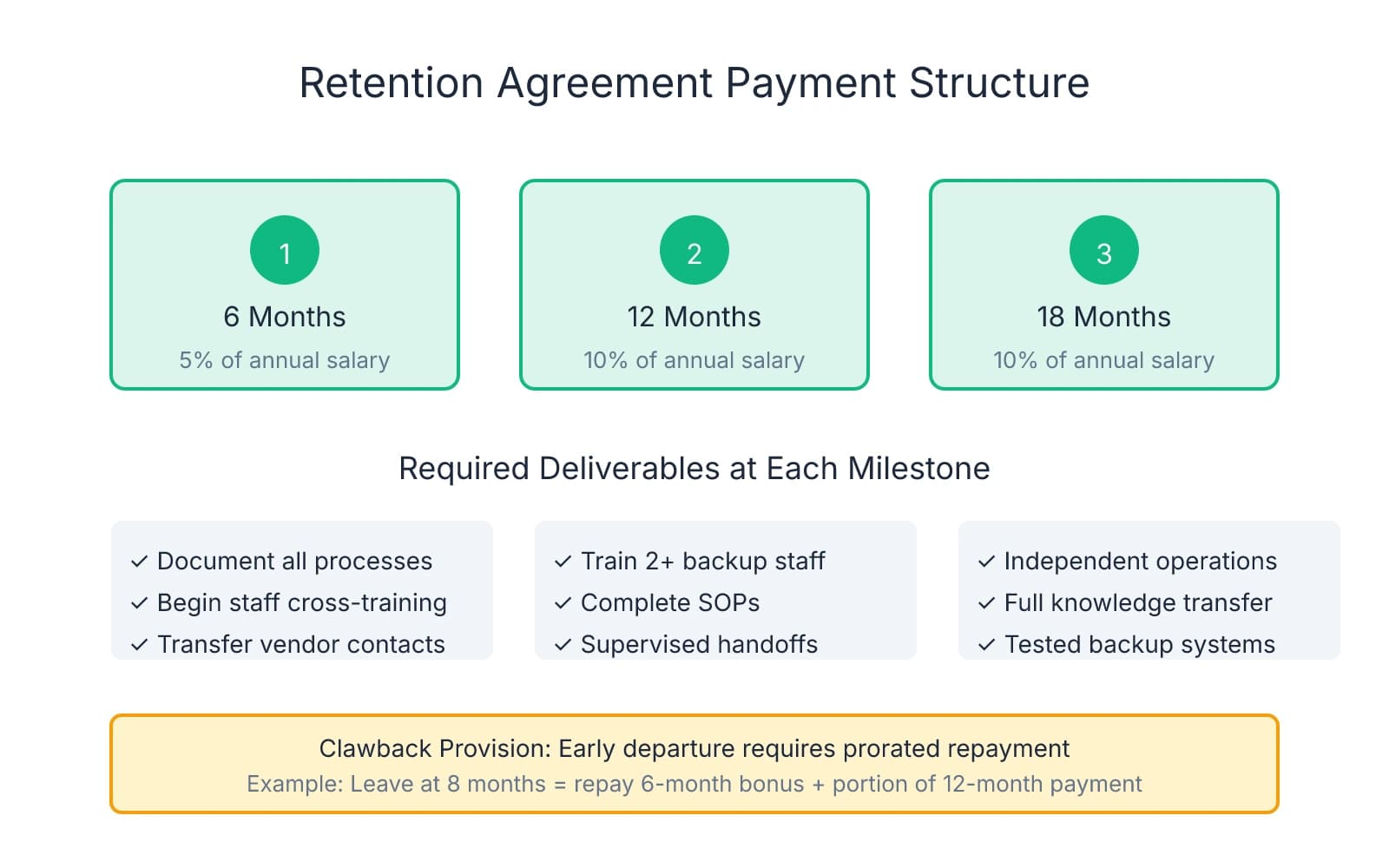
The structure that tends to work best is milestone-based payments tied to specific deliverables. A common framework is 10–25% of the employee's annual salary, split across three installments: 6 months post-closing, 12 months, and 18 months. The percentages can escalate — 5% at six months, 10% at twelve, 10% at eighteen — to create stronger incentive to stay through the full transition period. Each payment is contingent not just on continued employment but on completing defined responsibilities: documenting all operational processes within 90 days, training backup staff on critical systems, transferring vendor relationships with documented contacts and terms.
The reason milestone-based payments outperform lump-sum bonuses is incentive alignment. A $15,000 retention bonus paid at closing creates exactly the wrong dynamic — the employee receives the money, then decides whether to stay. When the same $15,000 is split into $3,000 at six months, $6,000 at twelve months, and $6,000 at eighteen months, each payment is earned through continued presence and documented knowledge transfer.
The employment agreement that accompanies the retention bonus matters more than the bonus itself. Retention bonuses without employment contracts create perverse incentives — the employee can collect the money and leave the next day unless contractual terms prevent it. The agreement should specify transition responsibilities in detail: "Employee will document all patient scheduling protocols, insurance verification procedures, and vendor relationships in written form within 90 days of closing. Employee will train at least two other team members on each critical system to ensure operational continuity." Vague language like "assist with transition" gives you no recourse when the employee shows up but doesn't actually transfer knowledge.
Non-compete provisions in retention agreements serve a different purpose than in associate contracts. You're not trying to prevent the hygienist from working in dentistry — you're protecting against her leaving and taking patients or staff to a competing practice nearby. A reasonable scope is 5–10 miles for 12–24 months, enough to prevent immediate competitive harm without being unenforceable.
The clawback language is what makes retention agreements enforceable. If the employee leaves before the 18-month period ends, they repay a prorated portion of bonuses already received. Leave at 8 months, repay the 6-month bonus plus a portion of the 12-month payment. This prevents the scenario where someone collects the first two installments and quits before the final one.
What doesn't work is more common than what does. Verbal agreements fail because they're unenforceable and because memory diverges under pressure. Handshake deals with the seller's assurance that "she'll never leave" are worth exactly nothing after closing. The seller's relationship with the employee ends when they sell the practice; their confidence in her loyalty doesn't transfer to you.
Retention bonuses without defined deliverables create a compliance problem. If the agreement says "Employee will receive $15,000 for staying 18 months" but doesn't specify what "staying" means — full-time hours? active training of backup staff? maintaining patient relationships? — you have no leverage when the employee shows up but stops doing the work that made her valuable.
The timing problem most buyers miss is negotiating retention agreements after closing. Once you own the practice, your leverage drops significantly. The employee can decline the agreement, continue working under at-will employment, and leave whenever she wants. Structuring retention terms into the purchase agreement — as a condition of closing or as a seller obligation to secure before closing — gives you the leverage to ensure the agreement exists before you take ownership. Some buyers make the retention agreement a contingency in the purchase contract, allowing them to renegotiate or walk away if the employee won't commit.
Even well-structured retention agreements have limits. They can't force someone to stay who's already decided to leave, and they can't manufacture competence in backup staff if no training infrastructure exists. If the employee won't sign a retention agreement, that's a clear signal they're not committed to staying. If the dependency is so deep that no other staff member can perform basic functions even with training, the retention agreement just delays the inevitable collapse.
Where retention agreements work best is in practices where the dependency is real but not total — the hygienist holds significant institutional knowledge, but other staff have baseline competence and documented systems exist in some form. The retention agreement buys you 18 months to cross-train staff, document processes, and distribute knowledge before the key person leaves. It's a bridge, not a permanent solution.
Building Redundancy Before the Dependency Becomes a Crisis
If you've closed on a practice with key person dependency, the retention agreement bought you time — now you need to use it. The goal isn't replacing the longtime hygienist or stripping her of responsibilities. It's building parallel systems so the practice can function when she's on vacation, when she's sick, and eventually when she decides to retire.
The first 30 days set the foundation. Your priority is shadowing the key employee and documenting every process she handles. Follow her through a typical week and map what she actually does: how she triages scheduling conflicts, which insurance verification steps happen before the appointment versus after, how she decides when to escalate a billing dispute, what she says to patients who are upset about treatment costs, which vendor reps she calls for rush orders and what terms she's negotiated. Most of this knowledge exists as pattern recognition in her head — "I just know when a patient is going to cancel" — and your job is translating that intuition into documented criteria others can apply.
Process documentation needs to match how different people learn. Written SOPs work for linear tasks like insurance verification: Step 1, call the carrier. Step 2, confirm coverage for the specific procedure code. Step 3, document the pre-authorization number in the patient file. For visual learners, short video tutorials showing the actual software clicks are more effective. For complex workflows with multiple decision points, decision trees work better than step-by-step instructions: "If the patient needs a crown and has insurance, check coverage limits first. If they're at their annual max, offer payment plan options before scheduling."
Cross-training strategy requires matching responsibilities to team members based on existing skills and capacity. The front desk staff member who already handles some scheduling can learn the hygienist's advanced scheduling protocols. The insurance coordinator who verifies eligibility can expand into the hygienist's insurance troubleshooting knowledge. Structure shadowing periods during slower patient flow times — Tuesday afternoons, not Friday mornings — so the training doesn't disrupt care.
The psychological challenge is framing this work without making the longtime hygienist feel like you're planning her exit or don't trust her competence. Position redundancy-building as succession planning and professional development, not risk mitigation. "I want to make sure you can actually take a vacation without fielding calls" lands better than "I need backup in case you leave." "Let's document your expertise so newer team members can learn from what you've built" respects her contribution rather than questioning it.
Creating backup systems means identifying secondary contacts and documented protocols for every critical function. For vendor relationships, that's not just recording phone numbers — it's documenting the negotiated terms, the rep's name and direct line, and the escalation path when the primary contact is unavailable. For vacation coverage, it's written protocols specifying who handles which responsibilities. For emergency decision-making authority, it's clear thresholds: "Billing disputes under $200 can be resolved by front desk using documented discount policy. Disputes $200-$500 require insurance coordinator approval. Anything over $500 escalates to owner."
The timeline for reducing critical dependency to manageable risk is longer than most buyers expect. Research on knowledge transfer in small businesses suggests 6–12 months of consistent documentation and cross-training before backup staff can handle most situations independently. The first 90 days focus on documenting processes and beginning cross-training. Months 4–6 involve supervised practice — backup staff handle tasks with the key employee available to answer questions. Months 7–12 shift to independent execution with periodic check-ins.
What to prioritize first: patient-facing processes before back-office functions. Start with scheduling protocols, recall systems, and treatment coordination — the workflows that directly affect patient experience and revenue. A gap in how appointments get scheduled creates immediate patient dissatisfaction and lost production. Once patient-facing systems have backup coverage, move to billing, insurance follow-up, and vendor management. Save HR functions and staff conflict resolution for last — these require judgment that develops over time, not just documented steps.
One step many buyers overlook is testing the backup systems before you need them. Have the backup staff member run the recall system for a week while the hygienist is still there to catch mistakes. Let the cross-trained assistant handle a vendor order with the hygienist reviewing it before submission. Schedule a mock "key employee out sick" day where backup staff run operations and you observe what breaks. These controlled tests reveal gaps in documentation and training while you still have time to fix them.
The work is tedious and time-consuming, but it's also the difference between owning a practice that depends on one employee's continued presence and owning a practice that can withstand normal staff transitions. Start with the first 30 days of shadowing and documentation. The rest builds from there.
Sources & References
The data and claims in this article are drawn from the following sources. We prioritize government data, peer-reviewed research, and established industry publications to ensure accuracy.
- What is the Key Person Dependency Risk and how you can avoid it— workflawless.comIndustry
- Research shows that 71% of small businesses depend on one or two key individuals— nationwide.com
- Due Diligence while buying a Dental Practice : r/Dentistry— www.reddit.com
- Dental Bonus Structures Overview | Robert Chelle— reviewdentalcontracts.comIndustry
Frequently Asked Questions
Ready to acquire a stable hygienist-led practice?
Buying a practice with a key hygienist requires careful evaluation of operational dependencies and transition planning. Minty Plus provides expert guidance through acquisition and post-close management to ensure smooth operations and staff retention.