How to Increase Same-Day Treatment Starts in a Dental Practice

Co-Founder, Minty Dental
In Summary
- Same-day treatment measures the dollar value of diagnosed treatment a patient starts on the same visit the plan was created, which is distinct from your overall case acceptance rate.
- The average practice completes only 34 to 57 percent of presented treatment, and 40 to 60 percent of diagnosed treatment often sits unscheduled in the practice management system.
- Low same-day starts usually trace to three operational gaps: no open chair time to seat the case, unclear clinical communication, and financial uncertainty at the point of decision.
- Same-day starts apply to procedures that can realistically be completed in the current appointment or an adjacent open slot, not multi-visit cases that require sequencing.
- Each of the three gaps maps to a system an owner can build or improve: scheduling structure, chairside presentation, and financial clarity.
Same-Day Treatment Starts Are a Systems Problem, Not a Sales Problem
Same-day treatment is the total dollar value of treatment a patient begins on the same visit the plan was created, tracked as a distinct key performance indicator from overall case acceptance. Case acceptance measures whether a patient agrees to treatment at any point. Same-day starts measure whether the practice converted that agreement into completed production before the patient left the building.
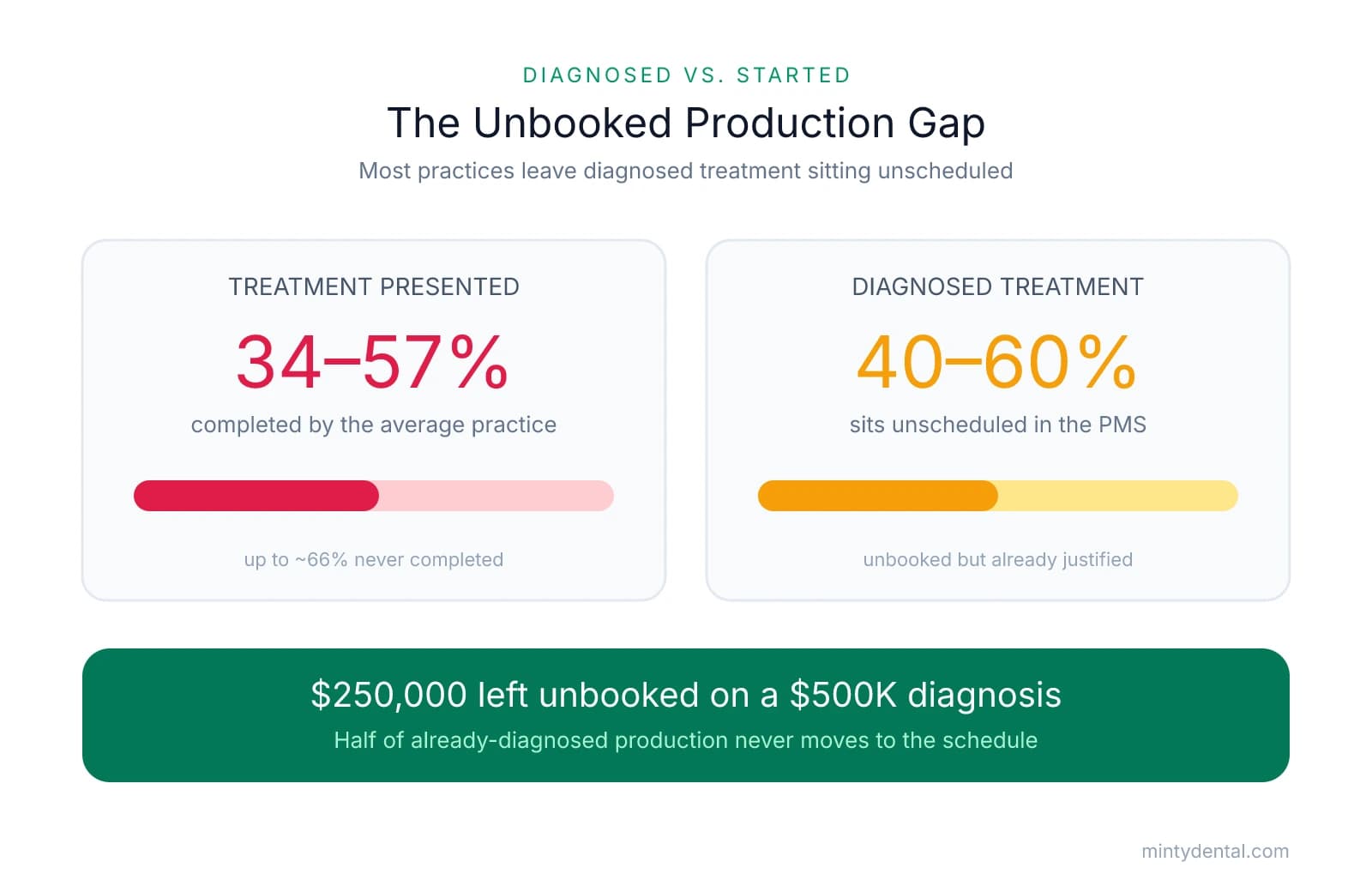
Most practices complete only 34 to 57 percent of the treatment they present, and 40 to 60 percent of diagnosed treatment often sits unscheduled in the practice management system. A practice that diagnoses $500,000 in treatment and schedules only half of it leaves roughly $250,000 of already-diagnosed production unbooked each year. That revenue was clinically justified and presented to patients, yet it never moved to the schedule.
When patients diagnosed for treatment do not start it, the cause usually falls into one of three operational gaps:
- Scheduling friction: There is no open chair time to seat the case, so the patient is asked to call back and rebook, which introduces delay and drop-off.
- Communication gaps: The patient does not fully understand the diagnosis or does not yet trust that the treatment is necessary, so a decision gets deferred.
- Financial uncertainty: The patient leaves without a clear picture of what they will owe, which makes committing on the spot difficult.
Same-day starts apply to procedures that can realistically be completed in the current appointment or an adjacent open slot, such as a single restoration or an extraction, rather than multi-visit cases that require lab work or staged sequencing. That distinction keeps the metric focused on production the practice can actually capture today.
Each gap maps to a system an owner can build rather than a personality trait a provider is asked to develop. Practices working on the broader picture may also find it useful to review what to do when case acceptance runs low.
Building a Schedule That Has Room for Same-Day Treatment
The first operational gap, scheduling friction, comes down to physical capacity. When every chair is committed to pre-booked appointments, a hygiene patient who accepts a crown prep or filling has nowhere to be seated, so the front desk asks them to rebook. Each rebooking introduces a delay during which enthusiasm fades and competing priorities take over. Creating room for same-day starts requires holding capacity on purpose while still keeping chairs productive.
A protected same-day block is one or two open slots in the doctor's daily schedule held specifically for same-day conversions. These are typically placed mid-morning and early afternoon, when hygiene exams cluster and treatment gets diagnosed. The slots stay open until 24 to 48 hours before the day, then release to your recall or waitlist if no same-day case has filled them. This structure keeps the chair from sitting empty while preserving room to seat a case the moment a patient says yes. For a fuller approach to keeping open time productive, the tactics in filling open schedule time without discounting apply directly here.
| Fully pre-booked schedule | Schedule with protected blocks | |
|---|---|---|
| Response when a patient accepts | Ask patient to rebook later | Seat the case in the held slot |
| Same-day conversion capacity | None | 1 to 2 cases per day |
| Risk if slot unfilled | Not applicable | Released to waitlist 24 to 48 hrs out |
The morning huddle turns those blocks into booked production. In a 10 to 15 minute meeting before the first patient, the team reviews each scheduled patient's outstanding treatment so the clinical team can make an informed offer during the visit. Practices running daily huddles consistently achieved 12 to 18 percent higher production per provider than those that did not, largely because the team knows the goal and the patient's history before anyone walks in.
To prepare for the huddle, run the unscheduled treatment report from Dentrix, Eaglesoft, or Open Dental. Review three fields: treatment type, dollar value, and the age of the plan. Recent, single-visit, higher-value plans are the strongest candidates when a same-day slot opens. This same data helps you prioritize outreach and protect your production per hour.
The hygiene-to-restorative handoff determines whether the conversation happens at all. The hygienist sees the outstanding treatment during cleaning and can flag it before the doctor exam, which gives the doctor a specific case to address rather than a routine check.
How to Present Treatment So Patients Can Say Yes at the Appointment
The patient often cannot see or feel the problem being diagnosed, so the recommendation feels optional. This is the credibility gap: the distance between "the dentist says I need this" and "I can see why I need this." An intraoral camera image or an annotated X-ray on a screen closes that gap by making the clinical need visible and self-evident, which shifts the decision from trusting a claim to responding to something the patient observes directly.
Patients who received visual explanations were 32 percent more likely to schedule recommended treatment and showed 58 percent better recall of the plan one week later. A 2024 literature review found that visual aids improved patient understanding, reduced anxiety, and increased adherence across photographs, digital models, and intraoral imagery.
A consistent presentation sequence tends to produce steadier same-day conversion than an improvised conversation:
- Show the image and name what you see in plain language. Point to the fracture or the dark area and describe it in words the patient would use, not clinical shorthand.
- Explain the consequence of waiting without catastrophizing. State what tends to happen if the problem progresses, such as a filling becoming a crown, so the patient understands the tradeoff of delay.
- Confirm understanding before any cost enters the conversation. Ask what questions the patient has about the tooth itself. Introducing a fee before the clinical picture lands tends to let cost override comprehension.
The doctor establishes clinical trust and explains the need, then steps out. The treatment coordinator or a trained front office team member handles the financial estimate and scheduling. Separating these roles tends to produce higher same-day conversion than the doctor presenting both, because the doctor stays in a clinical role the patient trusts, and the financial conversation happens with someone whose job is to solve for affordability rather than diagnose.
For larger plans, phased treatment lowers the decision threshold. Rather than asking a patient to commit to a full-mouth sequence at once, offer to start one procedure today, usually the most urgent tooth or the one that uses remaining insurance benefits this year. Getting the patient into the chair for a single step captures production now, and scheduling the subsequent appointments before they leave keeps the rest of the plan moving. This approach connects the clinical conversation to hygiene throughput, which factors into whether the hygiene department is actually profitable.
Removing Financial Friction Before the Patient Leaves the Chair
Financial uncertainty is where a patient who wants to say yes often stalls anyway. The most common failure point is that the patient leaves without a clear out-of-pocket estimate because insurance was never verified before the appointment. Once they are home, the decision loses momentum, competing bills take priority, and most never call back to reschedule. A same-day financial system removes that friction by having the numbers ready at the moment of decision.
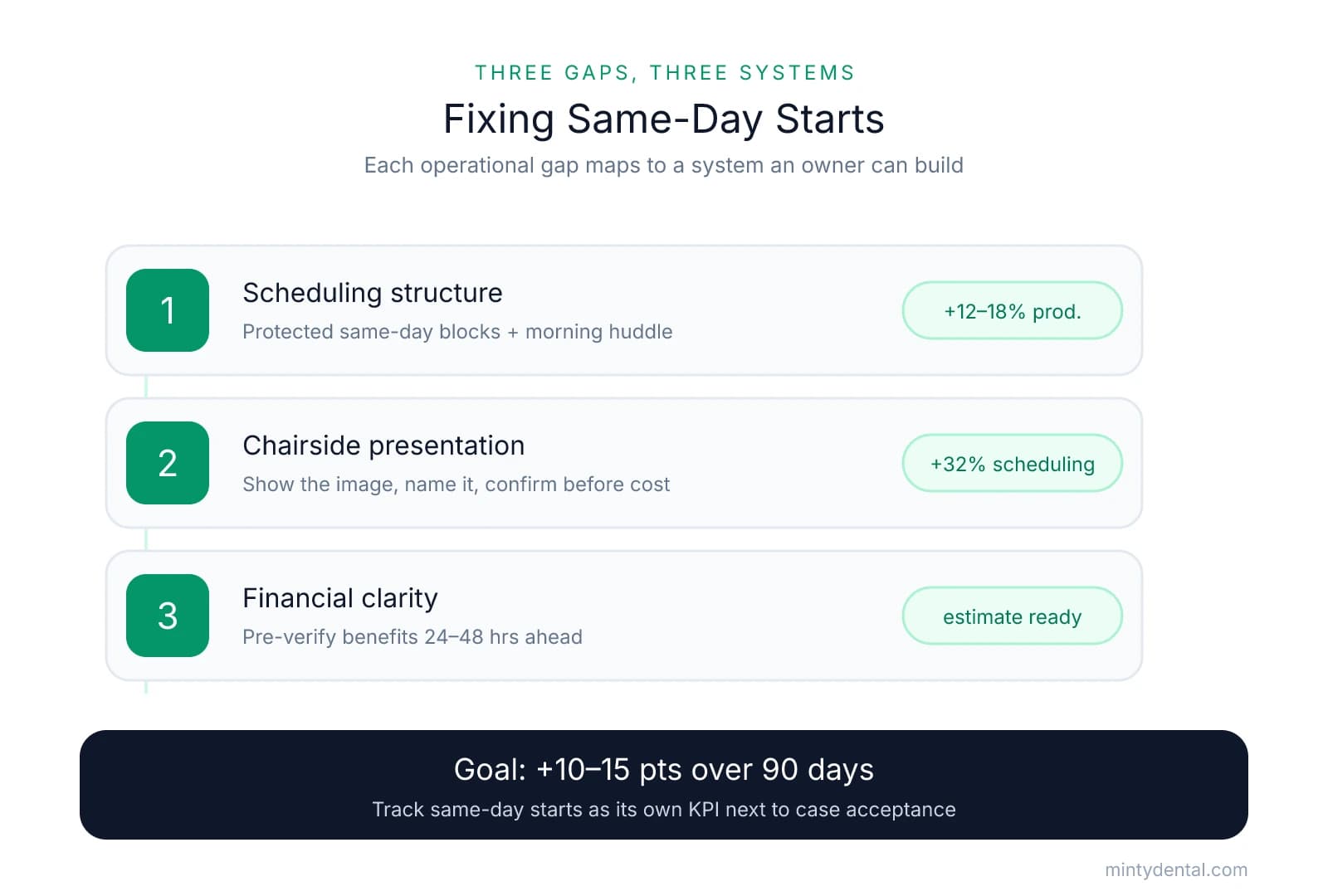
Pre-verification means insurance benefits are confirmed 24 to 48 hours before the appointment, with an estimate prepared and attached to the chart. When the doctor's recommendation lands, the treatment coordinator can present a specific out-of-pocket figure immediately rather than promising a call-back that resets the decision.
| Without pre-verification | With pre-verification | |
|---|---|---|
| Estimate available at the chair | No, requires follow-up | Yes, ready on the chart |
| Patient's next step | Wait for a call at home | Decide and schedule now |
| Typical outcome | Decision stalls, few rebook | Higher same-day conversion |
Presenting the total cost alongside a monthly payment amount, rather than the total alone, reduces sticker shock and makes the commitment feel manageable. This matters for a large share of patients, because 50.2 percent of adults aged 18 to 64 lacked dental coverage in recent CDC data, so financing is relevant well beyond the uninsured minority.
Third-party financing works best when offered at the point of presentation as a standard option, not introduced as a last resort after a patient hesitates. Presenting it upfront, in the same breath as the estimate, normalizes it and removes the stigma that leads some patients to decline rather than ask about payment terms.
Tracking same-day treatment as its own KPI keeps the system accountable. Calculate it monthly as the dollar value of treatment completed on the day the plan was created, and record it next to your overall case acceptance rate. Set a baseline from your current numbers, then review both figures in the weekly team meeting so the front and clinical teams see the same target. For practices starting without any structured system, an improvement of 10 to 15 percentage points over 90 days is a reasonable goal as pre-verification and presentation habits take hold.
Not every patient will start same-day, and that is expected. For those who leave without committing, a structured follow-up system matters, and the same principles that bring back lapsed patients apply to recovering unscheduled treatment before it goes cold.
Sources & References
The data and claims in this article are drawn from the following sources. We prioritize government data, peer-reviewed research, and established industry publications to ensure accuracy.
- Maximizing Same Day Treatment | Practice Help Center— help.practicenumbers.comIndustry
- A Dental Practice Management System That Recovers Lost Revenue— sunrisedentalsolutions.comIndustry
- Morning Huddle Template For Dental Practices— dentalpracticeinsider.orgIndustry
- Visual Aids For Dental Patient Education: Tools That Work— dentalpracticeinsider.orgIndustry
- 5 Proven Strategies to Increase Case Acceptance in Your Dental Practice— smilefy.comIndustry
- 50.2 percent of adults aged 18 to 64 lacked dental coverage— cdc.gov
Ready to boost your same-day treatment acceptance?
Implementing same-day treatment strategies requires operational excellence across scheduling, patient communication, and clinical workflows. Minty's operations team specializes in optimizing these systems to help independent practices maximize production and patient satisfaction.