Does a Dental Morning Huddle Actually Improve Production?

Co-Founder, Minty Dental

A Structured Morning Huddle Consistently Outperforms No Huddle — But Format Is Everything
A dental morning huddle is a structured 10 to 15 minute team meeting held before the first patient arrives, bringing together the dentists, hygienists, assistants, and front office staff. The purpose is alignment on the day ahead: the production goal, patients with outstanding treatment, scheduling gaps, and any clinical or personal notes that call for extra attention.
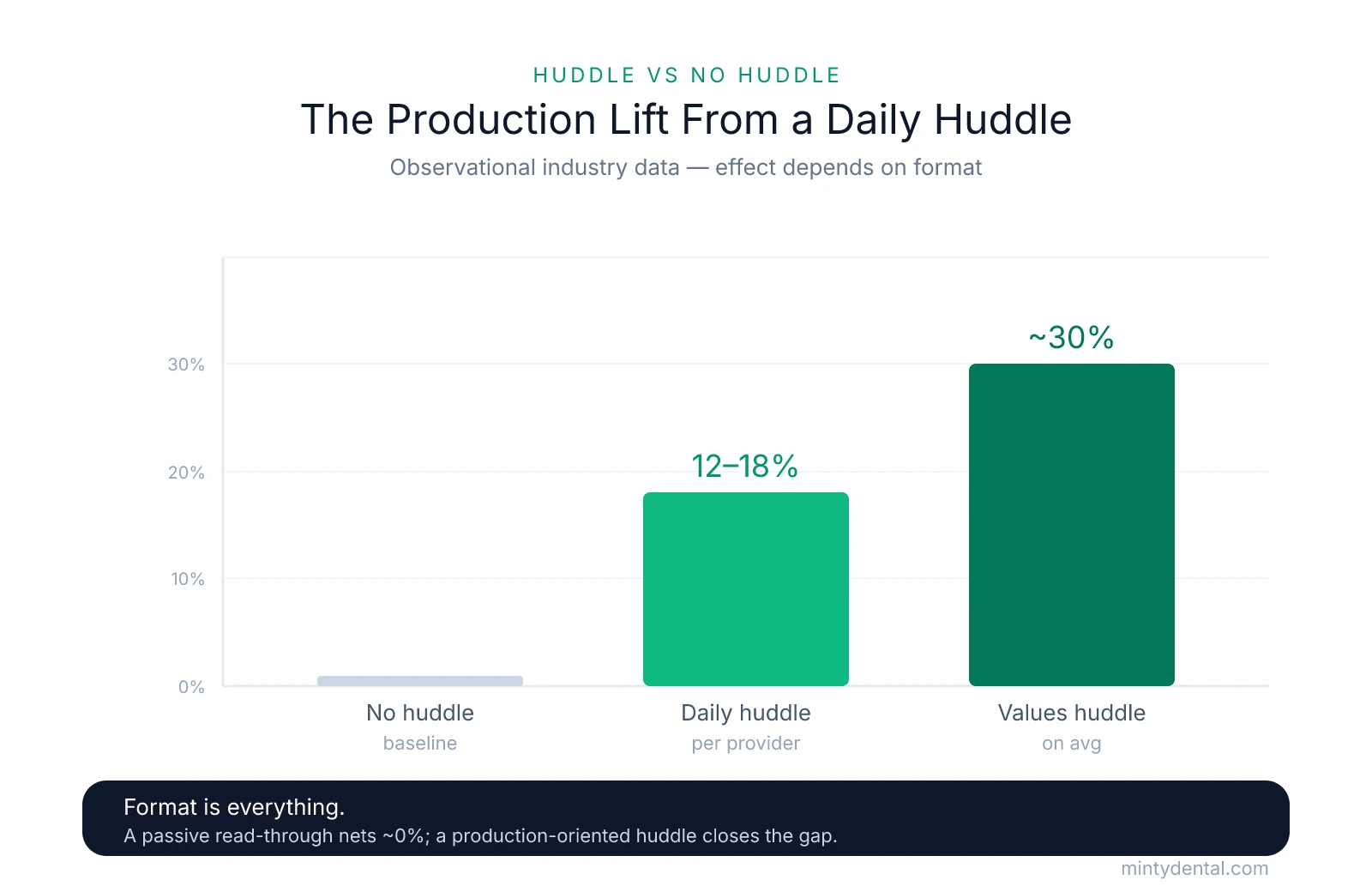
The core question for a practice owner is whether this meeting actually improves production, or whether it is a pleasant routine that could be skipped. The available evidence points in a consistent direction. Practices that value a daily morning huddle outproduce those that don't by about 30 percent on average. A survey of more than 500 practices found 12 to 18 percent higher production per provider among those conducting daily huddles. The reasoning behind the range is consistent across sources: when the team knows the goal and the patient's history before the day starts, each interaction is more intentional.
The mechanism is supported by research outside dentistry. Daily huddles help healthcare teams share information, flag concerns proactively, and increase accountability, which reduces the number of disruptions that surface mid-day. Those same disruptions, in a dental practice, are the cancellations, missed treatment opportunities, and scheduling scrambles that quietly erode daily production.
Most of the dental-specific numbers come from consultants and observational data rather than controlled trials, so the effect size should be read as a plausible range, not a guaranteed return. What tends to hold true is the direction and the condition attached to it.
Practices that run structured morning huddles consistently outproduce those that don't, but the format determines whether the gap is closer to 0 percent or 30 percent. A huddle that reviews the schedule passively produces little, while one built around a production goal and clear role assignments tends to improve daily production, an effect that compounds when paired with disciplined production-per-hour tracking.
Why Most Dental Morning Huddles Don't Move the Numbers
Many owners sense that their huddle isn't doing much, but they aren't sure what to change. The gap usually comes down to one distinction: a passive schedule review versus a production-oriented huddle. Reading the schedule line by line tells the team what is happening that day. A production-oriented huddle tells the team what they are going to do about it. Most practices run the first version without realizing the second exists.
Out of more than 100 practices studied, roughly 5 percent were running what qualified as an effective morning huddle. The other 95 percent were skipping it, going through the motions, or running a dry numbers meeting that left the team feeling blamed. Three specific failure modes explain why so many huddles consume 15 minutes without affecting the day's output.
Failure mode 1: No production goal. The team reviews who is coming in but never compares scheduled production to the daily target. When the number is never stated, gaps between the goal and the booked schedule go unnoticed, so no one acts to close them. A huddle that opens with "we are at $4,200 scheduled against a $6,000 goal" gives the team a problem to solve before the first patient arrives.
Failure mode 2: No designated leader or role assignments. Without someone owning the meeting and clear responsibilities for each attendee, the conversation drifts and accountability fades. The distinction between a manager who is organizing the day and one who is simply staying busy often shows up here, because a leaderless huddle produces activity without direction.
Failure mode 3: No action items. The meeting ends without anyone owning a specific follow-up, so the openings and unscheduled treatment that surfaced stay exactly where they were. This is where the largest opportunity sits. An estimated $150,000 to $250,000 in diagnosed but unscheduled treatment sits in the average practice's charts, work that patients have already accepted on paper but never booked. The huddle is the daily mechanism for surfacing that backlog and turning it into same-day treatment starts and booked appointments.
The doctor's presence shapes all three. When the owner skips the huddle or arrives late, it signals that the meeting is optional, and team engagement tends to follow that cue.
A 10–15 Minute Huddle Structure That Actually Drives Production
A repeatable agenda needs named owners and a fixed time budget. The structure below splits the meeting into four blocks that total 10 to 15 minutes. A strategically structured huddle functions as a daily production tool rather than a routine meeting when each block has a clear purpose and a person responsible for it.
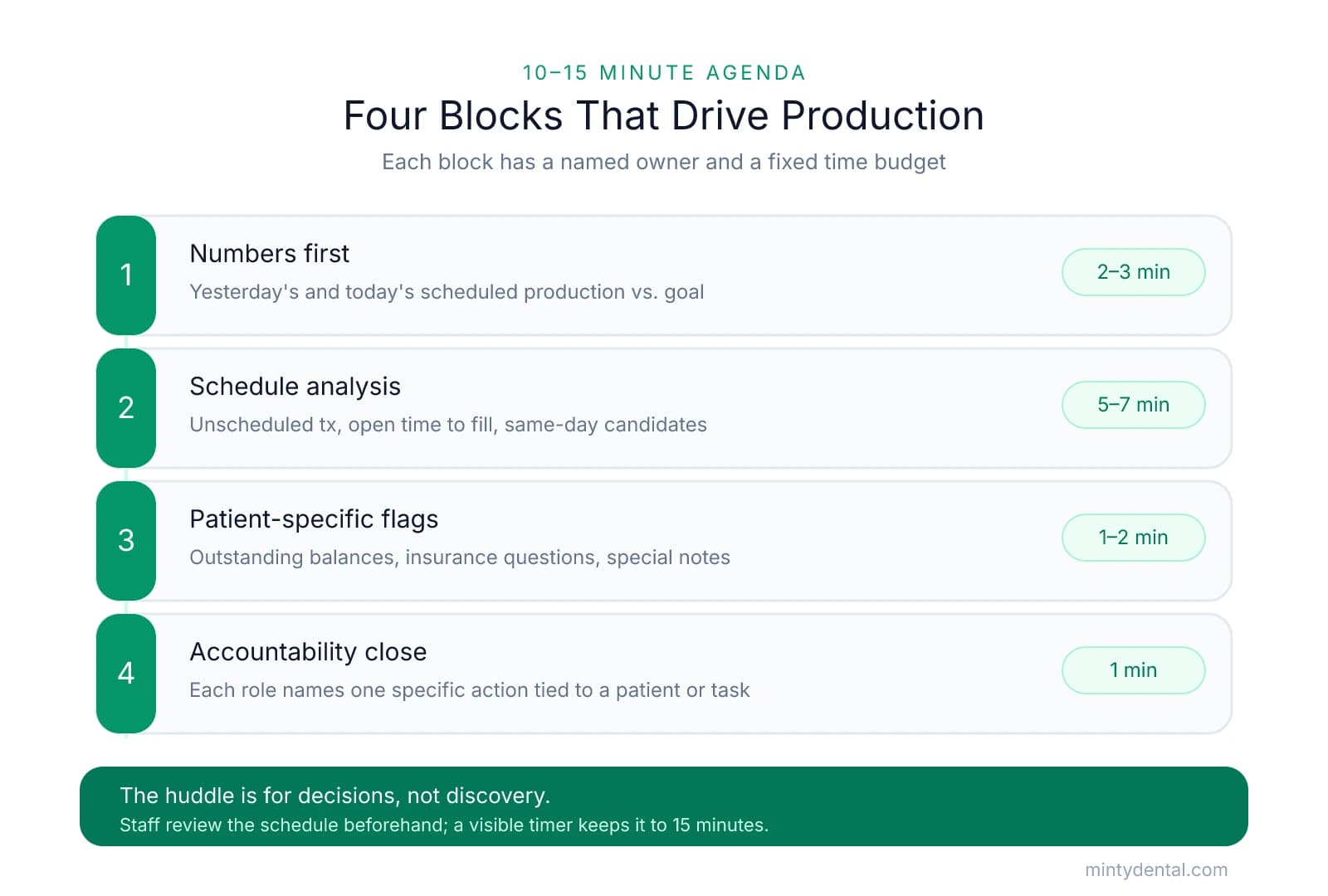
Step 1 — Numbers first (2 to 3 minutes). The office manager or scheduling coordinator states two figures: yesterday's production against goal, and today's scheduled production against the daily target. The gap between today's scheduled number and the goal becomes the team's shared focus. If the practice is at $4,800 scheduled against a $6,000 target, everyone in the room knows there is $1,200 to find during the rest of the huddle.
Step 2 — Schedule analysis (5 to 7 minutes). This is a focused review of three opportunities, not a line-by-line read of the day. A real huddle identifies where the opportunities and risks are before patients arrive, which means looking at:
- Patients on today's schedule with unscheduled treatment from a prior visit, flagged in advance by the hygienist and assistant
- Open time that could be filled from a short-call list, which pairs well with methods for filling gaps without discounting
- Same-day treatment candidates, identified from patient history and room availability so the assistant can prep the operatory
Step 3 — Patient-specific flags (1 to 2 minutes). The front desk surfaces patients with outstanding balances, pending insurance questions, or circumstances the clinical team should know before they walk in. Knowing a financial conversation is coming lets the treatment coordinator prepare rather than react at checkout.
Step 4 — Accountability close (1 minute). Each role names one specific action they own for the day: a named patient to call about unscheduled treatment, a case to present, or a particular opening to fill. A general intention ("I'll try to fill the gaps") does not count; the commitment should reference a patient or task.
Two conditions determine whether this structure works. First, the huddle is for decisions, not discovery. The hygienist, assistant, and scheduling coordinator review the schedule before the meeting so flags are ready when it starts. Each team member sharing a quick plan for the day builds engagement and accountability, but only when the review has already happened. Second, a timer visible to the team keeps the meeting at 10 to 15 minutes and prevents it from drifting into a staff meeting where problems get solved.
The doctor's role is mostly to listen and confirm clinical priorities. When the owner leads the entire meeting, the team becomes passive; when the owner confirms the day's clinical calls and lets staff own their blocks, the huddle runs on shared responsibility.
Three Numbers That Tell You Whether Your Huddle Is Working
A huddle can run on schedule every morning and still produce nothing measurable. The way to tell the difference is to track three numbers weekly and compare them over time. Practices that review key metrics weekly resolve problems faster and grow more consistently than those that review monthly or not at all, which makes a short weekly check the right cadence for evaluating a huddle.
Metric 1 — Same-day treatment starts. Count the procedures completed same-day that were not on the original schedule. This figure directly measures whether the huddle is surfacing diagnosed-but-unscheduled treatment and converting it. A huddle that flags same-day candidates each morning should move this number up within a few weeks.
Metric 2 — Schedule fill rate. Compare the open chair time identified at the start of the day to the open time remaining at the end of the day. When the huddle is working, gaps flagged in the morning get filled more consistently, so end-of-day open time shrinks relative to where it started.
Metric 3 — Daily production versus goal. Track how often the practice meets or exceeds its daily production target. A structured huddle should narrow the gap between scheduled production and actual production over time, because the team is acting on openings and unscheduled treatment rather than leaving them for later.
To establish a baseline, pull these three numbers for the four weeks before changing your huddle format, then compare them to the four weeks after. The comparison does not need to be statistically rigorous. A consistent directional improvement across all three metrics is a reliable signal that the format change is working.
The huddle surfaces opportunity, but it does not close every case on its own. If case acceptance is low because of fee presentation or financial friction at checkout, the huddle will put those patients in front of the team without improving the conversion. Those systems deserve separate attention, whether the issue is a case acceptance rate that stays stubbornly low or the operational steps involved in converting more same-day treatment.
A practical next step is to run your current huddle for two weeks while tracking these three numbers, then use that baseline to decide whether a format change is warranted. If the numbers are flat, the structure from the previous section gives you a specific place to start.
In Summary
- A dental morning huddle is a structured 10 to 15 minute team meeting held before the first patient arrives, involving all clinical and administrative staff.
- Practices that run daily huddles tend to outproduce non-huddle practices by roughly 12 to 30 percent per provider, based on observational industry data.
- Healthcare research confirms that team huddles improve communication, accountability, and early problem identification, which reduces day-of disruptions.
- Most dental-specific evidence is observational rather than controlled, so the actual production lift depends on how consistently and effectively the huddle is run.
- A passive schedule read-through produces little; a production-oriented huddle with clear goals and role assignments is what moves the number.
Sources & References
The data and claims in this article are drawn from the following sources. We prioritize government data, peer-reviewed research, and established industry publications to ensure accuracy.
- Maximize Your Dental Practice Daily Huddles - Jarvis Analytics— www.jarvisanalytics.comIndustry
- Morning Huddle Template For Dental Practices— dentalpracticeinsider.orgIndustry
- Improving Patient Safety and Team Communication through Daily ...— psnet.ahrq.govGovernment
- What a Good Dental Morning Huddle Actually Looks Like— dentalmasterydynamics.comIndustry
- $150K-$250K Is Sitting in Your Dental Charts Right Now | GrowthRx— getgrowthrx.comIndustry
- How Morning Huddles Improve Dental Practice Performance— www.dentalmanagers.comIndustry
- Morning Huddles for Dental Practices— thedentalateam.comIndustry
- Effective Dental Morning Huddles - Improve productivity— allstardentalacademy.comIndustry
- Dental Practice Key Performance Indicators: Which Metrics Actually ...— sunrisedentalsolutions.comIndustry
Ready to optimize your practice operations?
Morning huddles are just one piece of the operational puzzle. Minty's operations team helps independent practices streamline workflows, enhance team coordination, and boost overall productivity through comprehensive business management.