Dental Hygienist Pay: How to Structure Compensation

Co-Founder, Minty Dental
In Summary
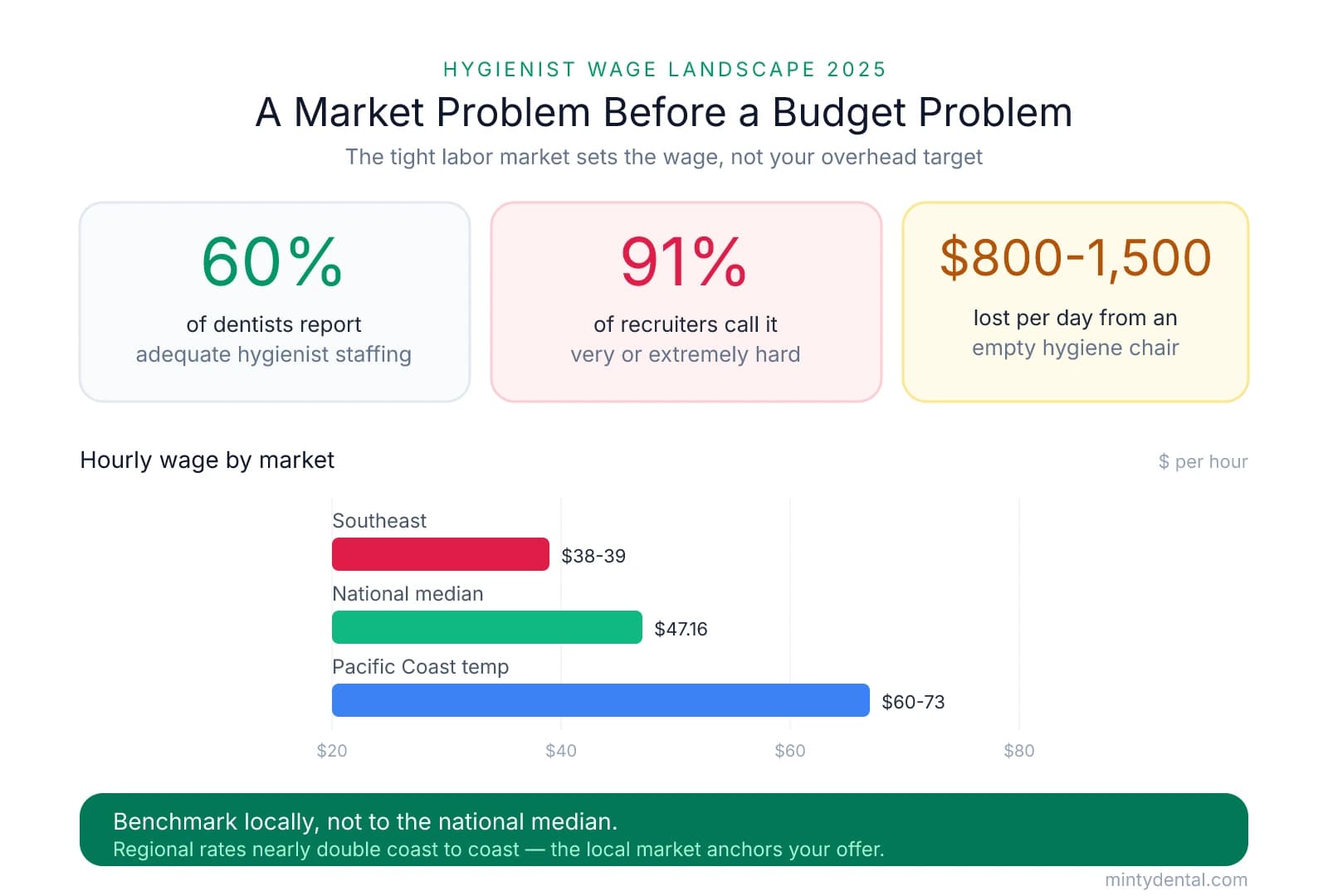
- Only 60% of dentists report adequate hygienist staffing, and 91% of active recruiters describe the search as very or extremely challenging, which sets the wage bargaining backdrop owners are working within.
- The national median hygienist wage is $98,100 per year ($47.16 per hour), but local rates vary widely, from roughly $38 to $39 per hour in parts of the Southeast to $60 to $73 per hour on Pacific Coast temp platforms.
- An empty hygiene chair costs roughly $800 to $1,500 per day in lost production, so the cost of understaffing is concrete rather than theoretical.
- Owners face two core decisions: what wage rate to anchor on locally, and which pay model (hourly, production-based, or hybrid) to use.
- Non-monetary factors and defensible production goals can protect hygiene department profitability while keeping offers competitive.
Hygienist Pay Is a Market Problem Before It Is a Budget Problem
Hygienist compensation is set by a tight labor market first, and by your budget second. Only 60% of dentists report having an adequate number of dental hygienists on staff, and among those actively recruiting, 91% describe the search as very or extremely challenging. When most practices in your area are hiring at the same time, the market, not your overhead target, determines the wage you need to offer to fill a chair.
That market context shapes both directions an owner can get wrong. Owners who underpay tend to lose hygienists to nearby practices or to temp platforms, where flexible schedules and higher day rates compete directly for the same candidates. Owners who overpay without a production framework raise labor cost against reimbursement rates that have not moved as quickly, which erodes hygiene department margin.
The wage numbers themselves show why national figures are not enough to plan with. The 2025 median hygienist wage is $98,100 per year, or $47.16 per hour, with the top 10% earning above $126,050. Regional spread is wide: Pacific Coast markets often run $60 to $73 per hour on temp platforms, while parts of the Southeast average closer to $38 to $39 per hour. Benchmarking locally, rather than to the national median, is the only way to anchor an offer accurately.
Timing pressure adds to this. An open hygiene chair costs roughly $800 to $1,500 per day in lost production, so a vacancy that runs several weeks is a measurable revenue loss, not an abstract inconvenience. That figure is worth calculating for your own practice before deciding how aggressively to price an offer, because it sets the ceiling on what a faster hire is worth.
Choosing the Right Pay Model: Hourly, Production-Based, or Hybrid
The pay model determines how a hygienist's compensation responds to production, cancellations, and scheduling gaps. Three structures cover most private practices: flat hourly, straight production percentage, and a base-plus-bonus hybrid.
| Model | How it's calculated | Best-fit scenario | Key risk |
|---|---|---|---|
| Flat hourly | Fixed rate per hour worked, regardless of production | Newer practices, inconsistent recall, or owners who want predictable payroll | No link between pay and production; the owner absorbs the full cost of an underbooked schedule |
| Straight production % | Typically 28–33% of collections | Practices with strong recall and reliable scheduling | Pay is exposed to scheduling gaps, so hygienists may resist practices with weak recall systems |
| Base-plus-bonus hybrid | Competitive hourly base plus a bonus on production above a goal | Most established private practices | A poorly calibrated goal either never pays out or triggers on average days |
Flat hourly is predictable and simple to administer, but it creates no alignment between pay and output. When the schedule has holes, the practice pays the full rate for a partly empty chair.
Straight production percentage aligns incentives directly, which tends to reward efficiency and treatment follow-through. The tradeoff is stability: because pay tracks collections, hygienists carry the downside of cancellations they cannot control, and strong candidates often screen out practices with inconsistent scheduling.
The base-plus-bonus hybrid is the structure most commonly recommended for private practice. A base pay covers slow days beyond the hygienist's control, and the commission is generally 25 to 30 percent of production above the daily goal. For example, with a $900 daily goal and a 30% rate, a $1,100 production day generates $60 in bonus on top of base pay (30% of the $200 excess).
The goal itself is where most hybrid plans succeed or fail. Calibrate it to the hygienist's actual schedule, procedure mix, and PPO-adjusted collections rather than a round number pulled from a benchmark. A goal that reflects real write-off rates keeps the math honest, and working through your production per hour by column and provider gives you a defensible starting point.
Two calibration errors are worth avoiding. A goal set too high is rarely reached and tends to demoralize rather than motivate. A goal set too low triggers bonuses on average days, which erodes the overhead benefit the model is meant to protect.
In practice, the model choice matters less than whether the arithmetic is transparent and the goal is achievable. Hygienists who understand exactly how their pay is calculated, and who see the goal as reachable, are more likely to stay.
Keeping Hygienist Labor Costs Within a Sustainable Range
A hygienist's rate is affordable only if it holds up against the production the chair actually generates. That requires two benchmarks: one for total staffing and one for hygiene specifically.
Total personnel costs. For an average practice, total staff costs typically run 24 to 26% of collections, with anything above 30% flagged as a warning threshold. This figure covers all wages plus benefits, so it tells you whether the practice as a whole is overstaffed relative to production, but it does not isolate hygiene.
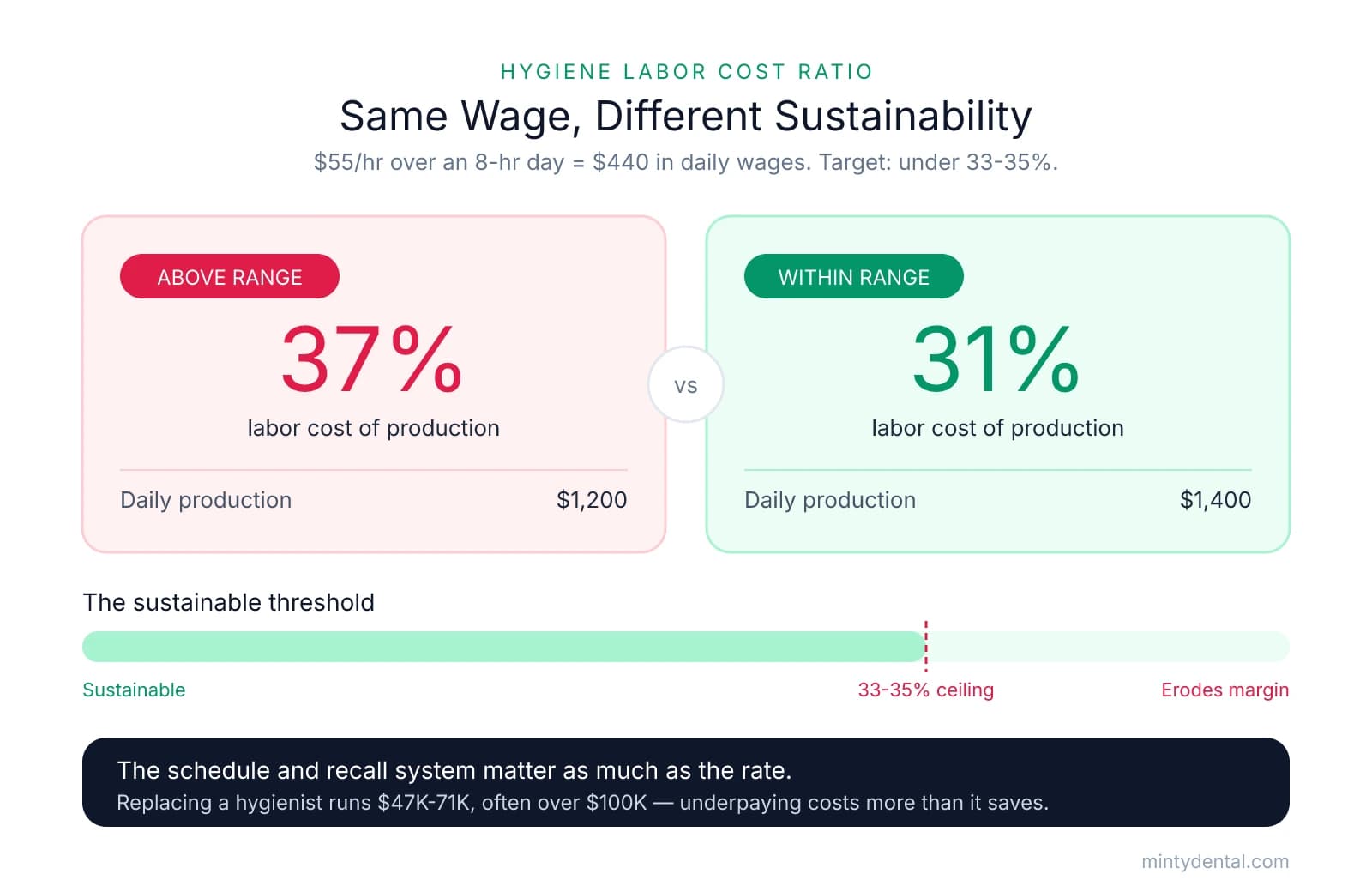
Hygiene labor cost as a share of hygiene production. To evaluate a specific rate, divide the hygienist's daily wage by that hygienist's daily production. A workable target is below 33 to 35%. Above that range, the hygiene department contributes less margin than it should once supplies, facility cost, and support staff time are accounted for.
The calculation makes a rate decision concrete before you commit to it. Consider a hygienist paid $55 per hour across an 8-hour day, or $440 in daily wages:
- At $1,200 in daily production, labor cost is 37% ($440 ÷ $1,200), above the sustainable range.
- At $1,400 in daily production, labor cost is 31% ($440 ÷ $1,400), within range.
The same wage moves from unaffordable to sustainable depending on production. That is why the schedule and recall system matter as much as the rate itself, and why the profitability of the hygiene department depends on both. Running this ratio on your current hygienists tells you whether a proposed rate is viable at your actual production levels. Reviewing whether the hygiene department is genuinely profitable can surface production gaps a wage number alone hides.
Turnover as the counterweight to underpaying. Cutting the rate to protect margin carries its own cost. Using the SHRM formula of six to nine months of salary, replacing a hygienist runs $47,000 to $71,000 in direct costs, and often exceeds $100,000 once lost production and patient attrition are included. Set against that figure, the goal is the minimum total cost of the position over time, not the lowest hourly rate. Paying somewhat more to keep a productive hygienist is frequently cheaper than a vacancy and a replacement search.
A monitoring routine. Track hygiene labor cost as a percentage of hygiene collections monthly, separate from total payroll as a percentage of practice collections. The monthly view catches a rate drifting out of range early, while the annual view is too coarse to act on. This keeps the department visible without micromanaging individual days.
What Hygienists Weigh Beyond the Hourly Rate
Pay gets a hygienist in the door, but working conditions determine whether they stay. In one survey, 63% of hygienists said income was the thing they liked most about their job, yet 69% said their employer had not provided a safe way to relay their concerns. A competitive rate answers the first factor and does nothing for the second. Four non-monetary factors do most of the retention work.
Schedule control. Hygienists who temp or work part-time often choose that path specifically for schedule autonomy, which is the same autonomy temp platforms use to compete for candidates. A practice that offers a predictable weekly schedule with some flexibility, such as a consistent day off or input into the recall calendar, competes on the ground where temp work usually wins.
Physical workload and ergonomics. Burnout, musculoskeletal disorders, and lack of support are leading reasons hygienists consider leaving clinical practice, with more than half of RDHs reporting they were searching for new roles in 2022. Ergonomic loupes, saddle stools, and a patient load that leaves recovery time between appointments reduce physical strain, and that investment signals a commitment to the hygienist's long-term career rather than short-term throughput.
Professional development. DSOs frequently offer structured career ladders, so independent practices need a comparable path. CE reimbursement, expanded-scope opportunities such as laser certification or a role in clear aligner cases, and a transparent route to higher-tier pay give a hygienist reasons to grow inside your practice instead of leaving for one.
Communication and autonomy. The gap between how many hygienists value their income and how few feel heard points directly at communication. Regular one-on-ones and genuine clinical input on scheduling decisions give hygienists a channel to raise concerns before those concerns become resignation letters. Building this into how the practice runs also reduces owner dependence, a theme covered in making a practice less reliant on any single person.
Sources & References
The data and claims in this article are drawn from the following sources. We prioritize government data, peer-reviewed research, and established industry publications to ensure accuracy.
- Dental Hygienist Shortage - American Dental Association— ada.orgIndustry
- Dental Hygienists : Occupational Outlook Handbook— www.bls.govGovernment
- Optimizing Hygienist Compensation for Practice Growth— www.jrcpa.com
- Dental Hygienist Pay Arrangements - Colgate Professional— www.colgateprofessional.com
- Dental Office Overhead Percentages: 2026 Report - DentiMax— dentimax.comIndustry
- Dental Staff Turnover: The Shocking Cost by Role | DMD— dentalmasterydynamics.comIndustry
- Dental Hygienist Salary 2026: Pay by State & City - Teero— teero.com
- Career longevity and satisfaction of dental hygienists - RDH Magazine— www.rdhmag.com
Ready to optimize your hygiene compensation strategy?
Structuring competitive hygienist pay is crucial for retention and practice profitability. Minty's operations team helps independent practices design compensation models that attract top talent while maintaining healthy margins.