How to Make Your Dental Practice Less Dependent on You

Co-Founder, Minty Dental

In Summary
- Owner dependency describes the degree to which a practice's revenue, operations, and patient relationships require the owner's personal presence to function across four distinct dimensions: clinical production, operational knowledge, patient relationships, and referral flow.
- When an owner produces 60% or more of practice revenue, buyers typically apply a key-person discount of roughly 10–20% against a comparable practice's valuation.
- Goodwill averages approximately 52% of annual gross revenue in general dentistry, and the portion tied to the individual owner transfers less reliably than goodwill tied to systems, staff, and location.
- Reducing owner dependency shifts value from personal goodwill to enterprise goodwill, which benefits practice owners whether they plan to sell, take extended time away, or simply want a more resilient business.
- The four dimensions are independent: a practice can have a productive associate on staff and still carry significant operational or relationship dependency on the owner.
Owner Dependency Has Four Measurable Dimensions, and Each One Affects Practice Value
Owner dependency is the degree to which a dental practice's revenue, operations, and patient relationships require the owner's personal presence to function. A practice with high owner dependency does not stop being profitable while the owner is present. The problem surfaces when the owner steps back, whether temporarily or permanently, and the business cannot sustain its performance without them.
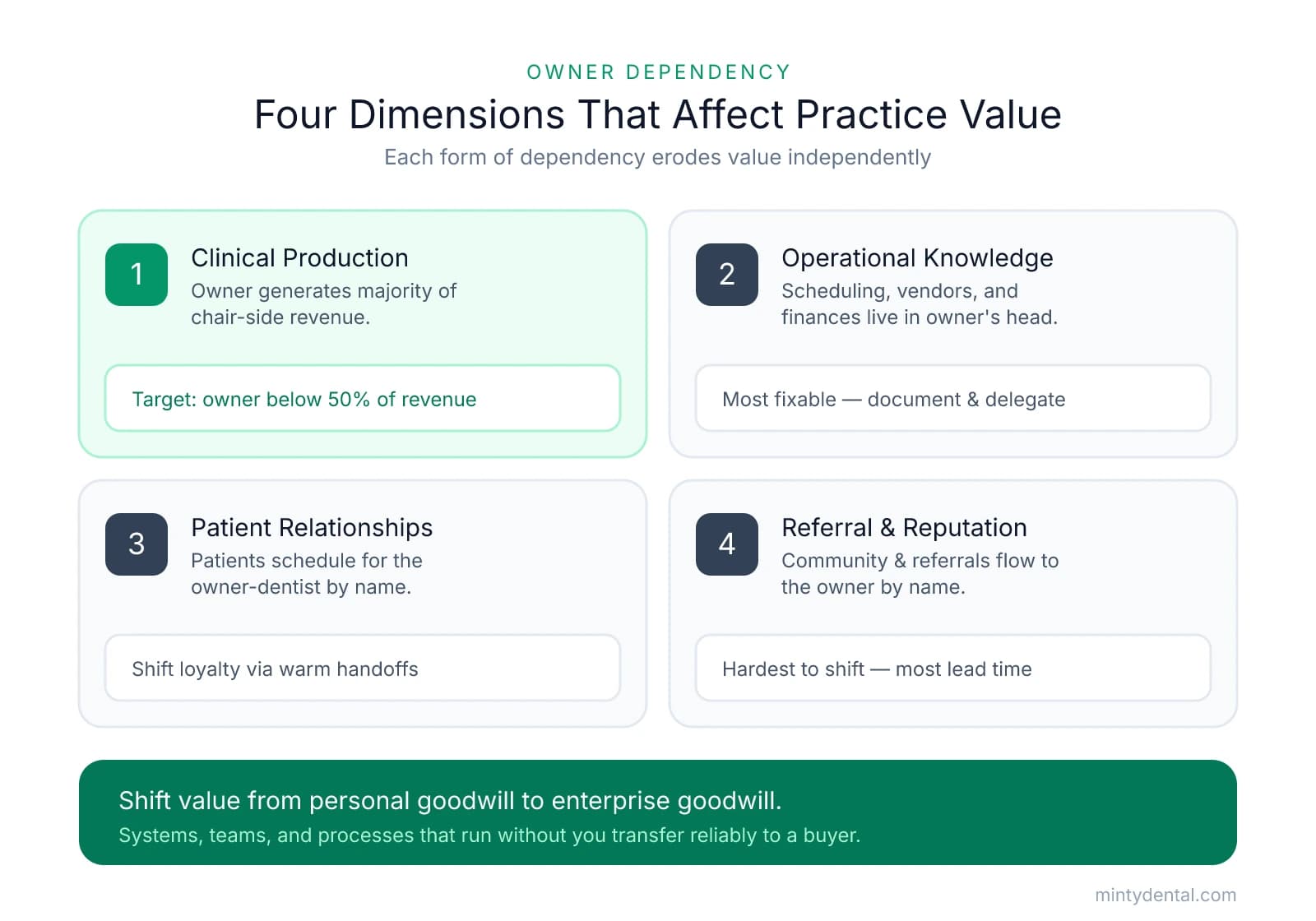
Dependency takes four distinct forms, and each one affects practice value independently.
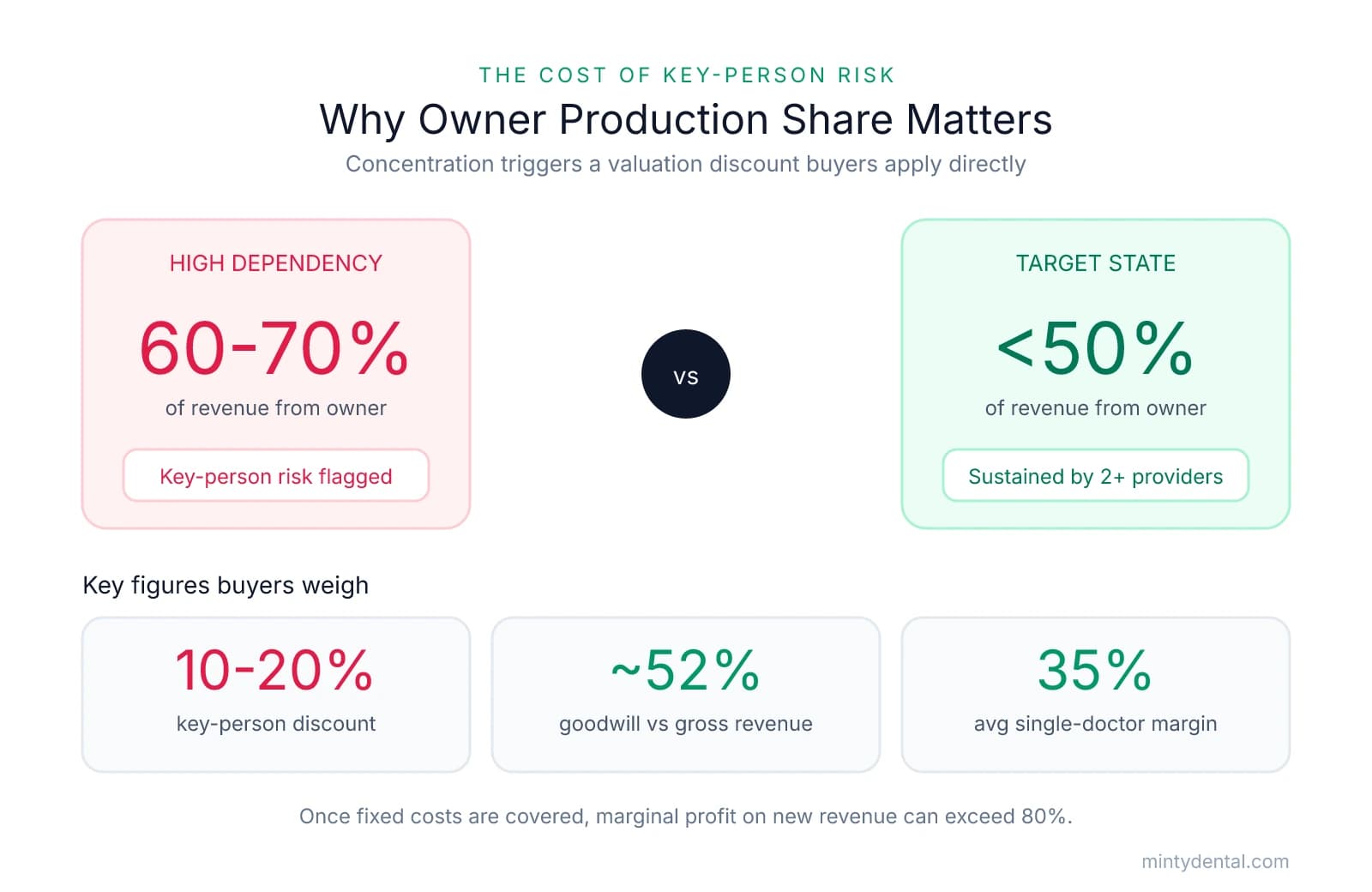
- Clinical production concentration. When the owner generates the majority of chair-side revenue, the practice's income is directly tied to their physical availability. Buyers evaluate this risk concretely: according to TUSK Practice Sales, when an owner produces 60 to 70 percent or more of revenue and is not committed to a long post-sale employment period, buyers apply a key-person discount of roughly 10 to 20 percent against an otherwise comparable practice.
- Operational knowledge concentration. Scheduling logic, vendor relationships, team management, and financial oversight often exist only in the owner's head. This form of dependency is less visible than production share but equally disruptive when the owner is unavailable.
- Patient relationship concentration. Some patients schedule specifically because of their relationship with the owner-dentist. When that dentist leaves, a portion of those patients may not transfer their loyalty to an associate or new owner.
- Referral and reputation concentration. Specialist referrals and community reputation that flow to the owner by name represent personal goodwill, not enterprise goodwill. They do not automatically follow the practice after a transition.
The distinction between personal and enterprise goodwill is central to understanding why all four dimensions matter financially.
| Characteristic | Personal Goodwill | Enterprise Goodwill |
|---|---|---|
| Tied to | The individual owner-dentist | The practice as a business entity |
| Examples | Owner's chairside reputation, referral relationships by name | Systems, staff, location, documented processes, brand |
| Transfers at sale | No, it leaves with the owner | Yes, it transfers to the buyer |
| Buyer's valuation | Discounted or excluded | Included at full value |
| Tax treatment risk | May be recharacterized as ordinary income | Generally taxed at capital gains rates |
As Precision Dental Analytics notes, goodwill in general dentistry averages roughly 52% of annual gross revenue and represents the largest single component of most practice sale prices. The portion tied to the owner personally is the portion a buyer will discount or exclude.
The practical goal across all four dimensions is to shift value from personal goodwill to enterprise goodwill by building systems, teams, and processes that function independently of any one person. Owners who accomplish this gain more than a stronger sale price. They gain operational optionality: the ability to take time away, bring in a partner, or exit on their own timeline rather than being constrained by what the practice requires of them personally. The sections that follow address each dimension with concrete steps for reducing dependency and strengthening the enterprise value that transfers reliably to a buyer.
Reducing Clinical Production Concentration: When and How to Add an Associate
Clinical production concentration is the most financially visible form of owner dependency. When the owner generates 60 to 70 percent or more of chair-side revenue, buyers interpret that as key-person risk and adjust their offers accordingly. The practical target is to bring the owner's production share below 50 percent of total practice revenue, signaling to buyers that the practice can sustain its output through more than one provider.
Confirming the Practice Can Support an Associate
Adding an associate before the practice has sufficient patient volume is a common sequencing mistake. A widely used benchmark is 1,500 to 2,000 active patients per full-time provider. If your current patient base sits below that threshold for a single provider, the associate's schedule will likely be underutilized, and the hire will compress margins rather than expand them.
Once volume supports a second provider, the economics shift meaningfully in the owner's favor. According to Focus Partners, single-doctor general practices average profit margins around 35%, but marginal profitability on incremental revenue can exceed 80% once fixed costs are covered. Because fixed costs such as rent, software, and core staff are already absorbed by the owner's production, the associate's revenue flows through at a much higher profit rate. A well-structured associate hire at 30 to 35 percent compensation can be meaningfully accretive even in the first year.
Choosing a Compensation Structure
Associate compensation typically follows one of two models: a percentage of collections or a daily guarantee. Each carries different risk and incentive profiles for both parties.
- Percentage of collections ties the associate's pay directly to their output, which aligns incentives but creates income variability for the associate, particularly in early months when their schedule is still filling.
- Daily guarantee provides income stability for the associate but transfers more financial risk to the owner if production is slow.
Modeling both structures before committing is worth the time. Minty's associate compensation calculator allows owners to compare pay structures across different production assumptions, and the W2 vs. 1099 calculator can clarify how classification affects total cost.
Transferring Patient Relationships Through Warm Handoffs
Patients who schedule specifically for the owner-dentist represent personal goodwill that does not transfer automatically to a new provider. Warm handoffs are the practical mechanism for shifting patient loyalty from the individual to the practice.
Effective handoffs typically involve the owner introducing the associate chairside during existing appointments, co-treating cases so patients observe the associate working alongside a provider they already trust, and having staff reinforce the associate's competence in scheduling conversations. A gradual schedule transition, where the associate takes on new patient appointments first before inheriting existing patient relationships, tends to reduce attrition compared to an abrupt reassignment.
The goal is not to replace the owner's relationship with patients but to extend the practice's relationship with them beyond any single provider.
Reducing Operational Dependency: Systems, Delegation, and a Capable Office Manager
Operational dependency is often the most fixable form of owner dependency and frequently the least visible. When scheduling logic, collections protocols, vendor relationships, and team management exist primarily in the owner's memory, the practice cannot function predictably without them. Unlike clinical production concentration, which requires hiring decisions and schedule restructuring, operational dependency can be addressed through documentation, authority structure, and performance visibility.
The Bottleneck Pattern Most Owners Don't Recognize
The most common operational bottleneck is not a controlling owner but a caring one. When owners answer every question, approve every exception, and step in whenever a process breaks down, they inadvertently train their teams to wait rather than decide. As the Dental Success Network describes it, growth changes the owner's job from personally knowing what is happening to building systems that make performance visible without constant involvement. The fix is not less engagement but clearer authority structures.
A useful starting exercise is identifying the three decisions you make most frequently that a trained team member could make with clear guidelines. Common examples include approving schedule changes, handling patient billing complaints, and authorizing supply orders under a set dollar threshold. Transferring those three decisions first, with explicit criteria for how they should be made, tends to produce faster results than attempting a broad delegation overhaul.
Prioritizing SOP Documentation
Documenting every process at once is neither practical nor necessary. Start with the tasks that cause the most revenue loss or patient experience variation when done inconsistently. In most practices, those are scheduling template management, collections and accounts receivable follow-up, new patient intake, and hygiene recall. As Sunrise Dental Solutions notes, the best first SOP is often a simple checklist of the current best practice for a common task, capturing existing knowledge before trying to improve it.
Defining the Office Manager's Role
A capable office manager should own personnel supervision, scheduling oversight, billing follow-up, and daily operational decisions. When that role is clearly defined, owners can focus on clinical work and strategic decisions rather than fielding operational questions throughout the day. The boundary worth establishing explicitly is which decisions require the owner's input and which do not. Without that boundary, even a strong office manager will default to asking rather than acting.
Managing by Exception Through KPI Visibility
Once authority is delegated, the owner's role shifts to monitoring outcomes rather than overseeing processes. A weekly metrics review covering production, collections rate, new patient volume, and accounts receivable aging gives owners enough visibility to identify problems early without being present for every interaction. Practices that track overhead categories alongside production metrics can often spot efficiency gaps before they compound, a topic covered in more depth in the guide to identifying where overhead is running high.
The goal is a practice where the owner's absence does not change what decisions get made or how quickly they get made.
A Self-Assessment and Sequencing Framework for Getting Started
The previous sections cover what to do across each dimension of owner dependency. The remaining question is where to start. Four questions can help you assess your current position before deciding which changes to prioritize.
Four-question self-assessment:
- What percentage of total collections do you personally produce? If the answer is above 50 percent, clinical production concentration is your highest-priority financial exposure.
- Could the practice operate for two weeks without you? If the honest answer is no, operational dependency is limiting your options regardless of your exit timeline.
- What share of patients specifically request you by name? A high rate signals that patient loyalty is tied to you personally rather than to the practice, which affects how much goodwill will transfer at a sale.
- Does new patient flow depend on your personal reputation or the practice's brand? Referral relationships and community recognition that follow you by name represent personal goodwill that a buyer cannot purchase.
These questions do not require a formal valuation to answer. They are a starting point for identifying which dimension of dependency deserves attention first.
Sequencing the work matters as much as doing it. Operational systems are the fastest to implement and have the broadest effect on day-to-day resilience. Associate hiring takes longer to execute and involves more financial risk, but it addresses the dimension that most directly affects how buyers price a practice. Patient relationship transfer happens gradually through consistent warm handoff behavior over months, not weeks. Referral and reputation dependency is the hardest to shift and typically requires the most lead time, because it involves changing how the community and referring providers perceive the practice rather than just how it operates internally.
The TUSK orthodontist example illustrates what this sequencing looks like over a longer horizon. By reducing his personal clinical production from roughly 75 percent to the mid-teens over several years, he built a 40-person organization he could sell on his own terms or choose not to sell at all. That outcome reflects what reduced dependency actually buys: optionality. A practice that can run without the owner can be sold, partially exited, or simply managed with fewer clinical hours.
The two-to-three-year preparation window matters here because the changes that most affect enterprise goodwill take time to appear in the financials. An associate hired this year needs time to build a patient panel before that production shows up as a durable revenue line. Systems documented today need to be tested through the owner's absence before a buyer will treat them as reliable. Practice valuation methods and the nine factors that influence what a buyer will pay are worth understanding early, because they clarify which operational changes will actually move the number. Owners who want to understand how these changes connect to sale price can find a broader framework in the guide to increasing practice value before selling.
The goal is not to remove yourself from the practice. It is to ensure the practice's value does not depend on your continued presence. That distinction matters operationally, and it matters at the negotiating table.
Sources & References
The data and claims in this article are drawn from the following sources. We prioritize government data, peer-reviewed research, and established industry publications to ensure accuracy.
- One Doctor, All the Risk: What Owner Dependence Really Costs at Exit— tuskpracticesales.comIndustry
- Personal Goodwill: Why a Dental Buyer Can Withhold Your Cash— precisiondentalanalytics.comIndustry
- The Economics of Bringing on an Associate Dentist | Focus Partners— focuspartners.comIndustry
- How Managing a Dental Practice Changes as Your Team and Patient ...— dentalsuccessnetwork.comIndustry
- Building Systems for Your Dental Practice: SOPs for Scheduling ...— sunrisedentalsolutions.comIndustry
- Buying Freedom: The Dental Practice Purchase Handbook (Full Audiobook)— www.youtube.com
Ready to build a practice that runs without you
Reducing owner dependency requires strong operational systems, delegation, and professional management. Minty's Operations service handles the business side of your practice, from billing and marketing to technology, freeing you to focus on clinical work or step back entirely.