Dental Practice Lab Fees Too High? How to Evaluate and Reduce

Co-Founder, Minty Dental
In Summary
- Lab fees typically run 6 to 8 percent of collections for a general practice, top performers hold 4 to 6 percent, and anything above 10 percent warrants a closer look.
- The more precise measure is lab cost as a percentage of each procedure's production: below 20 percent is healthy for most fixed prosthetics, and above 25 percent signals a problem worth investigating.
- A high practice-level ratio has three possible causes: lab pricing has crept up, case mix has shifted toward higher-lab-cost work, or the fee schedule has not kept pace with lab costs.
- Practice-level tracking tells you whether the overall number is in range; procedure-level tracking tells you which cases carry margin and which barely break even.
- Before cutting anything, identify which of the three drivers is at work, because each one points to a different fix.
Lab Fee Benchmarks Reveal Whether You Have a Pricing Problem or a Mix Problem
Dental lab fees are the outsourced fabrication costs a practice pays for crowns, bridges, dentures, implant components, and other restorations produced outside the office. As an overhead category, lab fees typically fall between 6 and 8 percent of collections for a general practice, which places them among the largest expense lines after staff, facility, and clinical supplies.
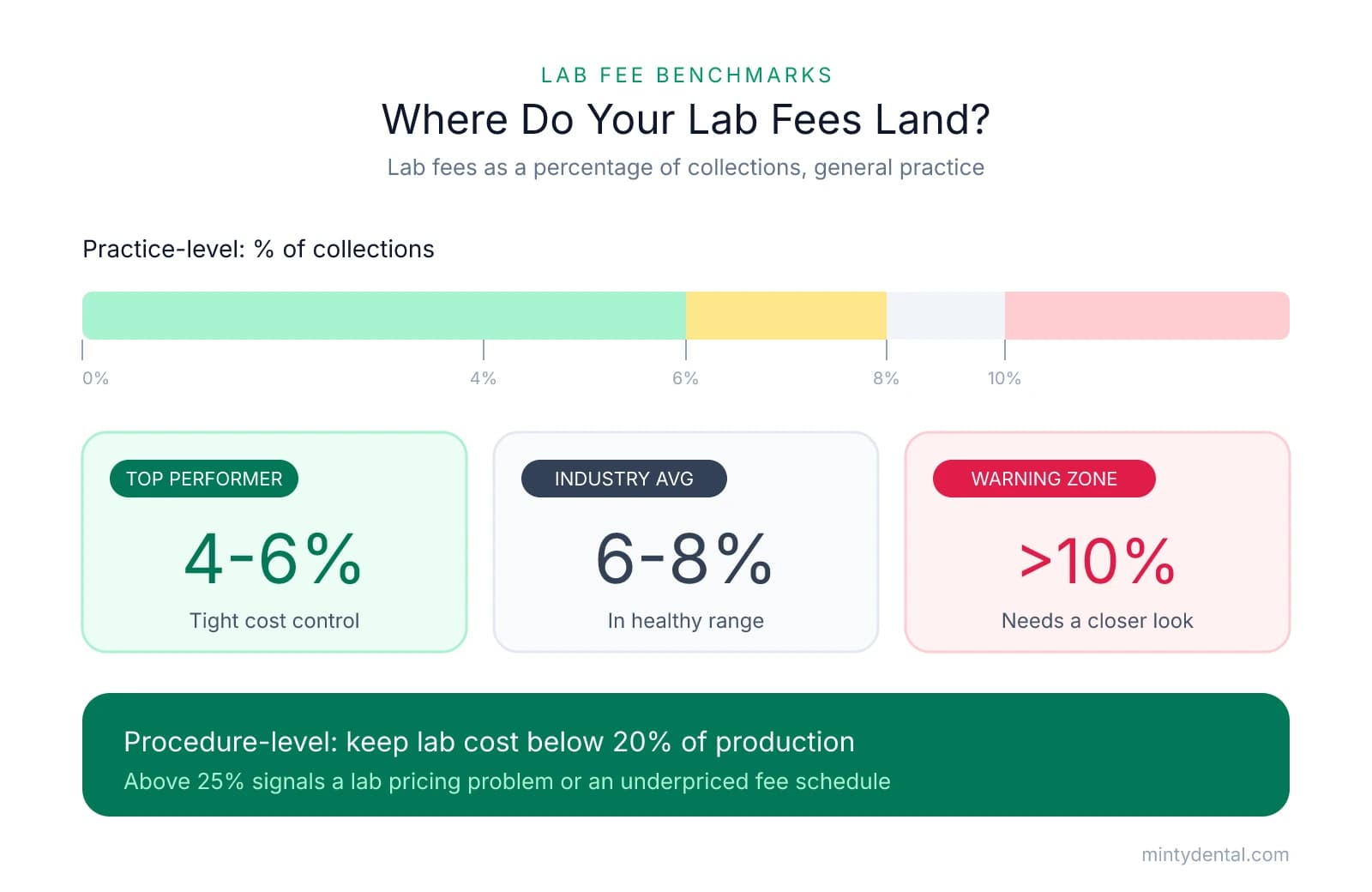
To locate your own practice, two benchmarks matter. The first is practice-level lab cost as a percentage of gross collections. The second is procedure-level lab cost as a percentage of that procedure's production.
| Benchmark | Lab Fees as % of Collections |
|---|---|
| Top performer | 4-6% |
| Industry average | 6-8% |
| Warning threshold | Above 10% |
The practice-level number alone does not tell you enough. A practice doing heavy implant or full-arch work will naturally run higher than one focused on routine restorative, because the lab component of those cases is far larger. A ratio of 9 percent might be perfectly healthy in an implant-focused office and a real concern in a bread-and-butter general practice.
The procedure-level benchmark: Lab cost above 20 percent of a procedure's production deserves evaluation, and above 25 percent signals either a lab fee problem or a production pricing problem. For most fixed prosthetics, staying below 20 percent keeps the case margin-positive. This is the number that reveals which cases carry healthy margin and which ones the lab fee quietly erodes.
When the practice-level ratio runs high, it can mean one of three things:
- Lab pricing has crept up. Fees rose over several years without a review, so you are paying more per unit than the market requires.
- Case mix has shifted. More implant, full-arch, or complex prosthetic work has moved the overall ratio up, even though each case is priced correctly.
- The fee schedule has not kept pace. Your reimbursement or self-pay fees have not risen with lab costs, so production is too low relative to what the lab charges.
Each driver points to a different fix, and the same high ratio can mask a mix problem in one office and a pricing problem in another. Reviewing lab fees alongside other overhead lines, as covered in a broader look at where to cut overhead first, helps you weigh the effort against the likely savings. Before changing labs, renegotiating, or investing in in-house milling, the diagnostic question is which of the three drivers is actually at work.
How to Diagnose the Root Cause Before Deciding What to Change
Diagnosing pricing, mix, and quality problems takes three passes through your own data, using the lab invoices you already have.
Step 1: Pull 12 months of lab invoices and segment by procedure type. Group every charge into categories: single crowns, bridges, implant components, full dentures, and partials. Total each category for the year. This tells you where your lab spend actually concentrates, which is often different from where owners assume it goes. A practice that thinks crowns drive the bill may find that implant components and full-arch work account for the majority of the spend. Reading these categories against production works the same way as reading any expense against revenue, a skill covered in more depth in a guide to reading a practice P&L.
Step 2: Calculate the lab-to-production ratio for each procedure type. For every category, divide the annual lab cost by the annual production for those same cases, then multiply by 100. Flag any category above the 20 to 25 percent range for evaluation. A category that sits at 15 percent is not your problem. A category running at 28 percent is either underpriced in your fee schedule or overpriced by your lab, and now you know exactly where to look.
Step 3: Separate remakes from base fees. Remakes are a distinct cost driver that negotiation alone will not fix, so they belong on their own line. The national average remake rate is 4 percent, ranging from 1 percent up to 6 or 7 percent, and nearly one in five dentists report a remake rate above 4 percent. Consider a practice placing 30 crowns per month at a 7 percent remake rate. That produces roughly 25 remakes a year. Between duplicate lab fees and the clinical chair time to reseat each case, the combined waste lands near $4,800 annually. A remake rate that high points to a quality or communication issue, which is addressed with the lab or by switching, not by renegotiating price.
A practice that added implant or full-arch cases in the past two years will see its lab ratio climb without any change in lab pricing. When the numbers point here, the fix is adjusting the fee schedule or case selection rather than the lab relationship.
Three Strategies for Reducing Lab Costs — and When Each One Applies
A pricing problem calls for negotiation, a persistent quality problem calls for switching or consolidating, and a high-volume crown practice may find the math favors bringing fabrication in-house.
Strategy 1: Negotiate with Your Current Lab
Lab pricing is negotiable, and practices spending $50,000 or more annually have enough volume to negotiate 5 to 10 percent reductions. Volume-based pricing tiers are standard, and many labs offer discounts once a practice reaches roughly 15 cases per month. Even when you intend to stay, competing quotes from two or three labs give you a factual basis for the conversation and show your current lab where its pricing sits against the market.
The more common issue is fee creep. Most practices negotiate once at the start of the relationship and never revisit it, so per-unit fees drift upward over several years. An annual price review, timed to the same month each year, keeps that drift in check. When the diagnosis in the previous step pointed to a pricing problem rather than a mix or quality problem, negotiation is usually the highest-return move because it requires no clinical or capital change.
Strategy 2: Consolidate Labs or Switch
Splitting cases across several labs can inflate costs when no single lab reaches a volume tier. Consolidating that work into one or two relationships often unlocks the same discount tiers described above. Switching is a different decision, and it tends to make sense when quality issues are persistent, pricing stays unresponsive after a review, or the lab has not updated its digital workflow to accept intraoral scans.
When evaluating a new lab, compare candidates across the dimensions that affect both cost and clinical outcomes:
- Turnaround time, which affects your scheduling and patient experience
- Digital versus analog workflow, since a scan-based workflow reduces impression remakes
- Remake policy, including who absorbs the cost and the redo timeline
- Per-unit pricing by material type, compared unit by unit rather than on a single headline rate
- Communication responsiveness, which correlates with fewer errors and clearer case notes
Strategy 3: In-House Milling
A CAD/CAM system eliminates the per-unit lab fee for eligible restorations, replacing it with a fixed capital cost plus a consumable cost per block. The break-even depends on four inputs: current lab fee per crown, monthly crown volume, equipment cost, and consumable cost per block. To estimate it, multiply your monthly crown volume by the per-crown lab fee you would avoid, subtract the consumable cost per unit, and compare that monthly saving against the amortized equipment cost.
In-house milling is most financially compelling for practices doing 15 or more crowns per month with lab fees above $200 per unit, because that combination generates enough monthly saving to recover the capital within a reasonable window. Below that volume, the per-crown lab fee usually costs less than owning and maintaining the equipment.
A Quarterly Lab Cost Review: Thresholds, Actions, and Dollar Impact
The way to keep lab fees in range over time is a recurring review rather than a one-time cleanup. A quarterly lab cost review takes the diagnostic from the previous sections and turns it into a habit that catches drift before it compounds. Set aside an hour each quarter and run the same four steps.
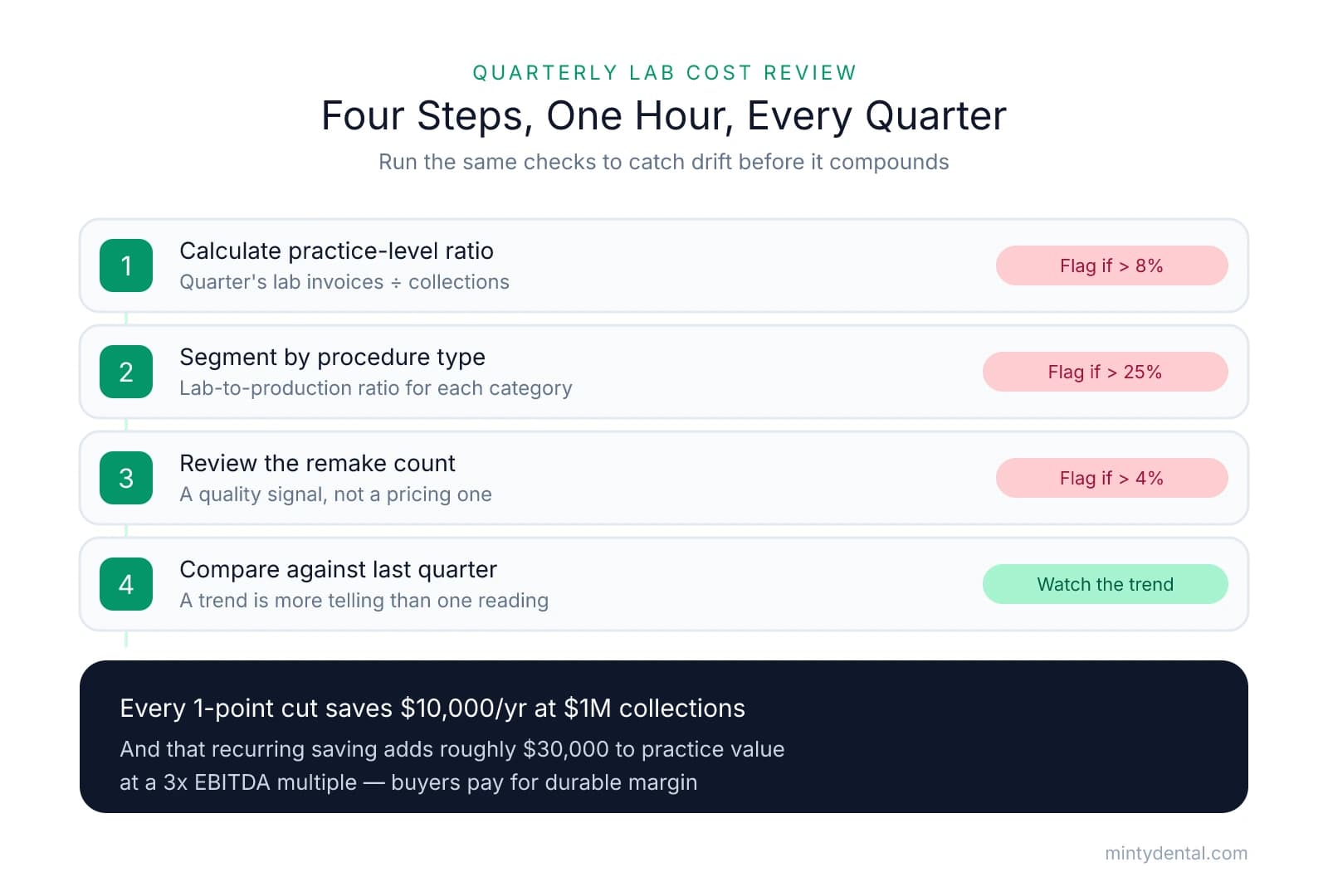
The quarterly review, in four steps:
- Pull total lab spend and calculate the practice-level ratio. Divide the quarter's lab invoices by collections for the same period. A ratio above 8 percent warrants investigation, since that sits at the upper end of the general-practice range.
- Segment by procedure type and calculate the lab-to-production ratio for each. Any category above 25 percent warrants either a fee schedule adjustment or a lab pricing conversation, depending on which side of the ratio is out of line.
- Review the remake count separately. A remake rate above 4 percent warrants a quality review with the lab, because that pattern points to a fabrication or communication issue rather than a pricing one.
- Compare each number against last quarter. A ratio that climbs steadily is more informative than a single reading, and it tells you whether a recent change in case mix or lab pricing is moving the total.
The dollar impact scales directly with collections. At $1 million in collections, each one-point reduction in the lab cost ratio saves $10,000 a year. That saving also carries into practice value: at a 3x EBITDA multiple, a recurring $10,000 in savings adds roughly $30,000 to the value of the practice, because buyers pay for durable margin improvement, not one-time cuts.
Reducing lab fees can involve a combination: renegotiating with the current lab, aligning the fee schedule so no procedure category runs underpriced, and reducing remakes through better communication and a scan-based workflow. Each move contributes a fraction of a point, and together they close the gap. Reviewing overhead costs on a monthly, quarterly, and annual basis to identify trends applies the same discipline to lab fees specifically — the cadence is what turns a one-time fix into a durable margin improvement.
Sources & References
The data and claims in this article are drawn from the following sources. We prioritize government data, peer-reviewed research, and established industry publications to ensure accuracy.
- Dental Office Overhead Percentages: 2026 Report - DentiMax— dentimax.comIndustry
- Dental Lab Costs: Track, Negotiate & Protect Your Margins | Numetix— numetix.aiIndustry
- The Cost of Laboratory Remakes - Spear Education— speareducation.comIndustry
- nearly one in five dentists report a remake rate above 4 percent— firstchoicelab.com
- Dental practice overhead: Cut costs without sacrificing quality— www.dentaleconomics.comIndustry
Ready to optimize your lab fee spending?
Managing lab costs effectively is crucial for practice profitability. Minty's operations team helps independent practices streamline expenses and maximize collections through strategic vendor management and financial optimization.