Hygiene Reappointment Rate: Benchmarks and How to Improve

Co-Founder, Minty Dental
In Summary
- Hygiene reappointment rate measures the percentage of hygiene patients who leave an appointment with their next hygiene visit already scheduled, divided by total hygiene visits completed in the period.
- It differs from recall rate, pre-appointment rate, and patient retention rate, and it tracks day-to-day schedule health more directly than any of them.
- Hygiene production represents 40 to 50 percent of total practice revenue in well-designed practices, which makes reappointment the highest-leverage retention metric to monitor.
- Analysis of more than 70 practices found reappointment rate most frequently separates practices collecting around $500,000 from those collecting $1,000,000 or more.
- The industrywide average has held around 60 to 65 percent, lower than most owners assume, because few track it precisely.
Hygiene Reappointment Rate Is the Metric That Most Reliably Separates High-Producing Practices from Average Ones
Hygiene reappointment rate is the percentage of hygiene patients who leave an appointment with their next hygiene visit already on the schedule, calculated by dividing the number of patients who reappoint by the total hygiene visits completed in the same period. A patient who finishes a cleaning and walks out with a confirmed date six months later counts toward the rate. A patient who leaves with a promise to "call when it's convenient" does not.
This definition separates reappointment rate from three metrics it is often confused with. Recall rate measures the share of patients who actually return within their recommended interval, which you only know after the interval closes. Pre-appointment rate reflects how many patients currently sit on your future schedule at any given moment. Patient retention rate uses a broader window, typically 18 months, to show how many patients remain active. Reappointment rate is the only one of the four that measures what happens at the moment of departure, which is why it responds to changes in the chairside conversation within weeks rather than months.
That immediacy matters because hygiene carries an outsized share of practice revenue. Hygiene production represents 40 to 50 percent of total practice revenue in well-designed practices and feeds the restorative schedule, which makes reappointment the retention metric most worth watching. Whether that revenue is actually profitable depends on how the department is staffed and scheduled, a question worth examining alongside hygiene department economics.
An analysis of more than 70 practices found that reappointment rate most frequently separated practices collecting around $500,000 from those collecting $1,000,000 or more. Yet many owners overestimate their own number, often by 20 points or more, because they infer it from a general sense that "most patients come back" rather than from a tracked figure. The industrywide average has held around 60 to 65 percent, which means the first step is measuring your rate precisely before deciding how to improve it.
What the Benchmarks Actually Mean: Interpreting Your Rate by Performance Tier
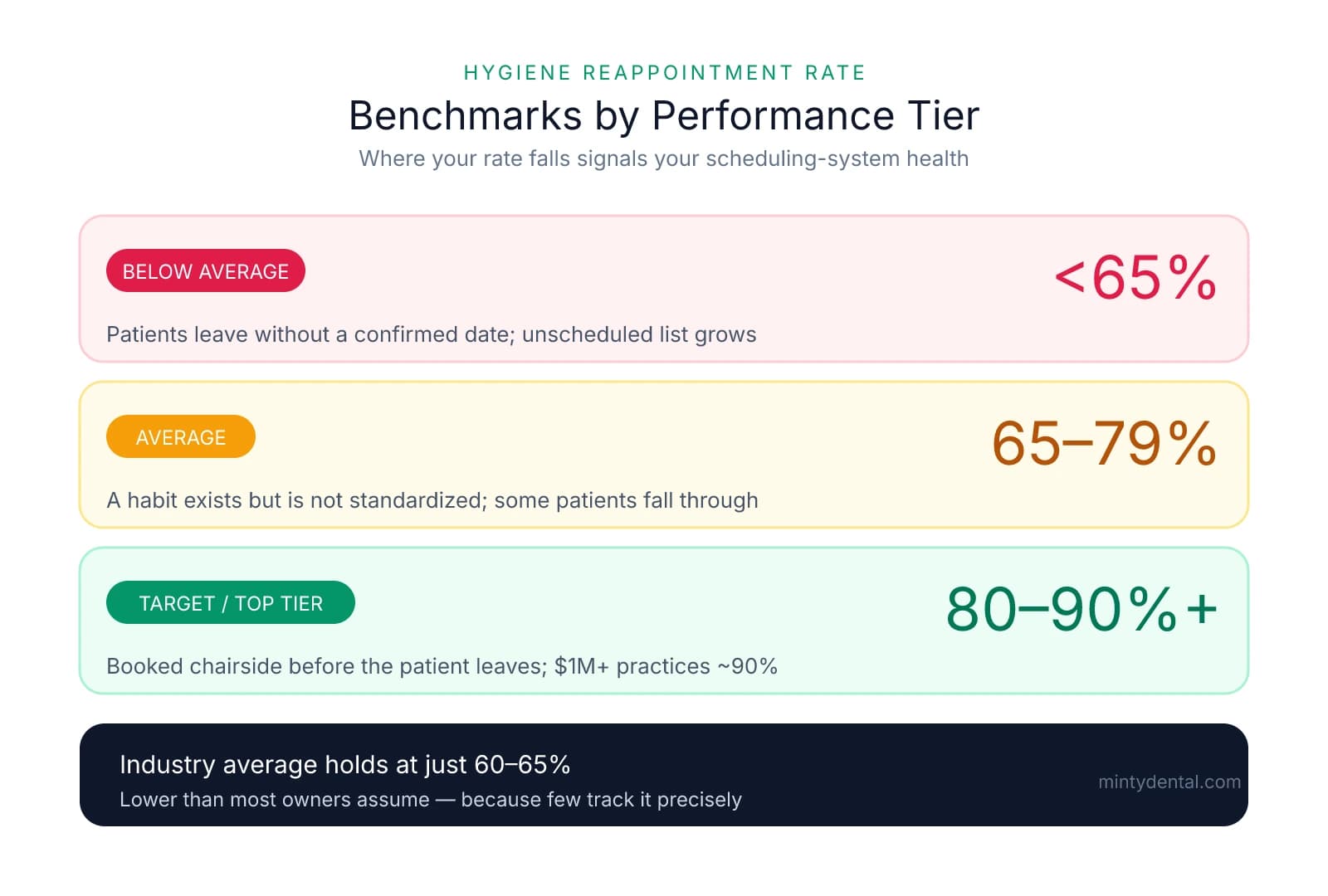
The table groups reappointment rates into three performance bands and shows the scheduling-system condition each band typically signals.
| Tier | Rate range | What it typically signals | Scheduling and production implications |
|---|---|---|---|
| Below average | Under 65% | Reappointment happens inconsistently or is deferred to the front desk after checkout; most patients leave without a confirmed date | Steadily growing unscheduled list; lost production compounds each month |
| Average | 65–79% | A reappointment habit exists but is not standardized across hygienists or shifts; some patients fall through | Moderate recovery possible by closing the gap to target |
| Target / top performer | 80–90%+ | Reappointment is treated as part of the appointment itself, booked chairside before the patient leaves the operatory | Stable recurring base; practices collecting $1M+ average roughly 90% |
Some consultants set the target at 85 percent and others at 90 percent, but both point in the same direction: top performers reappoint the large majority of patients before they leave the chair.
The gap between the average tier and the target tier carries measurable production value. Retaining 25 to 30 additional patients per month adds approximately $4,000 to $5,000 in incremental hygiene production, plus another $2,000 to $3,000 in restorative production from the roughly 20 percent of exams that identify treatment needs. In most practices that combines to a $6,500 to $9,000 monthly improvement, though the exact figure depends on your fee schedule and payer mix.
Two findings explain why so many practices sit in the lower tiers. First, only 17% of dentists report that most of their active patients receive hygiene every six months, which means the average practice is losing more patients between visits than owners tend to assume. Second, the average recall system recaptures only about 25 percent of patients who were not pre-appointed. When a patient leaves without a confirmed date, the probability of recovering that visit drops sharply, so a low reappointment rate does not stay flat. It feeds a growing unscheduled patient list that absorbs staff time without reliably refilling the schedule.
A rate in the below-average tier is often read as a patient behavior problem, but in most cases it reflects a system gap at the point of scheduling rather than patients choosing not to return. That distinction matters because a scheduling gap is fixable. Recovering patients who have already lapsed is a separate, more labor-intensive effort than keeping them on the schedule in the first place, as the mechanics of bringing back lapsed patients illustrate.
The Three Systems That Move the Reappointment Rate: Chair-Side, Front Desk, and Follow-Up
Closing the gap to the target tier depends on three systems that operate in sequence. Each one is a backstop for the one before it, so the goal is to resolve as many reappointments as possible at the first layer and route fewer patients to the later, less efficient ones.
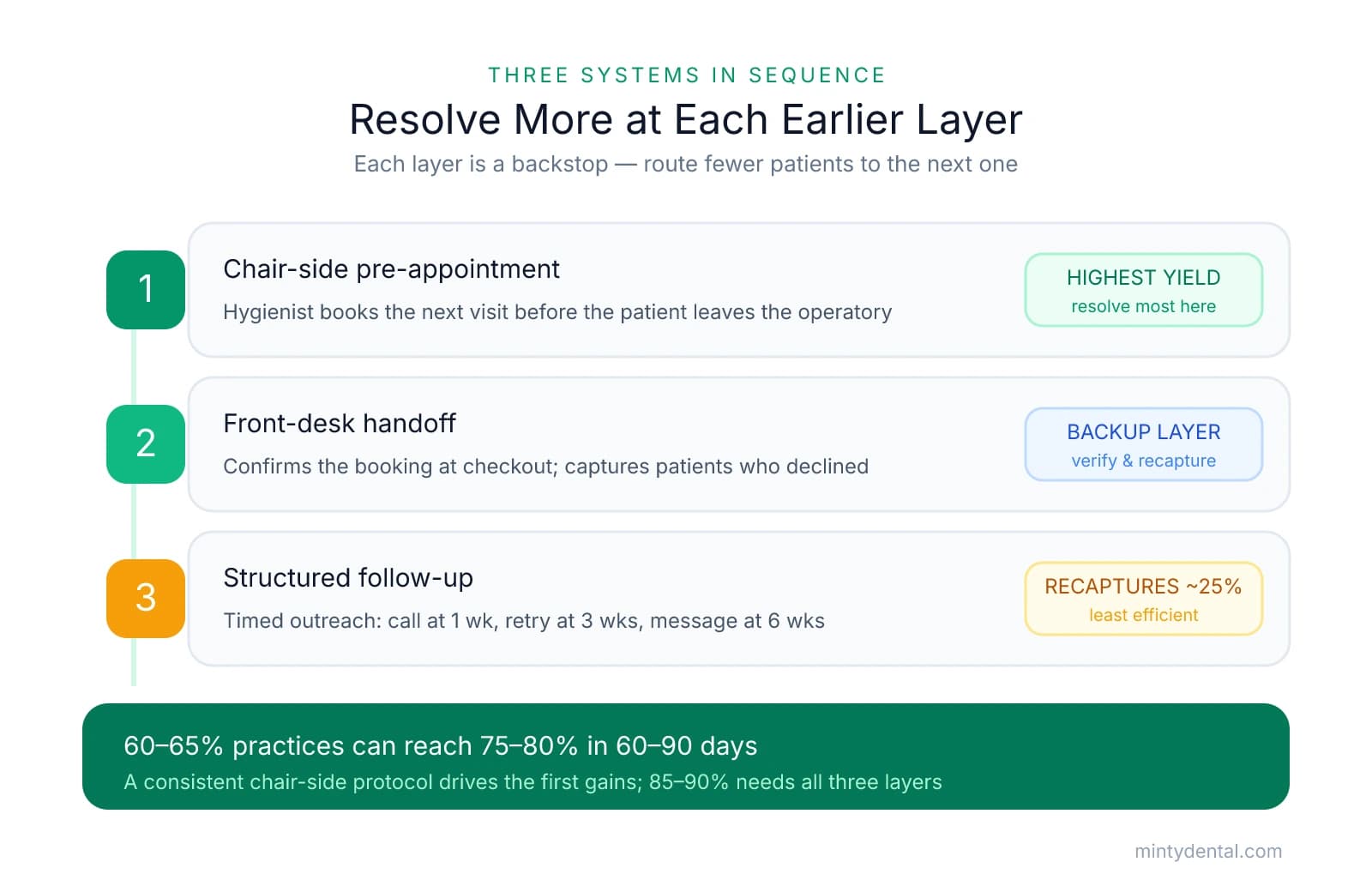
1. Chair-side pre-appointment. The hygienist schedules the next visit before the patient leaves the operatory, while the patient is still in the clinical environment and most engaged with their care. A directive framing, such as "Let's get you on the schedule now for your next cleaning in six months," treats reappointment as part of the visit. A permissive framing, such as "Would you like to schedule your next appointment?," invites a deferral. Because patients are most likely to schedule while they are still in the office, and the likelihood drops significantly once they walk out the door, the chair is the single highest-yield moment to secure the commitment. Equip each operatory with access to the schedule so the hygienist can book without walking the patient to the front first.
2. Front-desk handoff. This layer confirms, at checkout, that an appointment was actually made and captures a commitment from any patient who declined at the chair. A defined protocol works better than improvisation: the front desk verifies the booked date, offers a card or digital confirmation, and for patients without an appointment, asks a specific question such as "Would mornings or afternoons work better in May?" This is a backup system rather than the primary one. If most reappointments are reaching the front desk unbooked, the chair-side layer needs attention first.
3. Structured follow-up. For patients who still leave without an appointment, a defined outreach sequence with set timing windows (for example, a call at one week, a second attempt at three weeks, and a message at six weeks) performs better than an ad hoc list of names. This layer is the least efficient of the three, because the average recall system recaptures only about 25 percent of unbooked patients, so the practical aim is to minimize how many reach this stage. The patients who do land here overlap with the broader challenge of filling open hygiene time without resorting to discounts.
To manage all three, pull your reappointment rate from your practice management software, which most platforms report under scheduling, recall, or hygiene performance. Review it monthly rather than annually so trends surface before they become schedule holes, and assign one team member to report the figure at a morning huddle or weekly meeting so accountability sits with a named person.
Turning a Higher Reappointment Rate into a Measurable Practice Improvement
Measuring your baseline is the first concrete step. Pull the last 90 days of completed hygiene visits from your practice management software, count how many patients left with a future hygiene appointment on the schedule, and divide that number by total hygiene visits in the period. The result is your starting rate. Most owners find it lower than they expected.
From there, a four-step sequence moves you from the number to an improvement:
- Establish the baseline using the 90-day calculation above.
- Audit which layer is failing by observing a week of checkouts. If patients consistently reach the front desk without a booked date, the chair-side layer needs attention. If they leave the chair unbooked and the front desk rarely recovers them, the handoff is the gap.
- Implement the chair-side protocol first, because it resolves the most reappointments at the highest-leverage moment and reduces the load on the two later layers.
- Set a 30-day target and review it at the next team meeting, assigning the figure to one named person so progress stays visible.
Most practices in the 60 to 65 percent range can reach 75 to 80 percent within 60 to 90 days of a consistent chair-side protocol. Moving into the 85 to 90 percent band typically requires all three layers working together, since the final increments come from recovering the patients who slip past the chair.
Reappointment rate also functions as a leading indicator. Because it measures commitments made today, it predicts schedule health three to six months out — and as practice metrics together can tell a story no single number captures alone, it is one of the more actionable figures to surface in the morning huddle alongside production per hour.
The metric carries weight beyond daily scheduling. Buyers and DSOs evaluate hygiene utilization and patient retention durability during underwriting, and a consistently high reappointment rate signals predictable recurring revenue, which tends to support a stronger valuation. That is not the primary reason to improve it, but it is a meaningful benefit for owners thinking about an eventual transition, and it fits within the broader work of increasing practice value before selling.
Sources & References
The data and claims in this article are drawn from the following sources. We prioritize government data, peer-reviewed research, and established industry publications to ensure accuracy.
- How to Increase Hygiene Production and Patient Retention— sunrisedentalsolutions.comIndustry
- There's a hole in your hygiene: How reappointment rates dramatically ...— www.dentistryiq.com
- Dental Hygiene Recall Rates: The Key DSO Valuation Driver— mybcat.comIndustry
- Improving Patient Recall Increases Dental Practice Profitability— practiceanalytics.comIndustry
- Hygiene Reappoint Rate - Dental Edit— thedentaledit.com
- Your practice metrics are more than numbers on a report. Together, they ...— www.facebook.com
Ready to boost your reappointment rates?
Improving hygiene reappointment rates requires coordinated systems across scheduling, patient communication, and clinical follow-up. Minty's operations team handles these backend processes so your practice can focus on patient care and growth.