Dental Practice Loan Rate Lock Expiring Before Closing

Co-Founder, Minty Dental

In Summary
- A rate lock freezes your interest rate for a defined window — typically 30–60 days on conventional dental practice loans — so market movement after you lock doesn't change what you'll pay at closing
- SBA 7(a) loans don't have a traditional rate lock; the rate is variable (Prime + a fixed spread), but delays still carry risk if Prime moves significantly before closing
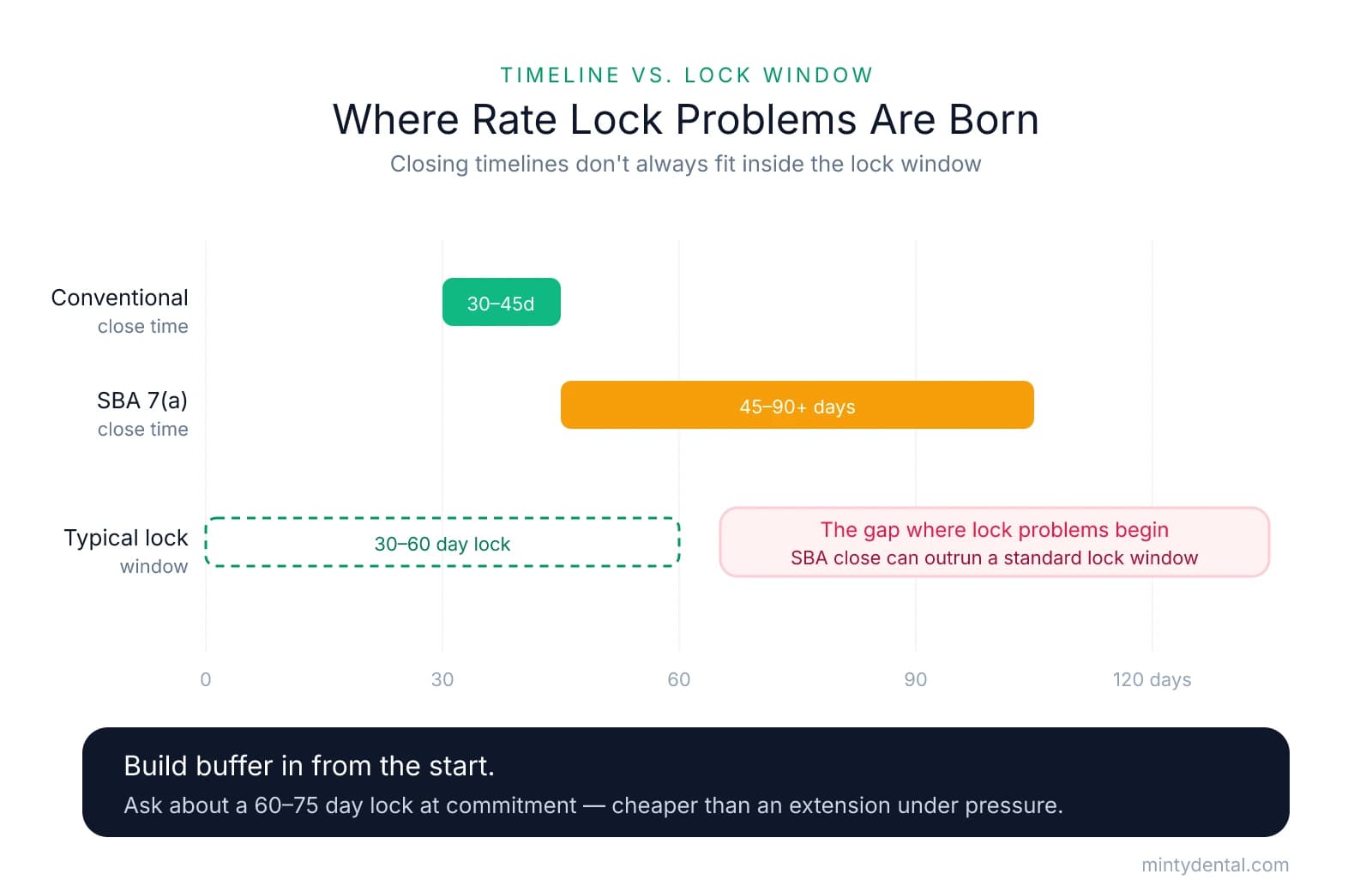
- Conventional dental-specific lenders typically close in 30–45 days; SBA 7(a) loans run 45–90+ days — meaning the lock window and the realistic closing timeline don't always align
- The moment you suspect your lock may not survive to closing, calling your loan officer immediately is the right move — not waiting to see if the deal closes in time
- Two questions determine your path forward: who caused the delay, and how many days are left in your lock window
A Rate Lock Expiration Is a Solvable Problem — If You Act Before It Happens
Rate lock definition: A rate lock is a lender's commitment to hold your quoted interest rate for a defined period — typically 30, 45, or 60 days — so that market movement between your loan offer and closing doesn't change what you'll actually pay. As the Consumer Financial Protection Bureau explains, your rate won't change between the lock and closing as long as you close within the specified time frame and there are no material changes to your application.
In a dental practice acquisition, that window matters more than most buyers expect. If you've spent six to eight weeks in due diligence, negotiating purchase agreements, and working through lender conditions, the idea that a rate you locked early in the process might expire before you reach the closing table is genuinely stressful — especially when you've already invested legal fees, appraisal costs, and significant time into the deal.
That stress is completely reasonable. But a rate lock expiration is rarely a deal-killer. It's a logistics problem, and like most logistics problems, it's far more manageable when you catch it early.
The challenge is that conventional dental-specific lenders typically close in 30–45 days from a complete application, while SBA 7(a) loans routinely run 45–90+ days — and many buyers lock their rate at loan commitment, not at closing. That gap is where most rate lock problems are born.
SBA 7(a) loans add a layer of complexity worth understanding upfront. Because the rate is variable — structured as Prime plus a fixed spread — there's no traditional rate lock to expire in the same way. But the spread and loan terms are set at commitment, and if Prime moves meaningfully during a prolonged closing process, your effective rate at closing may look different than the one you modeled. The risk is real; it just works differently.
Two questions will shape everything that follows: Who caused the delay? and How many days are left in your lock window? The answers determine whether you're looking at a straightforward extension, a cost-sharing conversation with the seller, or a more urgent escalation with your lender. The worst position to be in is discovering your lock expired yesterday — which is why the right move, the moment you sense the timeline slipping, is to call your loan officer and get a clear picture of where things stand.
What a Rate Lock Extension Actually Costs — and Who Pays
Once you've confirmed your lock is at risk, the next question is almost always: what is this going to cost me? The answer depends on your loan size, how many extra days you need, and — critically — who caused the delay.
The Fee Structure
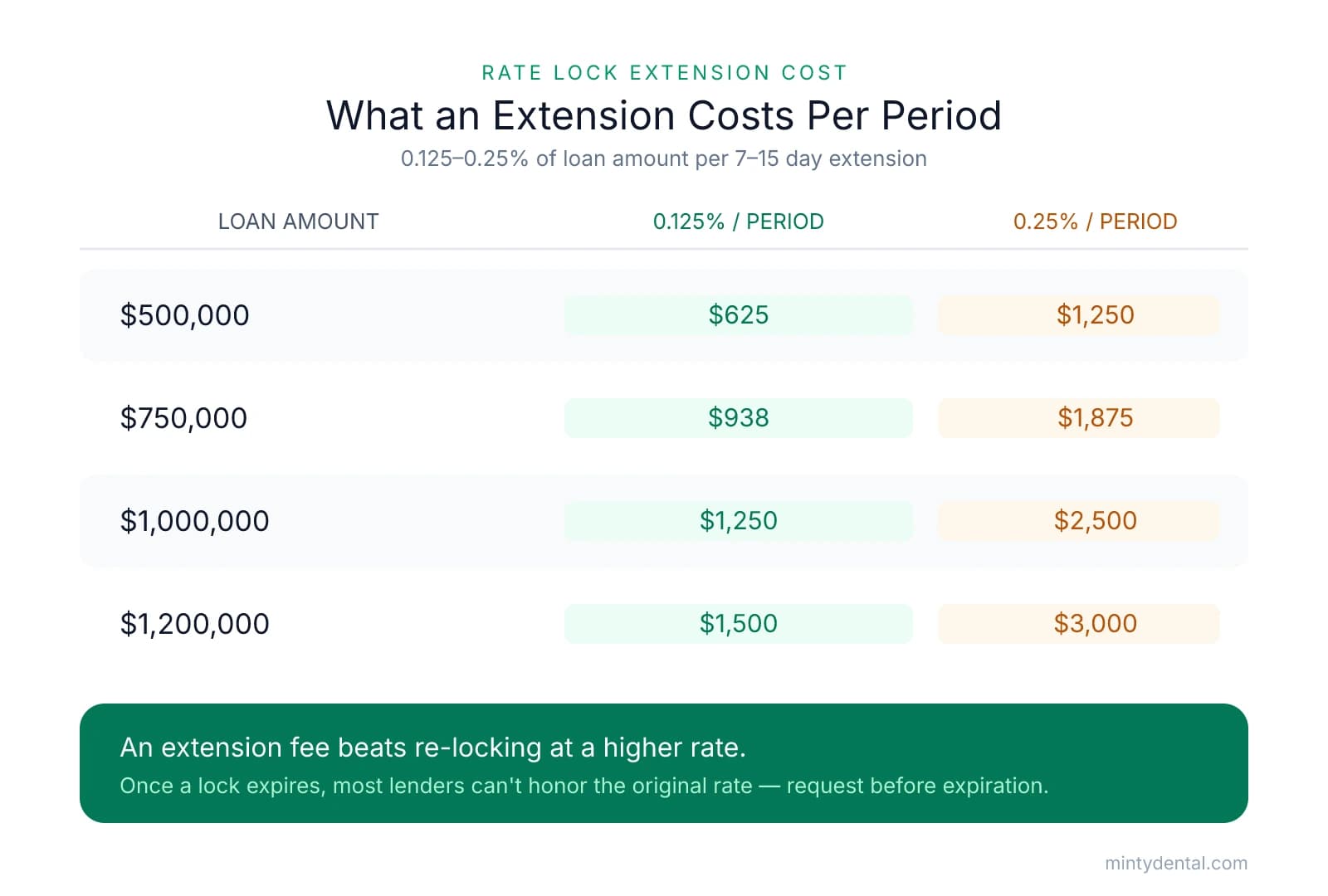
Rate lock extension fees typically run 0.125–0.25% of the loan amount per 7–15 day extension period. On a dental practice acquisition, where loan sizes commonly fall between $500,000 and $1.2 million, that math adds up quickly:
| Loan Amount | 0.125% per period | 0.25% per period |
|---|---|---|
| $500,000 | $625 | $1,250 |
| $750,000 | $938 | $1,875 |
| $1,000,000 | $1,250 | $2,500 |
| $1,200,000 | $1,500 | $3,000 |
Some lenders charge flat fees instead — a fixed $500 or $750 regardless of loan size. One step worth taking before your lock is ever issued is asking your loan officer for the exact extension fee schedule in writing. That conversation is much easier to have before you need an extension than after.
Who Pays — and Why It Matters
When the lender caused the delay, the calculus shifts in your favor. If underwriting ran long, conditions sat unreviewed, or a processing backlog pushed your closing date, most dental-specific lenders will absorb the extension cost rather than pass it to you. What tends to make the difference is documentation — buyers who get the delay acknowledged in writing, via email, are far better positioned to push back on extension charges than those who rely on verbal assurances. Ask explicitly: "Given that the delay originated on your end, will you be covering the extension fee?"
When a third party caused the delay — a landlord slow to provide lease consent, a title issue, or a seller's attorney holding up document review — the buyer typically pays. That said, if your purchase agreement contains language tying the seller to a timely closing, some of that cost may be recoverable. A quick conversation with your transaction attorney before you assume the fee is entirely yours to absorb is worth having.
When the buyer caused the delay, there's less room to negotiate. Late document submissions, renegotiation requests, or financing condition changes that restart underwriting generally mean the extension cost falls on you.
The Worst-Case Scenario
Letting the lock expire entirely — without requesting an extension first — is the outcome most worth avoiding. Once a lock expires, most lenders cannot retroactively honor the original rate. You may be forced to re-lock at current market rates, which could be meaningfully higher if rates have moved during your closing window. The extension fee, frustrating as it is, is almost always cheaper than re-locking at a rate that's moved against you.
Request the extension before expiration. That single timing decision is where most of the leverage lives.
The Most Common Reasons Dental Practice Closings Slip Past the Lock Window
Understanding why dental practice closings run long isn't about assigning blame — it's about pattern recognition. Most delays come from a predictable set of sources, and buyers who spot them early have a real advantage: they can build buffer into their lock window before the pressure starts, rather than scrambling for extensions after the fact.
Lease negotiation and landlord consent is, by a significant margin, the most common cause of closing delays in dental practice acquisitions. Lenders typically require at least five years of remaining lease term before they'll fund — and if the current lease is short or lacks a clean assignment clause, the buyer needs the landlord to either extend the term or formally consent to the transfer. Landlords can take weeks to respond, and some use the moment as leverage to renegotiate rent or add personal guaranty requirements. Neither buyer nor seller fully controls this timeline. As M&A attorney Jason Jones has noted, lease complications are one of the most common — and preventable — reasons dental deals stall or fall apart entirely.
UCC lien resolution on practice equipment is a less visible but meaningful source of delay. When a UCC lien search surfaces an encumbrance on the practice's equipment — often from the seller's existing lender — that lien must be formally released before your financing can close. If the seller's lender is slow to process the release, that can add one to three weeks to your timeline. This is primarily seller-adjacent, but the buyer bears the cost if it pushes past the lock window. UCC liens on dental practice equipment are more common than many first-time buyers expect, and reviewing what these searches surface before you're under time pressure is worthwhile.
Seller document gaps — missing tax returns, incomplete P&L statements, or a seller's accountant who's slow to respond — are frustrating because they feel like the seller's problem but often become the buyer's expense. If underwriting can't complete its review without a missing document, the closing slips and the extension fee typically falls on the buyer regardless of who caused the gap.
SBA-specific authorization adds structural time that's built into the process, not a sign something is wrong. On an SBA 7(a) loan, the SBA must authorize the loan guarantee separately from the lender's own credit approval — a step that adds meaningful processing time to an already longer timeline. Buyers who model a 45-day close on an SBA deal are often surprised when the realistic window runs 60–90 days.
The practical fix is to build buffer into your lock window from the start. If your lender's standard lock is 45 days and your deal has a lease negotiation pending or an SBA authorization step ahead, ask about a 60- or 75-day lock at commitment. The rate premium for a longer lock is usually smaller than an extension fee negotiated under pressure — and it eliminates the scramble entirely.
Your Action Plan When the Lock Is About to Expire
A rate lock expiration is a financing logistics problem — not a deal-killer. Buyers who stay communicative and move quickly almost always reach closing. The five steps below give you a clear sequence to work through right now.
Step 1: Call your loan officer today and get the specifics in writing. Find out the exact lock expiration date, the extension fee amount and structure, and the deadline by which you must request the extension. Most lenders require the extension request before expiration — not on the day of, and certainly not after. Get all of this confirmed via email so there's no ambiguity later.
Step 2: Identify who caused the delay and document it. Before you request the extension, establish the cause in writing. If the delay originated with your lender — slow underwriting, a processing backlog, conditions that sat unreviewed — put that on record via email before the extension conversation begins. That documentation is what gives you standing to push back on who pays. If the delay came from a third party (a landlord, a title issue, the seller's attorney), note that too. As covered earlier, who caused the delay is the primary factor in who absorbs the cost.
Step 3: Request the extension before the lock expires. This is the single most important timing decision in the entire process. Once a lock expires, most lenders cannot retroactively honor the original rate — you'd be re-locking at current market rates, which may have moved against you. The extension fee is almost always the cheaper outcome.
Step 4: Loop in your attorney in parallel. If the closing date in your purchase agreement needs to move, that typically requires seller consent and a formal written amendment — it doesn't happen automatically. An attorney experienced in dental practice transitions can handle this in parallel with your lender conversation, so both timelines move together rather than sequentially. If you haven't already engaged dedicated legal counsel, the case for having your own attorney becomes especially clear when closing logistics get complicated.
Step 5: If the delay is seller- or third-party-caused, raise the extension cost in deal negotiations. Extension fees may be recoverable as a closing cost adjustment or seller credit, particularly if the delay traces back to the seller's document gaps, their attorney's pace, or a landlord relationship the seller controls. Many buyers assume the cost is simply theirs to absorb without asking — it's worth raising before you accept that assumption.
The bigger picture: most rate lock problems surface because a deal took longer than anyone expected, not because something went fundamentally wrong. Buyers who catch the issue early, communicate clearly with their lender and attorney, and request the extension before expiration almost always get to closing — often without paying more than a modest fee for the extra time.
Sources & References
The data and claims in this article are drawn from the following sources. We prioritize government data, peer-reviewed research, and established industry publications to ensure accuracy.
- What's a lock-in or a rate lock on a mortgage?— www.consumerfinance.govGovernment
- How Lease Issues Can Slow Down—or Kill—Your Dental ...— martilawgroup.com
- SBA Dental Practice Acquisition Loans: August 2026 Rates— baystreetlending.com
- What Happens if Your Rate Lock Expires?— www.experian.com
Ready to close your dental practice acquisition?
Navigating loan timelines and rate locks can be complex when acquiring a dental practice. Minty's acquisition experts guide you through every step—from initial search to closing—ensuring you understand financing requirements and timelines without any upfront fees.