UCC Liens on Dental Practice Equipment: A Buyer's Guide

Co-Founder, Minty Dental
In Summary
- A UCC-1 financing statement is a public notice filed by a lender declaring a security interest in a borrower's business assets — not a judgment, but a legal claim that must be resolved before ownership transfers cleanly
- Dental practices are lien-heavy by nature: chairs, CBCT scanners, CAD/CAM systems, and sterilization units are routinely financed, and each loan typically triggers a separate UCC-1 filing
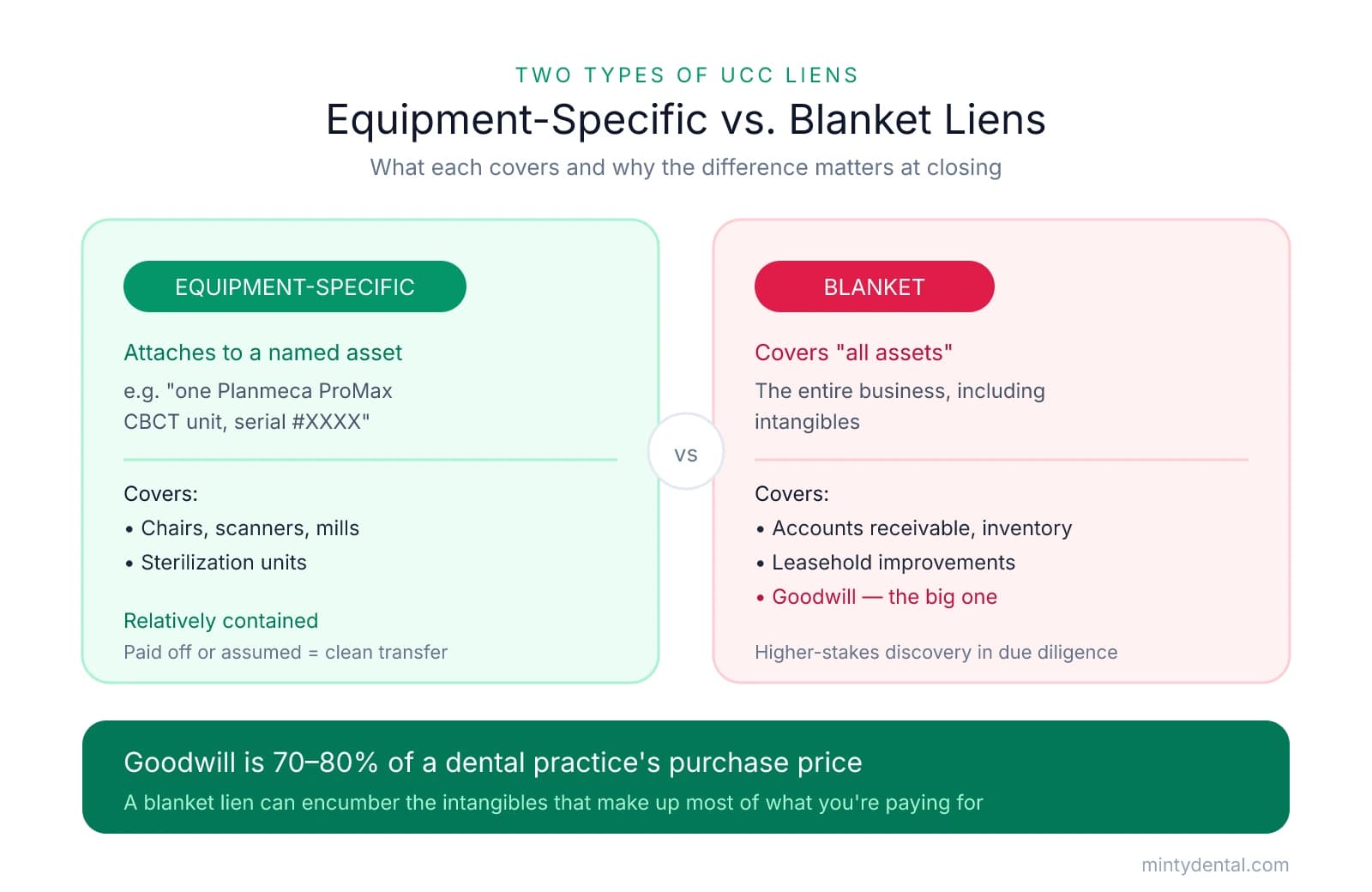
- Equipment-specific liens attach to a named asset; blanket liens cover "all assets" of the business — including accounts receivable, goodwill, and leasehold improvements
- Blanket liens are the higher-stakes discovery because they can encumber the intangible assets that represent 70–80% of a dental practice's purchase price
- UCC liens show up in nearly every dental practice transaction — the question isn't whether you'll find them, but what type they are and whether they've been properly cleared before closing
UCC Liens Are Present in Nearly Every Dental Practice Sale — and Most Buyers Don't Know What They're Looking At
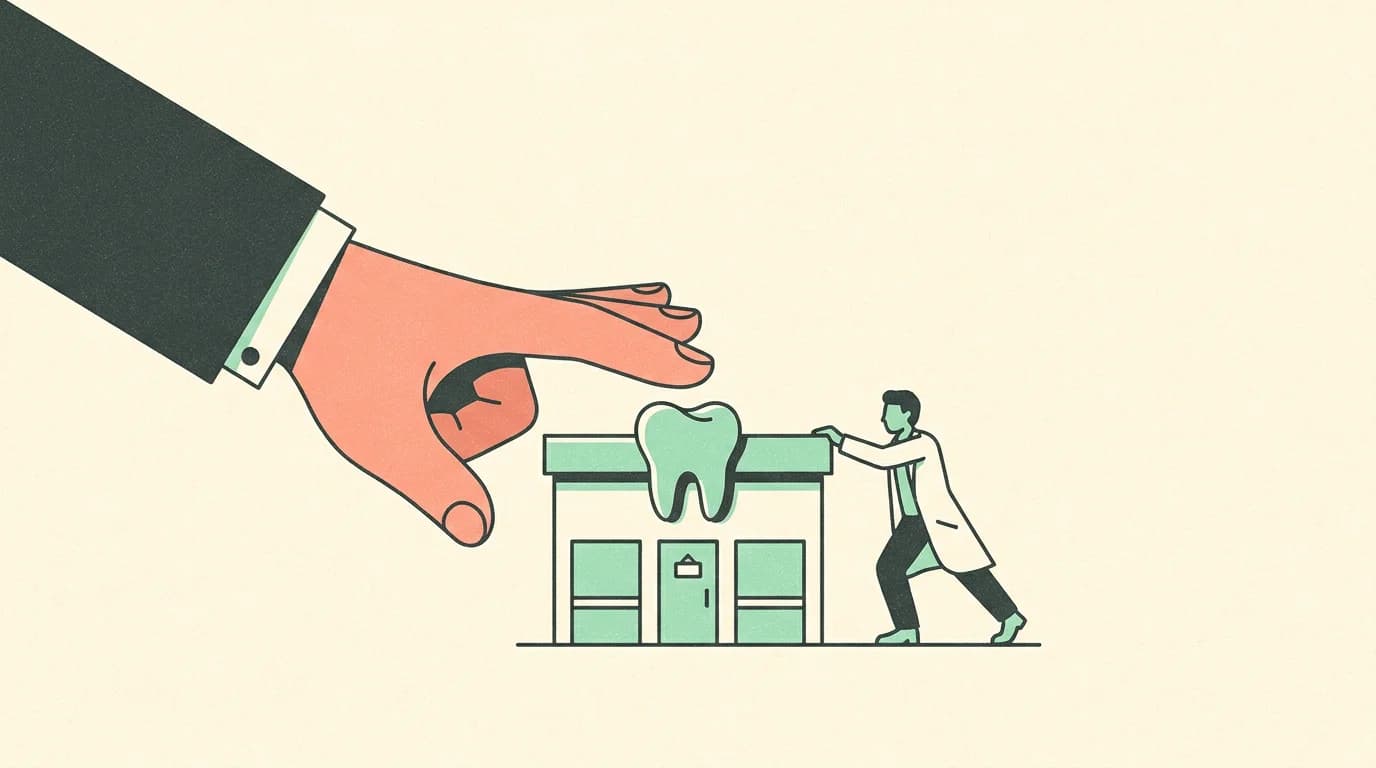
A UCC-1 financing statement is a public notice filed by a lender with the state Secretary of State declaring a security interest in a borrower's personal property. It isn't a judgment or a penalty — it's closer to a formal "we called dibs" on specific assets, recorded so that other creditors and prospective buyers can see what's already spoken for. As Wolters Kluwer explains, a creditor files a UCC-1 to provide public notice of a security interest in a debtor's personal property being used as collateral in a secured transaction — typically a loan or a lease.
Dental practices tend to accumulate these filings quickly. Chairs, CBCT scanners, CAD/CAM milling systems, and sterilization equipment are rarely purchased outright — most sellers financed them over time, and each financing agreement typically triggered its own UCC-1. By the time a practice hits the market, several active filings on the public record is common.
Not all liens carry the same weight. Two types matter most in due diligence:
- Equipment-specific liens attach to a named asset — something like "one Planmeca ProMax CBCT unit, serial number XXXX." These are relatively contained. If the underlying loan is paid off or assumed at closing, the lien gets released and the asset transfers cleanly.
- Blanket liens cover "all assets" of the business — which typically includes accounts receivable, inventory, leasehold improvements, and, critically, goodwill.
That last category is where blanket liens become consequential. In most dental practice acquisitions, goodwill — the patient relationships, reputation, and ongoing revenue the practice generates — represents the majority of what you're actually paying for. When a lender holds a blanket lien, they have a legal claim against those intangible assets until the underlying debt is satisfied. If that lien isn't resolved before closing, you could take ownership of a practice whose most valuable components are still encumbered by a seller's lender. Understanding how goodwill is valued and allocated, covered in this guide to goodwill allocation and tax impact, makes it easier to appreciate why an unresolved blanket lien is more than a paperwork issue.
The practical takeaway: expect UCC filings in almost every dental practice you evaluate. The goal of due diligence isn't to find a lien-free practice — it's to understand exactly what type of liens exist, what assets they cover, and whether there's a clear path to resolution before the keys change hands.
How to Run a UCC Search — and What the Results Actually Tell You
With a clear picture of what UCC liens are and why they matter, the next step is knowing how to find them yourself — before your lender does it for you.
The Search Process, Step by Step
UCC searches are conducted through each state's Secretary of State website and are free and publicly accessible. The search itself is straightforward; the precision required is not.
-
Identify the seller's exact legal entity name. Pull the practice's formation documents — articles of incorporation or organization — and use the name exactly as it appears. A missing comma, "LLC" vs. "L.L.C.", or a truncated name can cause a filing to not surface in results. As Wolters Kluwer notes, creditors must use the debtor's exact legal name to perfect a security interest — which means that's also the name you need to search.
-
Search under historical names, DBAs, and the owner's personal name. Practices get renamed, rebranded, or restructured. If the seller operated under a different entity name three years ago, liens from that period may still be active under the old name. For sole proprietorships, search the owner's personal name as well.
-
Note every active filing with its date and collateral description. Record the filing date, the secured party, and exactly what collateral is described. This is where you'll distinguish equipment-specific liens from blanket "all assets" filings.
-
Cross-reference against the seller's equipment list and loan payoff statements. Match each lien to a specific piece of equipment or loan. Ask the seller for payoff documentation on anything that appears active.
-
Flag any lien where the underlying loan status is unclear. If you can't match a filing to a known loan, treat it as unresolved until proven otherwise.
The Zombie Lien Problem
A pattern worth paying attention to is what practitioners sometimes call "zombie liens" — filings that appear active in the public record even though the underlying loan was paid off years ago. Lenders are legally required to file a UCC-3 termination statement once a debt is satisfied, but this step is routinely skipped, leaving stale filings that look identical to live ones in a search result.
There's one built-in protection: under UCC §9-515, a financing statement automatically lapses after five years unless the lender files a continuation. A lien filed more than five years ago with no continuation on record is legally expired — even if it still appears in the database. A lien filed four years ago on equipment paid off three years ago, however, still appears active. The only way to resolve it is to obtain a UCC-3 termination from the original lender.
What Your Lender Will Do With This Information
Your acquisition lender will run this same search independently — and what banks look for when financing a dental practice includes a clean lien record on the assets being purchased. Lenders will not fund until every lien on the purchased assets is either paid off at closing or formally terminated. Running the search yourself early means you're surfacing problems in time to resolve them, not discovering them at the closing table.
What to Do When You Find a Lien: Resolving Active Filings Before Closing
Finding active UCC filings isn't a reason to walk away — in most cases, it's a normal part of the process. What matters is discovering them early enough to act. A lien found six weeks before closing is a solvable problem. The same lien found two days before closing can derail funding entirely.
In an asset purchase — the standard structure for these deals — active liens on specific assets follow the asset to the buyer, not the seller. A creditor with a perfected security interest can pursue the collateral even after the sale closes, meaning equipment you paid for could be subject to a valid repossession claim if the underlying debt wasn't cleared at closing.
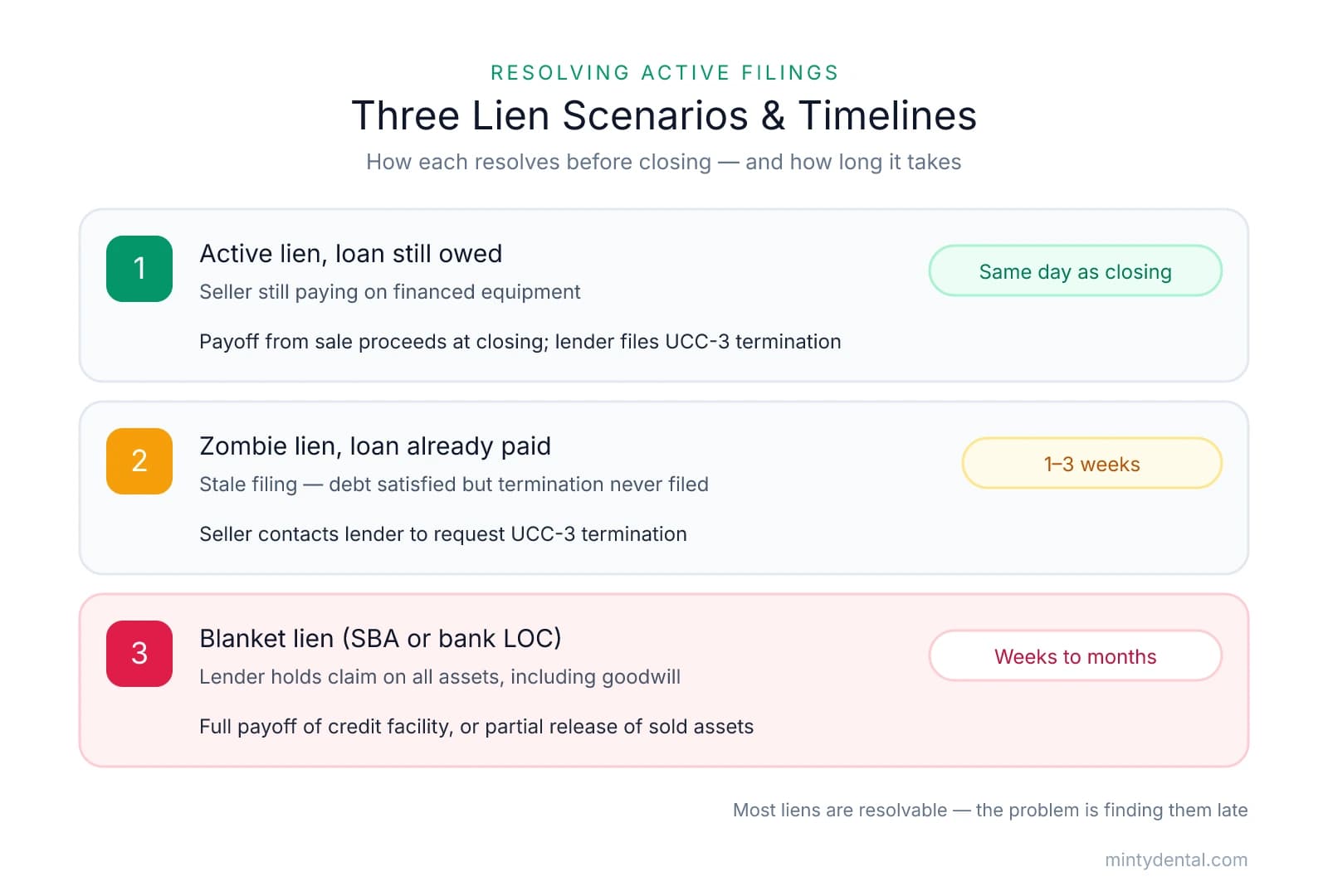
Here's how resolution typically works across the three scenarios you're most likely to encounter:
| Lien Type | What It Means | Resolution Path | Typical Timeline |
|---|---|---|---|
| Active lien, loan still owed | Seller is still making payments on financed equipment | Payoff from sale proceeds at closing; lender files UCC-3 termination | Same day as closing, if coordinated in advance |
| Zombie lien, loan already paid | Filing is stale — debt was satisfied but lender never filed termination | Seller contacts lender to request UCC-3 termination | 1–3 weeks |
| Blanket lien (SBA or bank LOC) | Lender holds claim on all business assets, including goodwill | Full payoff of credit facility, or partial release covering assets being sold | Weeks to months; most complex scenario |
Scenario 1 — Active lien, loan still owed: The seller's lender receives a payoff from the sale proceeds at closing and files a UCC-3 termination statement in exchange. The key is coordinating timing carefully — written confirmation that the termination has been filed should come before funds are released, not after.
Scenario 2 — Zombie lien: Once identified, the seller needs to contact the original lender and formally request a UCC-3 termination. This typically takes one to three weeks and should be initiated the moment the lien surfaces in due diligence.
Scenario 3 — Blanket lien from SBA loan or bank line of credit: The lender's security interest covers all assets, so they won't release the lien unless the underlying credit facility is paid off in full or they agree to a partial release covering the specific assets being transferred. Partial releases require lender cooperation and can take weeks to negotiate — expect this to be a significant closing condition if the seller carries an active SBA loan.
Purchase Agreement Language That Protects You
Resolving liens operationally is only half the picture. Three provisions worth looking for — or asking your attorney to include:
- Seller representation of clean title: A written representation that all assets being transferred are free of liens and encumbrances at closing
- Lien resolution as a closing condition: Funding doesn't release until every active lien on purchased assets is confirmed terminated — not just "in process"
- Escrow holdback for unresolved liens: If a lien can't be confirmed cleared before closing day, a portion of the purchase price is held in escrow until termination is verified
An attorney experienced in dental practice transactions — the kind of representation covered in this guide to hiring your own attorney — will know to build these provisions in as standard, not as special requests.
Most liens are resolvable. The buyers who run into trouble are typically those who discover them late, assume the seller is handling it, or treat lien resolution as a formality rather than a closing condition.
Your UCC Due Diligence Checklist: What to Confirm Before You Close
With the resolution process in mind, here's a checklist you can apply directly to your deal.
1. Run the search immediately after LOI signing — not during the final week of due diligence. As Stock Legal notes, UCC liens come up in just about every dental sale. Early discovery gives you weeks to resolve issues; late discovery creates closing pressure that benefits no one.
2. Have your own attorney run or review the search — not the broker, and not the seller's attorney. Your attorney searches under the correct legal name variants and interprets results in your interest — one of the clearest cases where independent representation pays for itself.
3. Request the following from the seller:
- A complete equipment list with purchase dates and financing history
- Copies of all existing loan payoff statements
- Any UCC-3 termination statements they have on file for previously paid-off loans
4. Cross-reference every active UCC filing against the seller's disclosed equipment loans. Each filing should map to a known loan. Any filing without a corresponding disclosed loan needs a direct explanation — not an assumption.
5. Confirm with your acquisition lender that their independent lien search is complete. Ask specifically whether any required payoffs are documented as closing conditions in the loan commitment. If your financing involves an SBA loan, how SBA and conventional loans differ for practice acquisitions is worth a closer look.
6. Verify that the purchase agreement includes:
- A seller representation that all assets transfer free and clear of encumbrances at closing
- Lien resolution as a documented closing condition — not just "in progress"
- Indemnification language covering any lien that surfaces post-closing and wasn't disclosed
UCC liens appear in nearly every dental practice transaction precisely because they're routine — practices finance expensive equipment, and lenders file accordingly. A practice with active filings isn't a red flag. What separates prepared buyers from unprepared ones is knowing what to look for, asking for the right documentation, and building the right protections into the agreement before closing day.
The buyers who walk away unnecessarily are usually reacting to something they didn't expect. The buyers who close confidently are the ones who found the same liens — and knew exactly what to do next.
Sources & References
The data and claims in this article are drawn from the following sources. We prioritize government data, peer-reviewed research, and established industry publications to ensure accuracy.
- UCC due diligence: Asset vs. stock deal searches— wolterskluwer.comIndustry
- UCC due diligence: Asset vs. stock deal searches— wolterskluwer.comIndustry
- How to Buy or Sell a Dental Clinic in Three Steps – Part 2a— www.stocklegal.comIndustry
- Part I, Title XV, Chapter 106, Article9, Section 9-515— malegislature.govGovernment
- Successor Liability, Even in an Asset Purchase— l4sb.comIndustry
Navigate UCC Liens When Buying Your Practice
Understanding UCC liens is crucial when acquiring a dental practice. Minty's acquisition experts guide you through every step of due diligence, ensuring you understand equipment encumbrances and negotiate clear ownership.