Buying a Practice with a Rebuilt Hygiene Department

Co-Founder, Minty Dental

In Summary
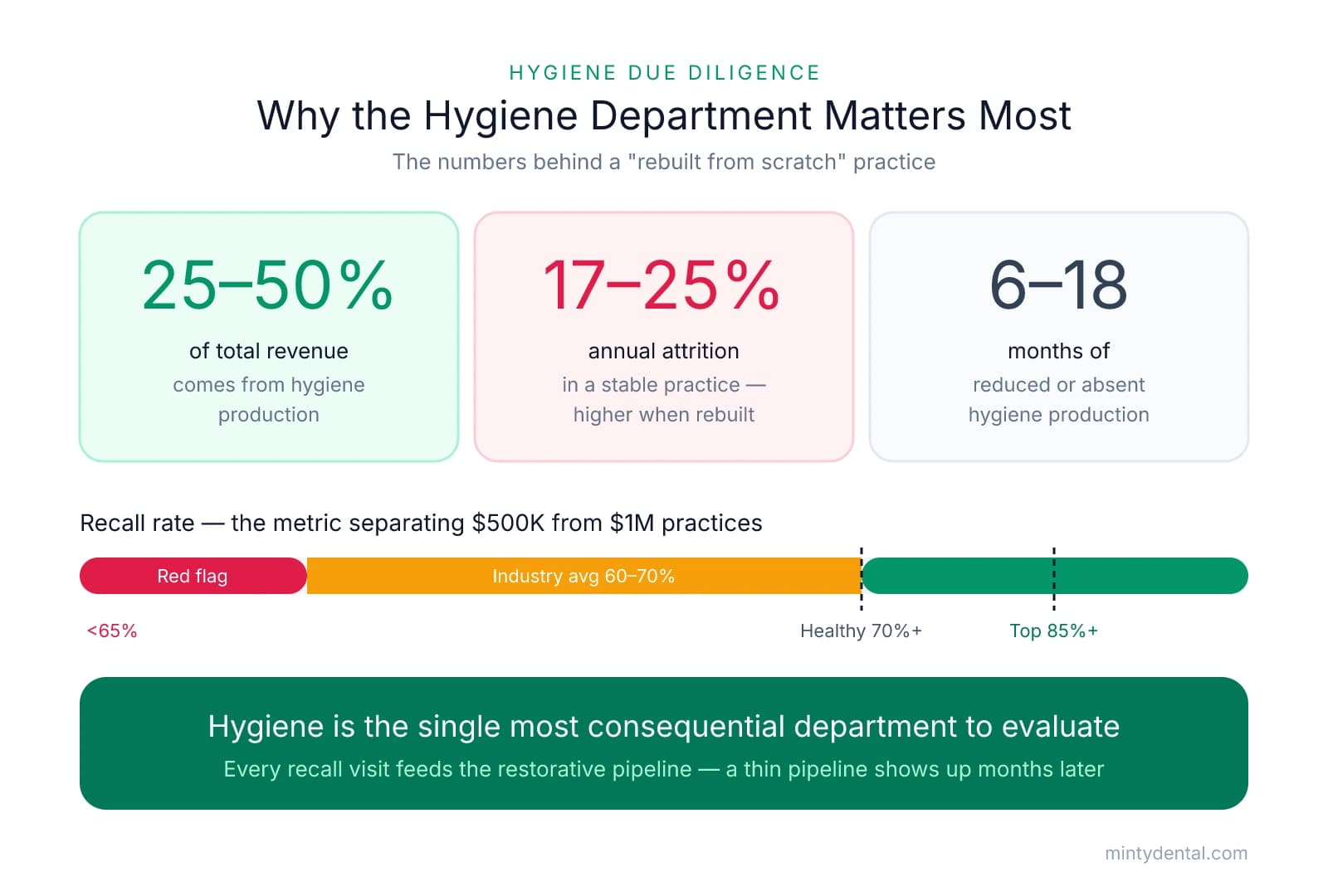
- A "rebuilt from scratch" hygiene department typically means 6–18 months of reduced or absent hygiene production due to staff turnover, followed by rehiring and patient reactivation — a period of real disruption that leaves a mark on the numbers.
- Hygiene production represents roughly 25–50% of a general practice's total revenue and drives restorative case flow, making it the single most consequential department to evaluate before closing.
- Normal annual patient attrition in a stable practice runs 17–25%; in a recently rebuilt department, that baseline is likely higher because patient relationships are newer and shallower.
- Sellers are often telling the truth when they say "we rebuilt it" — the real question is how far along the rebuild is and whether the patient base has had enough visits to develop genuine loyalty.
- Standard due diligence checklists treat hygiene as a single revenue line; this scenario requires a month-by-month time-series analysis to distinguish a durable recovery from a fragile one.
A Rebuilt Hygiene Department Is Upside You Haven't Earned Yet
"Rebuilt from scratch" usually means one of two things: a hygienist left — sometimes abruptly, sometimes after a slow fade — and the practice either ran reduced hygiene capacity for months or went dark on hygiene entirely before rehiring and reactivating patients. That disruption period typically runs 6–18 months, and its effects don't disappear the moment a new hygienist fills the chair.
This is a fundamentally different acquisition scenario than buying a practice with a stable, tenured hygiene department — and it deserves a different level of scrutiny.
The stakes are real: hygiene production typically accounts for 25–50% of a general practice's total revenue, and that figure understates the department's actual influence. Every hygiene appointment is a diagnostic touchpoint — a recall visit that surfaces decay, periodontal disease, and restorative needs. When hygiene runs well, it feeds the restorative schedule. When it's been disrupted, that pipeline runs thin, and the effects show up downstream in crown and restorative production, sometimes months later.
Sellers who've rebuilt their hygiene department aren't usually being dishonest. The rebuild often did happen. What the framing tends to leave out is where in the recovery arc the practice currently sits — and whether the patients who've returned have had enough visits to develop real loyalty.
Patient attrition is the hidden variable here. According to Dental Intelligence data across 4,000+ offices, normal annual patient attrition in a stable practice runs 17–25%. In a recently rebuilt department, that baseline is almost certainly higher — patients seen once or twice by a new hygienist have shallower roots than patients who've been coming in every six months for five years. A single scheduling inconvenience or insurance change is enough to lose them.
The tension in these deals is structural: sellers want to be valued on the upward trend the rebuild represents. Buyers are inheriting the risk that the trend reverses — or plateaus — once the seller is no longer in the building holding relationships together.
Standard due diligence checklists don't fully surface this risk. Treating hygiene production as a single annual line item can make a recovering department look indistinguishable from a stable one. What actually reveals the difference is a month-by-month look at how the department has performed since the disruption — tracking new patient flow, reactivation rates, and hygiene chair utilization over time. That time-series view is where a genuine recovery separates from a fragile one.
The upside a rebuilt hygiene department represents is real. But it's upside you haven't earned yet — and pricing it correctly starts with understanding exactly how much of the recovery is already behind you, and how much is still ahead.
The Data You Need — and How to Read It
The good news: if the rebuild is real and durable, the evidence shows up clearly in the practice management software. The challenge is knowing what to request — and what the numbers should look like at each stage of a genuine recovery.
Start by requesting 24 months of monthly hygiene production reports, broken out by provider. A genuine rebuild has a recognizable shape: steady month-over-month growth across 12–18 months, not a sharp jump followed by a plateau. A single spike — often tied to a reactivation campaign or a burst of new patient promotions — can look impressive in isolation but tells you little about whether the department has stabilized. The trend line matters more than any individual month.
From there, the following table gives you a practical framework for the five metrics worth examining most closely:
| What to Request | What Healthy Looks Like | Red Flag Threshold |
|---|---|---|
| Monthly hygiene production (24 months, by provider) | Consistent upward trend; no extended plateaus | Single spike followed by flat or declining months |
| Hygiene reappointment / recall rate | Trending toward 70%+; top performers reach 85%+ | Below 65% after 12+ months of operation |
| Active patient count in hygiene (12 vs. 24 months) | Growing unique patient count year-over-year | Flat or declining count — suggests recycling the same reactivated base |
| Hygienist tenure | Current hygienist(s) in place 2+ years | Primary hygienist joined within the last 12 months |
| Recall system infrastructure | Documented protocol, automated reminders, pre-appointment tracking | No formal system; recall driven entirely by one staff member's effort |
Recall rate benchmarks: According to Practice Analytics, most dental practices average 60–70% hygiene recall rates — and many dentists overestimate their own numbers because they lack reliable tracking. MyBCAT's DSO valuation research identifies recall rate as the single metric most frequently separating $500K practices from $1M practices, with top performers reaching 85%+. A rebuilt department trending below 65% after more than a year of operation is a meaningful concern — it suggests the recall system isn't yet functioning independently of whoever is manually chasing patients.
The active patient count comparison — unique patients seen in the last 12 months versus the prior 12 — is one of the most underused diagnostic tools in this scenario. A growing count confirms the rebuild is genuinely adding patients. A flat or declining count, even alongside rising production, often means the practice is cycling through the same reactivated base at higher visit frequency rather than expanding its patient relationships.
Hygienist tenure deserves particular attention. Oral Health Group's research on dental staff retention highlights that patient loyalty and continuity of care are directly tied to individual clinician relationships — when a hygienist leaves, those relationships often leave with them. A hygienist who joined eight months ago represents a meaningfully different risk profile than one who's been in the chair for three years. If the current hygienist is still relatively new, it's worth asking directly: what's keeping them here, and what does their compensation structure look like?
Finally, look at the recall infrastructure itself. A rebuild driven by documented protocols, automated reminders, and consistent pre-appointment rates is far more durable than one driven by a single motivated team member. If the system would stall without one person's daily effort, that's a people dependency — and a high no-show rate is often the first visible symptom. Practices with strong recall systems typically pre-appoint 70–80% of hygiene visits before the patient leaves the chair; asking for that percentage specifically is a quick way to gauge how self-sustaining the infrastructure really is.
How the Rebuild Changes What the Practice Is Worth
Once you've worked through the data, the next question is what it means for price. This is where many buyers get tripped up — not because the math is complicated, but because the valuation baseline the seller is using can point in either direction, and knowing which scenario you're in changes everything.
The core problem: dental practice valuations are typically built on historical earnings — either a trailing 12-month figure or a 3-year weighted average. When hygiene was disrupted and is now recovering, neither baseline tells the full story on its own.
Here's how to think through which scenario you're in:
Scenario A — The 3-year average understates current performance. If the seller's valuation uses a weighted average that includes the disruption period, the asking price may actually be lower than current run rate justifies. The low-hygiene months drag the average down, and if the rebuild is genuinely holding, you're buying a practice that's performing above what the price implies. This is the scenario where a rebuilt hygiene department represents real, underpriced upside — and where negotiating from due diligence findings may be less relevant than understanding what you're actually getting.
Scenario B — Trailing 12 months overstates durability. If the seller is using the most recent 12 months of a recovering department and asking for a full multiple, the buyer is paying for a trend that hasn't yet proven it can hold. As the previous section showed, a rebuilt department has shallower patient relationships, a hygienist who may still be building tenure, and a recall system that may not yet be self-sustaining. That's a different asset than the numbers suggest.
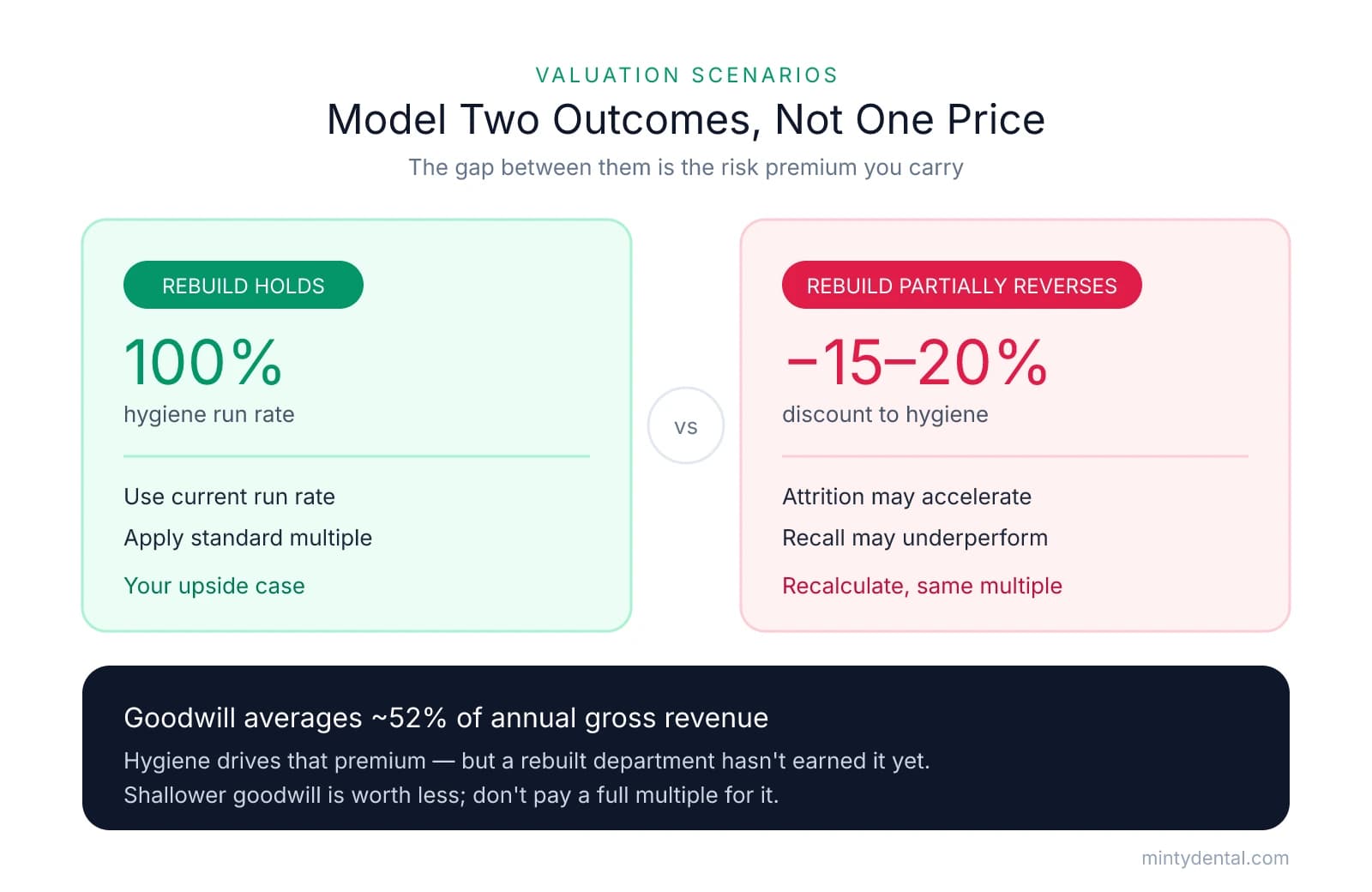
The goodwill question sharpens this further. According to the Health Care Group Goodwill Registry, goodwill in general dentistry averages approximately 52% of annual gross revenue — and hygiene is a primary driver of that goodwill precisely because it generates recurring, predictable revenue that buyers pay a premium for. A rebuilt department hasn't yet earned that premium. Patient relationships are newer, recall rates are still building, and the hygienist may not have the tenure that creates genuine patient loyalty. Shallower goodwill is worth less — and pricing it at the same multiple as an established department means absorbing risk you're not being compensated for.
The practical move is to model two scenarios explicitly:
- Rebuild holds: Use the current hygiene run rate as your earnings baseline. Apply a standard multiple. This is your upside case.
- Rebuild partially reverses: Apply a 15–20% discount to hygiene production, reflecting the possibility that attrition accelerates or the recall system underperforms post-transition. Recalculate earnings and apply the same multiple.
The gap between those two valuations is the risk premium you're carrying. If the seller's asking price sits at or above the "rebuild holds" number, you're paying for a best-case outcome with no margin for error. If it sits closer to the middle — or if the 3-year average has genuinely depressed the price below current run rate — the math may work in your favor.
Learning to read the P&L through this lens — normalizing for the disruption period rather than accepting the seller's framing — is what separates a well-structured acquisition from one where the buyer discovers the risk after closing.
Structuring the Deal When Hygiene Is Still Proving Itself
Knowing what the numbers mean is only half the work. The other half is translating that analysis into a deal structure that reflects the risk — without walking away from an opportunity that may genuinely be worth pursuing.
Anchor the price to a conservative baseline, then offer the seller upside. Rather than accepting a valuation built on the trailing 3 months of peak recovery, consider negotiating a purchase price anchored to an 18-month average — one that includes the disruption period and the early rebuild. From there, an earnout tied to continued hygiene growth post-close gives the seller a path to full value if the recovery holds. As Oral Health Group explains in their overview of dental earnout structures, earnouts allow buyers and sellers to disagree on current valuation while still reaching a transaction — the seller gets rewarded if the recovery continues, and the buyer isn't paying full price for a trend that hasn't yet proven durable. This structure tends to work better than a prolonged price negotiation because it aligns both parties around the same outcome.
If the rebuild is tied to a specific hygienist, protect yourself contractually. A hygienist who joined 10 months ago and built the recall system from scratch represents a key-person dependency. One structure worth exploring is a retention clause — a defined employment period post-close (typically 12–18 months), with a price adjustment mechanism triggered if that hygienist departs within the first 90–180 days. This is analogous to a seller transition clause but applied to clinical staff, and it gives both sides an incentive to support a smooth handoff.
Build a hygiene-specific patient retention threshold into the purchase agreement. A clawback or price adjustment triggered by a drop in active hygiene patient count — say, below a defined threshold in the first 12 months post-close — is one of the more direct ways to price the attrition risk discussed earlier. This is a variation on the broader patient retention guarantee concept, narrowed specifically to hygiene patients, where the relationship fragility is highest.
Ask the seller to participate in hygiene patient introductions during the transition. This is especially valuable when patients are returning after a disruption and their loyalty to the practice is still being re-established. A seller who personally introduces the new owner to hygiene patients — even informally, over 60–90 days — meaningfully reduces the risk that reactivated patients quietly drift away at the first sign of change.
When these structures are in place, a practice with a recently rebuilt hygiene department can be one of the more compelling acquisitions available. The disruption period often suppresses the valuation below what a stable practice would command, and if the rebuild is genuine, you're entering at a price that reflects past risk while the recovery is already underway. The key is making sure the deal structure reflects that reality — not just the seller's optimism about where the department is headed.
Sources & References
The data and claims in this article are drawn from the following sources. We prioritize government data, peer-reviewed research, and established industry publications to ensure accuracy.
- Top 6 KPIs to Track in your Dental Practice— adamsbrowncpa.comIndustry
- Personal Goodwill: Why a Dental Buyer Can Withhold Your ...— precisiondentalanalytics.comIndustry
- Improve Your Patient Recall Process | Dental Practice Tips— practiceanalytics.comIndustry
- Dental Hygiene Recall Rates: The Key DSO Valuation Driver— mybcat.comIndustry
- The Importance of Staff Retention in Dental Offices: Why It Matters— www.oralhealthgroup.comIndustry
- Earnouts in dental practice acquisitions: What you need to know— www.oralhealthgroup.comIndustry
Ready to acquire your ideal hygiene team?
Finding a practice with a strong hygiene department is crucial to your success as an owner. Minty's acquisition experts guide you through evaluating every aspect of a practice—from clinical operations to team stability—ensuring you make a confident investment.