Buying a Dental Practice from a Multi-Location Seller

Co-Founder, Minty Dental

In Summary
- A multi-location seller is optimizing a portfolio, not exiting dentistry — their incentives are fundamentally different from a retiring solo owner's
- The most common stated reason for selling one location ("freeing up time") often signals the location being sold is the weakest performer, hardest to staff, or most exposed to competition
- Sellers with multiple locations have an internal benchmark you don't have access to — they know exactly how this practice compares to their others
- Always ask directly: why this location and not one of the others? The answer — or the hesitation — is one of the most revealing moments in the process
- A seller who continues practicing dentistry nearby after closing creates a transition dynamic that carries risks a retiring seller simply doesn't
A Seller Who Still Owns Practices Has Different Incentives Than One Who's Walking Away
Multi-location seller vs. retiring solo owner: A retiring dentist selling their only practice and a multi-location owner selling one of several locations are not the same counterparty. The retiring seller's interests tend to align naturally with yours — they want patients to stay, staff to remain, and the transition to go smoothly, because their professional legacy depends on it. The multi-location seller has other practices to protect, other debts to manage, and a reason to sell that may have nothing to do with stepping away from dentistry.
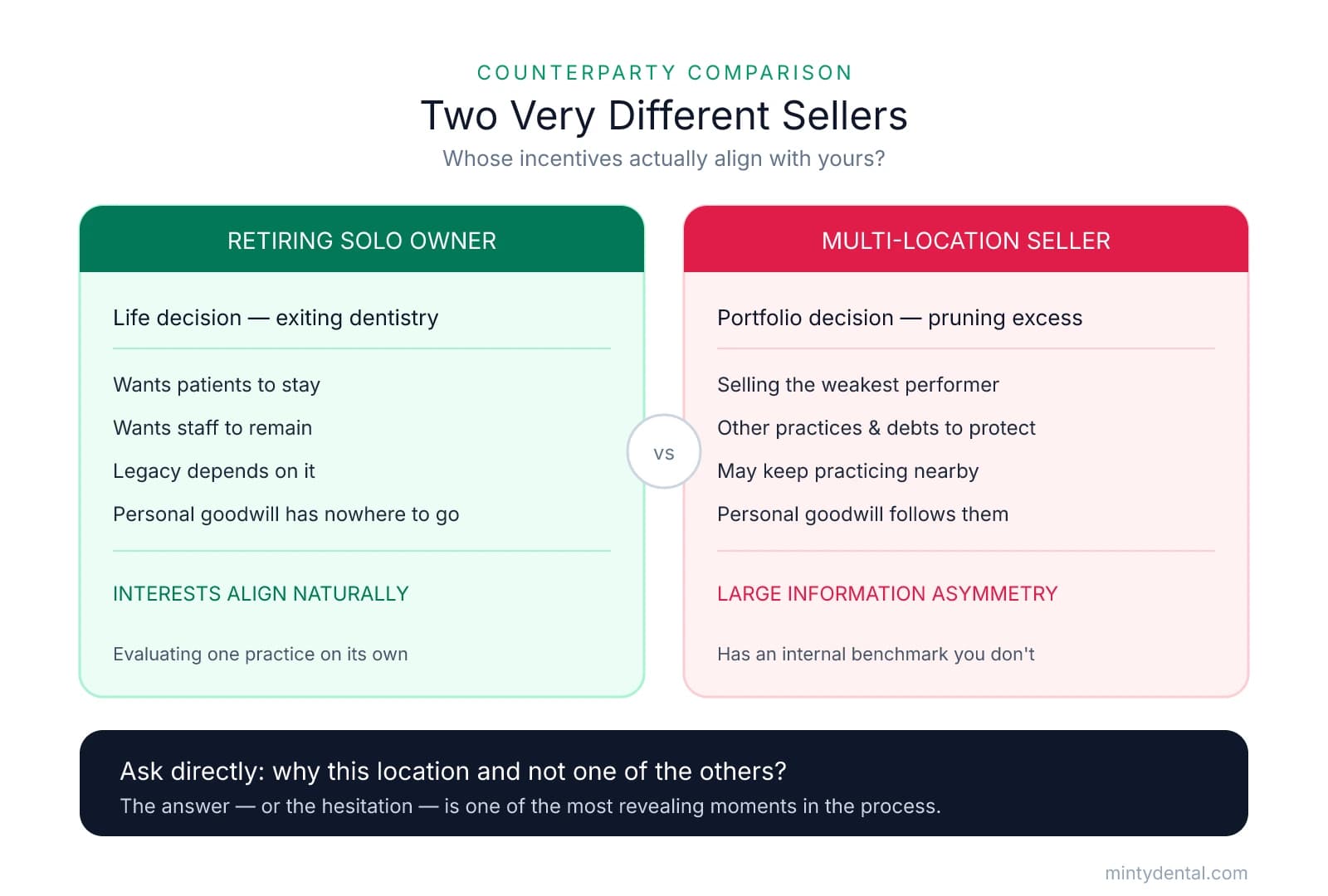
When a seller still owns and operates other locations, they're making a portfolio decision — not a life decision. What tends to happen is that the location being sold is the one that makes the least sense to keep: the lowest margin, the hardest to staff, the lease coming up for renewal, or the one most exposed to a new competitor down the street. That's not dishonesty — it's rational. But it means the information asymmetry between buyer and seller is larger than in a typical sale.
A seller with three locations has an internal benchmark you'll never fully access. They know how this practice's collections trend compares to their others, how its patient retention stacks up, how often the hygiene chair sits empty. You're evaluating the practice in isolation; they're evaluating it in context.
The three most common reasons multi-location sellers give — and what each one tends to signal:
- "I want to free up time." The most common framing, and the least informative. Worth probing: free up time from what, specifically? A seller stretched thin across locations may be selling the one that demands the most management attention — which is often the one with the most operational problems.
- "I'm focusing on other ventures." As Dental Buyer Advocates documents in a case study, a seller in his 40s used this exact framing while the practice being sold was encumbered by collateral liens on unrelated loans he'd nearly forgotten about. Other ventures can mean other financial obligations.
- "Portfolio pruning." The most candid framing is also the most telling. Sellers who describe the sale as pruning are, almost by definition, trimming what they consider excess — and excess rarely means their strongest asset.
One question worth asking directly, early in the process: Why this location and not one of the others? The answer is rarely rehearsed, and the hesitation — if there is one — can tell you more than the financials. A seller who reduced hours at this location before listing while maintaining full schedules elsewhere is showing you the comparison they'd rather you not make.
Perhaps the most underappreciated dynamic: a seller who continues practicing dentistry nearby after closing is a fundamentally different transition than one who is retiring. Their presence in the market, their relationships with referring providers, and their remaining patient base all create complications that simply don't exist when a seller is walking away from the profession entirely.
How to Untangle the Financials When a Seller Runs Multiple Locations
That information asymmetry shows up most concretely in the financials. Multi-location owners routinely share expenses, staff, and vendor relationships across their practices — and the P&L for the location being sold may look healthy on paper while quietly depending on infrastructure that won't transfer with the sale.
The first thing to request is location-specific P&Ls for at least three years — not consolidated financials that blend results across the seller's portfolio. Consolidated statements can make one practice appear more profitable than it actually is on a standalone basis, because shared overhead gets allocated unevenly across locations. If the seller can't produce location-specific financials, that gap is itself a finding worth taking seriously.
A pattern worth paying attention to is shared staff. A hygienist or office manager whose compensation appears entirely in the selling practice's books — but who splits time across two or three locations — inflates the apparent staffing efficiency of the practice being sold. Once you own it as a standalone business, you'll need to cover that role fully. Ask specifically whether any staff members work across locations, and request time-allocation records if they do. A dental-specific CPA can benchmark the location's standalone cost structure against what a single-location practice of similar size should actually look like.
Vendor contracts and supply purchasing negotiated at scale are another area where post-closing reality can diverge from what the financials suggest. A multi-location owner may have group pricing on supplies, lab fees, or marketing services that you won't be able to replicate as a single-location buyer. Factor this into your overhead projections before closing, not after.
Then there's lien risk. Dental Buyer Advocates documents a case that ended weeks before closing: the practice had been used as collateral on two business loans for unrelated ventures, one of which carried a prepayment restriction — not just a penalty — meaning the seller was legally unable to sell at all. He hadn't realized it until the lien search surfaced it.
Multi-location owners often cross-collateralize debt across their businesses without fully tracking which assets are encumbered. A UCC lien search is essential — and as this buyer's guide to UCC liens on dental equipment explains, the search needs to cover both the entity and the individual. Beyond the search itself, ask the seller directly: Are there any prepayment restrictions — not just penalties — on loans that use this practice as collateral? Sellers don't always volunteer the distinction.
Financial documents to request in a multi-location scenario:
- Location-specific P&Ls for the past three years
- Tax returns for each entity the seller owns (to identify cross-entity income and expense flows)
- Staff roster with time-allocation percentages across locations
- Vendor contracts and supply agreements — note which are shared and whether they're transferable
- UCC lien search results covering both the business entity and the seller individually
- Loan agreements for any debt secured by the practice, with specific attention to prepayment restrictions
- Equipment ownership records — confirm which assets are owned by this entity versus another
The seller's tax returns deserve particular attention. When a seller operates multiple entities, income and expenses often flow between them in ways that obscure the true profitability of a single location. A dental-specific CPA who regularly works on acquisitions will know what "normal" looks like — and will spot allocations that don't hold up under scrutiny.
Patient Loyalty and the Non-Compete Problem When the Seller Isn't Going Far
Once the financials are untangled, a second category of risk comes into focus — one that's harder to quantify but just as consequential: what happens to patients when the seller is still practicing nearby?
Personal goodwill and practice goodwill are two distinct components of what you're buying. Practice goodwill is tied to the business itself — its systems, location, and brand. Personal goodwill is tied to the seller's relationships. According to US Dental Practices, goodwill represents 60–80% of a dental practice's total purchase price — and a meaningful share of that is personal. When a seller retires, personal goodwill has nowhere to go. When a seller continues practicing four miles away, it follows them.
Patients who are unhappy with a transition don't have to search for a new dentist — they already know where the seller is. One protection worth building in early is a patient retention guarantee negotiated at the time of sale, tying a portion of the purchase price to actual retention outcomes rather than assuming goodwill transfers automatically.
The non-compete problem is closely related, and it's where standard purchase agreements tend to have a structural gap. Typical non-compete terms run 5–10 miles for 3–5 years, per American Practice Consultants — a framework built around a seller who would have to open a new practice to compete. A seller who already owns a location 4.9 miles away is technically compliant while continuing to see patients who followed them there. The clause doesn't prohibit operating an existing practice; it only prohibits opening a new one.
Before mapping the non-compete radius, ask how geographically close the seller's other locations are to the practice being sold, then overlay that against the patient draw area. If a meaningful share of your patient base lives closer to the seller's next location than to yours, the risk isn't theoretical.
A dental-specific attorney can close this gap. The non-compete language should explicitly address the seller's existing locations, not just prohibit future competition — restricting the seller from actively treating patients at any location within the defined radius, regardless of when that location was established. Pairing this with a non-solicitation clause prevents the seller from directing patients toward their other practices during or after the transition. State law adds another layer: enforceability varies significantly by jurisdiction, making local legal counsel non-negotiable.
How to Evaluate a Multi-Location Deal Before You Commit
The risks covered here are real — but they're also workable. Many buyers who've done this analysis carefully have closed excellent deals with multi-location sellers. The seller's operational experience, established systems, and familiarity with transitions can genuinely benefit you. The question isn't whether to walk away automatically. It's whether the specific risks have been identified, priced, and addressed before you commit.
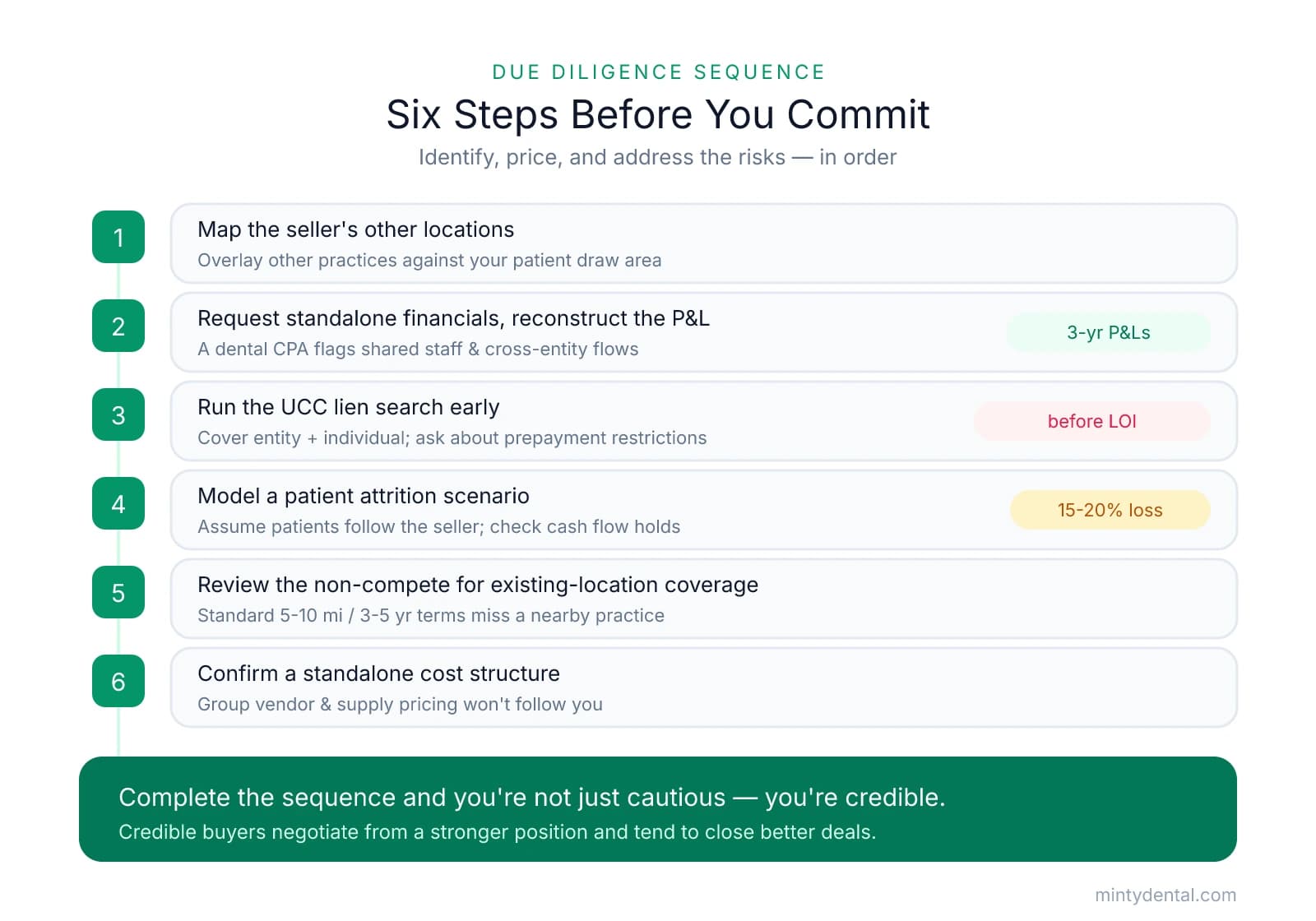
1. Map the seller's other locations geographically. Before reviewing a single financial document, pull up the seller's other practices on a map and overlay your patient draw area. Distance and overlap determine how real the patient loyalty and non-compete risks actually are.
2. Request standalone financials and have a dental CPA reconstruct the true P&L. A dental-specific CPA can identify shared staff allocations, vendor pricing that won't transfer, and expense flows between entities that inflate apparent profitability. As the ADA notes, beginning with an accurate valuation sets the stage for effective negotiations — and that's only possible with clean, location-specific numbers.
3. Run the UCC lien search early — ideally before the LOI. Don't wait until late-stage due diligence to surface encumbrances. The buyer's checklist for practices used as collateral is worth working through here. Ask the seller specifically about prepayment restrictions, not just balances or penalties — the distinction can determine whether the deal is legally executable at all.
4. Model a patient attrition scenario before finalizing your offer. Run the numbers assuming 15–20% of active patients follow the seller to their other location. If the practice still cash-flows at that level, you have a meaningful buffer. If it doesn't, that gap should be reflected in the price or addressed through a retention-based earnout. This is where negotiating the price down after due diligence becomes a practical tool.
5. Have a dental attorney review the non-compete for existing-location coverage. Standard language was written for sellers who are retiring — not sellers who already own a practice nearby. The clause needs to explicitly address existing locations. Having your own attorney review this language, rather than relying on the seller's counsel, is worth the cost.
6. Confirm the practice works at a standalone cost structure. Vendor pricing, supply contracts, and shared services negotiated at scale won't follow you. Build your overhead projections around what a single-location practice of this size actually costs to run.
Buyers who complete this sequence don't just protect themselves — they negotiate from a stronger position. When you can demonstrate that you've modeled attrition, identified encumbrances, and stress-tested the standalone P&L, you're not just a cautious buyer. You're a credible one. And credible buyers tend to close better deals.
Sources & References
The data and claims in this article are drawn from the following sources. We prioritize government data, peer-reviewed research, and established industry publications to ensure accuracy.
- 3 Reasons NOT to Buy a Dental Practice from a Multi- ...— www.dentalbuyeradvocates.comIndustry
- Dental Practice Goodwill: How It's Valued and Why It Matters— usdentalpractices.comIndustry
- Understanding Restrictive Covenants When Selling Your Dental Practice— ameriprac.comIndustry
- Buying or Selling a Dental Practice, Start with an Accurate Valuation— www.ada.orgIndustry
Ready to navigate multi-location practice acquisitions?
Buying from a multi-location seller introduces unique complexities in due diligence and transition planning. Minty's acquisition experts guide you through every step, from initial search to closing, ensuring you understand the full scope of what you're inheriting.