How to Tell When Seller Production Props Up a Dental Practice

Co-Founder, Minty Dental

In Summary
- Practices with 60%+ seller production create immediate cash flow risk—reported EBITDA often disappears when you adjust for market-rate replacement costs
- Request production reports broken down by provider during due diligence—this single document reveals whether profitability is structural or dependent on one person
- Adjusted EBITDA calculates what the practice will actually earn after normalizing seller compensation to market rates—often 30-50% lower than reported figures in seller-dependent practices
- A structured 60-90 day transition with defined responsibilities, followed by 6-12 months of part-time support, gives you runway to close the production gap without financial panic
Seller Production Isn't a Red Flag—Until It's the Only Thing Keeping the Practice Afloat
Most buyers reviewing a practice P&L focus on the bottom line: collections, overhead percentage, reported EBITDA. What many miss is the composition behind those numbers—specifically, how much of that profitability depends on the seller continuing to produce at their current level.
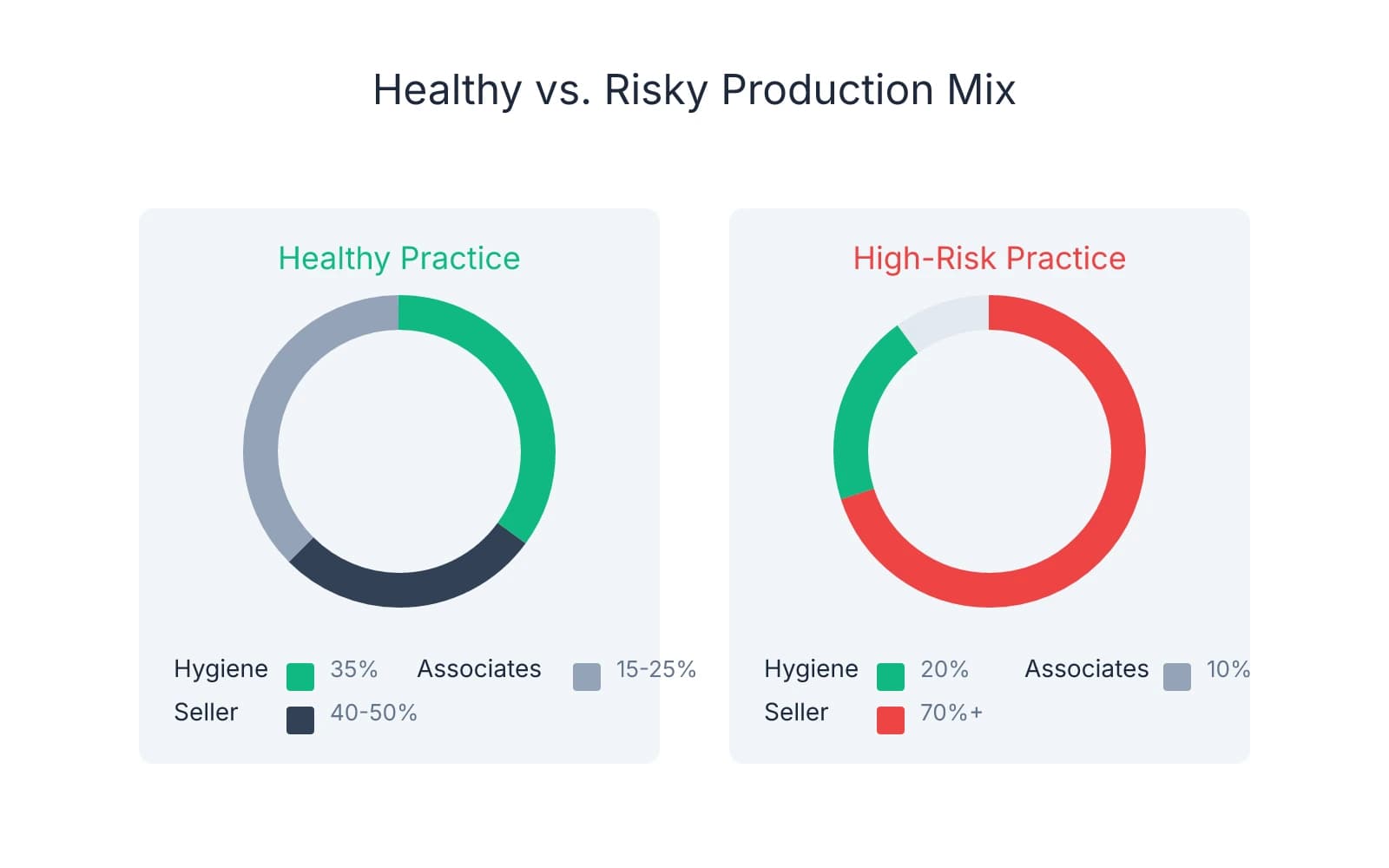
A practice generating $1.2 million with 25% EBITDA looks attractive until you realize the seller accounts for 70% of clinical production. Once they leave, you're either replacing that production yourself—which means working significantly more hours than anticipated—or hiring an associate at market rates, which often erases most of the reported profit margin.
One diagnostic step that clarifies this risk: request production reports broken down by provider. Most practice management systems can generate this in minutes. You're looking for three categories: seller production, hygiene production, and associate production (if applicable). What Buyers Miss When Evaluating a Dental Practice covers additional financial documents worth requesting during this phase.
The numbers start signaling risk when seller production exceeds 60% of total collections. At that threshold, the practice's profitability is structurally tied to one person's clinical output. If the seller is compensating themselves below market rates—or not compensating themselves at all beyond distributions—the reported EBITDA reflects an unsustainable cost structure.
The concept buyers use to adjust for this is "normalized EBITDA" or "adjusted EBITDA." According to FOCUS Investment Banking's analysis of dental practice valuations, buyers reset owner compensation to fair-market provider rates during underwriting. If the seller is paying themselves $80,000 but would need to hire an associate at $180,000 to replace their production, that $100,000 gap comes directly out of EBITDA. A practice reporting $300,000 in EBITDA might only generate $200,000—or less—once you account for market-rate replacement costs.
A healthier production mix typically looks like this: hygiene contributing 30-35% of total production, the seller at 40-50%, and associates or other providers covering the remainder. When hygiene sits below 25%, the practice is likely overly dependent on the owner's restorative work rather than building recurring preventive revenue. Large Practice Sales notes that EBITDA calculations can vary by as much as 50% depending on how provider compensation is normalized—which is why understanding the production breakdown matters more than the headline EBITDA figure.
The goal isn't to walk away from every practice with high seller production—it's to calculate what the practice will actually earn under your ownership. If the adjusted EBITDA still supports the purchase price and your debt service, the deal may work with the right transition structure. If the numbers only work because the seller is underpaying themselves, you're looking at a situation worth reconsidering.
The Questions That Reveal Whether a Practice Can Survive Without the Seller
Once you've identified high seller dependency in the production reports, the next step is diagnosing whether the practice infrastructure can support a transition—or whether profitability is tied not just to the seller's output, but to their specific clinical speed, patient relationships, and referral patterns.
Start with clinical capacity. Request the seller's average daily production and compare it to your own. If the seller is producing $4,000 per day and your typical output is $2,500, you're looking at a significant gap that won't close immediately. Ask: "How many operatories are in active use, and what's the typical schedule density?" A practice running three ops at 90% capacity with the seller working four days a week has limited room to absorb slower production without extending hours or adding clinical days.
Patient loyalty reveals whether you're buying relationships with the practice or with the seller personally. Request 12-month recall data and new patient flow. According to Dental Economics' analysis of practice transitions, practices with recall rates above 70% and consistent new patient acquisition (20+ per month) tend to retain patients through ownership changes more successfully than those dependent on long-tenured patient relationships with the seller. Ask: "What percentage of active patients have been with the practice for more than 10 years?" A high percentage isn't inherently problematic, but those patients may need more reassurance during the transition—and some may leave regardless of how well you manage the handoff.
Referral patterns often represent the clearest immediate revenue opportunity. Request a breakdown of procedures referred out over the past 12 months. If the seller is referring out molar endo, third molar extractions, or implant placements, and you're comfortable with those procedures, that's potential production you can capture without increasing patient volume. The follow-up question: "What equipment or technology would I need to bring those procedures in-house?" Capturing referred-out endo is straightforward if the practice already has a rotary system and apex locator. Bringing in implant cases may require a CBCT, surgical kit, and potentially additional training—which changes the timeline and capital requirement.
Staff capability determines whether the existing team can support your production level or workflow. Ask: "How many assistants are chairside-certified, and what's their experience level with the procedures you're planning to perform?" A practice where the seller has been doing bread-and-butter restorative work with one assistant may not have the team structure to support your interest in expanding endo or placing implants. One pattern that surfaces frequently is buyers who assume the team will adapt to their clinical style, only to realize they need to hire additional staff or invest in training to maintain the seller's production level.
Request the staff roster with roles, tenure, and compensation. If the practice has high turnover or multiple part-time employees covering full-time roles, the team may not be stable enough to support a transition without additional hiring costs. Ask the seller: "Have you had to adjust staffing levels in the past year, and if so, why?" The answer tells you whether the current team structure is sustainable or whether the seller has been running lean to maximize profitability before the sale.
How to Calculate What the Practice Will Actually Earn Under Your Ownership
The reported EBITDA on a seller's financials represents what the practice earned under their ownership—not what it will generate under yours. Before you commit to a purchase price or loan structure, calculate adjusted EBITDA: the practice's profitability after normalizing for market-rate provider compensation and realistic first-year operating conditions.
Start with the seller's most recent profit and loss statement. Identify reported net income, then add back owner compensation, discretionary expenses (personal vehicles, family member salaries, non-essential subscriptions), and any one-time costs like equipment repairs or legal fees. This gives you a baseline EBITDA figure—but it's not the number you'll see in year one.
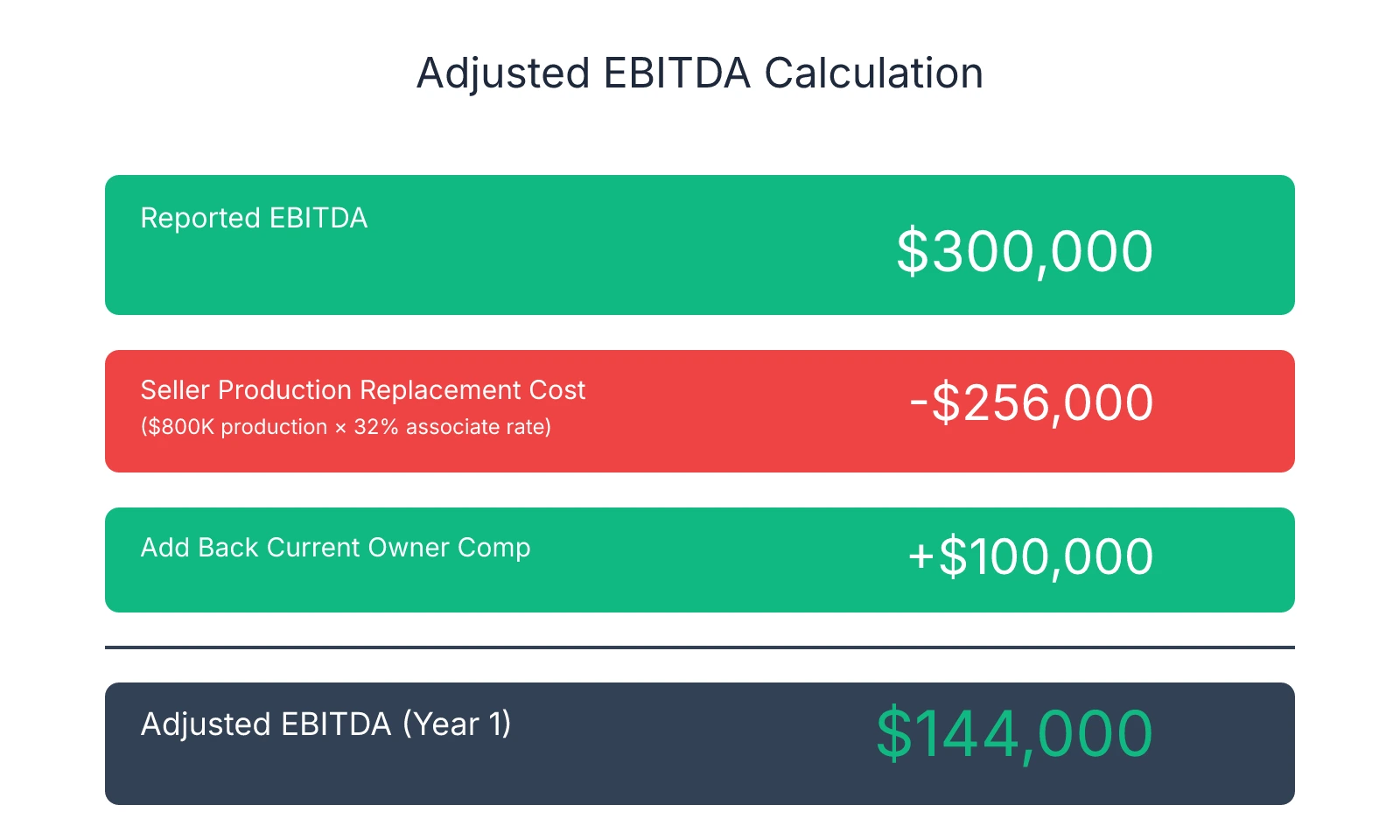
Next, subtract market-rate compensation for the seller's production hours. If the seller produced 70% of total collections working four days per week, you need to account for what it would cost to replace that output with an associate. According to Eclipse Corporate Finance's analysis of dental practice valuations, associate-led EBITDA calculations typically assume associate compensation at 30-35% of their production. If the seller generated $800,000 in collections, replacing that production would cost approximately $240,000-$280,000 in associate compensation—significantly higher than the $80,000-$120,000 many sellers pay themselves through salary and distributions.
The formula looks like this:
Adjusted EBITDA = Reported EBITDA - (Seller Production × 0.32) + Current Owner Compensation
For a practice reporting $300,000 EBITDA where the seller produced $800,000 and paid themselves $100,000, the adjusted EBITDA would be approximately $44,000—an 85% reduction from the reported figure.
Even with a strong transition period, assume 10-15% patient attrition in year one. Some patients will leave because they were loyal to the seller personally, others because they're uncomfortable with change. If the practice collected $1.2 million annually, a 12% attrition rate means $144,000 in lost revenue. At a 40% overhead ratio, that's roughly $58,000 in lost EBITDA before you've seen a single patient.
Now account for procedures you can't perform yet. Request a breakdown of production by procedure code for the past 12 months. If the seller generated $120,000 from molar endo and you're not comfortable with those cases yet, that revenue either gets referred out (and lost) or requires you to invest time in training and potentially additional equipment. From Associate to Owner: How Long It Really Takes to Buy a Practice outlines realistic timelines for building clinical confidence in new procedures—most buyers need 6-12 months to reach the seller's production level, even in procedures they're technically trained to perform.
What does break-even look like in year one? You need to cover three categories: debt service, your salary, and operating expenses. If you're financing $800,000 at 7% over 10 years, your annual debt service is approximately $111,000. Add your target salary—say $150,000—and you need $261,000 in EBITDA before covering a single dollar of rent, payroll, or supplies. If adjusted EBITDA after accounting for seller replacement costs and patient attrition is $180,000, you're $81,000 short of break-even in year one.
This is where the math either works or doesn't. If the adjusted EBITDA supports your debt service and salary with a reasonable margin for operating expenses, the deal may be viable with a structured transition period and realistic expectations about your first-year income. If the numbers only work by assuming you'll immediately match the seller's production level and retain 100% of patients, you're underwriting optimism rather than cash flow.
The goal of this calculation isn't to talk yourself out of buying a practice—it's to understand what you're actually purchasing and what financial gap you'll need to bridge in the first 12-18 months. Many buyers finance that gap with savings, a working capital reserve, or by keeping their associate position part-time during the transition. What doesn't work is discovering the gap three months after closing when your loan payment is due and collections are 30% below projections.
Structuring a Transition Period That Bridges the Production Gap
Once you've calculated the adjusted EBITDA and identified the production gap, the next decision is how to structure a transition period that protects patient retention without overpaying for the seller's time. In practices where seller production exceeds 60% of total collections, a standard 30-day handoff isn't sufficient—you need structured support that gives patients time to build trust with you while maintaining clinical continuity.
Many buyers negotiate 60-90 days of defined transition time. According to Kamkari Law's analysis of dental practice transitions, this period should include specific responsibilities: patient introductions, clinical mentorship for complex cases, and scheduled availability for questions from staff. The difference between "the seller will be available if needed" and "the seller will work Mondays and Tuesdays for 90 days to introduce patients" is the difference between a structured handoff and hoping the seller answers your calls.
Compensation during this period typically follows one of two structures. For patient introductions and administrative support—where the seller isn't producing—many buyers offer a per diem rate, often $500-$1,000 per day depending on the market. This covers the seller's time for meeting patients, reviewing charts, and supporting the transition without tying payment to production. Where the seller continues treating patients during the transition, compensation shifts to a production percentage, typically 30-35% of collections—the same rate you'd pay an associate. ADS Transitions notes that buyers should clarify upfront whether the seller is finishing work in progress (which may not require additional compensation) or actively seeing patients on the schedule (which does).
When seller production sits above 60% of total collections, consider negotiating an extended part-time associateship beyond the initial transition period. A structure that works: 60-90 days of full-time transition support, followed by 6-12 months where the seller works one or two days per week at a production-based rate. This gives you time to build your own patient base, increase your clinical speed, and capture procedures you may not be comfortable with yet—while maintaining revenue stability during the ramp-up period. The key is defining the seller's schedule and compensation in the purchase agreement, not leaving it to informal arrangements that create confusion later.
One protection worth building into the deal structure: earnout or holdback provisions tied to patient retention benchmarks. If the practice historically retained 85% of active patients year-over-year, you might structure 10-15% of the purchase price as a holdback, released 12 months post-closing if active patient retention stays above 75%. This aligns the seller's incentive with your success and provides financial recourse if the patient base erodes more than projected. The specific threshold should reflect realistic attrition—most transitions see 10-15% patient loss even with strong handoffs—so the benchmark should account for normal turnover rather than assuming zero attrition.
What doesn't work is assuming the seller will stay engaged without formal structure. Many buyers negotiate a transition period but don't define what "availability" means—leading to sellers who show up twice, introduce a handful of patients, and disappear. The purchase agreement should specify days per week, hours per day, and whether the seller is expected to treat patients or focus on introductions. If the seller resists committing to a structured schedule, that's a signal they may not be invested in the transition's success—and a reason to reconsider the deal.
The goal of a structured transition isn't just patient retention—it's buying yourself time to close the production gap without financial panic. If you've calculated that you'll produce $2,500 per day in year one while the seller was producing $4,000, a six-month part-time associateship gives you runway to build speed, confidence, and patient relationships before you're carrying the full clinical load. The cost of that extended support is almost always lower than the cost of losing 30% of the patient base in the first six months because the transition happened too quickly.
Sources & References
The data and claims in this article are drawn from the following sources. We prioritize government data, peer-reviewed research, and established industry publications to ensure accuracy.
- Dental Practice EBITDA - FOCUS Investment Banking— focusbankers.com
- Understanding and Improving Dental Practice EBITDA | LPS— largepracticesales.com
- Transition Period in Dental Acquisitions - Kamkari Law— www.dentalmedicalattorney.comIndustry
- The Dental Practice Transition Period— www.adstransitions.com
Frequently Asked Questions
Find a Practice Built for Growth
Practices that depend entirely on seller production often hide underlying profitability issues. Discover dental practices with sustainable business models and genuine growth potential, or get expert guidance to evaluate and improve your current practice's financial independence.