Dental Practice Perio Protocol Not Being Followed

Co-Founder, Minty Dental

In Summary
- Your perio percentage is calculated as (D4341 + D4342 + D4910) divided by that sum plus D1110 — most practice management software can produce this report in about ten minutes.
- Roughly 42% of U.S. adults 30 and older have periodontitis; that share rises to more than 70% in patients 65 and older, meaning a significant portion of your existing hygiene patients likely have diagnosable disease.
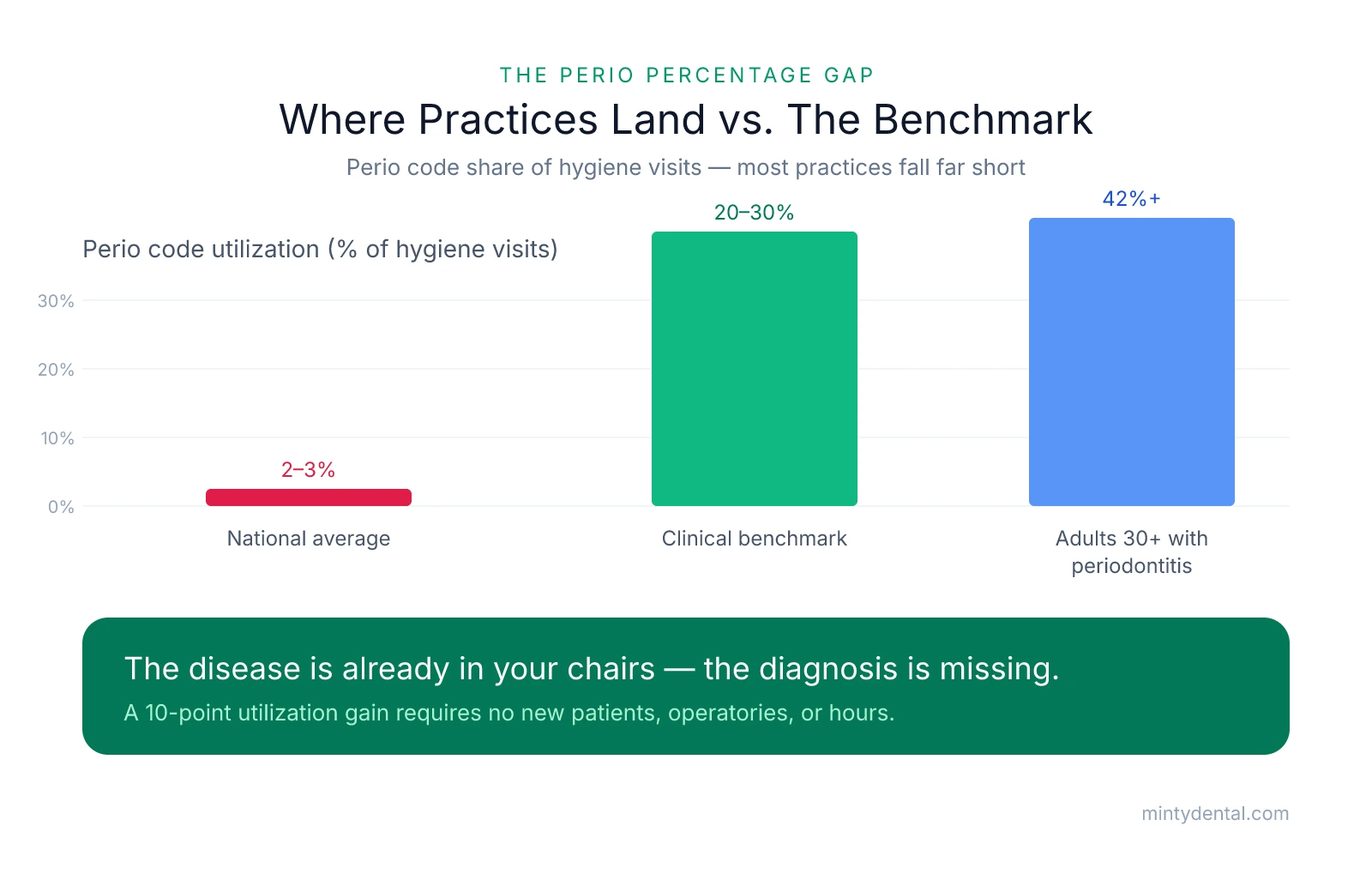
- The national average perio code utilization sits around 2 to 3% of hygiene visits; the clinical benchmark is 20 to 30%.
- The revenue gap between those two numbers is not a new-patient problem — it lives inside your current schedule, hidden in visits that are coded D1110 when they should carry a perio code.
- A written perio protocol, calibration between doctor and hygienist, and consistent charting are what move the number — not more chairs or more patients.
A Low Perio Percentage Is the Most Common Hidden Revenue Gap in Hygiene
If hygiene production is flat despite a full schedule, the most likely culprit is not your fee schedule, your insurance mix, or your patient volume. It is almost certainly your perio percentage.
The perio percentage is a single ratio that compares periodontal treatment codes to prophylaxis visits. The formula is: (D4341 + D4342 + D4910) divided by the total of those codes plus D1110. D4341 and D4342 are scaling and root planing codes billed by quadrant; D4910 is periodontal maintenance for patients who have already completed active therapy; D1110 is a routine adult prophylaxis. When you add up every hygiene visit and look at what share carried a perio code rather than a prophy code, that is your perio percentage. Pull a procedure code frequency report filtered to those five codes from your practice management software — most systems can generate it in about ten minutes.
What you find is usually a small number. Perio code utilization in most practices runs around 2 to 3% of hygiene visits, with hygiene consultants who audit practices routinely seeing figures under 2%. The clinical benchmark is 20 to 30%. That gap is not a rounding error.
The clinical reality makes the low utilization numbers harder to explain away. About 42% of U.S. adults 30 and older have mild, moderate, or severe periodontitis, and that prevalence rises to more than 70% in patients 65 and older. A practice billing perio codes on 2% of hygiene visits is not treating a uniquely healthy population. It is not finding what is there.
To see what that means in dollar terms, consider a hypothetical solo hygienist seeing 1,200 patients per year. At 1% perio utilization, roughly 12 patients per year receive a perio code, generating perhaps $12,000 in perio-related revenue. Move that utilization to 10% and the same hygienist, the same schedule, and the same patient base generates somewhere in the range of $120,000 to $150,000 from perio codes alone. These are illustrative numbers, not benchmarks, but the ratio holds: each percentage point of utilization represents a meaningful and repeatable revenue shift, and it requires no new patients, no additional operatories, and no extended hours.
This isn't a new-patient problem — the patients are already in the chair with the disease in their mouths, and what's missing is the diagnosis, the documentation, and the code. Those three things are connected to each other and to the systems inside your practice — specifically to whether your hygienists have a written perio protocol, whether the doctor and hygienist agree on the diagnostic threshold, and whether charting happens on every patient regardless of how the schedule is running. Perio percentage is one of the monthly KPIs that can reveal production problems hiding in plain sight, and it is often the one owners pull last.
Why Perio Protocol Breaks Down in the Operatory
When practices audit that perio percentage and find it sitting at 2%, the instinct is to assume someone dropped the ball. That framing misses what is actually happening. Only 16% of dental records in a study of 2,488 charts across 36 practices contained complete periodontic information — a result that spans practices of different sizes, different software platforms, and different hygiene team compositions. A problem that consistent is a systems problem, not a skills problem.
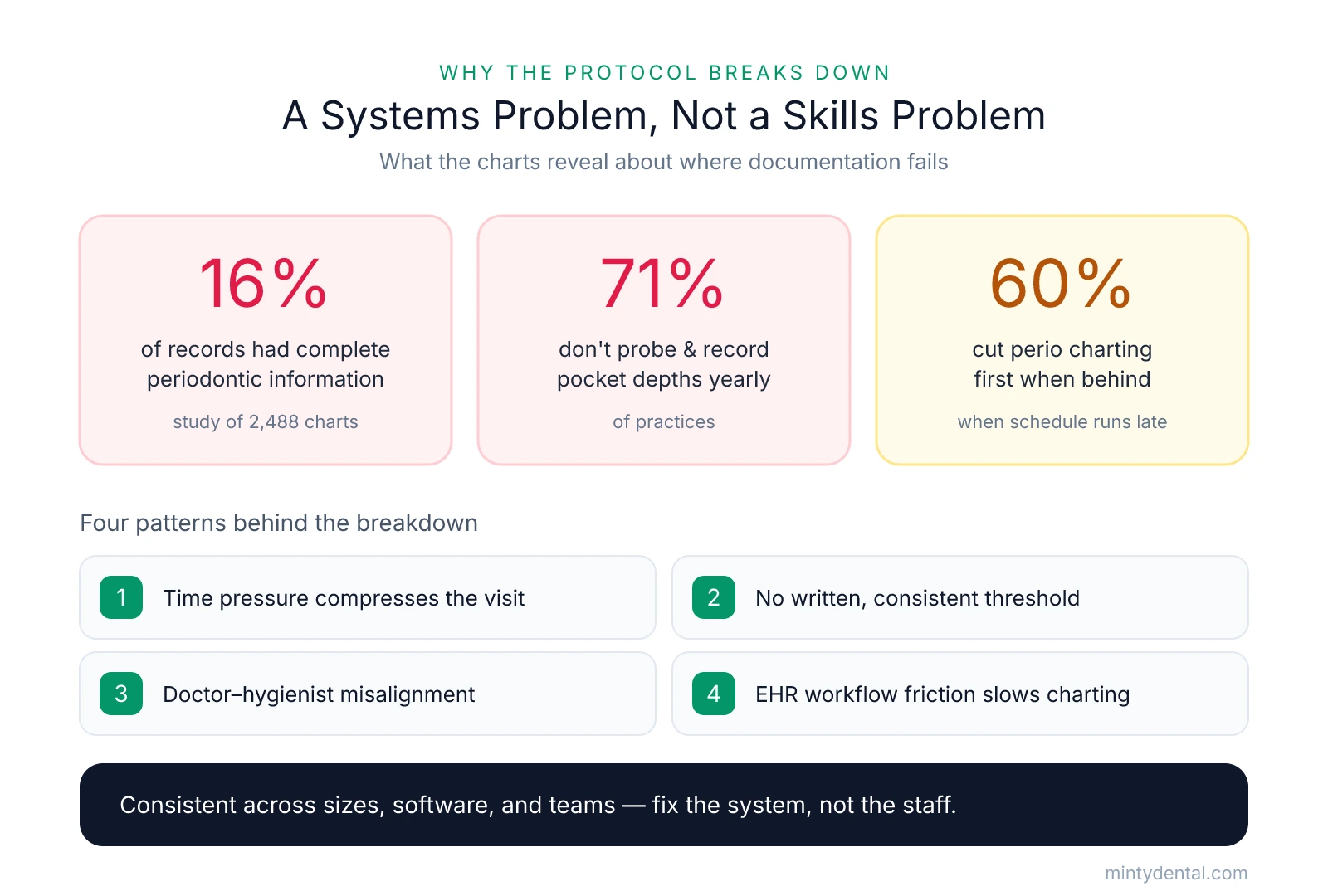
The breakdown tends to follow four recognizable patterns.
Time pressure compresses what gets done. A standard 45 to 60 minute hygiene appointment carries a lot of weight: medical history review, blood pressure, oral cancer screening, radiographs, full-mouth charting, patient education, and treatment. In a smooth appointment with a healthy, cooperative patient, a disciplined hygienist can move through all of it. Add a talkative patient, a history update that turns into a conversation, or radiographs that require retakes, and the margin disappears fast. Roughly 60% of practices report that full-mouth perio charting is the first task cut when the schedule runs behind — not because the hygienist doesn't value it, but because it feels like the most recoverable omission. It isn't, but the pressure in the moment doesn't allow for that calculation. If your hygiene schedule routinely leaves no margin, the perio chart will routinely be the thing that goes. That's a scheduling design problem more than a hygiene performance problem — worth keeping in mind if you're evaluating whether your hygienists have enough time in their day to do the clinical work properly.
No written protocol means no consistent threshold. When the standard isn't documented, each hygienist applies their own clinical judgment about when to diagnose, when to recommend SRP, and how to present it. One hygienist might recommend scaling and root planing at 4mm pockets with bleeding; another holds off until she sees 5mm consistently across a quadrant. Neither is necessarily wrong, but the result is that your diagnosis rate varies with whoever is in the operatory that day. That inconsistency shows up in your perio percentage as noise — and it makes it nearly impossible to hold a meaningful team conversation about why the number is what it is.
Doctor-hygienist misalignment silences recommendations. Roughly 71% of practices don't probe and record pocket depths even once a year, and part of that reflects a dynamic that develops quietly over time. If a hygienist recommends SRP and the doctor comes in for the exam, looks at the chart, and pivots to a "let's watch it" response without reinforcing the diagnosis, the hygienist learns something. She learns that bringing up perio creates friction without follow-through. Eventually she stops bringing it up, or softens the recommendation so much it doesn't land. The problem isn't that either person is wrong — it's that they've never explicitly agreed on the diagnostic threshold, so the exam room becomes the place where that disagreement plays out in front of the patient.
EHR workflow friction makes complete documentation slow. Most practice management software was built around scheduling and billing. Capturing a formal periodontal diagnosis with staging, grading, risk factors like diabetes or tobacco status, and full probing depths often requires navigating multiple screens, manual text entries, and drop-down menus that weren't designed with clinical flow in mind. When documentation takes significantly longer than the clinical finding itself, it gets deferred to the end of the day — and by then, the specifics are gone.
One more pattern deserves direct attention: the habit of treating a patient who clearly has periodontal disease with a prophy code to spare them the out-of-pocket cost difference. It feels like a kindness, but it isn't. Billing D1110 when the clinical findings indicate D4341 or D4910 means the disease isn't being treated at the appropriate level, and the record doesn't reflect what's actually present. That is the definition of supervised neglect — a clinical and legal exposure that protects no one, least of all the patient whose periodontitis keeps progressing while the chart says they received a routine cleaning.
Building a Written Perio Protocol That the Team Actually Follows
A perio protocol that holds up in a busy operatory is a written document with clear decision rules, not a general understanding that "we probe everyone."
Write the protocol in plain language. Define exactly when charting happens: full-mouth six-point probing for every new patient at their comprehensive exam, annually for existing patients, and at every perio maintenance (D4910) visit. What gets recorded at each appointment should not be left to judgment: probing depths at six sites per tooth, recession, furcation involvement, mobility, and bleeding on probing. Then add the decision tree. What findings trigger a recommendation for SRP versus gingivitis therapy versus a referral to a periodontist? A reasonable starting point might be: four or more sites at 4mm or deeper with bleeding on probing moves to a diagnosis conversation; true 5mm-plus pockets with radiographic bone loss go to SRP; generalized severe disease or cases that aren't responding to initial therapy go to the periodontist. Full six-point charting with recession, furcation, and mobility is the standard of care for new patients and at least annually for existing patients — the specific thresholds for treatment are yours to define, and writing them down is what makes them consistent. Include the completed protocol in onboarding materials so a new hygienist starts with the same standard from day one, not a six-month apprenticeship in reading the room.
Hold a calibration meeting. Schedule a short working session with your hygienist, or your full hygiene team if you have more than one, where you review a handful of actual cases together. The goal is to align on diagnostic thresholds so the hygienist knows exactly what the doctor will reinforce at the chair-side exam. Consistent perio diagnosis requires shared ownership between doctors and hygienists, with both roles operating from the same clinical definitions — that alignment doesn't happen through osmosis. When a hygienist recommends SRP and the doctor confirms it in front of the patient, the hygienist learns she has backup. That changes how confidently she presents findings going forward.
Build the scripting around health, not fees. A few natural phrases go further than a formal script. Something like: "What I'm seeing in a few areas is that the bone and gum tissue aren't as stable as we'd want. The cleaning we do for healthy gums won't address that — this type of treatment goes deeper and gives those areas a chance to actually heal." That framing explains the clinical reason for the different treatment without introducing cost anxiety or sounding like an upsell. If a patient asks about cost, answer directly — but lead with the health consequence of not treating.
Protect the time for charting to happen. If your hygiene appointments don't have room for full-mouth probing, the protocol will collapse under schedule pressure regardless of how well it's written. The practical fix is either building enough time into the appointment type, or using a dental assistant to record while the hygienist probes. The latter adds efficiency without extending appointment length and tends to improve data accuracy at the same time.
Track the number monthly. Pull the perio percentage report each month and bring it into your morning huddle or monthly team meeting. The goal in year one isn't going from 2% to 30% overnight; a 10-percentage-point improvement is a realistic and meaningful first target. If you're already running perio percentage alongside other hygiene metrics, this fits naturally into the KPI review that reveals where production problems are hiding. The number tells the team whether the protocol is actually running, and reviewing it together closes the feedback loop that keeps it from drifting.
Reviewing Your Perio Numbers After the First 90 Days
Pull your perio percentage again at the 90-day mark and put it next to the number you recorded before the protocol went in. In the first quarter, a realistic improvement is 3 to 5 percentage points. That might feel modest, but it reflects something real: hygienists are building new charting habits, the doctor is reinforcing diagnoses at the exam, and the team is still calibrating on edge cases. The larger movement happens over 6 to 12 months as the protocol becomes the default rather than the effort.
The percentage alone won't tell you where a stall is coming from, so look at the procedure mix underneath it. Open your code frequency report and check whether D4341 and D4342 are actually appearing, or whether the team is diagnosing periodontal disease and still billing D1110. Billing a prophy code when clinical findings indicate active periodontal disease is an insurance compliance risk, not just a revenue miss. If D4341 and D4342 remain absent while D4910 begins appearing, you may have a gap in who is being converted from active therapy to maintenance. If D1110 is doing all the work and the other codes are quiet, the diagnosis is still not making it to the record.
While you're in the schedule, look at the recall intervals for patients coded D4910. Perio maintenance visits are clinically appropriate every 3 to 4 months, not every 6 months. A patient converted from SRP to maintenance who is being recalled twice a year instead of three times is receiving substandard monitoring, and your hygiene schedule is carrying fewer appointments than it should. Check a sample of your D4910 patients and see what interval they're actually being booked at.
There's also a restorative signal worth watching. Patients whose periodontal disease is properly diagnosed and treated tend to have a clearer picture of their overall oral health, and that clarity tends to improve case acceptance. If your perio numbers are moving, check whether same-day treatment starts or acceptance of previously unscheduled restorative treatment is moving with them. The two aren't coincidental. Improving same-day treatment starts often tracks alongside better perio diagnosis because both depend on the patient understanding what's actually happening in their mouth.
If the perio percentage hasn't moved after 90 days, don't adjust the scripting or the written protocol first. Go back to the calibration meeting. The most common reason a protocol stalls is that the doctor stopped reinforcing the diagnosis at the exam, so the hygienist quietly stopped presenting it. That dynamic can reestablish itself within weeks of the first calibration session if there's no follow-up. One repeat calibration, reviewing a few actual charts together, usually identifies the disconnect faster than any other intervention.
Sources & References
The data and claims in this article are drawn from the following sources. We prioritize government data, peer-reviewed research, and established industry publications to ensure accuracy.
- How Much Revenue Is Your Hygiene Department Actually Leaving on the ...— altavoice.aiIndustry
- About Periodontal (Gum) Disease | Oral Health - CDC— www.cdc.govGovernment
- If Your Perio Documentation Feels Incomplete, You're Not Alone— altavoice.aiIndustry
- Build a Perio Program to Boost Your Production— www.agd.orgIndustry
- Standard of care for periodontal charting - RDH Magazine— www.rdhmag.comIndustry
- Build Better Perio Protocols Through Team Alignment - Dental A Team— thedentalateam.comIndustry
- The Perio Percentage KPI . . . how does your dental practice stack up?— dentalproductsreport.comIndustry
Close the Revenue Gap Your Hygiene Schedule Is Hiding
Consistent perio diagnosis starts with the right systems behind it. Minty can handle the business operations that keep your hygiene department running at full capacity.